
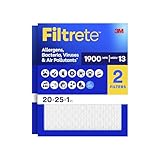
- Top Pick: Filtrete 20x25x1 Air Filter, MERV 13, MPR 1900, 2 HVAC Filters
- Best Value: Filtrete 20x25x4 Air Filter MERV 12, MPR 1550 Certified Asthma & Allergy Friendly 2-Pack, Fits Honeywell & AprilAire, AC Furnace HVAC Filters, Pleated Electrostatic (Actual Size 19.88×24.63×4.31 in)
- Premium Choice: Filtrete 20x25x1 Air Filter, MERV 11, MPR 1000, Allergens & Pet Dander, 3-Month AC and Furnace Filters, Cleaner Air, Reliable Airflow, 2 HVAC Filters (Actual Size 19.68 x 24.68 x 0.81 in)
Choosing an air-filter rating for allergies sounds simple: find the highest MERV number and install it. That advice can create problems. A filter that is too restrictive for your furnace or air conditioner may reduce airflow, increase operating strain, and make your home less comfortable. A filter that is too weak may not capture enough airborne particles to make a noticeable difference.
- Decide These 3 Things First
- Size and Fit Come Before MERV
- Choose the MERV Rating Your HVAC Can Handle
- Compare Filter Material and Construction
- Balance Allergy Performance With Airflow and Comfort
- Understand the Price Tiers
- Check Certifications and Claims Carefully
- Plan Replacement, Delivery, and Storage
- Spec Checklist
- Red Flags
- FAQ
The right choice depends on your HVAC system, filter dimensions, household sensitivities, and replacement habits. MERV, or Minimum Efficiency Reporting Value, measures how effectively a filter captures particles across a range of sizes. For many homes, MERV 11 to MERV 13 is the useful shopping range—but the best rating is the highest one your system can handle consistently. Here’s how to choose a MERV rating for allergies in 2026 without paying for performance your equipment cannot use.
As an Amazon Associate we earn from qualifying purchases at no extra cost to you.


Decide These 3 Things First
- Confirm the exact filter size. Read the dimensions printed on the existing filter and check the actual-size measurements, not just the nominal size. A filter labeled 20x25x1 may measure about 19.68×24.68×0.81 inches.
- Find your system’s airflow limit. Check the HVAC owner’s manual, equipment label, or ask a technician whether the system supports MERV 11 or MERV 13. A one-inch MERV 13 filter can be more restrictive than a deeper four-inch filter with a similar rating.
- Choose a replacement schedule you can maintain. Allergy performance depends on a clean filter. A filter that stays installed for a year because replacements are inconvenient may perform worse in practice than a lower-rated filter replaced on schedule.
Size and Fit Come Before MERV
A filter must seal correctly in its slot. Measure the length, width, and depth of the old filter, then compare those numbers with the product’s listed actual size. Nominal dimensions are rounded labels, while actual dimensions can be several tenths of an inch smaller.
Common one-inch sizes include 16x20x1, 16x25x1, 20x20x1, and 20x25x1. Four-inch filters are often labeled 16x25x4 or 20x25x4, but actual depth may be about 4.3 inches. Never force a 4-inch filter into a 1-inch slot or substitute a thinner filter simply because the length and width match.
A loose fit allows air to bypass the filter, reducing the value of a higher MERV rating. Look for a filter that slides in without bending and sits evenly against the surrounding frame. If the filter bows, leaves visible gaps, or is difficult to remove, verify the size before buying a multipack.
Choose the MERV Rating Your HVAC Can Handle
MERV ratings generally run from 1 to 20, with higher numbers indicating greater particle filtration under the test standard. For residential allergy concerns, MERV 8 is a basic starting point, MERV 11 is a stronger everyday option, and MERV 13 is often the upper end considered for typical home HVAC systems.
- MERV 8: Usually the budget range, suitable when a system has limited airflow capacity or when basic dust and larger particle filtration are the priority.
- MERV 11: A practical middle choice for homes dealing with dust, pollen, and pet dander, provided the system is approved for it.
- MERV 13: A higher-filtration option that can be useful for smaller airborne particles, but it may create more resistance—especially in a shallow one-inch format.
Do not assume that MERV 13 is automatically better for every furnace. If the system runs noisily, struggles to maintain temperature, or shows signs of reduced airflow after a filter upgrade, stop and consult an HVAC professional. The product label’s MERV rating is not a guarantee that every residential system can use it safely.
Compare Filter Material and Construction
Most residential allergy filters use pleated synthetic media, often supported by a cardboard or plastic frame. Pleats increase the amount of filter surface in a compact space. Electrostatic or charged media may improve particle capture, but marketing terms such as “allergen,” “odor,” or “cleaner air” should not replace the actual MERV rating.
Construction matters because a filter’s advertised performance depends on the media remaining properly supported. Look for evenly spaced pleats, a rigid frame, and a complete perimeter seal. A one-inch filter has limited depth for filter media, so it may use tighter pleating to reach a higher rating. A four-inch filter can provide substantially more media area and may offer a better airflow compromise, but only if your system is designed for that depth.
Activated carbon is a separate consideration. Carbon can help with some household odors, but it is not a substitute for particulate filtration and does not automatically make a filter better for pollen or dust-mite particles. If allergies are the main concern, prioritize a suitable MERV rating, good fit, and timely replacement.
Balance Allergy Performance With Airflow and Comfort
Airflow affects temperature consistency, noise, and equipment operation. A filter that is too restrictive can make vents feel weaker and may cause a furnace to cycle differently. Some systems also display an airflow warning or develop excess noise when the filter loads with dust.
Filter depth is important here. A 20x25x1 MERV 13 product may cost about $15 to $25 per filter when sold in a two-pack, while a 20x25x4 MERV 12 product may cost roughly $20 to $30 per filter in a two-pack. The deeper option may provide more media surface, but it must fit a 4-inch cabinet.
Replace filters more often in dusty homes, during renovation, or when you have several pets. A commonly advertised three-month interval is only a starting point. Inspect a filter after 30 days, then check it monthly. Homes with multiple occupants, pets, smokers, or nearby construction may need shorter intervals.
Understand the Price Tiers
Filter prices vary by size, depth, MERV rating, brand, and pack count. For common 20×25 sizes, a reasonable retail range is approximately:
- Budget: $6 to $12 per one-inch filter, often MERV 8 to MERV 11.
- Midrange: $10 to $20 per one-inch filter, commonly MERV 11 to MERV 13.
- Deep-filter or premium: $20 to $35 per four-inch filter, often MERV 11 to MERV 13.
For comparison, a two-pack of 20x25x1 MERV 11 filters may sell for about $22.99, while a two-pack of 20x25x1 MERV 13 filters may cost about $36.99. A two-pack of 20x25x4 MERV 12 filters may be around $49.99. A 16x25x4 MERV 11 two-pack may cost approximately $46.79. Compare the per-filter price and replacement interval rather than the package price alone.
Check Certifications and Claims Carefully
Some filters carry asthma- and allergy-related certifications or independent testing claims. These can be useful, but read what the certification covers. It may address particle removal, emissions, or a product category rather than guarantee a specific result in your home.
Also distinguish between MERV and manufacturer-specific ratings. Filtrete, for example, may list MPR alongside MERV. MPR is a separate manufacturer rating system, so do not compare an MPR number directly with a MERV number. Use the MERV rating for cross-brand comparison, then evaluate the actual dimensions, depth, and system compatibility.
Plan Replacement, Delivery, and Storage
Filters are consumables, so availability matters. A filter that is easy to find at a local store or available in a predictable multipack is often a better choice than a specialized model that goes out of stock. Before ordering, confirm that the package contains the advertised number of filters and that the listed size matches your system.
Store unused filters flat in a dry indoor location. Avoid a garage, basement, or utility area with high humidity, where cardboard frames can soften. If you use one filter every three months, a four-pack covers roughly one year, but heavy dust or pet exposure may shorten that schedule.
Spec Checklist
| Spec | Budget | Mid | Premium |
|---|---|---|---|
| MERV rating | MERV 8 | MERV 11 | MERV 12–13, if approved |
| Typical depth | 1 inch | 1 inch | 4 inches or a high-quality 1-inch design |
| Common price per filter | $6–$12 | $10–$20 | $20–$35 |
| Example size | 20x25x1 | 20x25x1 | 20x25x4 or 16x25x4 |
| Replacement starting point | Every 1–3 months | Every 1–3 months | Every 2–6 months |
| Best for | Basic dust control and compatible systems | Many homes with pollen or pet dander | Higher filtration where airflow capacity and fit are confirmed |
Red Flags
- The listing gives only a nominal size and omits actual dimensions.
- The filter has a high MERV rating but no guidance about system compatibility.
- The frame is visibly warped, crushed, or too flexible to seal.
- The product promises to eliminate allergies rather than describing filtration performance.
- The price is unusually low because the pack count is smaller than expected.
- The filter is difficult to install, leaves gaps, or causes a noticeable airflow change.
- The replacement schedule is presented as universal, regardless of pets, dust, smoking, or home size.
FAQ
Is MERV 13 always best for allergies?
No. MERV 13 can provide higher filtration, but it may restrict airflow in systems not designed for it. MERV 11 is often a sensible middle choice. Confirm the system’s approved rating and monitor airflow after installation.
Should I choose MERV 11 or MERV 13 for pet dander?
Either may be appropriate. Choose MERV 13 only when the HVAC system can handle it, the filter fits tightly, and you will replace it before it becomes heavily loaded. A properly fitted MERV 11 filter replaced regularly can be a practical alternative.
Are four-inch filters better than one-inch filters?
Not automatically, but four-inch filters have more depth for filter media and may offer a useful airflow compromise. They fit only systems designed for that size. Never insert a four-inch filter into a one-inch slot.
How often should I replace an allergy filter?
Start by checking it monthly. Many homes replace a one-inch filter every one to three months, while a four-inch filter may last two to six months. Replace it sooner if it looks clogged, airflow drops, odors develop, or your home has pets, smoke, renovation dust, or heavy seasonal pollen.
Ready to decide? Our #1 pick for 2026 is the MERV rating.
Live price & availability on Amazon.






Write Your Review
No reviews yet. Be the first to share your experience!