
The Short Answer
The best overall pick in this guide is Moose Games The Worst-Case Scenario Card Game Apocalypse, because it turns survival decision-making into a fast, replayable group activity that suits families, game nights, and classroom settings without any setup learning curve. It suits readers who want the survival genre as entertainment and conversation rather than as a solo text to study. If your goal is practical preparedness you carry with you, the Tiny Pocket Survival Guide for Emergency Preparedness is the budget pick, and the Tiny First Aid, Disaster & Survival Guide Set is the premium pick for a multi-topic handbook library. The rest of this guide organizes announced and active survival titles by release window, platform, solo and co-op support, core survival systems, development status, and early-access risk, so you can decide what to buy now, what to wishlist, and what to wait on.
- The Short Answer
- Top 3 Picks
- Quick Comparison
- How We Chose
- 1. Moose Games The Worst-Case Scenario Card Game Apocalypse – Best for Mixed-Age Game Nights
- 2. Sojourner Fieldcraft Wilderness Skills Pocket Guide – Best for Field and Bushcraft Reference
- 3. Tiny Pocket Survival Guide for Emergency Preparedness (1 Pack) – Best Budget Starter Handbook
- 4. Zombie Survival Guide for Teens: Quests, Challenges, and Life-Saving Skills – Best for Teens and Young Learners
- 5. Advanced Survival Guide (Stoney Wolf Productions) – Best for Experienced Self-Reliance Readers
- 6. Gamers’ Survival Guide (DK) – Best Budget Illustrated Read
- 7. Tiny First Aid, Disaster & Survival Guide Set – Best Premium Preparedness Library
- 8. Tiny Disaster Guide – Pocket Emergency Preparedness Handbook – Best Single-Topic Disaster Prep
- 9. Tiny Survival & Disaster Guide – Pocket Emergency Preparedness Handbook – Best Combined Mid-Range Handbook
- 10. Game of Survival (Majosta) – Best Strategy Board Game for Survival Groups
- 11. Stay Alive 1978 Edition (Milton Bradley) – Best for Solo and Small-Group Abstract Strategy
- 12. The New Dad Code: The Super Practical Pregnancy Guide for Men – Best Practical Nine-Month Guide for Expectant Fathers
- How to Choose
- Frequently Asked Questions
- Final Recommendation by Reader Situation
Top 3 Picks
Best Overall: Moose Games The Worst-Case Scenario Card Game Apocalypse
A party-format card game built on ranking five apocalyptic scenarios, which makes it the most broadly usable survival title here. It works for ages and group sizes that a dense strategy board game would exclude, and the premise generates the kind of argument-and-laugh table talk that keeps a game in rotation. Best for mixed-age groups who want survival themes without a rulebook study session.
Best Budget: Tiny Pocket Survival Guide for Emergency Preparedness
A single compact handbook that covers preparedness basics in a format that fits a glovebox, go-bag, or jacket pocket. It is the lowest-commitment way to put reference material in the places where you would actually need it. Best for readers starting a preparedness kit from zero and wanting something inexpensive enough to buy in multiples.
Best Premium: Tiny First Aid, Disaster & Survival Guide Set
A multi-handbook set that splits first aid, disaster response, and general survival into separate pocket volumes. Splitting topics across booklets means faster lookup under stress than paging through one combined manual. Best for households building a deliberate, layered preparedness library where each bag gets its own copy.
Quick Comparison
| Product | Best For | Key Specs & Category | Players / Use Mode | Price Tier |
|---|---|---|---|---|
| Moose Games The Worst-Case Scenario Card Game Apocalypse | Mixed-age game nights | Card game, ranking/scoring mechanic, compact box | Multiplayer group play | Mid-range |
| Sojourner Fieldcraft Wilderness Skills Pocket Guide | Field and bushcraft reference | Waterproof pocket manual, wilderness skills focus | Solo reference | Mid-range |
| Tiny Pocket Survival Guide for Emergency Preparedness (1 Pack) | Starter preparedness kit | Single compact handbook, pocket format | Solo reference | Budget |
| Zombie Survival Guide for Teens: Quests, Challenges, and Life-Saving Skills | Teens and young learners | Activity/quest book format, skill-building prompts | Solo or small-group activities | Premium |
| Advanced Survival Guide (Stoney Wolf Productions) | Experienced self-reliance readers | Long-form advanced survival text | Solo reference | Premium |
| Gamers’ Survival Guide (DK) | Gamers and pop-culture readers | Illustrated guide, gaming-culture framing | Solo reference | Budget |
| Tiny First Aid, Disaster & Survival Guide Set | Household preparedness library | Multi-handbook set, separated by topic | Solo reference, multi-user | Premium |
| Tiny Disaster Guide – Pocket Emergency Preparedness Handbook | Single-topic disaster prep | Compact handbook, disaster-response focus | Solo reference | Budget |
| Tiny Survival & Disaster Guide – Pocket Emergency Preparedness Handbook | Combined survival + disaster prep | Compact handbook covering two topic areas | Solo reference | Mid-range |
| Game of Survival (Majosta) | Strategy board game groups | Board game, competitive survival theme | Multiplayer | Mid-range |
| Stay Alive 1978 Edition (Milton Bradley) | Classic abstract strategy fans | Abstract strategy board game, 1–4 players, ages 8+ | 1–4 players, solo supported | Premium |
| The New Dad Code | Expectant fathers | Pregnancy guide for men, nine-month structure | Solo reference | Budget |
How We Chose
This guide is built from listing information, category norms, and what each format actually demands of a buyer — not from hands-on play or testing. The selection criteria were specification clarity, category fit, use case, and upgrade path. Specification clarity means the product states what it is: a card game, a waterproof pocket manual, a 1–4 player board game, a multi-handbook set. Vague listings that imply capability without naming a format were excluded.
Category fit means the product genuinely belongs in a survival-themed roundup. A pocket preparedness handbook, a wilderness skills field guide, and a survival board game all belong, because each serves a different reason someone searches for survival material: practical reference, skill development, or entertainment. Use case means we matched each product to the reader situation it serves best — a go-bag, a bookshelf, a game night with mixed ages, a teenager learning skills, an expectant father who wants practical pregnancy guidance. Upgrade path matters because survival preparation is cumulative: a single budget handbook leads to a multi-volume set, and a party card game leads to a deeper strategy board game. We grouped products so a reader can move up a tier without duplicating what they already own. Where a listing does not state an exact dimension, weight, or page count, we describe the product by spec class rather than inventing a number.
1. Moose Games The Worst-Case Scenario Card Game Apocalypse – Best for Mixed-Age Game Nights

Moose Games The Worst-Case Scenario Card Game Apocalypse | Match How Players Rank Five Apocalyptic Scenarios from Bad to Worst | Score Points and Win! for Ages 14 to Adult for 3 to 6 Players
Included for 'Best Upcoming Survival Games Guide' as a relevant option in this category; details come from the product listing.
View on AmazonThis is the pick for households where the group spans ages and attention spans, and where the survival theme is the hook rather than the rulebook. The game asks players to rank five apocalyptic scenarios, which means every round produces disagreement, and disagreement is what makes a party game replayable. It suits families, casual game groups, classroom reward sessions, and anyone who wants survival subject matter without a two-hour teach.
Key Specs
- Format: card game with a ranking and scoring mechanic
- Theme: apocalyptic and worst-case survival scenarios
- Component class: compact card deck, portable box
- Group fit: multiplayer, designed for table-wide discussion
- Setup burden: low — shuffle and deal, no scenario bookkeeping
- Price tier: mid-range
Strengths
The central mechanic is self-explanatory. Ranking five scenarios does not require a reference chart or a rules lawyer, so the first round teaches the game. That matters more than it sounds: the most common failure mode for themed card games is a rulebook that takes longer to read than the session lasts. This one converts the theme into conversation almost immediately.
The portability is also a real advantage. A compact card box lives in a bag, a car, or a drawer, which means it gets played in the places people actually gather rather than only at a dedicated game table. And because the scenarios are the content, each replay reshuffles the arguments rather than the mechanics.
Pros
- Rules fit on a card — no lengthy teach before play
- Scales naturally from a small group to a larger table
- Survival theme lands without graphic or heavy content
- Compact and genuinely portable
- Good gateway for readers who do not normally play strategy games
Cons
- Card-based ranking has limited strategic depth for dedicated strategy players
- Replay value depends on your group’s tolerance for debating the same scenario types
- Not a solo experience and not a preparedness reference of any kind
- Component count is modest compared to board-game boxes at a similar tier
How It Compares
Against Game of Survival (Majosta), the trade-off is depth versus accessibility. Game of Survival is a board game with a competitive survival structure, which gives it more decision space and a longer arc per session, but it also demands a rule teach and a larger table. Against Stay Alive 1978 Edition, the difference is sharper still: Stay Alive is an abstract strategy game supporting 1–4 players, so it works solo and rewards planning, while The Worst-Case Scenario Card Game is explicitly social. If your group includes younger players or non-gamers, the card game is the safer buy. If your group wants a repeatable strategy puzzle, go with Stay Alive.
2. Sojourner Fieldcraft Wilderness Skills Pocket Guide – Best for Field and Bushcraft Reference

Sojourner Fieldcraft Wilderness Skills Pocket Guide Waterproof Survival Manual for Bushcraft, Camping & Emergency Preparedness by Retired Green Beret Fire, Shelter, Water, Knots & First Aid
Included for 'Best Upcoming Survival Games Guide' because the listing specifies Camping & Emergency Preparedness by Retired Green Beret Fire and Shelter, details this guide uses to compare options.
View on AmazonThis is the practical field pick: a waterproof pocket manual oriented around wilderness skills and bushcraft rather than urban disaster response. It suits hikers, backpackers, foragers, hunters, and anyone who spends time far enough from a road that a phone battery is not a plan. It also suits the reader who wants a reference they can carry in a pack without worrying about rain.
Key Specs
- Format: pocket-sized reference manual
- Durability class: waterproof — the defining spec of this listing
- Topic focus: wilderness skills, bushcraft, camping, emergency field use
- Carry profile: designed for pack, pocket, or pouch
- Use mode: solo reference, lookup under field conditions
- Price tier: mid-range
Strengths
Waterproofing is not a marketing flourish in this category — it is the single spec that determines whether a field guide survives its first real trip. Paper manuals that live at the bottom of a pack get soaked, and a soaked reference is a lost reference at exactly the moment you need it. Paying mid-range for weather resistance is a rational purchase for anyone whose use case involves weather.
The wilderness focus is also a meaningful distinction. Many preparedness books are written around household emergencies — power outages, storms, evacuation routes. Those are useful, but they do not cover shelter building, fire craft, water procurement in the field, or navigation without infrastructure. A bushcraft-oriented guide sits in a different slot on the shelf, and for outdoor users it is the slot that gets used.
Pros
- Waterproof construction for genuine field carry
- Wilderness and bushcraft focus rather than generic preparedness
- Pocket format means it goes with you instead of staying home
- Complements, rather than duplicates, first-aid and disaster handbooks
- Useful across hiking, camping, hunting, and foraging contexts
Cons
- Pocket format limits depth — it is a reference, not a comprehensive course
- Narrower appeal than a general preparedness handbook
- Urban and household emergency scenarios are outside its focus
- Waterproof pages usually mean fewer pages than a full-size manual
How It Compares
The nearest alternative here is the Advanced Survival Guide. That title targets the experienced self-reliance reader and is structured as long-form study material, so it goes deeper but stays home. The Fieldcraft guide is the opposite trade: shallower coverage, but it is with you in the rain. A reader building a real kit benefits from both — the deep text for winter study, the waterproof pocket guide for the pack. If you can only buy one, choose based on where you will actually be when you need it.
3. Tiny Pocket Survival Guide for Emergency Preparedness (1 Pack) – Best Budget Starter Handbook

Tiny Pocket Survival Guide for Emergency Preparedness,1 Pack
Included for 'Best Upcoming Survival Games Guide' because the listing specifies 1 Pack, details this guide uses to compare options.
View on AmazonThis is the entry point for a preparedness kit that currently has nothing in it. It is a single compact handbook in pocket format, sold as a one-pack, which makes it the cheapest way to put reference material into a bag, glovebox, or desk drawer. It suits first-time preppers, students, renters, and anyone who wants a low-stakes first purchase before committing to a larger set.
Key Specs
- Format: single pocket handbook
- Pack size: 1 pack — buy multiples to distribute across kits
- Topic scope: emergency preparedness fundamentals
- Carry profile: pocket, glovebox, go-bag, desk drawer
- Use mode: solo reference
- Price tier: budget
Strengths
The budget tier is the point. Preparedness material works best when it is duplicated — one copy in the house, one in the car, one in the bag you actually carry. A single inexpensive handbook is the only realistic way to do that without spending premium money on books that will sit unused for years. The format also lowers the psychological barrier: a slim pocket guide gets read, while a thick manual gets shelved.
Scope-wise, a general preparedness handbook covers the common cases — power loss, water interruption, basic first response, communication plans, and what to keep stocked. That is the correct starting layer for someone with no kit at all. You are not buying depth; you are buying the checklist you did not have.
Pros
- Lowest-cost way to start a preparedness kit
- Compact enough to actually carry
- Inexpensive enough to buy several and distribute
- General coverage suits beginners without overwhelming them
- Makes a practical, non-novelty gift for new drivers or students
Cons
- Single handbook, single topic layer — no first-aid depth
- Limited detail compared with multi-volume sets
- Not waterproof in the way the fieldcraft guide is
- Experienced preppers will find it redundant
How It Compares
Compared with the Tiny First Aid, Disaster & Survival Guide Set, this is one booklet against several, at a fraction of the cost. The set wins on lookup speed and topic separation; this wins on price and on how many copies you can afford. Compared with the Tiny Survival & Disaster Guide at mid-range, the difference is coverage breadth — the mid-range title spans both survival and disaster material, while this one stays at the preparedness-fundamentals layer. Buy this first, then upgrade to the set once you know you will use it.
4. Zombie Survival Guide for Teens: Quests, Challenges, and Life-Saving Skills – Best for Teens and Young Learners
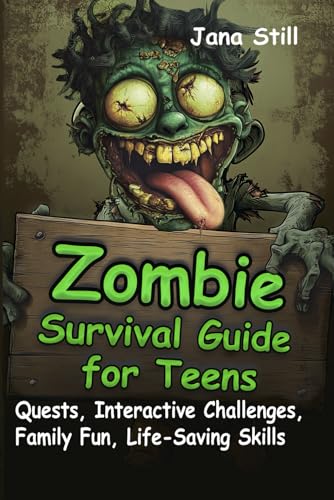
Zombie Survival Guide for Teens: Quests, Challenges, and Life-Saving Skills
Included for 'Best Upcoming Survival Games Guide' because the listing specifies Challenges and and Life-Saving Skills, details this guide uses to compare options.
View on AmazonThis is the pick for teaching survival concepts to a teenage reader who would not voluntarily open a preparedness manual. The zombie framing is the delivery mechanism: quests and challenges carry the reader through practical skills material without it reading like homework. It suits parents, teachers, scout leaders, and teens themselves.
Key Specs
- Format: activity-driven guide with quests and challenges
- Audience: teens
- Content focus: life-saving skills presented through scenario challenges
- Structure: progressive quest format rather than reference lookup
- Use mode: solo reading or small-group activities
- Price tier: premium
Strengths
The engagement design is the whole value proposition. Skills retention depends on practice and repetition, and a quest structure creates natural repetition — the reader completes a challenge, which is functionally a drill, without experiencing it as one. For a parent trying to get a teenager to learn basic emergency response, that is the difference between a book that gets read and a book that gets dusted.
The framing also sidesteps resistance. Survival content delivered straight can feel alarmist to a younger reader. Delivered as a zombie scenario, it reads as a game with real underlying skills, which is a well-established teaching pattern and a legitimate reason to pay above budget tier.
Pros
- Activity format drives actual engagement rather than passive reading
- Teen-appropriate framing for genuinely useful skills
- Challenges function as repeatable drills
- Works for solo readers and group activities
- Good bridge between entertainment and preparedness education
Cons
- Premium price for a teen-oriented title
- Zombie framing may not appeal to readers who want serious material
- Thematic layer adds pages that are not purely reference
- Skills depth is calibrated to beginners, not adults
How It Compares
The natural comparison is the Gamers’ Survival Guide from DK. Both target younger readers through a culture-adjacent frame, but DK’s guide leans on illustrated gaming-culture content at a budget tier, while the Zombie Survival Guide for Teens is structured around progressive challenges at a premium tier. If your goal is a fun illustrated read, DK is the better value. If your goal is a teen who comes out the other side knowing how to respond to an emergency, the quest format earns its premium price. Against the Advanced Survival Guide, the audience gap is total — one is written for beginners and teens, the other for experienced readers.
5. Advanced Survival Guide (Stoney Wolf Productions) – Best for Experienced Self-Reliance Readers

Advanced Survival Guide
Included for 'Best Upcoming Survival Games Guide' as a relevant option in this category; details come from the product listing.
View on AmazonThis is the deep-study option: a long-form advanced survival text for readers who already know the basics and want to go further into self-reliance. It suits homesteaders, long-term preppers, off-grid households, and anyone treating survival skills as a discipline rather than a checklist. It is not a beginner’s first book.
Key Specs
- Format: long-form advanced survival reference
- Level: advanced — assumes baseline knowledge
- Topic framing: survival and self-reliance
- Publisher class: independent survival-focused production
- Use mode: solo study, home reference
- Price tier: premium
Strengths
Advanced material is genuinely scarce. The survival shelf is crowded with introductory handbooks, because beginners are the larger market, and relatively thin at the level above them. A text written for readers who already understand water treatment and shelter basics can spend its pages on the harder problems — long-term food systems, resource planning across seasons, tool maintenance, and the compounding logistics of sustained self-reliance.
It is also the right kind of book to own physically rather than skim. Advanced references get revisited, annotated, and cross-checked, which is exactly the use pattern a home library serves.
Pros
- Targets an advanced level that most survival titles skip
- Suits long-term planning rather than one-off emergencies
- Home reference format rewards repeated consultation
- Useful for homestead and off-grid contexts
- Pairs well with pocket field guides rather than replacing them
Cons
- Not waterproof and not intended for field carry
- Assumes knowledge — beginners will find gaps
- Premium tier for a text-only product
- Urban and household emergency content is not its focus
How It Compares
Against the Sojourner Fieldcraft Wilderness Skills Pocket Guide, this is depth versus portability in its purest form. The fieldcraft guide is waterproof and carryable but shallow; the Advanced Survival Guide is broad and deep but stays on the desk. Many readers will reasonably own both. Against the Tiny handbook family, the difference is level rather than topic — those are beginner and generalist, this is advanced.
6. Gamers’ Survival Guide (DK) – Best Budget Illustrated Read

Gamers' Survival Guide
Included for 'Best Upcoming Survival Games Guide' as a relevant option in this category; details come from the product listing.
View on AmazonThis is the budget-tier pick for a reader who wants a well-produced, illustrated guide with a gaming-culture angle. DK’s reputation in reference publishing is built on visual layout and clear design, and this title fits that pattern. It suits younger readers, casual gamers, and anyone who wants an accessible, fun-to-flip book rather than a dense manual.
Key Specs
- Format: illustrated guide
- Publisher class: established illustrated reference publisher
- Audience: general and younger readers, gaming-adjacent
- Design: visual, layout-driven reference format
- Use mode: solo browsing and light reference
- Price tier: budget
Strengths
At a budget price, an illustrated reference from a major publisher is one of the better value purchases on this list. The visual format does real work: diagrams and layout make concepts easier to absorb at a glance than columns of prose. For a younger reader or a casual gamer, that accessibility is what turns a book into something actually opened.
It is also a low-risk gift. It reads as entertainment, which means it gets given without the implied pressure of a preparedness purchase, while still delivering survival-themed content.
Pros
- Budget price for a professionally produced illustrated reference
- Visual format suits younger and casual readers
- Gaming framing makes it approachable rather than alarmist
- Works as a gift without preparedness pressure
- Easy to browse in short sessions
Cons
- Not a serious preparedness reference for adults
- Gaming angle is appeal-driven, not depth-driven
- Illustrated format limits technical detail
- Not waterproof or designed for field carry
How It Compares
Against the Zombie Survival Guide for Teens, the split is price tier versus structure. DK delivers an illustrated browse at budget; the Teen guide delivers a quest-and-challenge structure at premium. Against the Tiny Pocket Survival Guide, also budget tier, the distinction is purpose: the Tiny handbook is a preparedness reference meant to be carried and consulted, while the DK guide is meant to be read and enjoyed. Neither replaces the other.
7. Tiny First Aid, Disaster & Survival Guide Set – Best Premium Preparedness Library

Tiny First Aid, Disaster & Survival Guide Set – Pocket Emergency Preparedness Handbooks for Safety, Crisis Response & Natural Disaster Readiness (3-Pack)
Included for 'Best Upcoming Survival Games Guide' because the listing specifies Disaster & Survival Guide Set and Pocket Emergency Preparedness Handbooks for Safety, details this guide uses to compare options.
View on AmazonThis is the premium pick for a household that wants a deliberate, layered reference library rather than a single book. The set splits first aid, disaster response, and survival into separate pocket handbooks, which means you look up the right topic in the right booklet instead of paging through a combined manual. It suits families, multi-car households, small businesses, and anyone building kits that will be used by more than one person.
Key Specs
- Format: multi-handbook pocket set
- Topic separation: first aid, disaster, and survival as distinct volumes
- Carry profile: pocket-sized, distribute across bags and locations
- Use mode: solo reference and multi-user household
- Scope note: general emergency information only — first-aid content in any handbook is not a substitute for professional medical training or advice
- Price tier: premium
Strengths
Topic separation is the real functional advantage. Under stress, lookup speed collapses if you have to find the right section in a combined book. Separate booklets mean the first-aid volume is the one you grab when the situation is medical, and you are not flipping past disaster-preparedness pages to get there.
The set structure also matches how preparedness actually works in a household. Different bags serve different purposes — a car kit, a home kit, a work bag. A multi-volume set lets you assign volumes where they belong rather than photocopying pages or buying duplicates.
Pros
- Separated topics mean faster lookup under pressure
- Multiple volumes suit multi-location kits
- First-aid content sits in its own dedicated volume
- Pocket format keeps each booklet carryable
- Appropriate for households, vehicles, and small workplaces
Cons
- Highest price tier on this list
- Multi-volume sets can get separated and lost
- Pocket format caps the depth of each topic
- Overkill for a single person who needs one handbook
Note on health content: first-aid handbooks provide general information. They do not replace certified first-aid or CPR training, and they are not medical advice. For any medical concern, consult a qualified professional.
How It Compares
Against the Tiny Disaster Guide and the Tiny Survival & Disaster Guide, the difference is scope architecture. Those are single booklets at budget and mid-range tiers covering one or two topics; this set covers three as separate volumes at premium. If you want one book, buy one of the singles. If you are outfitting more than one location with more than one topic, the set is the more efficient purchase despite the higher upfront cost — buying separate single-topic handbooks to match its coverage generally costs more.
8. Tiny Disaster Guide – Pocket Emergency Preparedness Handbook – Best Single-Topic Disaster Prep

Tiny Disaster Guide – Pocket Emergency Preparedness Handbook for Survival, Safety, First Aid, Natural Disasters & Everyday Crisis Response, Pack of 1
Included for 'Best Upcoming Survival Games Guide' because the listing specifies Pocket Emergency Preparedness Handbook for Survival and Safety, details this guide uses to compare options.
View on AmazonThis is the focused budget option for readers whose concern is specifically disaster response rather than general survival skills. It is a compact handbook in the Tiny family, centered on disaster preparedness, and it suits apartment dwellers, renters in storm or wildfire regions, and anyone who wants one clearly scoped reference rather than a broad set.
Key Specs
- Format: single pocket handbook
- Topic scope: disaster preparedness and response
- Carry profile: pocket, bag, drawer
- Use mode: solo reference
- Series note: one volume in the Tiny preparedness handbook family
- Price tier: budget
Strengths
Narrow scope is a feature when it matches your actual risk. Disaster preparedness covers evacuation planning, sheltering, utility shutdowns, communication, and supply staging — a coherent topic that stands on its own. If that is your concern, paying for first-aid and wilderness content you will not use is waste.
The budget tier also makes duplication practical. One copy in the apartment, one in the car, one at a relative’s house is an affordable plan at this price.
Pros
- Clear single-topic focus on disaster preparedness
- Budget price supports buying multiple copies
- Pocket format is genuinely carryable
- Complements first-aid and wilderness references rather than duplicating them
- Straightforward scope with no filler topics
Cons
- No first-aid content
- No wilderness or bushcraft material
- Less comprehensive than the multi-volume set
- Budget format means less depth per page
How It Compares
Against the Tiny Survival & Disaster Guide at mid-range, the trade is obvious: that title covers two topic areas, this covers one, for less. If disaster response is your only concern, buy this. Against the Tiny First Aid, Disaster & Survival Guide Set, this is one volume against three — the set wins on breadth, this wins on price and on not paying for topics you will not use.
9. Tiny Survival & Disaster Guide – Pocket Emergency Preparedness Handbook – Best Combined Mid-Range Handbook

Tiny Survival & Disaster Guide – Pocket Emergency Preparedness Handbook for Safety, First Aid, Natural Disasters & Crisis Response (2-Pack)
Included for 'Best Upcoming Survival Games Guide' because the listing specifies Pocket Emergency Preparedness Handbook for Safety and First Aid, details this guide uses to compare options.
View on AmazonThis sits between the single-topic budget booklet and the premium multi-volume set. It is a compact handbook covering both survival and disaster preparedness in one volume, which makes it the right pick for a reader who wants broader coverage than a single-topic guide without paying for a full set. It suits one-bag carriers, commuters, and readers who want one book that covers the two most common scenarios.
Key Specs
- Format: single compact handbook
- Topic scope: survival and disaster preparedness combined
- Carry profile: pocket, bag, glovebox
- Use mode: solo reference
- Series note: mid-tier volume in the Tiny preparedness family
- Price tier: mid-range
Strengths
Combined coverage solves a real problem: most people face both a general “what if I’m stuck” scenario and a specific “what if the storm hits” scenario, and owning two booklets for that is friction. One volume covering both means one item in the bag, which means it is more likely to actually be in the bag.
The mid-range tier also positions it well as a gift or a first serious purchase. It costs meaningfully less than the full set while delivering two of the three topics that set covers.
Pros
- Two topic areas in a single carryable volume
- Mid-range price between budget singles and the full set
- Reduces kit clutter compared with multiple booklets
- Pocket format suits everyday carry
- Good middle step for readers upgrading from a budget handbook
Cons
- No dedicated first-aid volume
- Single-volume format means less depth per topic than the set
- Combined books can be slower to navigate under stress than separated ones
- Mid-range price is close enough to the set that buyers should compare carefully
How It Compares
Against the Tiny Disaster Guide, you pay more for the added survival coverage — worth it if you want both, wasteful if disaster response is your only concern. Against the Tiny First Aid, Disaster & Survival Guide Set, the decision comes down to first aid. If you want first-aid material in a separate dedicated volume, buy the set. If you already carry a first-aid reference or have taken a certified course and keep a card, this combined guide covers the remaining ground for less.
10. Game of Survival (Majosta) – Best Strategy Board Game for Survival Groups

Game of Survival
Included for 'Best Upcoming Survival Games Guide' as a relevant option in this category; details come from the product listing.
View on AmazonThis is the step up from party-format survival play: a competitive board game built around survival themes, aimed at groups who want a real strategy session rather than a round of arguments. It suits established board-game groups, older teens, and adults who want decision-making tension without a full wargame commitment.
Key Specs
- Format: competitive board game
- Theme: survival
- Group fit: multiplayer, table-based play
- Session profile: longer than a card-game round
- Setup burden: moderate — board, components, rule teach
- Price tier: mid-range
Strengths
Board-game survival framing produces a different experience from card rankings: resource decisions accumulate, positions shift, and outcomes feel earned. For a group that plays regularly, that arc is the appeal — the game rewards repeat plays and strategic adjustment in a way a party card game does not attempt.
The mid-range tier is also appropriate for what it is. Board games with boards and multiple component types sit above card games in cost, and this one stays out of the premium band occupied by collector editions and heavier strategy titles.
Pros
- Real strategic depth for regular game groups
- Survival theme drives the decision space rather than decorating it
- Mid-range price for a component-heavy board game
- Rewards repeat plays and group metagame
- Good escalation from a card-game starting point
Cons
- Requires a rule teach before the first play
- Needs table space and a committed group
- Not suitable for very young players
- Not a solo experience
How It Compares
Against Moose Games The Worst-Case Scenario Card Game Apocalypse, this is depth versus accessibility. The card game is playable in minutes with mixed ages; this game asks for a teach and a table. Against Stay Alive 1978 Edition, the difference is solo support and abstraction level: Stay Alive supports 1–4 players and is an abstract strategy game, so it plays alone and rewards pure planning, while Game of Survival is built around competitive multiplayer survival play. Groups with irregular attendance should lean toward the card game or the solo-capable abstract title.
11. Stay Alive 1978 Edition (Milton Bradley) – Best for Solo and Small-Group Abstract Strategy

Stay Alive 1978 Edition: Survival Abstract Strategy Board Game for 1-4 Players, Ages 8+
Included for 'Best Upcoming Survival Games Guide' because the listing specifies Ages 8+, details this guide uses to compare options.
View on AmazonThis is the classic pick and the only board game on this list that supports solo play. The 1978 Edition of Stay Alive is an abstract strategy game for 1–4 players, ages 8 and up, which makes it unusually flexible: it works as a solitaire puzzle, a two-player duel, or a small-group session. It suits strategy purists, families, and anyone who wants a survival-themed game that does not require a partner.
Key Specs
- Format: abstract strategy board game
- Players: 1–4
- Age range: ages 8 and up
- Edition: 1978 Edition, a known heritage board-game release
- Solo support: yes — the only solo-capable title in this roundup
- Price tier: premium
Strengths
Solo support is the headline. Most survival board games assume a group, which makes them unusable on the evening you actually want to play. A 1–4 player game solves that: it fills a table of any size from one person up, and it stays playable as your household changes.
Abstract strategy also ages well. Because the challenge comes from mechanics rather than a content theme, the game does not date the way tie-in products do. Age 8+ means it covers the largest realistic audience span of any competitive title here, and it works as a genuine teaching tool for planning and consequence-thinking.
Pros
- Supports solo play — unique in this roundup
- 1–4 player range covers every realistic group size
- Age 8+ makes it family-viable
- Abstract design rewards planning over luck
- Established heritage edition with known rules
Cons
- Premium price tier for an abstract game
- Heritage editions can vary in component condition
- Abstract format means no narrative survival content
- Deep strategy may frustrate very casual players
How It Compares
Against Game of Survival, the deciding factor is player count flexibility and solo capability. If you regularly have three or four people at a table, Game of Survival delivers more thematic competitive depth. If you sometimes play alone, or your group size varies unpredictably, Stay Alive is the only title here that accommodates you. Against The Worst-Case Scenario Card Game, the choice is social versus strategic — one is built for conversation, the other for calculation.
12. The New Dad Code: The Super Practical Pregnancy Guide for Men – Best Practical Nine-Month Guide for Expectant Fathers

The New Dad Code: The Super Practical Pregnancy Guide for Men: Master the 9 Month Journey & Become the Ultimate Supportive Partner w/ Tips & Hacks for ... To Be) (Handbook for Expectant Fathers 1)
Included for 'Best Upcoming Survival Games Guide' as a relevant option in this category; details come from the product listing.
View on AmazonThis is the non-obvious inclusion, and it earns its place: a pregnancy guide written for men and structured around the nine-month journey. It suits expectant fathers, partners who want to be genuinely useful rather than present, and readers who prefer practical guidance over abstract support language. It sits in the “preparedness” category in the broadest sense — preparing for the most consequential logistics project most people ever take on.
Key Specs
- Format: practical pregnancy guide for men
- Structure: organized around the nine months of pregnancy
- Audience: expectant fathers and partners
- Approach: practical and task-oriented rather than medical
- Use mode: solo reading, shared reference
- Price tier: budget
Strengths
The audience gap is real. Most pregnancy books are written for the pregnant person, which leaves partners reading material that does not answer their actual questions: what to do, when to do it, what to prepare, how to be useful during appointments, and what to have ready before the due date. A guide structured around the nine months gives the partner a timeline and a task list instead of vague encouragement.
At budget tier, there is essentially no risk in the purchase. And the nine-month structure means it gets read progressively, in the order the milestones actually happen, rather than skimmed once.
Note: this is general informational material, not medical advice. Pregnancy decisions, symptoms, and concerns should be discussed with a qualified healthcare professional.
Pros
- Written specifically for expectant fathers and partners
- Nine-month structure matches the actual timeline
- Practical, task-oriented framing rather than abstract support
- Budget price makes it a low-risk gift
- Useful as a shared reference between partners
Cons
- Not a medical reference and not intended as one
- Practical tone will not suit readers wanting emotional or reflective content
- Narrower audience than parenting books written for both partners
- Budget format means modest length
How It Compares
There is no direct equivalent elsewhere on this list — it is the only parenting title here, and its relevance is thematic: preparation for a known, dated, high-stakes event. Readers drawn to this guide for its preparedness logic will find the same logic in the Tiny handbook family; readers who want a task-based timeline for a major life event will find this one delivers it at the lowest price on the list.
How to Choose
The right purchase depends on which of four jobs you are trying to do: play, learn skills, prepare a kit, or prepare for a life event. Start by identifying the job, then match the format, then check the spec class. Most buyer regret in this category comes from buying the wrong format rather than the wrong quality.
Step 1: Decide Whether You Want Entertainment or Reference
These are not interchangeable, and this is the single most common mistake. A survival board game will not help you treat a wound, and a pocket handbook will not entertain a game night. If your goal is a social evening, stay in the games group: The Worst-Case Scenario Card Game for mixed ages and low rules overhead, Game of Survival for committed strategy groups, Stay Alive for solo or variable-size play. If your goal is practical capability, stay in the reference group: the Tiny handbook family, the Sojourner Fieldcraft guide, and the Advanced Survival Guide.
Step 2: Match the Reference to Where It Will Live
Where a reference stored determines which spec matters. Use this decision matrix:
| Your Situation | Shelf Life & Location | What Matters Most | Recommended Pick |
|---|---|---|---|
| Starting from zero, one household | Drawer or shelf at home | Lowest cost, general coverage | Tiny Pocket Survival Guide (budget) |
| Storm/wildfire region, apartment | Entryway or car | Single-topic disaster depth | Tiny Disaster Guide (budget) |
| One-bag carrier, commuter | Everyday bag | Two topics in one volume | Tiny Survival & Disaster Guide (mid-range) |
| Outdoor use, hiking or hunting | Pack, in weather | Water resistance | Sojourner Fieldcraft Pocket Guide (mid-range) |
| Multi-car or multi-person household | Several locations | Multiple volumes, separated topics | Tiny First Aid, Disaster & Survival Set (premium) |
| Experienced, planning long-term | Home study desk | Depth, advanced level | Advanced Survival Guide (premium) |
Step 3: Budget by Coverage, Not by Brand
A useful way to think about it: budget tier buys one topic, mid-range buys one topic deeply or two topics combined, premium buys multiple topics or advanced depth. If you need three topics — first aid, disaster, survival — the multi-volume set is usually more efficient than buying three separate single-topic booklets, even though its sticker tier looks higher. Everyone’s situation is different, and prices change daily, so do a quick total of the coverage you actually need before deciding.
Step 4: Check the Spec Class Before Buying
Concrete specs to look for in this category:
- Weather resistance: if the item will live in a pack or car, check whether it is described as waterproof. Non-waterproof paper fails in field conditions.
- Format: single handbook versus multi-volume set. Multi-volume is faster to navigate under stress; single volume is easier to keep track of.
- Carry size: pocket format means it travels with you; full-size format means it stays home but holds more.
- Topic separation: first aid separated from disaster response matters, because you want to grab one booklet, not hunt through a combined index.
- Level: beginner, general, or advanced. An advanced text assumes baseline knowledge and will frustrate a first-time reader.
- Player count and solo support (games): verify how many people it supports. A title that needs three players will not get played in a one-person household.
- Age range (games): published age minimums tell you whether a title works for your actual table.
- Structure (activity books): quests and challenges mean drills, which aid retention. Plain prose means reading, which aids awareness. Choose by which you want.
Step 5: Understand Ownership Realities
Preparedness purchases have a distinctly different ownership pattern from most consumer goods. Three realities are worth planning for.
Consumables and expiry. The books themselves do not expire, but the supplies they tell you to stock do — water, food, batteries, and medications all have shelf lives. A handbook is only useful if you act on it, which means an annual review of whatever kit the book describes. Budget for replacement supplies, not just the book.
What wears first. On pocket handbooks, the binding and page edges wear first. Waterproof guides resist moisture but their folds still fatigue with repeated opening. If a guide lives in your bag daily, expect visible wear within a year or two of real use — that is normal and a sign it is doing its job.
Duplication and loss. Multi-volume sets get separated. The volume you need is often in the other bag. This is the strongest argument for either buying duplicates of single-topic budget booklets or deliberately assigning each set volume to a fixed location and never moving it.
Common mistakes. The most frequent errors are buying a reference and never reading it, storing a kit somewhere you cannot reach in an emergency, relying on an untrained person’s interpretation of a first-aid booklet during an actual medical event, and treating an advanced text as a beginner guide. A less common but costlier mistake is buying entertainment in place of preparation — a survival board game is a fine purchase, but it is not a plan.
Step 6: Understand Early-Access and Development Risk in the Digital Survival Space
Physical products on this list are finished goods — a published book or manufactured game does not change after you buy it. Digital survival games work differently, and if you are tracking announced titles, the risk profile needs managing.
- Announced only: a trailer and a store page. No release window commitment. Treat as a wishlist, never a preorder.
- Early access: playable, but systems, balance, and survival mechanics can be reworked repeatedly. Buy only if the current build is already worth the price to you.
- Release window stated, no date: the most common state. Expect slippage of months to a year, especially for small studios.
- Solo versus co-op: confirm which the developer has committed to. A title marketed around co-op may ship with limited solo support, which matters if you play alone.
- Platform commitments: console versions often follow PC by a significant margin. If you do not play on PC, wait for your platform’s dated announcement.
- Development status signals: regular, specific developer updates are a positive sign. Long silences and repeated window shifts are not.
For a reader whose real interest is playing survival games this year, the finished physical titles in this guide carry zero development risk. For a reader tracking announced digital titles, the practical rule is simple: never pay for a survival game based on a release window that has not been dated, and never preorder an unproven studio’s first title.
Step 7: Think About the Upgrade Path
Survival preparation is cumulative, so buy in the order you will actually use. The most sensible sequence for most readers: a budget single handbook first, so you have something in the bag today; a waterproof field guide second if you spend time outdoors; a multi-volume set third once you know which topics you actually consult; an advanced text last, once the basics are genuinely familiar. On the games side, the sequence runs the other way — start with the accessible card game to see whether your group engages with the theme, then move to a strategy board game, then to a solo-capable title if your group’s schedule is unreliable. Buying the deepest, most expensive option first is the classic mistake: it sits unread and unplayed because the entry point was never established.
Frequently Asked Questions
Are these products actually about survival, or is the theme just marketing?
They split into three genuine categories. The handbook family — the Tiny guides, the Sojourner Fieldcraft pocket guide, and the Advanced Survival Guide — is practical reference material you consult in real situations. The game titles — The Worst-Case Scenario Card Game, Game of Survival, and Stay Alive — use survival themes as the driver of play rather than as a claim of practical utility. The Zombie Survival Guide for Teens and the Gamers’ Survival Guide sit in between, teaching real skills through an entertainment frame. Knowing which category you are buying from prevents disappointment.
What actually matters most when choosing a survival book?
Water resistance, format, and level. Water resistance determines whether the guide survives field conditions; format determines whether it lives in your pocket or your desk; level determines whether you can use it. Topic breadth matters less than people assume, because a narrow guide you use beats a broad guide you shelve. Price tier correlates loosely with all three — budget buys one topic, premium buys separated topics or advanced depth — but the correlation is not automatic, so check the actual description rather than assuming tier equals fit.
What is the difference between the Tiny Disaster Guide, the Tiny Survival & Disaster Guide, and the full Tiny set?
They are layered options at three tiers. The Tiny Disaster Guide is a single budget handbook focused on disaster preparedness. The Tiny Survival & Disaster Guide is a mid-range volume covering both survival and disaster material in one book. The Tiny First Aid, Disaster & Survival Guide Set is a premium multi-volume set that adds a dedicated first-aid volume and separates topics across booklets. Buy the single if your concern is one scenario, the combined volume if you want two topics in one carryable item, and the set if multiple people or locations need coverage.
Do first-aid handbooks replace first-aid training?
No. A first-aid handbook is general reference information, and reading it does not make anyone competent to provide medical care. Formal certified training with practical instruction is a different thing entirely. If you carry a first-aid booklet, pair it with an actual course and keep the booklet as a memory aid. For any medical concern or emergency, seek qualified professional help.
Which survival game works best for a solo player?
Stay Alive 1978 Edition, because it is the only game in this roundup with stated support for 1–4 players. The Worst-Case Scenario Card Game and Game of Survival both assume a group, and Game of Survival in particular needs a committed table to function. If you sometimes play alone and sometimes with others, Stay Alive’s player range is the most flexible by a wide margin.
Is a survival board game worth the premium price over a card game?
It depends on how often you play. A board game with components supports strategic depth that a card-ranking game does not attempt, but it also needs a rule teach, table space, and a group that shows up consistently. If your group meets monthly and enjoys learning rules, the board game earns the higher tier. If your group is casual, mixed-age, or irregular, the card game will get played far more often per unit of cost.
How should I organize a multi-volume preparedness set so it doesn’t get lost?
Assign each volume to a fixed location and treat it as permanent. Put the first-aid volume where injuries most likely occur in your household, the disaster volume with your go-bag or entryway kit, and the survival volume in your vehicle or outdoor pack. Label the inside cover of each volume with its assigned location. The main failure mode with sets is that a volume migrates to a kitchen drawer and stays there, which is why duplicate budget booklets are often the more practical solution for multi-location coverage.
What is the realistic risk of buying a digital survival game before release?
The main risks are delay, scope change, and abandonment. An announced title without a firm date can slip by months or years, and a small studio’s first release can be delayed indefinitely. Early access carries the additional risk that core survival systems get reworked after you have already learned them. The practical rule is to pay only for what you can play today, and treat every undated announcement as a wishlist entry rather than a purchase — which is exactly why the finished physical titles in this guide carry no such risk.
Should I buy one broad guide or several narrow ones?
Several narrow ones, in most cases. Lookup speed under stress matters more than owning a comprehensive volume, and separate booklets let you put the right topic in the right place. A single broad manual is often the right first purchase because it tells you which topics you actually care about — but once you know, buying topic-specific booklets or a multi-volume set generally serves you better than one thick book you rarely open.
Final Recommendation by Reader Situation
If you want a survival-themed activity for a mixed-age group this weekend, buy Moose Games The Worst-Case Scenario Card Game Apocalypse — it is the lowest-friction way in. If you play alone or your group size varies, Stay Alive 1978 Edition is the only title here that accommodates you. If you have a regular strategy group, Game of Survival delivers more depth once the rules are learned.
If your goal is practical preparation and you are starting from nothing, begin with the Tiny Pocket Survival Guide for Emergency Preparedness at budget tier, one copy per bag. If your concern is specifically storms, evacuation, or utility failure, choose the Tiny Disaster Guide instead. If you want one carryable book covering both general survival and disaster response, step up to the Tiny Survival & Disaster Guide. For outdoor use where weather is a factor, the Sojourner Fieldcraft Wilderness Skills Pocket Guide is the right buy because waterproofing is the spec that decides whether a field guide survives. For a household outfitting several locations with several topics, the Tiny First Aid, Disaster & Survival Guide Set is the more efficient purchase than buying three separate booklets. For experienced readers planning long-term self-reliance, the Advanced Survival Guide goes deeper than anything else here.
If there is a teenager in your life who would never open a preparedness manual, the Zombie Survival Guide for Teens gets the skills in through the front door, while the Gamers’ Survival Guide from DK is the better budget choice for a reader who just wants a well-made illustrated book. And if you are preparing for a nine-month countdown of a very different kind, The New Dad Code is the practical timeline-and-task-list option, best paired with professional medical guidance from your healthcare provider.







Write Your Review
No reviews yet. Be the first to share your experience!