
The NAVAC NP7DP Pro is the best overall choice here for working technicians: it is a 7 CFM, dual-stage pump with a stated 15-micron ultimate vacuum, and the manufacturer lists dual-voltage operation, a sight window for oil and a lifting hook. For occasional mini split installs and small systems, a 3.5 to 5 CFM single-stage pump is plenty. An HVAC vacuum pump removes air and moisture from a refrigerant circuit before charging, and its two key numbers are CFM, which sets how fast it pulls, and ultimate vacuum in microns, which sets how deep it can go.
Quick List
- NAVAC NP7DP Pro 7 CFM – best for professional installs and deep, repeatable evacuations
- VTG VOGTEN 4.5 CFM Pump and Gauge Kit – best for a starter bundle covering mini splits and auto A/C
- VEVOR 7 CFM Two-Stage Pump – best for large-capacity pulling with a 3/4 HP motor
- Elitech 5 CFM Single-Stage Pump – best for a mid-size pump with thermal protection
- OMT 3.5 CFM Single-Stage Pump – best for light residential and automotive service
- Robinair 15500 VacuMaster Economy – best for a familiar two-stage 5 CFM workhorse
Which One Is Right for You?
| If you… | Choose |
|---|---|
| install or service systems every week and need a deep vacuum | NAVAC NP7DP Pro |
| handle large line sets or multiple systems and want 7 CFM | VEVOR 7 CFM Two-Stage Pump |
| want a two-stage pump from a long-established service brand | Robinair 15500 |
| install a mini split now and then and want a gauge kit included | VTG VOGTEN 4.5 CFM Kit |
| want a single-stage pump with auto-reset thermal protection | Elitech 5 CFM |
| work mostly on small residential or car systems | OMT 3.5 CFM |
If you care most about reaching a very low micron level, favor the two-stage pumps, since two pumping stages in series are designed to pull deeper than a single stage. If portability and simplicity matter more, a single-stage 3.5 to 5 CFM pump is lighter and handles most home-sized jobs. Whatever you buy, a separate micron gauge is the only way to know the evacuation is actually complete.

NAVAC NP7DP Pro Vacuum Pump - 7 CFM, 15 Microns, Dual-Stage AC Motor | Pro Series HVAC vacuum pump delivers 7 CFM flow with a dual-stage AC motor, 15-micron vacuum and forced oil circulation.
Included for '6 Best HVAC Vacuum Pumps (October 2026) Expert Picks' because the listing specifies 7 CFM and 15 Microns, details this guide uses to compare options.
View on Amazon
VTG VOGTEN 4.5 CFM AC Vacuum Pump and Gauge Set for R134a R12 R22 R502 | AC Vacuum Pump Kit for Mini Split/HVAC/Auto Systems,w/2 R134a Can Taps,2 R410a Adapters,Vacuum Oil,Storage Bag
Included for '6 Best HVAC Vacuum Pumps (October 2026) Expert Picks' because the listing specifies AC Vacuum Pump Kit for Mini Split/HVAC/Auto Systems and w/2 R134a Can Taps, details this guide uses to compare options.
View on Amazon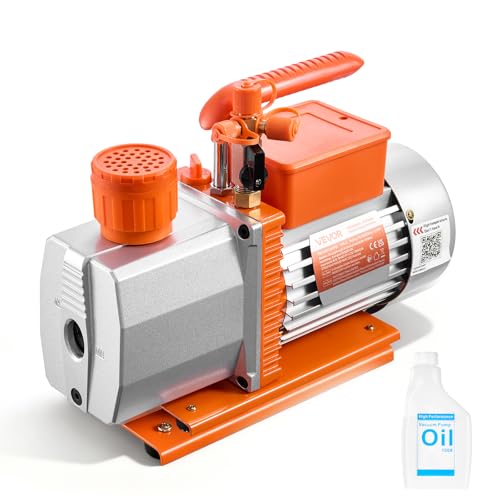
VEVOR Vacuum Pump, 7 CFM 3/4 HP, HVAC Two Stage Rotary Vane AC Vacuum Pump, for R134a R22 R410a R1234YF R32, 4 Pole Motor, for Automotive Air Conditioner Maintenance Resin Degassing, Oil Included
Included for '6 Best HVAC Vacuum Pumps (October 2026) Expert Picks' because the listing specifies 7 CFM 3/4 HP and HVAC Two Stage Rotary Vane AC Vacuum Pump, details this guide uses to compare options.
View on Amazon
Elitech HVAC Vacuum Pump, 5 CFM Single Stage Rotary Vane | 1/3 HP Motor, 2 Pa Ultimate Vacuum, Aluminum Alloy Housing, Auto-Reset Thermal Protection, 1/4" & 3/8" Ports
Included for '6 Best HVAC Vacuum Pumps (October 2026) Expert Picks' because the listing specifies 5 CFM Single Stage Rotary Vane and 1/3 HP Motor, details this guide uses to compare options.
View on Amazon
OMT 3.5 CFM Single Stage Vacuum Pump for R134a R410a R22 Auto AC HVAC Kit | Copper Motor; 37.5 Microns Ultimate Vacuum; Aluminum Alloy Casing; For Automotive HVAC and Resin Degassing; Oil Included
Included for '6 Best HVAC Vacuum Pumps (October 2026) Expert Picks' as a relevant option in this category; details come from the product listing.
View on Amazon
Robinair 15500 VacuMaster Economy Vacuum Pump for Air Conditioning and Refrigeration Service, 2-Stage, 5 CFM, 1/3HP 115V/60HZ Motor
Included for '6 Best HVAC Vacuum Pumps (October 2026) Expert Picks' because the listing specifies 2-Stage and 5 CFM, details this guide uses to compare options.
View on AmazonAll 6 Picks in Detail
1. NAVAC NP7DP Pro 7 CFM – Best for Professional Installs and Deep Evacuations
As an Amazon Associate we earn from qualifying purchases at no extra cost to you.

The NAVAC NP7DP is a dual-stage pump rated by the maker at 7 CFM and 15 microns, driven by a 3/4 HP AC motor that runs on either 115 or 230 volts at 60 Hz. NAVAC also lists forced oil circulation, an internal check valve that prevents oil from backflowing, an oil level window and a lifting hook. It suits technicians who evacuate many systems and need a pump that gets down to a low micron level reliably.
With a pump this size, plan the hose side of the setup too. Large-bore 3/8-inch or 1/2-inch vacuum hoses, and valve core removal tools if you have them, let the pump see the system with less restriction. That is where a high-CFM machine pays off, because it cannot pull faster than the hose lets air through. Store it with fresh oil after each job so moisture does not sit inside overnight.
Its inlet ports include 1/4-inch, 3/8-inch and 1/2-inch flares, so you can match it to larger vacuum hoses that move air more quickly than 1/4-inch hoses. If you work with A2L refrigerants such as R-32 or R-454B, note that NAVAC sells a separate A2L-compatible variant, the NP7DP2, so check which one your jobs require.
- Flow rate: 7 CFM
- Ultimate vacuum: 15 microns per NAVAC
- Stages: two
- Motor: 3/4 HP, dual voltage 115/230 V
- Oil capacity and weight: about 15 oz and 26 lbs per NAVAC
Pros:
- Deep vacuum capability with a larger-bore inlet option
- Oil sight window and check valve are practical service features
Cons:
- Heavier and bulkier than 3 to 5 CFM pumps
- More capacity than a homeowner or occasional installer needs
Against the VEVOR, the NAVAC matches the 7 CFM class but adds more published detail on oil handling and ports.
2. VTG VOGTEN 4.5 CFM Pump and Gauge Kit – Best for a Starter Bundle
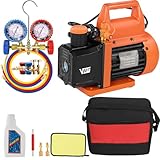
This VTG VOGTEN listing is a 4.5 CFM AC vacuum pump sold with a gauge set for R134a, R12, R22 and R502, and it mentions mini split, HVAC and auto systems, with two R134a can taps. It is aimed at the person who wants one box with a pump and a basic manifold. The refrigerants named in the title are older types, so check whether the bundled gauges are suitable for R-410A, R-32 or R-454B before using them on a modern system.
If you buy a kit like this, read the manifold portion of the listing separately from the pump portion. The gauge set may not be rated for R-410A pressures, and the pump may not be rated for A2L refrigerants, so treat each part on its own merits. Many DIY installers pair the pump with a separate micron gauge to get a true reading before opening service valves.
A kit like this is attractive for a DIY mini split installer who needs a pump and gauges just once or twice. Because the pump stage design is not stated in the title, confirm on the product page whether it is single-stage or two-stage.
- Flow rate: 4.5 CFM
- Bundle: pump plus gauge set and two R134a can taps
- Refrigerants named for the gauges: R134a, R12, R22, R502
- Stage type and ultimate vacuum: confirm on listing
- Applications named: mini split, HVAC, auto
Pros:
- Pump and gauges in one purchase
- 4.5 CFM is a sensible size for small systems
Cons:
- Gauge refrigerant list leaves out current residential types
- Ultimate vacuum figure is not visible in the title
Compared with the OMT, this kit moves slightly more air and adds gauges, but it gives less clarity on the vacuum depth.
3. VEVOR 7 CFM Two-Stage Pump – Best for Large-Capacity Pulling
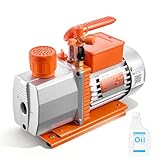
VEVOR lists this as a 7 CFM, 3/4 HP, two-stage rotary vane pump with a 4-pole motor, for R134a, R22, R410a, R1234yf and R32 air conditioning work. A 7 CFM two-stage pump is the class that installers choose for long line sets, multi-zone systems and commercial jobs, where a small pump would take much longer to reach a deep vacuum.
A pump with a 4-pole motor generally runs a little slower and quieter than a 2-pole motor, which can help with noise in an enclosed utility room. Use a heavy-gauge extension cord that is as short as possible if you must use one, since long thin cords starve a 3/4 HP motor on startup and can make it hard to start in cold weather.
It is a natural alternative for buyers who want the same nominal capacity as the NAVAC. Specifications such as ultimate vacuum, oil capacity and weight are not shown in the visible title, so verify them before you buy.
- Flow rate: 7 CFM
- Stages: two, rotary vane
- Motor: 3/4 HP, 4-pole
- Refrigerants named: R134a, R22, R410a, R1234yf, R32
- Ultimate vacuum, oil volume, weight: confirm on listing
Pros:
- High pumping speed for big or long systems
- Broad list of refrigerants in the title
Cons:
- Key depth specification is not stated in the title
- Large pump is overkill for a single small mini split
Next to the Robinair 15500, the VEVOR moves more air, while the Robinair is smaller and easier to carry.
4. Elitech 5 CFM Single-Stage Pump – Best for a Mid-Size Pump With Thermal Protection

The Elitech listing describes a 5 CFM single-stage rotary vane pump with a 1/3 HP motor, a 2 Pa ultimate vacuum, an aluminum alloy housing and an auto-reset thermal protector. Converting units, 2 Pa is roughly 15 microns, which is a low figure for a single-stage design, although manufacturers measure ultimate vacuum under ideal conditions with fresh oil and a direct gauge connection. It suits technicians who want a lighter pump that still has meaningful capacity.
Because single-stage pumps are sensitive to oil condition, this is the kind of model where changing oil often pays back quickly. After each use, run the pump a minute with the inlet capped to warm the oil and drive out moisture, then drain and refill if the oil looks cloudy. Keep the inlet capped in storage to keep dust and humid air out.
Auto-reset thermal protection shuts the motor off if it overheats and restarts it after it cools, which helps in hot attics. Always let the pump cool and check the oil if it trips.
- Flow rate: 5 CFM
- Stage: single
- Motor: 1/3 HP
- Ultimate vacuum: 2 Pa (about 15 microns) per the listing
- Housing and protection: aluminum alloy, auto-reset thermal protector
Pros:
- Thermal protection guards the motor
- Strong stated vacuum level for a single-stage pump
Cons:
- Single-stage design may be slower to reach very low levels than a two-stage unit
- Oil capacity and weight are not shown in the title
Compared with the OMT, this Elitech has more airflow and a deeper stated vacuum, and with the Robinair it trades a second stage for a more detailed spec line.
5. OMT 3.5 CFM Single-Stage Pump – Best for Light Residential and Automotive Service

OMT lists a 3.5 CFM single-stage pump for R134a, R410a and R22 with a kit mention for auto and HVAC, a copper motor, an aluminum alloy casing and a 37.5-micron ultimate vacuum. It is a small, easy-to-carry pump for occasional use on small split systems, window-sized jobs and car air conditioners. The 37.5-micron figure is quite acceptable, since most evacuation targets are in the hundreds of microns.
At this capacity it makes sense to pair the pump with short, large-diameter hoses and a micron gauge on the system side, rather than relying on the pump’s own gauge. Smaller pumps also warm up more quickly during a long pull, so give the motor breaks on very hot days and keep it in shade whenever possible.
Because it is a smaller pump, it needs longer to pull down a larger system. Keep hoses short and use the largest-bore hose that your manifold accepts to improve evacuation speed.
- Flow rate: 3.5 CFM
- Stage: single
- Ultimate vacuum: 37.5 microns per the listing
- Motor and casing: copper motor, aluminum alloy casing
- Refrigerants named: R134a, R410a, R22
Pros:
- Compact and suitable for light-duty work
- Low stated micron level for its size
Cons:
- Smaller capacity slows evacuation of larger systems
- Kit contents are not detailed in the visible title
Compared with the VTG kit, the OMT lists a vacuum depth, while the VTG adds a gauge set and a slightly larger flow rate.
6. Robinair 15500 VacuMaster Economy – Best for a Familiar Two-Stage Workhorse

The Robinair 15500 VacuMaster Economy is a two-stage pump rated at 5 CFM with a 1/3 HP motor running on 115 V at 60 Hz, intended for air conditioning and refrigeration service. Two-stage construction at this size makes it a popular choice for residential service trucks that need decent depth without the weight of a 7 CFM pump. The Economy name tells you it is a basic model without extras.
A two-stage economy pump like this is a good fit for a technician who values simplicity. It has few frills, so you bring your own isolation valve and micron gauge. Keep a bottle of vacuum pump oil in the truck and change it at the first sign of cloudiness, since the pump’s depth depends heavily on clean oil.
The listing does not give an ultimate vacuum in the visible title, so check the product page if you need a specific micron level. Like any pump, it relies on clean oil for its best performance.
- Flow rate: 5 CFM
- Stages: two
- Motor: 1/3 HP, 115 V, 60 Hz
- Intended use: air conditioning and refrigeration service
- Ultimate vacuum: confirm on listing
Pros:
- Two stages in a manageable 5 CFM size
- Established service brand with common replacement parts
Cons:
- 115 V only, so it will not run on 230 V jobsite power
- Ultimate vacuum and weight are not shown in the title
Next to the Elitech, you get a second stage but less published detail about depth and thermal protection.
Specs Compared
| Product | CFM | Stages | Motor | Ultimate vacuum | Notes |
|---|---|---|---|---|---|
| NAVAC NP7DP Pro | 7 | Two | 3/4 HP, 115/230 V | 15 microns | Oil sight window, check valve, 1/4, 3/8, 1/2 in flare inlets |
| VTG VOGTEN 4.5 CFM Kit | 4.5 | Confirm on listing | Confirm on listing | Confirm on listing | Includes gauge set and two R134a can taps |
| VEVOR 7 CFM | 7 | Two | 3/4 HP, 4-pole | Confirm on listing | Rotary vane |
| Elitech 5 CFM | 5 | Single | 1/3 HP | 2 Pa (about 15 microns) | Auto-reset thermal protector, aluminum housing |
| OMT 3.5 CFM | 3.5 | Single | Copper motor, HP to confirm | 37.5 microns | Aluminum alloy casing |
| Robinair 15500 | 5 | Two | 1/3 HP, 115 V, 60 Hz | Confirm on listing | Economy model |
How We Chose These
We selected and compared these six pumps using stated specifications rather than performance claims. For each one we looked at CFM, number of stages, motor size and voltage, the ultimate vacuum figure where the listing gives one, and which refrigerants and applications the listing names. For the NAVAC we also consulted the manufacturer’s specification table, and we converted pascals to microns where a listing uses metric units. We did not run these pumps ourselves, so we do not make speed or reliability claims. Where a listing leaves out a value such as oil capacity or ultimate vacuum, this guide tells you to confirm it on the product page.
What to Look For
CFM: How Fast the Pump Moves Air
CFM stands for cubic feet per minute and describes pumping speed at atmospheric pressure. Higher CFM shortens the early part of evacuation, but it does not change how deep the pump can ultimately go. As a rule of thumb, 3 to 4 CFM serves small residential splits and mini splits, 5 CFM is a comfortable all-round size, and 7 CFM or more helps with larger tonnage, long line sets and commercial work. Hose size matters as much as pump size, because a long, narrow 1/4-inch hose can choke a big pump.
Single-Stage Versus Two-Stage
A two-stage pump uses two pumping stages in series. The second stage works on the already-reduced pressure from the first, which lets the pump reach lower pressures than a single-stage unit of similar size. For routine HVAC work the target is 500 microns or lower, followed by a decay test, and a good single-stage pump can reach that on a clean, tight system. A two-stage pump has more margin on stubborn jobs where moisture lingers.
Ultimate Vacuum and Why You Need a Micron Gauge
Ultimate vacuum is the lowest pressure a pump can reach when connected directly to a gauge with fresh oil. A unit that lists 15 microns has plenty of margin if the goal is 500 microns. One micron is one thousandth of a millimeter of mercury, and one pascal equals about 7.5 microns, so 2 Pa is about 15 microns. A standard compound gauge cannot read deep vacuum, so use a dedicated micron gauge placed as close to the system as possible, and isolate the pump with a valve to run a decay test.
Oil, Maintenance and Worked Example
Vacuum pump oil absorbs moisture and gases, and contaminated oil raises the lowest pressure you can reach. Change it at the start of every important evacuation or whenever it looks milky or dark. Fill to the middle of the sight glass with oil made for vacuum pumps, not engine oil. Here is a simple example: you are installing a 2-ton mini split with a 25-foot line set. A 3.5 to 5 CFM pump with fresh oil and a micron gauge will do the job. Run the pump until the gauge falls below 500 microns, close the isolation valve, and watch for rise over 10 minutes. If it climbs steadily, you have a leak or moisture, and more pulling will not fix a leak.
Power, Safety and Refrigerant Compatibility
Check the voltage on your jobsite, because some pumps are 115 V only while others accept 230 V. Keep the pump grounded and on a dry surface. A vacuum pump is for removing air and moisture, not for recovering refrigerant, and refrigerant must be recovered in accordance with federal rules before you open a system. Ordinary AC motor pumps can produce sparks, so for mildly flammable A2L refrigerants follow the pump maker’s guidance and look for models designated A2L compatible.
Questions
How many CFM do I need for a home air conditioner?
For typical residential systems, 3 to 5 CFM is usually adequate. Choose 7 CFM or more if you service larger systems or very long line sets.
Can I use a car A/C vacuum pump on a home system?
Often yes, because the pump simply removes air and moisture, but check the manufacturer’s stated applications and confirm that the fittings, hoses and gauge set match your system. Use a micron gauge to verify the result.
How often should I change the vacuum pump oil?
Change it before each major evacuation or whenever it looks cloudy, milky or dark. Fresh oil is the cheapest way to keep the pump reaching its rated vacuum.
What micron level is good enough?
Many installers aim for 500 microns or lower and then confirm the system holds with a decay test. Follow the equipment manufacturer’s instruction if it specifies a different level.
Is a two-stage pump worth it?
For frequent professional use, yes, since the second stage offers deeper vacuum and more margin. For occasional mini split installs, a quality single-stage pump with a micron gauge is usually enough.
Why does the vacuum climb after I close the valve?
A rapid rise usually means a leak, while a slow rise that levels off often means moisture is still boiling off. Continue pulling and retest, and look for leaks if the reading keeps climbing.
Update History
- October 14, 2026 – Initial publication; product set drawn from current catalog listings.
- Check the product page for current specifications and availability before buying.
Sources
- Manufacturer product and specification pages for NAVAC
- Retailer listing titles and specification fields for all six pumps
Write Your Review
No reviews yet. Be the first to share your experience!