
Iron removal fails more often from a mismatch than from bad hardware. A cartridge system asked to swallow 6 ppm of iron chokes within weeks, while a backwashing tank on a well with barely 1 ppm is money and floor space spent on capacity nobody needs. The honest first step is a laboratory test of your own well, because the iron number on that report — not the staining, not the taste — decides which of these designs belongs in your house.

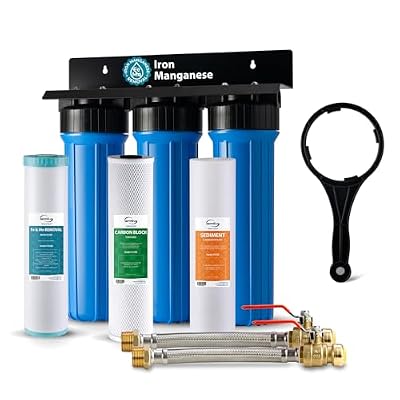
The four systems below serve two camps: households with modest iron who want a cartridge train and no drain line, and owners of iron-heavy wells who need self-cleaning tanks. Each was chosen from its Amazon listing name and stated specifications, including removal ceilings and included components. That last field matters here, because exactly one of the four lists pressure gauges as included; the others leave monitoring to hardware you add yourself.
Quick Picks
As an Amazon Associate we earn from qualifying purchases
| Product | Best for | Key spec from title |
|---|---|---|
| Express Water Iron & Manganese Deluxe | Gauges included in the box | 3-stage system, pressure gauges listed as included |
| iSpring WGB32BM | Iron up to 3.0 ppm with no drain available | 3-stage cartridge system with iron and manganese cartridge |
| AFWFilters Air Injection Titanium 20 | Iron up to 15 ppm | Air injection tank with 2 cu ft media |
| DuraWater Fleck 5600SXT Iron Eater 1.5 | Daily automatic backwash | 1.5 cu ft catalytic carbon tank |
How to Choose
Test Your Own Well Before Comparing Models
A neighbor’s results describe a neighbor’s aquifer. Iron levels swing between properties on the same road, and they swing across seasons on the same property. Order a laboratory test that reports iron, manganese, hydrogen sulfide and pH together, because those four numbers interact: low pH slows oxidation, and manganese rides along with iron in many wells. Test in the season when staining bothers you most, and keep the report beside you while shopping — every ceiling quoted below should be checked against it.
Cartridge Trains and Backwashing Tanks Solve Different Problems
A three-stage cartridge system filters as water passes and asks only for fresh cartridges on a schedule; it needs no power and no drain, which suits finished basements and homes where a drain line is impractical. A backwashing tank oxidizes iron inside a media bed and cleans itself, handling far higher iron loads, but it claims floor space, an outlet and a drain. Neither design is better in the abstract. The cartridge train wins on simplicity below its ceiling; the tank wins the moment iron climbs past what cartridges can hold.
Read the Iron Ceiling, Not the Headline
Every iron system has a ceiling, and the honest ones print it. The iSpring cartridge system below caps iron at 3.0 ppm — a hard limit, not a suggestion — while the Titanium 20 tank states 15 ppm. Treat any ceiling with care: figures in this category sometimes belong to a sibling variant with different media, so confirm the number sits on the exact model and size you are ordering. A system run above its ceiling does not fail politely; it passes iron through and stains fixtures anyway.
Decide How You Will Watch the Pressure
Pressure readings tell you when cartridges load up and when a media bed needs attention, yet inclusion varies sharply here. The Express Water system’s listing names pressure gauges among its included components, mounted on the frame with release buttons for filter changes. The other three listings do not state a gauge, so their owners either work blind or fit an inline gauge on a tee and track pressure drop across the system. Decide which owner you will be before the boxes arrive, and order any gauge hardware with the system.
The 4 Best Options
Express Water Iron & Manganese Whole House System, Deluxe
This is the one pick whose paperwork settles the gauge question: its listing’s Included Components field names pressure gauges, and the frame carries them alongside release buttons for filter changes. The three-stage train targets iron and manganese, with lead and arsenic also named in the listing description, and it flows up to 17 GPM — the strongest figure here. Three housings stand on a stainless steel free-standing frame, so plan floor space by the main line rather than wall mounting.
Specs
- Model: WH300SICS, Iron & Manganese Whole House (Deluxe)
- Design: 3-stage system targeting iron, manganese, lead and arsenic per the listing description
- Flow: up to 17 GPM
- Capacity: up to 100,000 gallons
- Operating pressure: 20-80 psi
- Build: three food-grade ABS/PCE housings on a stainless steel free-standing frame
- Pressure gauges: included — named in the listing’s Included Components, with pressure release buttons on the frame
Best for: buyers who want pressure readings from day one without adding plumbing hardware.
Watch out for: the captured listing fields do not break down each stage’s media or state the inlet size, so confirm your pipe size on the listing before ordering fittings.
ASIN: B0D1HGW1D1
iSpring WGB32BM Iron & Manganese System
For wells under its ceiling, this cartridge train is the low-fuss route. A 5-micron sediment cartridge guards a coconut carbon block, and the third housing carries an FM25B iron and manganese cartridge rated to 3.0 ppm iron. Flow reaches 15 GPM, no power or drain is involved, and the sediment and carbon cartridges are rated around 100,000 gallons. The iron cartridge works harder: figure roughly 50,000 gallons at the full 3.0 ppm, so iron near the ceiling shortens its life.
Specs
- Stages: 5-micron polypropylene sediment, CTO coconut carbon block, FM25B iron and manganese cartridge
- Housings: 20 x 4.5 inch Big Blue style; 1-inch NPT inlet and outlet
- Flow: up to 15 GPM
- Reduction limits: iron up to 3.0 ppm, manganese up to 1.0 ppm
- Cartridge life: sediment and carbon about 100,000 gallons; iron cartridge about 50,000 gallons at 3.0 ppm iron
- Operating range: 25-80 psi, 40-100°F, pH 6-11
- Hydrogen sulfide: no rating listed
- Pressure gauges: none stated in the listing data
Best for: well homes with iron at or below 3.0 ppm and no practical place to run a drain.
Watch out for: the 3.0 ppm iron ceiling is hard — test first — and no pressure gauge is stated, so add an inline gauge if you want to watch cartridge loading.
ASIN: B07NX1MXF6
AFWFilters Air Injection Titanium 20 Iron Filter

Above cartridge territory, the Titanium 20 takes over. Its air injection design oxidizes iron before the water reaches 2 cu ft of KL lightweight media, and the listing’s stated ceiling of 15 ppm iron is five times the cartridge system’s limit. A Fleck 2510SXT valve automates the backwash that keeps the bed honest. The catch is hydraulic: regeneration demands at least 7.4 GPM from the well, so this filter rewards strong pumps and punishes weak ones.
Specs
- Media: 2 cu ft KL (Katalox-type lightweight) media in an air injection oxidation tank
- Control valve: Fleck 2510SXT air-injection valve; automatic backwashing regeneration
- Tank: 13 x 54 inches; 1-inch inlet on this version
- Flow: 5.5 GPM service, 11 GPM peak
- Stated removal limits: iron up to 15 ppm, hydrogen sulfide up to 6 ppm, manganese up to 2 ppm
- Installation needs: minimum 7.4 GPM available for backwash, power and a drain
- Pressure gauges: none stated in the listing data
Best for: iron-heavy wells that have outgrown every cartridge option.
Watch out for: no pressure gauge is stated in the listing data, and the backwash demand is real — verify your well’s output before ordering.
ASIN: B07658BG8Q
DuraWater Fleck 5600SXT Iron Eater 1.5

DuraWater’s entry pairs 1.5 cu ft of Centaur catalytic carbon with the widely used Fleck 5600SXT digital valve, set to a daily backwash. Catalytic carbon goes after iron, manganese and hydrogen sulfide in one bed, and the tank arrives loaded with media over its gravel bedding, which simplifies installation. The honest gap is documentation: the listing data for this unit states no maximum removal levels, so it suits buyers whose test shows moderate contamination rather than extremes.
Specs
- Media: 1.5 cu ft Centaur catalytic carbon with gravel bedding, shipped loaded
- Control valve: Fleck 5600SXT digital air-injection valve; daily backwash cycle
- Tank: 10 x 54 inch mineral tank; overall about 12 x 15 x 62 inches
- Bypass: 1-inch Noryl plastic bypass
- Targets: iron, manganese and hydrogen sulfide; maximum levels not stated in the listing data
- Pressure gauges: none stated in the listing data
Best for: moderate iron and sulfur on a well where a daily self-cleaning cycle sounds better than cartridge swaps.
Watch out for: no pressure gauge is stated, and with no published removal maximums, a current water test matters more for this pick than for any other here.
ASIN: B07P67Y8CS
Which One Fits Your Situation
Modest Iron, No Drain, No Fuss
A test showing 1 to 3 ppm iron, a finished basement and no floor drain describe the WGB32BM’s home. It bolts into the main line, asks for no power, and trades cartridge changes for plumbing projects. Respect its 3.0 ppm ceiling and its shorter iron-cartridge life near that ceiling, and it is the simplest ownership story in this group.
You Want Pressure Readings From Day One
If watching pressure drop is how you plan to time filter changes, the Express Water Deluxe removes the extra work: gauges are named in its included components and sit on the frame with release buttons. Its 17 GPM flow also suits larger homes. The homework is fit — confirm inlet size and clear floor space for the three-housing frame before it ships.
Iron That Has Outgrown Cartridges
When the report reads 8, 10 or 14 ppm, the conversation ends at tanks. The Titanium 20 states a 15 ppm ceiling on 2 cu ft of KL media, the highest here, with automatic backwashing instead of a cartridge subscription. Choose it only with a pump that can prove 7.4 GPM for backwash; below that output, the bed cannot clean itself properly.
Iron and Sulfur Together, Moderate Levels
Wells that stain and smell at once, without extreme numbers, fit the DuraWater Iron Eater. Catalytic carbon addresses iron and hydrogen sulfide in a single bed, the valve backwashes daily, and the loaded tank shortens installation day. Because its listing publishes no maximums, keep this choice for tested, moderate water — and retest after the first season to confirm the match.
Common Mistakes
- Shopping from a neighbor’s water test or from staining alone, without your own laboratory numbers.
- Running a cartridge system above its stated iron ceiling and blaming the cartridges when staining returns.
- Assuming every system in this category includes pressure gauges; only one of these four lists them.
- Forgetting that the iron cartridge in a three-stage train wears out far sooner than its sediment and carbon partners.
- Chasing iron while ignoring manganese and pH, which change how well oxidation-based systems work.
Frequently Asked Questions
Which of these iron filters actually includes pressure gauges?
Only the Express Water Iron & Manganese Deluxe. Its listing’s Included Components field names pressure gauges outright, and the description places them on the stainless frame with release buttons for filter changes. The other three listings state nothing about gauges, so treat them as gauge-free and plan on an inline gauge if readings matter to you.
What iron level is too high for the iSpring WGB32BM?
Anything above 3.0 ppm. That figure is the listing’s stated ceiling for the FM25B iron cartridge, and the cartridge’s roughly 50,000-gallon life is quoted at that full level, so water near the ceiling also means more frequent changes. Wells testing above 3.0 ppm belong with a backwashing tank such as the Titanium 20, whose stated ceiling is 15 ppm.
Will an iron filter also fix a rotten-egg smell?
Sometimes, and the listings draw the lines. The WGB32BM carries no hydrogen sulfide rating, so odor is outside its job description. The DuraWater’s catalytic carbon targets hydrogen sulfide without a stated maximum, and the Titanium 20 states a 6 ppm limit. Test for sulfur separately, because an iron-only answer to a sulfur problem disappoints.
How do I monitor pressure on a system with no gauge listed?
Add one inline gauge on a tee fitting after the system, or a pair before and after it. The pair is more informative: the difference between readings is the pressure drop across cartridges or media, and a drop that grows month by month is your earliest warning that a cartridge is loading or a backwash cycle is falling behind.





Write Your Review
No reviews yet. Be the first to share your experience!