
The best whole house iron filter systems for utility room installations address iron and manganese at the point where water enters the home, before they can stain sinks, showers, and laundry or damage fixtures and appliances. This guide is written for homeowners on well water, or on a municipal supply with iron in the pipes, who have a utility room where a filter system can sit on the main line with room for service and, where needed, a drain.


Iron in water shows up in several ways. Clear water iron is dissolved and invisible until it meets air, when it turns rusty and leaves orange stains. Red water iron is already oxidized and looks cloudy or colored at the tap. Manganese often travels with iron and can leave dark stains of its own. A water test that lists iron and manganese in parts per million is the starting point, because each filter type has a limit for the iron level it can handle, and a system that is too small for your iron level will not hold up.
What to Look For
- Iron level limit: Check the listed maximum iron and manganese levels for each system, usually in parts per million. Size the system to a lab test result with headroom, because a system run above its limit will pass iron through to the fixtures.
- Iron type: Dissolved clear water iron, oxidized red water iron, and iron bacteria behave differently. A cartridge iron stage suits dissolved iron at a moderate level, while a tank system with oxidation or a softener suits a different set of conditions.
- Filter media: Iron and manganese reducing cartridges, catalytic media, and fine mesh resin each target iron in a different way. Match the media to the iron type and level a lab test shows, not to a general claim.
- Flow rate and household demand: Iron filters add resistance, and a system that is too small will cut flow when several fixtures run. Match the listed flow to simultaneous use, such as a shower plus a washing machine.
- Stages and pre-filtration: A sediment stage before an iron cartridge protects it from clogging, and a carbon stage after it addresses taste and odor. Look for a logical stage order and for cartridges that are easy to reach and change.
Top Picks
1. iSpring WGB32BM 3-Stage Whole House Water Filter System
The iSpring WGB32BM is a 3-stage system with a sediment cartridge, a carbon block cartridge, and a dedicated iron and manganese reducing cartridge, all in 20 inch by 4.5 inch housings. The iron stage is listed to reduce iron from up to 3.0 parts per million and manganese from up to 1.0 part per million down to a very low level, which suits many well water homes with a moderate iron concern. The sediment stage protects the later stages, and the carbon stage addresses chlorine taste and odor.
This system suits a utility room wall install where the homeowner wants a clear, serviceable iron solution without a tank, a drain, or power. The large cartridges hold a good amount of media, and the bracket keeps the three housings in a tidy row. It is a practical fit for a family home on well water with iron at or below the listed limit.
A caution is the iron limit itself. If a lab test shows iron above 3.0 parts per million, or iron bacteria, this cartridge system on its own may not be enough, and a tank system with oxidation or a softener may be needed. Test first, and keep the iron stage on its service schedule so it does not become a bottleneck for flow.
2. AFWFilters Iron Pro 2 Combination Water Softener Iron Filter Fleck 5600SXT
The AFWFilters Iron Pro 2 combines a fine mesh resin softener with iron filtration in one tank, controlled by a Fleck 5600SXT digital metered valve. The 64,000 grain capacity suits a family home, and the fine mesh resin is built to handle dissolved iron along with hardness in the same bed. The metered valve recharges based on water use, which keeps the cycle tied to real demand.
This system suits a well water home where iron and hard water arrive together, which is a common pairing. One tank in the utility room handles both concerns, rather than two separate systems on the wall and floor. The digital valve is easy to read, and the metered control helps avoid recharging a resin bed that still has capacity left.
A caution is that this is a softener system, so it needs a brine tank, salt, a drain, and power, and it needs floor space for both tanks. It also has a limit for the iron level it can handle, so a test that shows very high iron or iron bacteria may need a different approach. Confirm the iron level, the backwash flow, and the drain route before you buy.
3. iSpring WGB21BM 2-Stage Whole House Water Filtration System
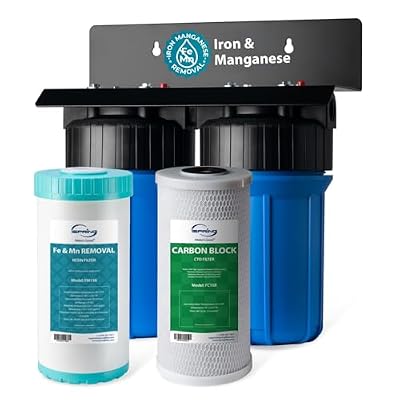
The iSpring WGB21BM is a compact 2-stage system with a carbon block cartridge and an iron and manganese reducing cartridge, both in 10 inch by 4.5 inch housings. The iron stage is listed to reduce iron from up to 3.0 parts per million and manganese from up to 1.0 part per million down to a very low level, while the carbon block addresses chlorine, taste, odor, and volatile organic compounds. The 1 inch ports suit a standard main line.
This system suits a smaller utility room where wall space is limited and where a 20 inch system would be too tall or too wide. The 10 inch housings are easier to fit under a shelf or beside a water heater, and the two-stage layout is simple to service. It is a good fit for a smaller household, a rental, or a home where iron is a moderate concern rather than a severe one.
A caution is cartridge life. The 10 inch cartridges hold less media than 20 inch cartridges, so they need changing more often, especially if the iron level is near the top of the listed range. Leave clearance below the housings, fit a bypass, and keep spare cartridges on hand so a change does not leave the house without filtered water.
4. iSpring WGB22BM 2-Stage Whole House Water Filtration System

The iSpring WGB22BM is a 2-stage system with a carbon block cartridge and an iron and manganese reducing cartridge, both in 20 inch by 4.5 inch housings. The larger cartridges give it more media and a longer interval between changes than the 10 inch version, while the stage order keeps the iron cartridge working on water that has already passed through carbon. The iron stage is listed for iron up to 3.0 parts per million and manganese up to 1.0 part per million.
This system suits a utility room with enough wall height for 20 inch housings and a household that wants fewer cartridge changes than a compact system requires. The larger format suits a family home with a steady daily demand, and the 1 inch ports keep flow steady when several fixtures run together. It is a balanced middle ground between a compact iron system and a full tank system.
A caution is the same iron limit that applies to the other cartridge systems here. If a lab test shows iron above the listed level, or a strong sulfur odor alongside the iron, this system on its own may not be enough. Use the test to decide, and plan the install with a bypass and with clearance below the housings for service.
Comparison at a Glance
| System | Iron stage | Cartridge or tank format | Also handles | Best fit |
|---|---|---|---|---|
| iSpring WGB32BM | Iron and manganese cartridge, up to 3.0 ppm iron | Three 20 inch housings | Sediment, chlorine taste, odor | Well water with moderate iron |
| AFWFilters Iron Pro 2 | Fine mesh resin for dissolved iron | Tall tank with Fleck valve | Hardness, sediment, rust | Iron plus hard water in one tank |
| iSpring WGB21BM | Iron and manganese cartridge, up to 3.0 ppm iron | Two 10 inch housings | Chlorine taste, odor, volatile compounds | Tight utility room wall |
| iSpring WGB22BM | Iron and manganese cartridge, up to 3.0 ppm iron | Two 20 inch housings | Chlorine taste, odor | Family home wanting longer cartridge life |
Frequently Asked Questions
How do I know if I need an iron filter?
A water test that lists iron and manganese is the reliable starting point. Orange or brown stains on fixtures and laundry, a metallic taste, and cloudy water after the tap has sat unused are common signs, but only a test shows the level and the iron type.
What iron level can a cartridge iron filter handle?
Many cartridge iron systems list a limit of up to 3.0 parts per million for iron and up to 1.0 part per million for manganese. If a lab test is above that level, or if iron bacteria are present, a tank system with oxidation or a softener may be a better fit.
Does an iron filter also soften water?
A cartridge iron filter does not soften water. A combination softener with fine mesh resin, such as the Iron Pro 2 in this guide, handles hardness and dissolved iron together, but it needs salt, a drain, and power.
Conclusion
The best whole house iron filter systems for utility room installations are the ones that match your iron level, your iron type, and your room. A compact iSpring WGB21BM suits a tight wall, a larger iSpring WGB22BM or WGB32BM suits a family home with moderate iron, and the AFWFilters Iron Pro 2 suits a home where iron and hard water arrive together. Test the water first, then choose the media and format that fit the result.
Disclosure: As an Amazon Associate, bestairductcleaner.com earns from qualifying purchases.



Write Your Review
No reviews yet. Be the first to share your experience!