
CRC Intake Valve Cleaner: The Fix Direct-Injection Engines Actually Need
- Why Direct-Injection Engines Cake Up With Carbon
- What Makes the Formula Effective
- How to Apply It Yourself, Step by Step
- What You’ll Notice Afterward
- Building a Maintenance Schedule That Actually Prevents Buildup
- Is a CRC Intake Valve Cleaner Worth Adding to Your Routine?
- Related Guides
- Frequently Asked Questions
- Related Articles
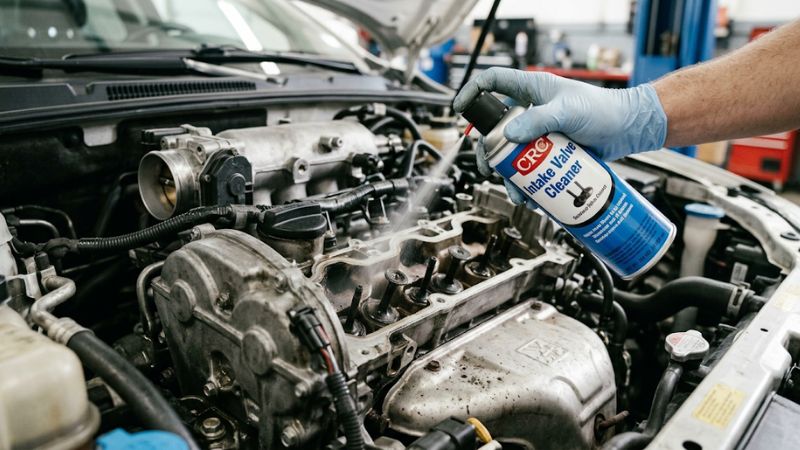
Direct-injection engines are efficient by design, but that design has a quirk: it lets carbon pile up on the intake valves in a way older engines never experienced. A CRC intake valve cleaner exists specifically to undo that damage, and understanding why it works starts with understanding why GDI engines get dirty in the first place.
As an Amazon Associate we earn from qualifying purchases at no extra cost to you.



🛒 Best Price Today on Amazon
Prime members get fast, free shipping on everything above, plus member-only deals. New members get a 30-day free trial — cancel anytime.
Why Direct-Injection Engines Cake Up With Carbon
Port-injected engines had one built-in advantage: fuel sprayed across the intake valves on its way into the cylinder, and gasoline is a decent solvent. That constant rinsing kept the valves relatively clean without anyone trying. Direct injection throws that advantage away. Fuel goes straight into the combustion chamber, bypassing the valves entirely, so nothing ever washes them.
Left unrinsed, the valves become a landing pad for oil vapor and blow-by residue. Combined with the heat of the engine bay, these deposits don’t just sit there — they bake, hardening into a crust that chokes off airflow. It’s not a defect or a manufacturing flaw; it’s a side effect of chasing better fuel economy. Which means almost every GDI vehicle will eventually need some form of chemical intervention to stay breathing properly, and a CRC intake valve cleaner is typically the most accessible way to get there.
How to Tell Your Airflow Is Restricted
The first clue is usually a rough idle. Sitting at a red light, the car shudders or hesitates instead of settling into a smooth hum — a direct result of carbon deposits disrupting the air-fuel ratio the engine’s computer is trying to maintain.
Next comes hesitation under load: stepping on the gas to merge onto a freeway or pass a slow-moving truck and feeling the response lag behind your input. The ECU is fighting narrowed air passages and can’t always compensate fast enough. Ignore these signs long enough and a check engine light will eventually show up, along with a diagnostic bill.
What Happens If You Let It Go Too Far
Carbon buildup isn’t just a comfort issue — it’s a durability issue. Deposits can break loose and tumble into the combustion chamber, scoring cylinder walls or pitting piston surfaces. Valves coated in enough carbon may stop sealing fully, bleeding away compression that the engine needs to run efficiently.
Push it far enough and you’re looking at burnt valves, which typically means pulling the cylinder head for a rebuild — a repair bill that dwarfs anything spent on preventative cleaning. Catching the problem early isn’t just cheaper; it’s what keeps a car reliable for commuting and road trips alike.
What Makes the Formula Effective
The job of a CRC intake valve cleaner is to chemically break down carbon that’s already hardened onto metal, turning it into particles small enough to burn off harmlessly during normal engine operation rather than needing to be scraped away by hand.
PEA Chemistry Built for Heat
The active ingredient doing the heavy lifting is polyetheramine, better known by its abbreviation, PEA. Where lesser solvents flash off the instant they meet a hot engine surface, PEA holds together and keeps working, methodically dissolving the baked-on layers instead of evaporating uselessly.
As the carbon softens, it releases from the metal gradually rather than all at once. That controlled pace matters: large chunks breaking free simultaneously could otherwise travel downstream and damage a catalytic converter. The chemistry is deliberately paced to respect how tightly modern engines are built.
Won’t Hurt Your Turbo or Intercooler
A common worry among owners of turbocharged cars is whether a strong solvent spray might damage the turbo itself. It won’t. The vapor passes through turbine blades without eroding them or shocking them thermally, leaving forced-induction hardware untouched.
The intercooler is similarly unaffected — no residue builds up inside it, so the intake charge stays cool and dense the way it’s supposed to. That makes the product just as suitable for a turbocharged commuter hatchback as it is for a naturally aspirated sedan.
Bringing Back a Proper Valve Seal
Peak engine performance depends on the intake valves closing completely, with no gap for compression to leak through. Even a thin carbon film can be enough to prevent that seal. Dissolving that film lets the valve seat flush against the head again.
Once compression is where it should be, the difference shows up immediately — sharper throttle response, smoother delivery of power, and an engine that isn’t straining internally to hit the same speed it used to reach with ease. That reduced strain is ultimately what protects the motor’s long-term lifespan.
How to Apply It Yourself, Step by Step
You don’t need a shop lift or a scan tool for this job — just a driveway, an hour of your time, and a can of cleaner.
Find the Mass Air Flow Sensor First
Before spraying anything, locate the mass air flow sensor on the intake tubing. The nozzle needs to go in downstream of it — spraying directly onto the sensor’s wiring can damage it and trigger a check engine light of its own.
Follow the plastic ducting from the air filter box toward the throttle body until you spot the electrical connector plugged into the tube — that’s the sensor. Loosen the hose clamp just beyond it so you can slide the spray straw into the intake tract without getting anywhere near the sensor element.
Get the Engine to Operating Temperature
The solvent needs heat to do its job. Idle the car for roughly ten minutes, or take it for a short drive, until the temperature gauge sits at its normal midpoint. Warm metal lets the chemical penetrate the carbon far more effectively than a cold engine would.
Once warm, park on level ground, set the parking brake, and keep the engine running throughout the process. It helps to have someone in the driver’s seat, since the next step requires managing engine speed while you spray.
Spray in Bursts, Then Let It Soak
With the engine held around 2,000 RPM, apply the cleaner in short, controlled bursts while your helper feathers the throttle to prevent stalling. Keep going until the can is empty.
Shut the engine off immediately afterward and leave it alone for at least an hour — this is the heat-soak period, when the loosened chemical continues breaking down softened carbon. Afterward, drive on the highway for about ten minutes so the exhaust flow clears out the dissolved residue.
What You’ll Notice Afterward
The results tend to be immediate and noticeable rather than subtle. Because the engine can finally draw air the way it was designed to, performance returns close to factory condition.
Power and Torque Come Back
Carbon buildup steals horsepower so gradually that most drivers simply adapt to the sluggishness without noticing it happening. Clearing the blockage releases that trapped power all at once.
Dyno comparisons routinely show measurable power recovery after a cleaning, and drivers typically feel it first in quicker acceleration off the line and stronger pulling power under load — without any modifications beyond the cleaning itself.
Better Mileage at the Pump
A carbon-choked intake forces the engine’s computer to compensate with adjusted fuel delivery, which leads to incomplete combustion and wasted gasoline. With clean valves, the air-fuel mixture balances out properly again.
The payoff shows up as more miles per tank — savings that, over a year of driving, can more than offset what you spent on the cleaner itself. It’s maintenance that effectively pays for itself.
A Calmer Idle and Easier Cold Starts
An engine shaking at idle is often just carbon causing uneven airflow between cylinders, forcing the motor to work harder just to keep running. Clearing the deposits restores even, balanced airflow across every cylinder.
Cold mornings show the difference most clearly — instead of coughing or misfiring on startup, a cleaned engine settles into a smooth, quiet idle right away, which matters most during winter.
Building a Maintenance Schedule That Actually Prevents Buildup
A single application can make a dramatic difference, but the real value comes from treating the intake regularly enough that carbon never gets the chance to harden in the first place.
How Often to Treat the Intake
Most automotive technicians suggest running a CRC intake valve cleaner treatment at every oil change — roughly every 5,000 to 10,000 miles. That rhythm keeps deposits soft and manageable instead of letting them cement into something harder to remove.
Drivers who spend most of their time in stop-and-go city traffic, or who push a high-performance engine hard, may want to shorten that interval. City driving rarely lets an engine reach the sustained heat needed to burn off minor deposits naturally, so carbon accumulates faster under those conditions.
Pairing It With a Fuel System Additive
An intake valve cleaner addresses the valves, but it isn’t designed to touch the fuel injectors or combustion chamber. Adding a quality fuel-tank additive to the routine covers those areas, creating full coverage from tank to exhaust.
A good tank additive keeps injector tips spraying in a precise, consistent pattern for proper atomization, complementing what the valve cleaner accomplishes and helping curb engine knock. Together, the two products form a more complete cleaning strategy than either one alone.
What It Saves You Over Time
It’s easy to view a can of cleaner as an avoidable expense, but weigh it against the alternative: professional walnut-blasting services to physically remove carbon from valves can run several hundred dollars at a shop.
Doing the treatment yourself sidesteps that cost entirely, while also protecting components from premature wear that could otherwise turn into a much larger repair bill down the road. Over the life of a vehicle, that’s a meaningful amount of money kept in your pocket.
Is a CRC Intake Valve Cleaner Worth Adding to Your Routine?
For anyone driving a direct-injection engine, the answer is effectively yes. This formula dissolves the carbon that direct injection is naturally prone to building up, restoring horsepower, improving fuel economy, and smoothing out the idle — all without a trip to the repair shop. Treated on a regular schedule, it’s one of the simplest ways to keep a modern engine running the way it did when it was new.
Related Guides
- Zap Cleaner Ultimate Review: Achieve Incredible Shine Today
- Best home carpet cleaner: ultimate guides to perfect rugs
- Ar cleaning kit: Essential Maintenance for Precision
- Ro Cleaner Guide Mastering Membrane Maintenance
Frequently Asked Questions
Which engines actually need an intake valve cleaner?
Gasoline direct-injection engines benefit most, because fuel is sprayed into the cylinder and never washes the back of the valves, so oil vapor and exhaust gas residue bake into hard carbon. Port-injected engines get a constant fuel rinse on the valves and rarely develop the same deposits, so treatment there is mostly preventive.
How often should I apply it?
A common schedule is one can every 10,000 to 15,000 miles on a direct-injection engine as preventive maintenance. Waiting until you have a rough cold start, misfire codes, or a noticeable power loss usually means deposits are already thick enough that only mechanical cleaning such as walnut blasting will fully restore flow.
Is it safe with turbochargers and catalytic converters?
Products labeled catalyst-safe are formulated to burn off cleanly at the recommended dose, but spraying too fast can hydro-lock a cylinder or slug the turbo with liquid. Follow the timed spray intervals exactly, keep the engine at the specified RPM, and stop immediately if the idle drops sharply or the engine tries to stall.
What safety gear and setting do I need?
Work outdoors or with a shop exhaust extractor connected, never in a closed garage, since exhaust carbon monoxide is odorless and lethal. Wear eye protection and nitrile gloves, keep the can away from hot manifolds because the aerosol is flammable, and keep hair, tools, and hoses clear of the accessory belt.
How will I know if it worked?
Look for a smoother cold idle, fewer random misfire counts on a scan tool, and less hesitation under light throttle. Expect a strong smoke plume during treatment and for a few minutes afterward. If codes and rough running persist after a full heat cycle and a highway drive, have the valves inspected with a borescope.








Write Your Review
No reviews yet. Be the first to share your experience!