
Whole house humidifier types are essential to understand when you want to eliminate dry indoor air during cold winter months. Choosing the wrong system can lead to poor performance, mold growth, or high utility bills. Our comprehensive review breaks down the pros and cons of steam, bypass, and fan-powered options to help you make your final choice.
🛒 Best Price Today on Amazon
Prime members get fast, free shipping on everything above, plus member-only deals. New members get a 30-day free trial — cancel anytime.
Understanding the Mechanics of Whole House Humidifier Types
When winter sets in, portable humidifiers often fail to keep up with the continuous demands of an entire household, leaving you with uncomfortably dry skin, raw throats, and annoying static shocks. Integrating a whole-house system directly into your central HVAC ductwork provides a comprehensive, hands-free solution for your entire property. To help you navigate the crowded home comfort market, we have meticulously reviewed customer feedback, installation demands, and technical specifications for the major humidifier configurations available today.
The Role of Bypass Systems in Modern HVAC Installations
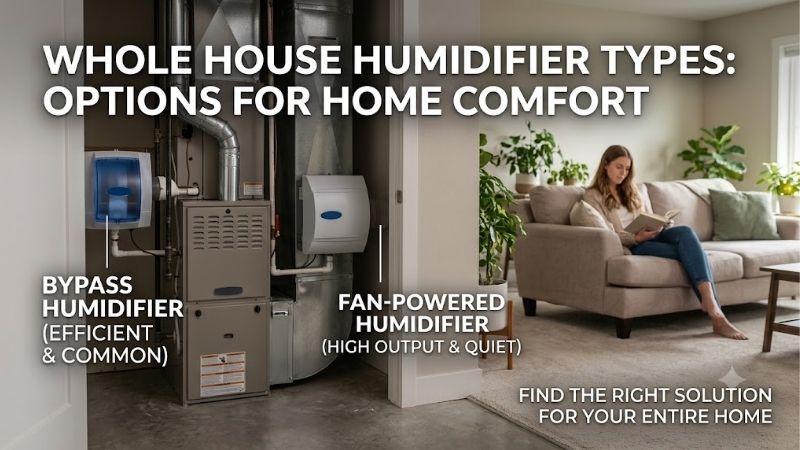
Bypass humidifiers are currently among the most popular and budget-friendly whole-house options on the market. They work by leveraging the pressure differential between your HVAC system’s supply and return air plenums to move air without an internal blower. A dedicated bypass duct routes dry return air through a water panel, where it absorbs natural moisture before circulating back throughout your living spaces.
Many homeowners favor bypass models because they lack complex electric motors, which makes them highly reliable, quiet, and inexpensive to operate over time. They are ideal for houses with accessible basement ductwork and standard heating cycles that run consistently. The retail cost for a quality bypass unit ranges from $150 to $250, presenting an affordable way to upgrade your family’s winter comfort.
Customer reviews on Amazon frequently praise their durability and simple engineering, with many 5-star ratings citing a complete end to winter sinus irritation and static electricity. However, critical 2-star reviews point to water waste since excess water drains away continuously down your home’s drain tube. If you reside in an arid region with strict utility water rates or severe droughts, this water usage is a key factor to analyze.
How Fan-Powered Humidifiers Enhance Moisture Distribution
Fan-powered units improve on bypass designs by incorporating an internal fan motor to pull dry air actively across the evaporative humidifier pad. This self-contained design does not require a bulky bypass duct to connect supply and return plenums, saving significant installation space. It is highly advantageous for small mechanical rooms, closets, or basements where layout space is limited.
These units are exceptionally efficient and can disperse up to 18 gallons of water daily into your ductwork, making them perfect for large, multi-level households. Priced between $250 and $400, they represent a fantastic mid-range investment for your HVAC system. They offer excellent, uniform moisture distribution even when your furnace is running on lower heat or blower speeds.
On Amazon, users leave high-scoring ratings for their ease of installation, space-saving profile, and powerful performance during cold snaps. Critical 3-star reviews, however, mention a soft motor hum during operation and more complicated electrical wiring during the initial setup. Despite these minor complaints, they remain a top recommendation for those wanting consistent humidity without bypass ductwork.
The Power of Steam Humidifiers for Large Homes
For premium performance and rapid moisture control, electrode steam humidifiers stand in a class of their own. Rather than relying on simple evaporation, these systems use electric current passed through submerged electrodes to boil water, creating clean steam that is injected directly into your supply ducts. This technology provides rapid humidification that does not rely on warm furnace air.
Steam humidifiers are highly recommended for dry northern climates and luxury homes filled with expensive wood furniture, artwork, or musical instruments. These units represent a significant premium, with retail prices ranging from $600 to $1000, excluding professional HVAC installation costs. They provide extremely precise relative humidity control through advanced digital humidistats and outdoor sensors.
Top reviews on Amazon celebrate their incredible efficiency, rapid comfort delivery, and silent operation. Conversely, critical 3-star complaints focus on high electrical consumption and the requirement to replace the canisters annually. Replacing these canisters typically costs around $80 to $100, which is an important operational factor that buyers should keep in mind before purchasing.
Analyzing Pros and Cons of Leading Whole House Humidifier Types
Selecting the perfect HVAC humidifier requires a balanced look at how each unit operates in real-world scenarios. Each model carries distinct trade-offs in water usage, electrical draw, upfront cost, and mechanical longevity. In this section, we break down the benefits and drawbacks of each major design based on real homeowner feedback and professional HVAC ratings.
Evaluating Bypass Units: Cost-Effective but Water-Dependent
The major advantage of bypass units is their structural simplicity and affordable retail price. Lacking electrical fan motors, they require minimal maintenance and have very few internal parts that can fail over years of winter operation. This makes them exceptionally quiet, operating with nothing more than the gentle sound of air moving through your furnace plenums.
The main disadvantage is their high reliance on furnace heat and their continuous water usage. Because water runs over the evaporative pad constantly and drains away, they can waste a significant volume of water during a single heating season. They also struggle to raise humidity levels if your home heating cycles are relatively short.
Assessing Fan-Powered Systems: Active Airflow with Minor Noise
Fan-powered units are celebrated for their high output capacity and space-saving installation. Because they use an active internal fan, they evaporate water much more efficiently than bypass systems, wasting less water overall down the drain. They can also run when the furnace is not actively heating, utilizing only the HVAC system blower to disperse moisture.
On the downside, the addition of an internal fan motor introduces a potential mechanical failure point. Homeowners in hard-water areas complain that mineral buildup can scale up and lock the fan blades if not cleaned regularly. They also produce a quiet but noticeable electric hum during operation, unlike passive bypass units.
Weighing Steam Systems: Ultimate Performance vs. Operational Cost
Steam humidifiers offer unparalleled capacity and are highly sanitary, as boiling water kills any bacterial contaminants before they enter your home’s air supply. They can maintain perfect relative humidity levels regardless of furnace run times, making them the ultimate indoor comfort solution for large estates or homes with extensive woodwork.
However, they carry a high upfront purchase cost and require dedicated electrical lines and plumbing. They consume a substantial amount of electricity, which will noticeably raise your winter power bills. The necessity of regular electrode canisters replacements also adds to the lifetime cost of ownership, making them a high-end luxury investment.
Buying Guide: Choosing Your Ideal Whole House Humidifier Types
Finding the perfect system for your household goes beyond looking at retail prices. You must also consider the size of your living space, your local climate, water hardness levels, and your DIY installation skills. This comprehensive guide simplifies these elements to ensure you select a model that keeps your family comfortable for many years.
Matching Humidifier Capacity to Your Square Footage
Home size is the most critical element of your selection process. Bypass humidifiers are excellent for smaller, well-insulated homes up to 3000 square feet. Installing a system that is too small will result in dry air, while an oversized unit can cause dangerous window condensation and potential mold growth.
For homes between 3000 and 4200 square feet, fan-powered systems provide the extra capacity needed to ensure even humidity distribution throughout your house. If your property exceeds 4500 square feet, a steam humidifier is your best choice. Check Amazon today to browse the top-rated models categorized by home square footage.
Maintenance Requirements and Long-Term Operational Costs
Ongoing maintenance determines how much you will spend on your humidifier over its lifespan. Bypass and fan-powered models utilize evaporative water panels that must be changed once or twice each heating season. These replacement panels are highly affordable, usually costing around $15 to $30 on Amazon, making long-term upkeep effortless.
In contrast, steam systems require more expensive maintenance, as the electrode boiling canister must be replaced when mineral deposits build up. These canisters typically cost around $80 to $120 each and scale quickly in hard water. If you prefer low maintenance, an evaporative system remains the most practical and budget-friendly choice.
Installation Complexity and Professional vs. DIY Setup
Installation ease can impact your project’s overall cost. Bypass and fan-powered models are popular among intermediate DIYers because they require only basic sheet metal tools and simple plumbing lines. Most packages include helpful mounting templates, step-by-step videos, and hardware to assist you with a seamless setup in your basement.
Steam models are significantly more complex, requiring dedicated electrical circuits, drainage lines, and water supplies. For these, professional HVAC installation is strongly recommended to avoid code violations and warranty issues. Browse Amazon to compare complete installation kits and read through customer reviews on DIY setup ease before purchasing.
Finding the Perfect Balance for Your Indoor Climate
Upgrading your home with a whole-house system is one of the smartest decisions you can make to secure winter health, protect wood furnishings, and improve comfort. Whether you select a budget-friendly bypass unit, a powerful fan-powered system, or a high-end steam generator, you will immediately notice the difference. When you are ready to purchase, visit Amazon to explore top brands like Aprilaire and Honeywell. Investing in your indoor climate today guarantees a warm, healthy, and highly comfortable winter season for your family.
Frequently Asked Questions
What are the main types of whole house humidifier?
There are three common designs. Bypass units divert warm furnace air across a wet pad and back into the return. Fan powered units add their own blower for roughly 50 percent more output in the same footprint. Steam units boil water electrically and can humidify even when the furnace is not calling for heat.
As an Amazon Associate we earn from qualifying purchases at no extra cost to you.


Which type suits my home?
Bypass models fit most average homes with a conventional furnace and adequate duct space. Fan powered units suit tighter mechanical rooms or larger homes needing more moisture. Steam is best for very large or very leaky houses, heat pump systems where supply air is cooler, and anyone wanting precise humidity control year round.
What humidity setting should I target?
Hold 30 to 50 percent relative humidity. Many humidistats include an outdoor sensor that lowers the target automatically as it gets colder, because warm humid air condenses on cold glass. If windows fog or frost persistently, reduce the setting by five percent at a time until the condensation stops.
How much water and electricity do they use?
Bypass and fan powered units evaporate roughly 12 to 17 gallons per day at full output and use almost no electricity beyond the small fan. Steam humidifiers deliver similar or greater output but draw significant power, often 1,000 watts or more, so factor the running cost into your decision.
What maintenance does each type need?
All types need the water panel, pad or steam canister replaced at least annually, and more often with hard water. Flush the drain line, check the solenoid valve, clean scale from the distribution tray, and close the bypass damper and water supply in spring so the system does not add moisture during cooling season.






Write Your Review
No reviews yet. Be the first to share your experience!