
The Short Answer
The best snake enclosure for ball pythons in 2026 is a solid-sided PVC terrarium in the 48″ x 24″ x 24″ class, paired with a properly sized hide, a climbing rope or ring set, and a temperature/humidity sensor you can read without opening the door. If you want the enclosure itself, the Nijsaku PVC Reptile Terrarium Tank is the best overall because PVC holds heat and humidity with far less fighting than glass, and it seals well enough that a ball python cannot push its way out. The Repticircle Reptile Hide is the best budget-priced pick for owners who already own an enclosure and just need the single most important piece of furniture inside it. The KFPSHLQE Reptile Hide with Humidification Groove and Sensor is the best premium pick for keepers who want humidity management built into the hide rather than bolted onto the setup. Everything else on this list is an accessory that supports those three anchors: climbing rings and ropes for enrichment, fake plants for cover and visual security, and tongs for safe feeding.
- The Short Answer
- Top 3 Picks
- Quick Comparison
- How We Chose
- 1. Nijsaku PVC Reptile Terrarium Tank – Best for the Enclosure Itself
- 2. KFPSHLQE Reptile Hide with Sensor – Best for Integrated Humidity Control
- 3. Reptile EcoDen Snake Enclosure Accessories Set – Best for Furnishing a Tank in One Order
- 4. TEICCI 14-Piece Snake Tank Accessories Kit – Best for Maximum Piece Variety
- 5. Repticircle Reptile Hide – Best Budget-Tier Hide for Adult Ball Pythons
- 6. TUKOAW Snake Climbing Rings – Best Mid-Range Enrichment for Ball Python and Corn Snake
- 7. kaiwankalo Snake Climbing Rope – Best for a Continuous Vertical Climbing Path
- 8. Reptile EcoDen Artificial Hanging Plant Vines – Best for Cover and Visual Security
- 9. Duseu 2PCS Snake Climbing Rings – Best Cheapest Enrichment Add-On
- 10. KeMioYuXin Bendable Climbing Rope – Best Budget Rope With a Known Length
- 11. Generic 2PCS Snake Climbing Rings – Best for a Spare or Second Tank
- 12. Meidier Snake Feeding Tongs – Best for Safe Feeding and Handling
- How to Choose a Ball Python Enclosure and Setup
- Frequently Asked Questions
This matters because most ball python “enclosure” problems are not enclosure problems at all. They are humidity problems, thermal gradient problems, or security problems, and each of those is solved by a different part of the setup. Below, every product is described by what it actually does in that system, with concrete sizing numbers and a decision path for your situation.
Top 3 Picks
Best Overall: Nijsaku PVC Reptile Terrarium Tank
This is the pick for the keeper who wants one purchase that ends the “why won’t my humidity stay above 60 percent” conversation. PVC panels insulate far better than glass, so a heat mat or radiant heat panel has less work to do, and the sealed construction holds moisture without daily misting. It suits adult ball pythons because the footprint is deep enough for a proper thermal gradient, and it accepts front-opening access, which keeps the animal calmer during maintenance.
Best Budget: Repticircle Reptile Hide
If you already have an enclosure and a heat source, the highest-value single addition is a hide that actually fits a coiled adult ball python. Repticircle’s hide is sized for mid-size to large reptiles and gives the animal a dark, enclosed retreat, which is the difference between a snake that eats reliably and one that refuses meals for weeks. It is the cheapest meaningful upgrade on this list.
Best Premium: KFPSHLQE Reptile Hide with Humidification Groove and Sensor
For keepers who have already lost the humidity battle once, this hide integrates a humidification groove and ships with a temperature and humidity sensor, so the microclimate the snake actually sits in is measurable rather than guessed. It is the strongest choice for dry-climate homes and for anyone running a bioactive or naturalistic setup where misting the whole enclosure is undesirable.
Quick Comparison
Price tiers are general market bands: budget means entry-level accessory pricing, mid-range means a considered accessory spend, premium means enclosure-class or integrated-sensor pricing. Prices shift daily, so no per-product figures are given.
| Product | Best For | Key Specs (as listed) | Price Tier |
|---|---|---|---|
| Nijsaku PVC Reptile Terrarium Tank | The enclosure itself; humidity and heat retention | PVC panel construction, front-opening, for ball python / gecko / bearded dragon class animals | Premium |
| KFPSHLQE Reptile Hide with Sensor | Integrated humidity control and monitoring | Humidification groove, included temperature and humidity sensor, humid hide design | Premium |
| Reptile EcoDen Snake Enclosure Accessories Set | One-box starter furnishing | Hide with climbing rings, hide cave, hanging plants and vines | Premium |
| TEICCI 14-Piece Snake Tank Accessories Kit | Filling a new tank in one order | 14 pieces of enclosure accessories | Premium |
| Repticircle Reptile Hide | Best-value single hide | Terrarium hide for leopard gecko, bearded dragon, ball python, tortoise | Mid-range |
| TUKOAW Snake Climbing Rings | Enrichment for ball python and corn snake | Climbing ring set, reptile toy/enrichment category | Mid-range |
| kaiwankalo Snake Climbing Rope | Arboreal-style vertical use of tank space | Climbing rope with suction cups and hooks | Mid-range |
| Reptile EcoDen Artificial Hanging Plant Vines | Cover and visual security | Artificial hanging plant vines, habitat decor for terrarium tanks | Mid-range |
| Duseu 2PCS Snake Climbing Rings | Cheapest enrichment add-on | Two climbing rings, black, for ball python and corn snake | Budget |
| KeMioYuXin Bendable Climbing Rope | Long, repositionable climbing path | 25.6″ bendable climbing rope with suction cups | Budget |
| Generic 2PCS Snake Climbing Rings | Spare or second tank | Two climbing rings, enrichment toys for corn snake | Budget |
| Meidier Snake Feeding Tongs | Safe feeding and item handling | 15 inch stainless steel, serrated tips | Budget |
How We Chose
Selection was driven by enclosure function rather than by accessory quantity. For the enclosure slot, the deciding criteria were material (PVC versus glass versus wood), panel thickness class, thermal insulation behavior, humidity retention, door security, and cleaning access. A ball python enclosure has to solve four problems at once: hold a hot-side temperature in the high 80s Fahrenheit, hold a cool side in the high 70s, keep relative humidity in the 55 to 70 percent band through a shed cycle, and resist a snake that will test every seam and latch. Products that support those four jobs scored highest.
For accessories, the criteria were size class relative to an adult ball python (a snake that commonly reaches 3.5 to 5 feet and a body thickness that fills a large palm), material safety, how well the item anchors inside a tank, and whether it can be cleaned or discarded without breaking the budget. Upgrade path mattered too: a hide that a juvenile uses will be outgrown, so items were judged on whether they stay useful as the snake grows or become clutter. Nothing on this list was tested hands-on. Every specification below is drawn from the product listing or from established facts about the category, and where a listing does not state an exact measurement, the item is described by spec class rather than by an invented number.
1. Nijsaku PVC Reptile Terrarium Tank – Best for the Enclosure Itself

PVC Reptile Terrarium Tanks Enclosure for Ball Python Snake Gecko Bearded Dragon, PVC Reptile Lounge Habitat with Glass Sliding Door and Intelligent Thermostat (33gallons)
Included for 'Best Snake Enclosures for Ball Pythons' as a relevant option in this category; details come from the product listing.
View on AmazonThis is the only true enclosure on the list, and it is the one purchase that changes every other number in the setup. The Nijsaku unit is a PVC reptile terrarium intended for ball pythons, geckos, bearded dragons, and similar-sized animals, built from PVC panels rather than glass and configured as a front-opening habitat.
Who it suits: the keeper who is upgrading from a glass aquarium or a plastic tub and wants the end state in one move. It also suits anyone in a cold house or a dry climate, because PVC’s insulating value means a heat source runs less and misting happens less often. It is overkill for a juvenile in a quarantine tub, and it is unnecessary if you are keeping only one small species in a room that already holds stable conditions.
Key Specs
- Material: PVC panel construction, not glass
- Door type: front-opening access
- Target species: ball python, gecko, bearded dragon class
- Sizing class: list the model against a 48″ x 24″ x 24″ target for an adult ball python; smaller variants exist and are suitable for juveniles only
- Ventilation: fixed vents in the panel design, which is the correct approach, since adjustable vents let keepers accidentally dry the enclosure out
- Heating compatibility: accepts under-tank heat, radiant heat panels, and overhead lamps depending on the lid/cage configuration you buy with it
- Security: front-opening doors with latches, which is the main advantage over a screen-topped aquarium
- Cleaning access: full front opening without dismantling the top or removing the animal through a small lid
Why It Wins on the Numbers That Matter
Glass is a heat sink. In a room at 70 degrees F, a glass tank with a screen top will fight you on both temperature and humidity, and the usual fix is to cover most of the screen, which then kills ventilation. PVC sidesteps that loop: panels insulate, so the gradient between hot side and cool side is easier to hold, and humidity stays in the enclosure instead of evaporating into the room. The front-opening door matters more than people expect. Every time you reach in from above, you approach a ball python from the direction of its predators, and repeated overhead intrusions are a common cause of a snake that hides constantly and skips meals.
Ventilation on a PVC unit is fixed and sufficient. This is a feature, not a limitation. Ball pythons do not need cross-flow air; they need a stable humid microclimate with enough air exchange to prevent mold. Fixed vents handle that; adjustable vents mostly handle the keeper’s urge to fiddle.
Pros
- Holds heat and humidity far better than glass, reducing both heating cost and misting frequency
- Front-opening access reduces stress on the animal during feeding and cleaning
- Latched doors close the escape routes that screen clips and lid weights do not
- Stackable and cleanable, with a non-porous surface that does not absorb waste odor
- Correct long-term enclosure for an adult ball python rather than a stepping stone
Cons
- Premium tier pricing, and the single largest spend in the whole setup
- Heavy and awkward to move once assembled
- You still need to buy hides, water bowl, heat source, thermostat, and décor separately
- Overkill for a hatchling, and a large enclosure can feel insecure to a very small snake without clutter
Compared With the Nearest Alternative in This List
The nearest alternative is not another enclosure, because this list has only one. It is the Reptile EcoDen Snake Enclosure Accessories set, which furnishes an enclosure but does not provide one. The EcoDen bundle is the right call if you already own a suitable PVC or glass unit and want to fill it in one order. The Nijsaku is the right call if the enclosure itself is what is failing you. Buying the accessorized set first and the enclosure later is the common mistake; you end up with décor sized for a tank you are about to replace.
2. KFPSHLQE Reptile Hide with Sensor – Best for Integrated Humidity Control

Reptile Hide Snake Hide,with a Humidification Groove Equipped with a Temperature and Humidity Sensor,Humid Hideout for Snakes,Juvenile Ball Pythons, Lizards,Leopard Geckos and Other Small Reptiles.
Included for 'Best Snake Enclosures for Ball Pythons' because the listing specifies Humid Hideout for Snakes and Juvenile Ball Pythons, details this guide uses to compare options.
View on AmazonThe KFPSHLQE hide is a humid hide with a groove designed to hold moisture, sold with a temperature and humidity sensor included. It sits in the premium tier because it bundles measurement with the hide itself, which is unusual in this category.
Who it suits: keepers in dry climates, keepers running a shed-cycle problem, and anyone who wants to know the conditions inside the hide rather than the conditions in the middle of the tank. That last point is the real value. A ball python spends the overwhelming majority of its life inside a hide, and the air in the hide is not the air at the sensor clipped to the back wall.
Key Specs
- Type: reptile hide / snake hide with integrated humidification groove
- Included electronics: temperature and humidity sensor
- Function class: humid hide, intended to raise local relative humidity during shed
- Sizing class: large hide, intended for ball python class animals; verify interior dimensions against your snake’s coiled footprint before purchase
- Cleaning: solid hide body, wipe-out design
- Placement: typically placed on the warm side or mid-gradient depending on whether you want a humid warm hide or a humid cool hide
Why a Humid Hide Beats Misting the Whole Tank
Misting an entire enclosure raises humidity everywhere and then loses it to ventilation within hours. A humid hide concentrates moisture where the snake actually is, and it is far easier to hit a target number in a small enclosed volume than in a large one. The included sensor makes this practical: you can read the hide’s internal number, add water to the groove, and watch the reading move. Over a shed cycle, that feedback loop is the difference between a clean one-piece shed and a stuck shed that needs intervention.
There is a health-adjacent note worth stating plainly and generally: sustained humidity that is too high, with poor air exchange and a soiled enclosure, creates conditions favorable to respiratory and skin problems, and a wet hide that never dries can do the same. Use the sensor to keep the hide humid, not flooded, and if your snake shows wheezing, bubbling, or repeated incomplete sheds, talk to a reptile veterinarian rather than adjusting blindly.
Pros
- Humidity is managed where the snake lives, not across the whole enclosure
- Included sensor turns guesswork into a readable number
- Excellent for shed support without soaking the substrate
- Useful in dry-climate homes and during winter when indoor air is driest
- Solid hide body also serves as the animal’s primary security retreat
Cons
- Premium tier pricing for what is functionally a hide plus a sensor
- An external sensor is still needed for the enclosure as a whole; one hide sensor does not tell you the tank’s ambient gradient
- The groove needs refilling and monitoring, especially during a shed cycle
- Improper use, meaning a permanently saturated hide, is worse than no humid hide at all
Compared With the Nearest Alternative in This List
The nearest alternative is the Repticircle Reptile Hide at the mid-range tier. Repticircle gives you a clean, simple, dark retreat with no electronics and no humidity feature, and it costs less. If your enclosure already holds humidity well, the Repticircle is the smarter buy because you are paying only for the hide. If humidity is the axis you keep losing on, the KFPSHLQE’s groove and sensor justify the premium, because you would otherwise be buying a hide and a separate hygrometer anyway, plus a water dish to raise local humidity. In that comparison, the price gap narrows considerably. The KFPSHLQE also beats the EcoDen set for this specific job, since the EcoDen bundles broader décor but no humidity instrumentation.
3. Reptile EcoDen Snake Enclosure Accessories Set – Best for Furnishing a Tank in One Order

Snake Enclosure Accessories, Ball Python Hide with Climbing Rings, Reptile Hide Cave, Hanging Plants and Vine Decor, Snake Toys for Ball Pythons, Snakes, Geckos and Bearded Dragons(Large)
Included for 'Best Snake Enclosures for Ball Pythons' because the listing specifies Ball Python Hide with Climbing Rings and Reptile Hide Cave, details this guide uses to compare options.
View on AmazonThis is a bundled snake enclosure accessory set that combines a ball python hide with climbing rings, a reptile hide cave, and hanging plants and vines. It is a premium-tier bundle, and its value depends entirely on whether you need most of what is in the box.
Who it suits: the keeper who has just bought or assembled an enclosure and wants the interior finished without five separate orders. It also suits anyone whose tank looks empty and sterile, which is a real welfare issue rather than an aesthetic one, since an exposed ball python will stay hidden in the one spot it trusts and skip the rest of its enclosure.
Key Specs
- Contents: hide with climbing rings, hide cave, hanging plants and vines
- Category: ball python enclosure accessories, décor and enrichment
- Enrichment type: climbing rings plus a hide, giving both retreat and physical activity
- Cover type: hanging artificial plants and vines for visual barriers
- Material class: terrarium-safe artificial plants and molded hide components
- Sizing class: ball python class; confirm the hide cave interior against your snake’s coiled size
The Case for Buying Décor as a Set
Cover is not cosmetic. A ball python that can move from hide to water bowl to hot side without being visible will use all of its enclosure, which is how you get a functional thermal gradient, good muscle tone, and reliable feeding. A bare tank produces a snake that sits in one corner and behaves like it is still in a shipping box. Bundles exist because the parts work together, and this one covers the three categories that matter most in a new tank: retreat, climbing, and cover.
The practical caution with any bundle is duplicate sizing. Two hides that are both the same small size give you one usable hide, because a ball python generally wants a hide that its coiled body fills snugly and a second option with different dimensions. If the hide cave in this set is smaller than the hide-with-rings, you get a warm-side snug hide and a cooler-side looser hide, which is exactly the arrangement you want. If they are the same size, expect to add a third hide later as the snake grows.
Pros
- Covers hide, climbing, and cover in one purchase instead of four
- Includes climbing rings, which are the accessory most new keepers skip entirely
- Décor immediately breaks up a bare tank and improves the snake’s sense of security
- Plants and vines can be repositioned as the snake grows, so the set ages with the animal
- Fewer separate orders means a faster path from empty tank to settled snake
Cons
- Premium tier pricing, and you may already own some of the pieces
- Bundled hides can duplicate a size you already have
- No temperature or humidity instrumentation included
- Artificial plants need periodic cleaning; waste and dust collect in the foliage
Compared With the Nearest Alternative in This List
The nearest alternative is the TEICCI 14-Piece Snake Tank Accessories Kit, also premium tier and also a bundle, but broader in piece count. The EcoDen set is more focused, with a hide-and-climbing-and-vines combination aimed squarely at ball python behavior. The TEICCI kit is the better choice if you want maximum piece variety to spread across two tanks or to experiment with layout. The EcoDen set is the better choice if you want a coherent interior for one enclosure and would rather not end up with fourteen items of which five go in a drawer. Neither includes an enclosure or heating equipment, and both assume you have solved heat and humidity separately.
4. TEICCI 14-Piece Snake Tank Accessories Kit – Best for Maximum Piece Variety

TEICCI 14-Piece Snake Tank Accessories Kit-Snake Enclosure Accessories
Included for 'Best Snake Enclosures for Ball Pythons' as a relevant option in this category; details come from the product listing.
View on AmazonTEICCI’s kit is a 14-piece snake enclosure accessory set at the premium tier. It is aimed at keepers who want to fill an enclosure, or two, with a wide spread of small items rather than a small number of larger ones.
Who it suits: a keeper setting up a first tank who genuinely wants variety, or a keeper furnishing a second enclosure without re-buying the same few pieces. It also suits anyone whose snake is in a large PVC unit and needs enough clutter to feel secure in a big footprint.
Key Specs
- Piece count: 14 items
- Category: snake tank accessories, enclosure accessories
- Composition class: mixed small accessories, décor and enclosure furnishing items
- Sizing class: ball python and mid-size snake class; verify larger hide pieces individually
- Assembly: minimal, items are placed rather than built
How a High Piece Count Actually Helps
Clutter is a welfare tool in a large enclosure. A 48-inch-wide PVC unit is a lot of open floor for a snake that wants to feel hidden, and the cheapest way to make that space usable is to add visual barriers. Fourteen small items can create a broken-up floor plan, which encourages the snake to move along the gradient instead of parking on one side. That is a real behavioral benefit and the strongest argument for a kit like this over three large decor pieces.
The counterargument is that piece count and usefulness are not the same thing, and a kit with fourteen items will typically include several that you place and then remove. Treat the purchase as buying four or five things you want and nine you might use. If that math works for you, the kit is efficient. If you are furnishing one tank and know exactly what you want, buying individual items, including the climbing rings and hides listed here, will land you with a better-fitting interior.
Pros
- Broad variety in a single order, useful when starting from an empty tank
- Enough pieces to break up a large enclosure floor and create a gradient path
- Enough spares to furnish a second tank or replace worn items without reordering
- Fast way to take an enclosure from bare to visually complex
Cons
- Premium tier pricing for a bundle where you may not use every piece
- Small items can be shifted or buried by an adult ball python and need resetting
- No hide with humidity control and no instrumentation
- Piece variety makes it harder to judge exactly what you are getting before it arrives
Compared With the Nearest Alternative in This List
The nearest alternative is the Reptile EcoDen accessories set, also premium tier. TEICCI wins on breadth; EcoDen wins on focus. If your goal is to fill a large enclosure with variety and you do not mind some unused pieces, TEICCI is the stronger buy. If your goal is a working interior for one adult ball python with a clear retreat, a climbing element, and cover, the EcoDen combination is tighter and easier to place. Neither is a substitute for the Nijsaku enclosure or for a heat source with a thermostat, and pairing either with the KFPSHLQE humid hide is a stronger setup than either bundle alone.
5. Repticircle Reptile Hide – Best Budget-Tier Hide for Adult Ball Pythons
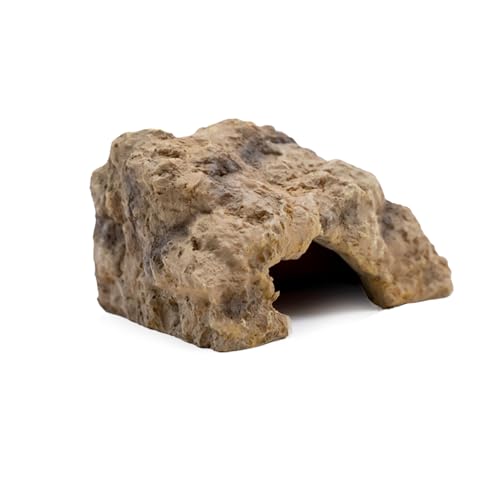
Repticircle Reptile Hide for Leopard Gecko, Bearded Dragon, Ball Python & Tortoise – Terrarium Habitat Décor, Snake & Lizard Hideout(Resin, Large)
Included for 'Best Snake Enclosures for Ball Pythons' because the listing specifies Bearded Dragon and Ball Python & Tortoise, details this guide uses to compare options.
View on AmazonRepticircle’s hide is a terrarium habitat piece listed for leopard geckos, bearded dragons, ball pythons, and tortoises. It is mid-range tier and it is the most efficient single dollar in a ball python setup, because a hide is the one item the snake uses every hour of every day.
Who it suits: keepers who already have an enclosure and a heat source but are using an undersized or improvised hide. It also suits keepers who want a second hide to complete the warm-side and cool-side pair, and keepers who need a hide with a wide enough opening for an adult to enter without squeezing.
Key Specs
- Type: reptile hide / terrarium habitat decor
- Target species: leopard gecko, bearded dragon, ball python, tortoise
- Sizing class: multi-size class hide; because it serves tortoise and bearded dragon alongside ball python, expect larger options that suit an adult snake
- Material class: molded solid hide body, non-porous and wipe-clean
- Security: enclosed dark retreat rather than an open arch, which is what a ball python needs
- Cleaning: removable, soakable, replaceable at low cost
Why Hide Fit Is a Number, Not an Opinion
There is a sizing rule for hides that is worth working through rather than guessing. A ball python wants a hide it can coil inside with its body touching the walls on most sides. If the interior footprint is much larger than the snake’s coil, the hide stops feeling like a burrow and the snake will seek a tighter space, often wedging behind the water bowl. So the calculation is: measure your snake’s coiled footprint, then match the hide’s interior floor, not its exterior shell. An adult ball python in the 4-foot range typically needs an interior on the order of a wide hand-span across, and hides listed for tortoises and bearded dragons in this line commonly provide that.
This is also where the growth problem shows up. A hide that fits a hatchling becomes a decoration within a year, and a hide bought for an adult will feel cavernous to a juvenile. Repticircle’s multi-species sizing means you can size up as the snake grows rather than switching brands. Budget for two hides at the adult size, one on the warm side and one on the cool side, and treat the juvenile hide as a consumable you will retire.
Pros
- Very low cost per benefit, since the hide is the most-used object in the enclosure
- Multi-species sizing means adult-capable options are available in the same line
- Solid, wipe-clean body that does not absorb waste or hold odor
- Easy to buy two and complete the warm-side / cool-side hide pair
- Ideal second hide if you already own a humid hide on the warm side
Cons
- No humidity feature and no sensor, so it does nothing for a shed-cycle humidity problem
- Multi-species listing means you must check interior dimensions rather than trust the name
- Plain appearance compared with naturalistic hides, which is a matter of taste rather than function
- One hide is not a complete setup; you still need heat, a thermostat, a bowl, and a gradient
Compared With the Nearest Alternative in This List
The nearest alternative is the KFPSHLQE hide with humidification groove and sensor at the premium tier. If your enclosure humidity is already stable, Repticircle is the better buy: you get the same core function, a dark secure retreat, at a fraction of the tier. If you have fought shed problems, the KFPSHLQE’s integration of moisture and measurement is worth the step up, and the two work well together: KFPSHLQE on the warm side as the humid hide, Repticircle on the cool side as the dry retreat. That pairing is the most functional hide arrangement in this article. The KFPSHLQE also beats the bundles here for the specific job of humidity, since none of the kits include moisture management or a sensor.
6. TUKOAW Snake Climbing Rings – Best Mid-Range Enrichment for Ball Python and Corn Snake

TUKOAW Snake Climbing Rings for Ball Python & Corn Snake, Reptile Toys
Included for 'Best Snake Enclosures for Ball Pythons' because the listing specifies Reptile Toys, details this guide uses to compare options.
View on AmazonTUKOAW’s climbing rings are a reptile enrichment toy set designed for ball pythons and corn snakes. They sit in the mid-range tier, above the near-identical budget ring sets and below bundle pricing.
Who it suits: an adult ball python in a tall enclosure, and corn snake keepers who want vertical activity. The wrong buyer is someone with a low-profile enclosure and no mounting points, because climbing rings need something to attach to and vertical space to be worth it.
Key Specs
- Type: snake climbing rings / reptile enrichment toy
- Target species: ball python and corn snake
- Mounting class: designed to be attached or hung inside a terrarium, typically requiring hooks, suction, or a mounting point depending on the variant
- Material class: durable ring elements intended for climbing contact
- Use: enrichment and exercise, not structural support
- Cleaning: wipe or rinse; rings accumulate waste where the snake crosses them
Why Ball Pythons Climb, Contrary to the Reputation
Ball pythons are described as terrestrial, and that is mostly true, but they are not floor-bound. Wild individuals climb into low brush and termite mounds, and captive ball pythons will use vertical space decisively when it is offered, particularly at night. Climbing rings give a snake a stable raised loop to move through, which provides a form of exercise that a flat floor cannot. Muscle tone in the body is a genuine husbandry outcome, and a snake that only ever traverses a flat surface does not develop it.
The practical requirement is safety. Rings must be mounted so they cannot drop onto the animal, must be high enough that a falling snake lands on soft substrate rather than a water bowl lip, and must not create a gap between the ring and the enclosure wall where a snake can wedge its body. Place climbing elements away from heat lamps so the animal is not pinned under a hot surface, and check mounting points at every cleaning, since a large ball python will test them.
Pros
- Adds genuine vertical enrichment rather than another floor item
- Sized for ball python and corn snake body weights
- Simple to reposition as the enclosure layout changes
- Encourages nighttime activity and more complete use of the enclosure
- Mid-range tier cost is a small fraction of the enclosure spend
Cons
- Requires suitable mounting points and vertical space; useless in a short tank
- Mounting hardware class varies, so attachment reliability depends on your setup
- An adult ball python can dislodge a poorly fixed ring
- No functional benefit for humidity, heat, or security
Compared With the Nearest Alternative in This List
The nearest alternatives are the budget ring sets: Duseu’s two-pack and the Generic two-pack. Functionally, all three do the same job of providing loops to climb through. TUKOAW’s mid-range positioning suggests better build consistency, but the honest guidance is that if budget is tight, the cheapest rings are not a mistake, because enrichment value comes from presence and placement rather than from brand. The other nearby option is the kaiwankalo climbing rope with suction cups, which offers a longer, more flexible climbing path than rigid rings. Choose rings for a compact loop in a specific spot; choose the rope if you want a continuous climb from floor to mid-height.
7. kaiwankalo Snake Climbing Rope – Best for a Continuous Vertical Climbing Path

Ball Python Tank Accessories Snake Climbing Rope with Suction Cups & Hooks
Included for 'Best Snake Enclosures for Ball Pythons' as a relevant option in this category; details come from the product listing.
View on Amazonkaiwankalo’s climbing rope is a ball python tank accessory that mounts with suction cups and hooks. It is mid-range tier and it does something rings cannot: it creates an unbroken climbing route.
Who it suits: keepers with a tall PVC or glass enclosure who want the snake to travel vertically, and keepers whose snake is already using the top of a hide and clearly wants more. It also suits anyone who has tried rigid rings and found the fixed shape awkward for their layout.
Key Specs
- Type: snake climbing rope
- Mounting: suction cups and hooks
- Shape: rope form, positionable into curves rather than a fixed ring
- Target species class: ball python and similar mid-size snakes
- Use: enrichment and climbing, decorative as well as functional
- Cleaning: wipe down; rope texture holds debris more than smooth plastic rings
The Suction Cup Reality
Suction cups are the weak point of every rope-style product, and this is worth stating before purchase rather than after. Suction holds well on smooth, clean glass and poorly on textured PVC, dusty surfaces, or anywhere near a heat source that warms the cup. Expect to re-press them periodically, and expect an adult ball python’s weight to test them. The fix is straightforward: mount the rope so that if a cup releases, the rope falls into empty space or onto substrate, and use the hooks to anchor the high end to a secure point rather than relying on suction alone. If your enclosure is PVC with a matte interior, plan for the hooks to do most of the work.
Beyond mounting, this is the most flexible climbing item on the list. A rope can sweep from a corner up and across, giving a snake a route that also breaks up sight lines, which serves the security goal at the same time as the exercise goal. That dual function is why it edges out rings for a tall enclosure, where a single ring would occupy one spot and leave the rest empty.
Pros
- Creates a continuous climb rather than an isolated loop
- Positionable shape adapts to any enclosure layout
- Doubles as a visual barrier that improves the snake’s sense of cover
- Suction cups and hooks make installation tool-free
- Good use of wasted vertical space in a tall tank
Cons
- Suction cups lose grip over time and on textured surfaces
- Rope texture traps debris and needs regular cleaning
- Rope plus an adult snake means a measurable load on the mounting points
- No humidity, heating, or security function beyond the cover it provides
Compared With the Nearest Alternative in This List
The nearest alternative is the KeMioYuXin bendable climbing rope, which is explicitly listed at 25.6 inches and sits at the budget tier. That is a known length, which makes it easy to plan: 25.6 inches is roughly two feet of climbable run, enough for a diagonal in a mid-size tank but not a full floor-to-top sweep in a tall one. The kaiwankalo rope’s mid-range tier suggests a sturdier hook and cup package, which matters for an adult ball python’s weight. If budget is the deciding factor and your tank is modest, the KeMioYuXin length is a known quantity and hard to beat. If you are mounting in a tall enclosure with a heavy snake, the kaiwankalo kit’s mounting components justify the higher tier. Compared with the TUKOAW rings, the rope wins on flexibility and coverage; the rings win on simplicity and knowing exactly where the snake will be.
8. Reptile EcoDen Artificial Hanging Plant Vines – Best for Cover and Visual Security

Reptile Plants for Terrarium Tank – Bearded Dragon Tank Accessories, Artificial Hanging Plant Vines, Habitat Decor & Hide for Crested Gecko, Lizard, Snake, Chameleon and Ball Pythons(Group B)
Included for 'Best Snake Enclosures for Ball Pythons' because the listing specifies Bearded Dragon Tank Accessories and Artificial Hanging Plant Vines, details this guide uses to compare options.
View on AmazonThis is an artificial hanging plant vine set for terrarium tanks, listed for bearded dragon and similar habitat use. It is mid-range tier and it addresses the least glamorous but most underrated variable in ball python husbandry: how exposed the snake feels.
Who it suits: keepers with a bare or minimally furnished enclosure, keepers with a large PVC unit where the floor plan is too open, and keepers whose snake spends all its time in one hide and never uses the rest of the tank. It also suits anyone who wants foliage without maintaining live plants.
Key Specs
- Type: artificial hanging plant vines, habitat decor
- Target: terrarium tanks, bearded dragon and similar habitat class
- Material class: artificial foliage on vine segments
- Placement: hangs from enclosure furniture, vines, or mounting points
- Maintenance: periodic rinse or wipe; foliage traps dust and waste
- Function: cover and visual barrier, not structural climbing support
Why Cover Changes Behavior
A ball python that feels exposed chooses a single safe point and stays there. That produces three problems: it never uses the thermal gradient, so it cannot thermoregulate properly; it gets less activity, so muscle tone suffers; and it is more likely to refuse food or strike defensively during handling. Cover solves all three at once by making the middle of the enclosure feel traversable. The cheapest way to add cover is foliage, which is why artificial vines earn a place in a functional setup rather than being dismissed as decoration.
Two practical notes. First, vines are not load-bearing. Do not treat them as climbing support; they should drape so the snake can pass through or under them without depending on them. Second, artificial foliage needs cleaning, because dust and waste accumulate where the snake brushes past. A monthly rinse, or a soak in a dilute reptile-safe cleaner followed by a thorough rinse and dry, keeps the plants from becoming a hygiene problem.
Pros
- Immediately breaks up an empty enclosure and creates usable middle ground
- Encourages movement across the thermal gradient instead of parking in one spot
- No watering, no light requirements, no die-off
- Repositionable as the snake grows or the layout changes
- Low mid-range cost for a measurable behavior benefit
Cons
- Traps dust and waste and requires periodic cleaning
- Not structural; cannot be used as a climbing support
- Listed for bearded dragon habitat, so a ball python keeper should confirm it drapes rather than blocks floor space
- No heating, humidity, or enclosure-sealing function
Compared With the Nearest Alternative in This List
The nearest alternative inside this list is the cover provided by the two bundles, the EcoDen accessories set and TEICCI’s 14-piece kit, both of which include plants. If you already own one of those bundles, buy this vine set only to add density in a large enclosure, since you already have foliage. If you own neither and simply need cover, this standalone vine product is a more targeted buy than a full kit, and it pairs naturally with the Repticircle hide, which provides the retreat the vines cannot. Compared with the climbing rope, the vine serves a different purpose: the rope gives structure to climb on, the vines give cover to move behind. A enclosure with both reads as a much safer space to a ball python than one with either alone.
9. Duseu 2PCS Snake Climbing Rings – Best Cheapest Enrichment Add-On

Duseu 2PCS Snake Climbing Rings for Ball Python & Corn Snake, Black
Included for 'Best Snake Enclosures for Ball Pythons' because the listing specifies Black, details this guide uses to compare options.
View on AmazonDuseu’s climbing rings are a two-piece set in black, listed for ball pythons and corn snakes, at the budget tier. They are the lowest-cost way to add a climbing element to an enclosure.
Who it suits: keepers furnishing a second tank on a tight budget, keepers who want to test whether their ball python will actually use vertical space before spending more, and anyone adding enrichment to a juvenile setup.
Key Specs
- Type: snake climbing rings, two pieces
- Color: black
- Target species: ball python and corn snake
- Mounting class: attachable inside the enclosure; verify the mounting method for your tank surface
- Use: enrichment and climbing
- Cleaning: wipe or rinse
What You Are Actually Buying at the Budget Tier
Two rings and a mounting method. That is the whole product, and it is enough to do the job. The budget tier here is not a compromise on function, because a climbing ring has no mechanism to fail: it is a loop of material. Where budget tier does show up is consistency of finish and the quality of whatever attachment is supplied. Two rings also means you can place one high and one low, giving a snake a stepped route rather than a single perch, which is more useful than one larger element in many layouts.
The safety checks are the same as for any climbing item: confirm the rings cannot drop, keep them clear of heat sources, and make sure a fall lands on substrate. At this price you can also treat the rings as semi-disposable, replacing them if a mounting point wears out rather than engineering a fix.
Pros
- Lowest-cost way to add climbing enrichment
- Two rings allow a stepped route instead of a single spot
- No mechanism to break; function is entirely geometry and placement
- Low enough cost to add to a second or third enclosure without thinking about it
- Easy to clean and easy to reposition
Cons
- Budget-tier finish and attachment hardware vary
- Requires mounting points and vertical space to be useful
- No cover value, unlike vines or a rope
- An adult ball python can dislodge a weak mount
Compared With the Nearest Alternative in This List
The nearest alternative is the Generic two-piece climbing ring set, also budget tier and functionally equivalent. Between two products that do the same thing at the same price band, choose on availability and on whether the mounting method suits your enclosure surface. TUKOAW’s rings sit a tier higher and are the upgrade if you want more consistent build quality; the honest answer is that rings are rings, and placement matters more than brand. Against the kaiwankalo rope, the rings are simpler and cheaper but give one fixed loop instead of a continuous path, so the rope is the better buy for a tall enclosure and the rings are the better buy for a compact one.
10. KeMioYuXin Bendable Climbing Rope – Best Budget Rope With a Known Length

KeMioYuXin Snake Enclosure Accessories - 25.6” Ball Python Tank Accessories Bendable Climbing Rope with Suction Cups Snake Enrichment Toys Snakes Tank Decor for Corn Snakes, Ball Pythons, King Snake
Included for 'Best Snake Enclosures for Ball Pythons' because the listing specifies Ball Pythons and King Snake, details this guide uses to compare options.
View on AmazonKeMioYuXin’s climbing rope is listed at 25.6 inches and comes with suction cups, at the budget tier, as an enclosure accessory for ball pythons.
Who it suits: keepers who want a climbing route in a modest enclosure and want to know the dimension before buying. It also suits keepers furnishing multiple enclosures, where a known two-foot-length rope can be planned into each tank.
Key Specs
- Type: bendable climbing rope
- Length: 25.6 inches
- Mounting: suction cups
- Form: bendable, positionable into curves
- Target species class: ball python
- Cleaning: wipe down; rope texture holds debris
Sizing a 25.6-Inch Rope to a Real Enclosure
The number matters, so it is worth working through. At 25.6 inches, roughly 2.1 feet, a rope run in a straight vertical line covers just over two feet of height, which is most of the interior height of a 24-inch-tall enclosure. Bent into a diagonal across a 48-inch-wide, 24-inch-tall tank, it covers a good line of travel with slack left for a curve. In a taller enclosure, there is no way to span floor to ceiling with one length. So the realistic use cases are: a diagonal climbing element in a 24-inch-tall unit, a short vertical run near the back wall, or a curve draped between two mounting points. If your enclosure is 36 inches tall or more, plan on two lengths or accept a partial climb.
The suction cup caveat from the kaiwankalo entry applies here without modification. Clean the surface before pressing, keep cups away from heat, and mount so a release drops the rope onto substrate. At budget tier, this is a genuinely useful product precisely because the length is stated, which is more than many listings offer.
Pros
- Stated 25.6-inch length makes sizing predictable before purchase
- Bendable form fits a diagonal or curved route
- Budget tier pricing makes it easy to add two or three
- Doubles as a visual barrier when draped across open space
- Suction mounting requires no tools
Cons
- Suction cups lose grip over time, especially on textured PVC
- Length limits it to partial climbs in tall enclosures
- Cannot be trimmed safely to size without exposing the internal core
- Rope texture traps debris and needs regular cleaning
Compared With the Nearest Alternative in This List
The nearest alternative is the kaiwankalo climbing rope with suction cups and hooks at the mid-range tier. The trade is length predictability and price against mounting robustness. KeMioYuXin gives you a stated 25.6 inches and a budget price; kaiwankalo adds hooks, which is the more reliable anchor for an adult ball python’s weight. If your snake is small or mid-size and your tank is 24 inches tall, the KeMioYuXin length is sufficient and the savings are real. If you are mounting in a tall PVC enclosure with a heavy adult, the kaiwankalo hook-and-cup package is the safer purchase, and you may want two of either. Compared with the ring sets, the rope covers more space; the rings are more predictable to mount.
11. Generic 2PCS Snake Climbing Rings – Best for a Spare or Second Tank

2PCS Snake Climbing Rings for Ball Python - Enrichment Toys for Corn Snake
Included for 'Best Snake Enclosures for Ball Pythons' because the listing specifies Enrichment Toys for Corn Snake, details this guide uses to compare options.
View on AmazonThis is a two-piece climbing ring set listed as enrichment toys for corn snakes and ball pythons, at the budget tier, sold under a generic label.
Who it suits: keepers who need a second set for a quarantine or second enclosure and do not want to pay a tier premium, and keepers who want a cheap way to test whether their snake uses rings at all before investing in a more finished set.
Key Specs
- Type: climbing rings, two pieces
- Target species: ball python and corn snake
- Price tier: budget
- Brand: generic, meaning no established brand identity to evaluate
- Mounting class: attachable inside the enclosure; confirm the attachment method before purchase
- Cleaning: wipe or rinse
What “Generic” Actually Means for a Purchase Decision
A generic listing removes brand as a decision variable, which for a climbing ring is less of a loss than it sounds. There is no mechanism, no electronics, and no sizing complexity, just rings and an attachment. What you give up is consistency: two units from the same generic listing may differ in finish or in the hardware included. What you gain is price. For a second enclosure, a quarantine setup, or a test of whether your ball python climbs at all, that trade is reasonable.
The use case that makes this genuinely valuable is the trial. Some ball pythons ignore vertical elements entirely, and finding that out with a budget-tier set costs almost nothing. If your snake uses the rings nightly, upgrade to a mid-range set or add a rope. If it never touches them, you have lost very little and learned something about your animal.
Pros
- Lowest possible cost of entry for enrichment
- Two rings allow a low and high placement
- Ideal for a second tank, quarantine enclosure, or trial
- Simple to clean and reposition
- No functional compromise versus pricier rings in this category
Cons
- No brand identity, so quality consistency is unknown
- Mounting hardware class is unclear from the listing
- Requires vertical space and an attachment point to be useful
- No cover or humidity function
Compared With the Nearest Alternative in This List
The nearest alternative is the Duseu two-piece ring set, also budget tier. The two are near-substitutes. Duseu at least carries a brand name and a stated color; the generic set offers nothing beyond the count. If both are available at similar tiers, Duseu is the marginally safer pick for consistency. If you simply need a set for a quarantine tub and want the lowest cost, the generic set is fine, because a climbing ring has no failure mode beyond the mounting point. Against the TUKOAW rings at mid-range, the budget sets concede only finish and hardware confidence, and for a juvenile snake in a modest enclosure that concession costs you very little.
12. Meidier Snake Feeding Tongs – Best for Safe Feeding and Handling

Snake Feeding Tongs, 15 Inch Stainless Steel Tongs with Serrated Tips
Included for 'Best Snake Enclosures for Ball Pythons' because the listing specifies 15 Inch Stainless Steel Tongs with Serrated Tips, details this guide uses to compare options.
View on AmazonMeidier’s feeding tongs are 15-inch stainless steel tongs with serrated tips, at the budget tier. They are not an enclosure component, but they are the accessory that most directly prevents a common and entirely avoidable injury: a feeding strike that lands on a hand.
Who it suits: every ball python keeper, but especially anyone feeding pre-killed or frozen-thawed prey, anyone whose snake has a strong feeding response, and anyone who has ever been tempted to dangle a rodent with fingers.
Key Specs
- Type: snake feeding tongs
- Length: 15 inches
- Material: stainless steel
- Tip: serrated, for grip on prey items
- Cleaning: wash and disinfect after use, especially between animals if you keep more than one
- Price tier: budget
Why 15 Inches Is the Right Number
Ball pythons strike fast and can lunge further than their resting posture suggests. Fifteen inches keeps the prey item, and therefore the strike zone, roughly a forearm’s length from your hand. It also keeps your scent off the prey as little as possible, since the tongs grip rather than your fingers, which reduces the chance the snake associates a hand with food. That association is the root of most “my snake bit me” incidents, and it is built by hand-feeding.
Serrated tips matter for a specific reason: they hold a thawed rodent firmly enough that you can present it and let the snake take it cleanly, rather than dropping it and triggering a strike at the floor. Stainless is the right material because it does not absorb odor and can be disinfected, which matters if you keep multiple snakes and want to avoid cross-contamination.
One general safety note: feeding injuries and feeding-related stress are husbandry-adjacent concerns, and if your snake repeatedly refuses food, regurgitates, or shows signs of illness, those are questions for a reptile veterinarian rather than for a tool upgrade.
Pros
- 15-inch reach keeps hands clear of the strike zone
- Serrated tips grip thawed prey securely for clean presentation
- Stainless steel does not retain odor and can be disinfected
- Cards the hand-feeding habit that causes most bites
- Budget tier, so there is no reason to skip it
Cons
- Serrated tips need care so they do not tear prey and make a mess
- Stainless steel gets hot if left under a heat lamp and cold if left in a cool room; store away from both
- Not an enclosure component, so it does not improve the habitat itself
- Long tongs are slightly clumsier for precise placement than shorter ones
Compared With the Nearest Alternative in This List
This item has no true competitor in the list, since everything else is either an enclosure, a hide, a climbing element, or cover. The nearest functional neighbor is the R
epticircle hide, in the sense that both are budget-conscious items that solve a specific and frequent problem: the hide solves security, the tongs solve safe feeding. If you are assembling a first setup and trying to decide what to buy after the enclosure and heat source, the hide comes first and the tongs come second, and both cost little enough that there is no reason to delay either. Skimping on tongs to save a small amount is a bad trade against a bite that could have been avoided.
How to Choose a Ball Python Enclosure and Setup
The enclosure decision has a sequence, and getting the order wrong is the most common and most expensive mistake. Work through these in order: enclosure material and size, then heat, then humidity, then security, then enrichment and cover, then feeding and maintenance tools. Each step constrains the next one.
Step 1: Size the Enclosure for an Adult, Not a Hatchling
Adult ball pythons commonly reach 3.5 to 5 feet in length, with females typically larger than males. The enclosure target for an adult is a floor footprint of roughly 48 inches by 24 inches, with a height of at least 18 to 24 inches if you want to offer climbing, and more if you want significant vertical use. A 36 by 18 footprint is workable for a smaller adult male but is tight for a large female, and a 40-gallon glass tank is a common starting point that many keepers outgrow within two to three years.
The tempting mistake is buying small because a hatchling looks lost in a big enclosure. That is a real problem, but the fix is clutter, not a smaller tank: fill the space with hides, cover, and climbing elements, and a small snake will use it comfortably. Buying the adult-size enclosure once costs less than buying a juvenile tank and then a second adult tank. If you do buy small for a hatchling, plan the upgrade date at purchase time rather than discovering it when the snake outgrows the space.
Step 2: Choose the Material Before Anything Else
Material determines how hard the rest of your job will be.
- PVC: best heat and humidity retention, sealed and secure, front-opening, washable, stackable. Heaviest and most expensive upfront. Best overall choice for the species, and the reason the Nijsaku unit anchors this list.
- Glass with a screen top: cheapest and most widely available, but it leaks heat and humidity badly. Requires covering most of the screen, which then requires careful ventilation management. Good for quarantine and short-term housing; a recurring maintenance burden as a permanent home in a dry or cold room.
- Wood or melamine: insulates well and is often cheap to build, but untreated wood absorbs moisture and waste, and it swells and warps over time. Requires sealing inside and out. Only worth it if you are confident in the build and the sealing.
- Plastic tub: the cheapest functional option and excellent for humidity and security, but visually opaque, awkward to light and heat from above, and limited in size for a large adult. Ideal for quarantine and juveniles; not the end state for a display animal.
For a ball python in a house that runs cool or dry, PVC is the material that removes the most ongoing work. For a keeper in a warm, humid climate with a spare room, glass can be managed. The material choice is really a question about how much daily correction you are willing to do.
Step 3: Plan Heat Before You Buy the Enclosure
Ball pythons need a thermal gradient, not a single temperature. The working target is a hot-side basking area in the high 80s Fahrenheit, a cool side in the high 70s, and a gradient in between, with a nighttime drop that most keepers allow to fall modestly. The gradient only exists if the enclosure is large enough and the heat source is placed on one side.
Heat source compatibility is where enclosure choice and equipment choice collide. Under-tank heat requires a solid floor and works with glass and PVC. Radiant heat panels mount to the ceiling and work best in PVC and wood, where they are protected from the animal and do not dry the air the way a lamp does. Overhead lamps need a screen or a lamp cage plus clearance, and in a sealed PVC unit they can cook the enclosure without a thermostat controlling them.
The non-negotiable rule is a thermostat on every heat source. An uncontrolled heat mat or lamp can reach temperatures that injure or kill a snake, and this is the single most common serious husbandry error. Buy the thermostat with the heat source, not after.
Step 4: Solve Humidity With the Enclosure, Then With a Hide
The target relative humidity band for a ball python sits roughly between 55 and 70 percent, moving toward the higher end during a shed cycle. In a glass tank with a screen top in a heated home, hitting that band usually requires daily misting, which is both tedious and inconsistent. In a sealed PVC enclosure, the same room conditions often need far less intervention, because the moisture stays in the box.
The layered approach works best. The enclosure provides the baseline, a moisture-holding substrate contributes, and a humid hide provides the local spike where the snake actually spends its time. That is why the KFPSHLQE hide with its groove and sensor earns a premium slot in this list: it handles the third layer and makes it measurable. If you are fighting shed problems, add the humid hide before you increase misting across the whole enclosure, because over-misting a poorly ventilated tank creates a different set of problems, including skin and respiratory issues. If your snake shows persistent respiratory signs, that is a veterinary question, not a humidity-dial question.
Step 5: Security Is a Number and a Design, Not a Feeling
Ball pythons are strong for their size and are persistent at seams. Security has three parts:
- Latches and lids: screen clips and weights are a compromise; a latched front-opening door is the standard for good reason. If you use a screen top, secure it at multiple points and check it every time you open the enclosure.
- Gaps: check cord pass-throughs, vent edges, and the gap between a door and its frame. A snake can exploit an opening that looks too small. Measure, do not eyeball it.
- Interior security: this is the part keepers forget. A snake with a snug hide, cover, and a climbing option feels safe and behaves calmly. A snake in a bare enclosure behaves defensively, refuses food, and hides constantly. Security inside the box is as important as the latch outside it.
Step 6: Match Enrichment to the Enclosure You Actually Have
Enrichment purchases should follow the enclosure’s dimensions, not the other way around. Use this mapping:
- 24-inch-tall enclosure: a 25.6-inch rope (KeMioYuXin) covers most of the height as a diagonal or a short vertical run, and two-piece ring sets (Duseu or the generic set) give two stepping points. This is the configuration where budget climbing gear delivers full value.
- 36-inch-tall or taller enclosure: plan on a rope with hooks (kaiwankalo) plus rings, or two rope lengths, because a single 25.6-inch rope cannot span the height. Tall enclosures reward more climbing investment because there is more space to use.
- Low, wide enclosure: skip climbing elements and spend on hides and cover instead. A ball python in a short tank has nowhere to climb; vines and a second hide do more for it than rings it cannot reach.
- Large PVC unit with an open floor: add cover aggressively. The EcoDen vine set or a bundle like TEICCI’s 14-piece kit breaks up a big footprint and is the difference between a snake that uses the whole gradient and one that sits in a corner.
Step 7: Decide Between Individual Items and a Bundle
This is a straightforward calculation based on how much you already own.
| Your Situation | Best Buy | Why |
|---|---|---|
| Nothing yet, starting from zero | Nijsaku PVC enclosure, plus Repticircle hide, plus budget rings | Enclosure and hide are the two functional anchors; climbing can be cheap |
| Enclosure owned, humidity problems | KFPSHLQE humid hide with sensor | Solves humidity where the snake lives and makes it measurable |
| Enclosure owned, bare interior | EcoDen accessories set or TEICCI 14-piece kit | Fills the tank in one order with hide, climbing, and cover |
| Enclosure owned, tight budget | Repticircle hide plus a budget ring set | Security and enrichment for the least money |
| Furnishing a second or quarantine tank | Generic ring set, budget rope, spare hide | Function over finish; predictable low cost |
| Large, tall PVC in a dry room | KFPSHLQE hide, kaiwankalo rope, vine set | Humidity, vertical enrichment, and cover for wasted space |
Common Mistakes That Cost the Most
- Buying a hide too large. A ball python wants a snug fit. A cavernous hide is ignored. Measure your snake’s coiled footprint and match the interior, not the exterior.
- Running a heat source without a thermostat. This is the most dangerous and most common error. It can injure an animal and it invalidates every other careful decision in the setup.
- Covering a glass screen top completely to hold humidity. This kills ventilation and creates stagnant, moldy air. Reduce the screen partially and manage ventilation deliberately.
- Skipping cover because décor feels optional. Cover changes behavior: it drives thermoregulation, activity, and feeding reliability. It is husbandry, not decoration.
- Hand-feeding without tongs. It builds a hand-equals-food association, and it is the origin of most bites. Fifteen-inch tongs cost almost nothing.
- Buying for a hatchling and planning to upgrade “later.” Set the upgrade date when you buy the juvenile enclosure, or buy the adult size immediately and add clutter.
- Never cleaning artificial foliage. Plants and ropes trap dust and waste. A monthly wash prevents them from becoming a hygiene issue.
Durability and Ownership Realities
What wears out first in a ball python setup, in rough order: suction cups, artificial plant foliage (stains and dust), rope texture (holds debris until washed), hide surfaces (scratch and stain but rarely fail), and finally the enclosure itself, which should last many years unless a panel seam or latch mechanism is damaged. The consumables budget is small, and the replacement cycle is long, which is why spending on the enclosure and the hide early is the better allocation than spending on accessories.
Cleaning is the recurring task that determines how pleasant ownership is. A front-opening enclosure turns a ten-minute chore into a two-minute one, and it lets you spot-clean without dismantling the top. A screen-topped glass tank requires lifting the lid and moving heat equipment every time, which is exactly why so many keepers clean less often than they should. Factor access into the enclosure decision and you will end up with a healthier animal and less resentment.
Frequently Asked Questions
What size enclosure does an adult ball python actually need?
Plan on a floor footprint of about 48 inches by 24 inches for an adult, with a height of at least 18 to 24 inches. A large adult female benefits from the full 48-inch length because it allows a proper thermal gradient across the floor. A smaller adult male can live comfortably in a 36 by 18 footprint, but that is a minimum rather than a target.
Is PVC really better than glass for ball pythons?
For heat and humidity retention, yes, and the gap is significant. PVC panels insulate, so a heat source runs less and the enclosure holds moisture instead of leaking it into the room. Glass with a screen top is cheaper and easier to find, but it usually requires covering part of the screen, which then requires managing ventilation carefully. In a cold or dry home, PVC removes the most ongoing work.
How do I keep humidity up without soaking the enclosure?
Use three layers instead of one. Choose a moisture-holding substrate, seal the enclosure reasonably well, and add a humid hide that concentrates moisture where the snake actually sits. A hide with a humidification groove and a sensor, like the KFPSHLQE, lets you hit a target number and read it rather than guessing. Over-misting a poorly ventilated enclosure creates a different problem set, including skin and respiratory issues.
Do ball pythons really use climbing rings and ropes?
Many do, especially at night. Ball pythons are described as terrestrial, but they climb readily when given stable structure, and vertical enrichment supports muscle tone and activity that a flat floor cannot. Some individuals ignore climbing elements entirely, which is why a budget-tier set is a sensible way to find out what your snake prefers before investing more.
How many hides should a ball python enclosure have?
At least two: one on the warm side and one on the cool side, so the snake can thermoregulate without leaving cover. A third humid hide is a strong addition for shed cycles. Each hide should be snug enough that the coiled snake touches the interior walls, and if two hides are identical in size you effectively have one usable option.
Where should climbing elements be placed in the enclosure?
Away from heat sources, mounted so they cannot fall onto the animal, and positioned so that a slip lands on soft substrate rather than the water bowl or a hard surface. Check every mounting point during cleaning, because a large ball python will test them. Suction cups hold best on clean, smooth glass and poorly on textured PVC.
Is a starter accessory kit worth it, or should I buy items individually?
Products in this guide
- Repticircle Reptile Hide for Leopard Gecko, Bearded Dragon, Ball Python & Tortoise – Terrarium Habitat Décor, Snake & Lizard Hideout(Resin, Large)
- PVC Reptile Terrarium Tanks Enclosure for Ball Python Snake Gecko Bearded Dragon, PVC Reptile Lounge Habitat with Glass Sliding Door and Intelligent Thermostat (33gallons)
- Reptile Hide Snake Hide,with a Humidification Groove Equipped with a Temperature and Humidity Sensor,Humid Hideout for Snakes,Juvenile Ball Pythons, Lizards,Leopard Geckos and Other Small Reptiles.
- 2PCS Snake Climbing Rings for Ball Python - Enrichment Toys for Corn Snake
- TUKOAW Snake Climbing Rings for Ball Python & Corn Snake, Reptile Toys
- Duseu 2PCS Snake Climbing Rings for Ball Python & Corn Snake, Black
- Reptile Plants for Terrarium Tank – Bearded Dragon Tank Accessories, Artificial Hanging Plant Vines, Habitat Decor & Hide for Crested Gecko, Lizard, Snake, Chameleon and Ball Pythons(Group B)
- KeMioYuXin Snake Enclosure Accessories - 25.6” Ball Python Tank Accessories Bendable Climbing Rope with Suction Cups Snake Enrichment Toys Snakes Tank Decor for Corn Snakes, Ball Pythons, King Snake
- Ball Python Tank Accessories Snake Climbing Rope with Suction Cups & Hooks
- Snake Feeding Tongs, 15 Inch Stainless Steel Tongs with Serrated Tips
- Snake Enclosure Accessories, Ball Python Hide with Climbing Rings, Reptile Hide Cave, Hanging Plants and Vine Decor, Snake Toys for Ball Pythons, Snakes, Geckos and Bearded Dragons(Large)
- TEICCI 14-Piece Snake Tank Accessories Kit-Snake Enclosure Accessories






Write Your Review
No reviews yet. Be the first to share your experience!