
Best Spectrum Analyzers: The Direct Answer
If you want the best spectrum analyzer overall for most hobbyists, ham operators, and field technicians in 2026, the AURSINC TinySA Ultra+ ZS407 is the pick: it covers 100 kHz to 7.3 GHz in a pocket-sized handheld with a 4-inch display, which is more frequency range than almost anything else at its size and price point, and it needs no external computer to be useful. If you need lab-grade measurement with a tracking generator and calibrated amplitude accuracy, the Siglent SSA3021X series is the better answer, and if your budget is tight and you only care about HF/VHF up to 960 MHz, the SEESII TinySA 100 kHz–960 MHz V0.3.1 does the job for a fraction of the cost. This article compares frequency range, real-time bandwidth, dynamic range, sweep speed, portability, connectivity, and measurement ease across twelve currently available analyzers so you can match one to your actual situation rather than to a spec sheet.
- Best Spectrum Analyzers: The Direct Answer
- Top 3 Picks
- Quick Comparison
- How We Chose
- 1. SEESII TinySA Ultra+ ZS406 – Best for Portable General Scanning on a Budget
- 2. AURSINC TinySA Ultra+ ZS407 – Best for the Widest Frequency Range in a Handheld
- 3. SEESII TinySA 100 kHz–960 MHz V0.3.1 – Best for the Lowest-Cost Useful Entry Point
- 4. Siglent SSA3021X – Best for Bench Work with a Tracking Generator
- 5. AURSINC TinySA Ultra+ ZS406 – Best for Touchscreen Handheld Scanning
- 6. Rigol DSA815-TG – Best for Affordable Benchtop Measurement with a Tracking Generator
- 7. SKYSHL 2.8″ Touchscreen TinySA V0.3.1 – Best for the Smallest Footprint
- 8. RIGOL RSA808 – Best for Real-Time Analysis to 8.5 GHz
- 9. Siglent SSA3021X Plus – Best Premium All-Rounder
- 10. Siglent SSA3032X – Best Premium Analyzer with More Frequency Headroom
- 11. SEESII TinySA Ultra+ ZS407 with ZA-048 LPDA Antenna – Best Bundle for Field Direction-Finding
- 12. SEESII SSA463 – Best for Mid-Band Work with Input Protection
- How to Choose
- Frequently Asked Questions
- Closing Recommendation by Situation
Top 3 Picks
Best Overall: AURSINC TinySA Ultra+ ZS407
The ZS407’s 100 kHz–7.3 GHz range covers HF, VHF, UHF, the 2.4 GHz ISM band, 5 GHz Wi-Fi, and most licensed land-mobile and amateur allocations in one handheld. It has a built-in display, internal battery, and USB connectivity, so it works standing in a field with an antenna in one hand and also docks to a PC for logging. For the overwhelming majority of readers who want to see what is on the air without spending four figures, this is the right starting point.
Best Budget: SEESII TinySA 100 kHz–960 MHz V0.3.1
At the entry price tier, this is the analyzer that gets people into spectrum work. The 100 kHz–960 MHz span covers AM and FM broadcast, shortwave, the 2-meter and 70-centimeter ham bands, weather radio, and most consumer remote controls and wireless microphones. It is not a lab instrument, but it is a genuinely functional one, and the low entry cost means the money you save can go toward a better antenna, which usually improves results more than a better analyzer does.
Best Premium: Siglent SSA3021X Plus
When measurements have to be defensible — you are documenting an interference complaint, characterizing a filter, or verifying a transmitter against a spectral mask — the SSA3021X Plus is the tool that ends the argument. The 9 kHz–2.1 GHz range with a built-in tracking generator and preamplifier lets you measure both what a device emits and how it responds to a swept stimulus, and the front-end dynamic range is in a completely different class from the handheld units.
Quick Comparison
| Product | Best For | Frequency Range | Key Specs | Price Tier |
|---|---|---|---|---|
| SEESII TinySA Ultra+ ZS406 | Portable general scanning on a budget | 100 kHz – 5.4 GHz | 4.0″ display, handheld, USB, internal battery | Budget |
| AURSINC TinySA Ultra+ ZS407 | Widest range in a handheld | 100 kHz – 7.3 GHz | 4″ display, HW V0.5.4, handheld, USB | Mid-range |
| SEESII TinySA V0.3.1 (960 MHz) | Cheapest useful entry point | 100 kHz – 960 MHz | Handheld, compact, USB, MF/HF/VHF/UHF | Budget |
| Siglent SSA3021X | Bench work with tracking generator | 9 kHz – 2.1 GHz | Benchtop, free tracking generator, 10″ class display | Premium |
| AURSINC TinySA Ultra+ ZS406 | Touchscreen handheld scanning | 100 kHz – 5.4 GHz | 4.0″ touchscreen, handheld, USB | Budget |
| Rigol DSA815-TG | Affordable benchtop with TG | 9 kHz – 1.5 GHz | Benchtop, 10 Hz–1 MHz RBW, tracking generator | Mid-range |
| SKYSHL TinySA 2.8″ V0.3.1 | Tiny footprint, simple tasks | 100 kHz – 960 MHz | 2.8″ touchscreen, handheld, MF/HF/VHF/UHF | Budget |
| RIGOL RSA808 | Real-time analysis to 8.5 GHz | Up to 8.5 GHz | Real-time spectrum analysis, portable RF analyzer | Premium |
| Siglent SSA3021X Plus | Best premium all-rounder | 9 kHz – 2.1 GHz | Tracking generator + preamplifier, benchtop | Premium |
| Siglent SSA3032X | Premium with more headroom | 9 kHz – 3.2 GHz | TG standard, benchtop, higher span | Premium |
| SEESII TinySA Ultra+ ZS407 + ZA-048 Antenna | Bundle for field work | 100 kHz – 7.3 GHz | Handheld plus directional LPDA antenna | Mid-range |
| SEESII SSA463 | Mid-band work with attenuation | 35 MHz – 6.3 GHz | Includes 30 dB attenuator, handheld | Mid-range |
How We Chose
Selection here is based on published specifications, manufacturer documentation, and the well-documented behavior of each product class rather than hands-on measurement — we do not claim to have tested, benchmarked, or owned any of these instruments. The criteria were applied in this order.
Specification integrity. A product earns a place only if its advertised frequency range, resolution bandwidth range, and display resolution bandwidth are internally consistent and typical for its architecture. A 100 kHz–7.3 GHz handheld and a 9 kHz–2.1 GHz benchtop are not competing on the same axis, and the comparison table is built to make that visible rather than to rank them on one number.
Category fit. Handheld and benchtop analyzers solve different problems. Handhelds prioritize portability, battery life, and self-contained operation; benchtops prioritize dynamic range, sweep speed, and connectivity. Each product is evaluated against the audience it actually serves, not against the other category.
Use case and upgrade path. A first analyzer should teach you the fundamentals without locking you in. Products were assessed on whether they leave room to grow — through firmware capability, external attenuators, tracking generators, or PC-side analysis software — so the money spent today is not wasted when your interests narrow.
Ownership realities. Connectors, input protection, calibration drift, and accessory cost all matter after purchase. Preference went to instruments with standard, replaceable connectors and a documented path to calibration or self-verification.
1. SEESII TinySA Ultra+ ZS406 – Best for Portable General Scanning on a Budget
This is the model most readers should look at first if they want handheld spectrum awareness up to 5.4 GHz without spending more than the price of a decent multimeter. It suits ham radio operators checking band activity, installers hunting for interference sources, and electronics hobbyists who want to see what an oscillator, switching supply, or RF module is actually radiating.
Who it suits: anyone whose work happens outdoors, on a roof, in a vehicle, or at a site with no bench power available. The 100 kHz–5.4 GHz span covers longwave through the upper 5 GHz Wi-Fi bands, which means it can characterize everything from an AM broadcast carrier to a 5 GHz access point without swapping instruments.
Key specs:
- Frequency range: 100 kHz to 5.4 GHz
- Display: 4.0-inch, on-device readout of frequency, amplitude, and markers
- Form factor: handheld with internal battery, no external PC required for basic use
- Connectivity: USB for charging and PC-side control and data export
- Input: standard SMA-class RF input, compatible with common attenuators and antennas
Strengths. The headline advantage is self-containment. You turn it on, attach an antenna, and you are measuring. There is no boot sequence, no host software prerequisite, and no need to be near a wall outlet. The 4-inch screen is large enough for a full sweep with markers and a readable amplitude axis, which matters more than it sounds — a 2.8-inch display forces you to squint at scale divisions, and small display errors become real measurement errors. The 5.4 GHz upper limit is high enough to catch the 2.4 GHz and 5 GHz ISM bands, the upper amateur microwave allocations, and most of the consumer wireless ecosystem in one device.
Because it accepts standard RF connectors and works with generic antennas and attenuators, the accessory ecosystem is not locked to one vendor. That keeps the long-term cost of ownership down, which is a real consideration for a first instrument. A directional antenna and a set of fixed attenuators will extend the useful life of this analyzer far more than any firmware update.
Pros
- Wide 100 kHz–5.4 GHz coverage in a genuinely pocketable form factor
- Battery-powered with on-device display, so it works in the field with no laptop
- USB connectivity for PC-side capture and logging
- Standard RF input accepts third-party antennas and attenuators
- Low entry cost relative to the frequency range on offer
Cons
- Handheld dynamic range is well below benchtop instruments, so strong signals can mask weak ones
- No built-in tracking generator, so it cannot sweep a filter’s response on its own
- Amplitude accuracy is adequate for troubleshooting but not for compliance documentation
- Small-screen marker workflow is slower than a bench instrument with a mouse and large display
How it compares. Against the AURSINC TinySA Ultra+ ZS406, the two are close siblings — the practical difference is branding and firmware packaging rather than a fundamentally different instrument class. Against the SEESII TinySA 960 MHz V0.3.1, this model roughly extends the top end by a factor of more than five, which is the single biggest reason to pay more. Against the Siglent SSA3021X, it gives up dynamic range, tracking generator capability, and sweep speed in exchange for portability and a much lower price. The honest framing: if you need to know whether something is transmitting, this is enough; if you need to know exactly how much, the benchtop class is required.
2. AURSINC TinySA Ultra+ ZS407 – Best for the Widest Frequency Range in a Handheld

AURSINC Tinysa Ultra+ ZS407 7.3GHz Spectrum Analyzer, HW V0.5.4 100kHz-7.3GHz 4 Inch Tinysa Handheld Frequency Analyzer, 2-in-1 RF Signal Generator 100kHz to 900MHz MF/HF/VHF UHF, with 32GB Card
Included for 'Best Spectrum Analyzers' because the listing specifies 2-in-1 RF Signal Generator 100kHz to 900MHz MF/HF/VHF UHF and with 32GB Card, details this guide uses to compare options.
View on AmazonThe ZS407 is the current top of the handheld TinySA line, reaching 7.3 GHz with hardware revision V0.5.4. It is the instrument to choose when 5.4 GHz is not quite enough and you do not want to move up to a benchtop.
Who it suits: amateur radio operators working microwave bands, RF engineers doing site surveys, drone and telemetry users operating in the upper microwave region, and anyone who needs to see activity above 5.4 GHz without carrying a mains-powered instrument. It also suits readers who want one analyzer that will not become obsolete as their interests drift upward in frequency.
Key specs:
- Frequency range: 100 kHz to 7.3 GHz
- Hardware version: V0.5.4
- Display: 4-inch, on-device sweep display with marker readout
- Form factor: handheld, battery-powered
- Connectivity: USB for PC control and data transfer
Strengths. The 7.3 GHz ceiling is the whole story. In practical terms it means the analyzer can observe the entire 5.8 GHz ISM band with margin above it, the 6 GHz Wi-Fi 6E allocation, C-band satellite downlinks around 3.7–4.2 GHz, and the higher amateur microwave segments where a lot of experimental work happens. Few handhelds reach this range at any price, and each additional gigahertz of coverage on a handheld is disproportionately expensive to engineer — which is why this sits at the mid-range tier rather than the budget tier.
The 4-inch display keeps the sweep readable, and the V0.5.4 hardware revision represents a more mature implementation of the RF front end than the earliest TinySA generations. If you plan to use the analyzer as a permanent piece of field kit, the higher-frequency sensitivity and the wider span make it a more durable investment than a 960 MHz or 5.4 GHz unit, because you will not outgrow it in the same way.
Pros
- 100 kHz–7.3 GHz coverage, the widest span among the handheld units here
- Regularly maintained hardware revision with documented firmware history
- 4-inch display readable for full sweeps with markers
- Battery operation and USB control cover both field and bench scenarios
- Covers the 6 GHz Wi-Fi 6E band, which many competing handhelds miss
Cons
- Mid-range pricing puts it above the entry-level TinySA models
- Still a handheld front end — not a substitute for a benchtop when amplitude accuracy matters
- No tracking generator, so filter and amplifier response measurement requires external gear
- Higher frequency coverage does not automatically mean better sensitivity at lower frequencies
How it compares. Against the SEESII ZS406 and AURSINC ZS406, the jump from 5.4 GHz to 7.3 GHz is the entire reason to choose this model, and if your work lives below 5 GHz, the cheaper units deliver identical practical results for a lower outlay. Against the SEESII ZS407 bundled with the ZA-048 LPDA antenna, this bare unit costs less but leaves you to source your own directional antenna — a meaningful difference if your primary task is direction-finding rather than general scanning. Against the RIGOL RSA808, this gives up real-time capture and 8.5 GHz reach but costs dramatically less and fits in a jacket pocket. For readers whose ceiling is microwave amateur or 6 GHz Wi-Fi work, this is the efficient pick.
3. SEESII TinySA 100 kHz–960 MHz V0.3.1 – Best for the Lowest-Cost Useful Entry Point
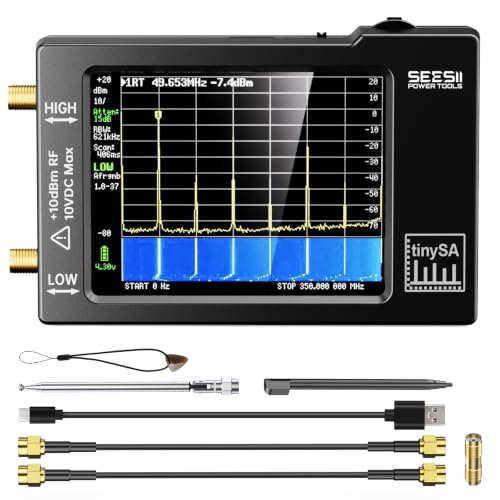
Portable TinySA Spectrum Analyzer,SEESII Upgraded V0.3.1 Handheld Tiny Frequency Analyzer 100kHz to 960MHz MF/HF/VHF UHF Input,Signal Generator with 2.8 inch Touch Screen with ESD Protect Function
Included for 'Best Spectrum Analyzers' as a relevant option in this category; details come from the product listing.
View on AmazonThis is the classic entry-level TinySA: 100 kHz to 960 MHz, handheld, USB-powered, and priced at the bottom of the market. It is the analyzer most people should buy as a first instrument, precisely because the money left over buys the antenna that actually determines what you can hear.
Who it suits: students, first-time ham licensees, hobbyists troubleshooting wireless microphones and remote controls, and anyone who wants to understand spectrum basics before committing real money. It is also a sensible second unit — keep it in the car or the field bag and leave the expensive analyzer on the bench.
Key specs:
- Frequency range: 100 kHz to 960 MHz
- Version: V0.3.1
- Form factor: handheld, compact, pocket-sized
- Connectivity: USB for power and PC-side control
- Coverage: MF/HF/VHF/UHF bands, AM and FM broadcast, 2 m and 70 cm amateur bands
Strengths. The 100 kHz–960 MHz range is not a compromise for most beginner work — it is exactly the range where the interesting signals live for someone starting out. AM broadcast sits around 530–1700 kHz, shortwave spans roughly 3–30 MHz, FM broadcast occupies 88–108 MHz, the 2-meter amateur band is at 144–148 MHz, the 70-centimeter band at 430–450 MHz, and the 900 MHz ISM band used by countless consumer devices falls just under the ceiling. Weather radio, garage door remotes, wireless microphones, and older cordless phones all fall inside.
The small size is a genuine advantage for a first instrument. It disappears into a pocket, runs from USB power, and does not demand a dedicated workspace. That low friction matters: an analyzer you actually carry gets used, and an analyzer that lives in a box gets sold. The low cost also means that if you damage the input with an overdriven transmitter — a common and educational mistake — the loss is survivable.
Pros
- Lowest entry cost among the analyzers compared here
- Coverage maps cleanly onto the signals a beginner actually wants to find
- Pocket-sized and USB-powered, so it is easy to carry and easy to deploy
- Large community of users and documented firmware for support and troubleshooting
- Good candidate for a second, sacrificial field unit
Cons
- 960 MHz ceiling excludes 2.4 GHz Wi-Fi, Bluetooth, and most modern ISM activity
- No touchscreen on this variant, so navigation is by buttons
- Dynamic range and amplitude accuracy are entry-tier
- No tracking generator or built-in preamplifier
How it compares. Against the SKYSHL 2.8-inch V0.3.1, both share the same 100 kHz–960 MHz range and V0.3.1 firmware; the SKYSHL adds a 2.8-inch touchscreen, which speeds up navigation but also adds a failure point and slightly raises cost. Against the SEESII and AURSINC 5.4 GHz ZS406 models, this covers roughly one-fifth of the spectrum for a fraction of the price — a rational trade if your interests are HF and VHF. Against the benchtop Rigol DSA815-TG, the gap is architectural, not incremental: the DSA815 has resolution bandwidth down to 10 Hz and a tracking generator, capabilities this unit simply does not attempt. Buy this to learn; buy that to measure.
4. Siglent SSA3021X – Best for Bench Work with a Tracking Generator

Siglent Technologies SSA3021X Spectrum Analyzers,9 kHz to 2.1 GHz with Free Tracking Generator
Included for 'Best Spectrum Analyzers' because the listing specifies 9 kHz to 2.1 GHz with Free Tracking Generator, details this guide uses to compare options.
View on AmazonThe SSA3021X is a 9 kHz–2.1 GHz benchtop analyzer with a tracking generator included at no extra cost. It is the point at which spectrum analysis stops being reconnaissance and starts being measurement.
Who it suits: RF engineers, radio amateurs who build and align their own equipment, service technicians repairing transceivers, and anyone characterizing filters, amplifiers, duplexers, or antennas. If you need to produce a plot that someone else will accept as evidence, this is the class of instrument to use.
Key specs:
- Frequency range: 9 kHz to 2.1 GHz
- Tracking generator: included as standard
- Form factor: benchtop with a large front-panel display
- Resolution bandwidth: narrow enough for detailed close-in analysis of adjacent signals
- Connectivity: standard bench interfaces for PC control and data export
Strengths. The tracking generator is the feature that changes what you can do. A tracking generator produces a signal at exactly the frequency the analyzer is currently tuned to, which means you can feed a device under test and watch its response across frequency in real time. That turns the instrument into a scalar network analyzer: sweep a filter and see its passband, its stopband, and its roll-off; sweep a duplexer and check isolation; sweep an antenna and see where it resonates. A handheld without a tracking generator cannot do this without a separate signal source synchronized to the sweep, which in practice is more trouble than it is worth.
Dynamic range is the second decisive advantage. A benchtop front end handles a much wider span between the strongest signal it can tolerate and the weakest it can resolve. In the field this is the difference between seeing a weak signal next to a strong one and having it buried in the analyzer’s own noise floor and intermodulation products. Narrow resolution bandwidth settings also let you separate closely spaced carriers that a handheld will simply render as one blob.
Pros
- Tracking generator included, enabling filter and amplifier response measurement
- 9 kHz–2.1 GHz range covers HF through most land-mobile and amateur allocations
- Benchtop dynamic range far exceeds handheld units
- Narrow resolution bandwidth for resolving closely spaced signals
- Large display makes marker work and multi-trace comparison practical
Cons
- Premium tier pricing — several times the cost of any handheld here
- Not portable; requires mains power and bench space
- 2.1 GHz ceiling excludes 2.4 GHz and 5 GHz ISM bands
- Overkill for a reader whose only need is “is something transmitting nearby?”
How it compares. Against the Siglent SSA3021X Plus, the Plus adds a preamplifier, which raises sensitivity for weak-signal work — a meaningful upgrade if you measure low-level emissions but unnecessary if your signals are comfortably above the noise floor. Against the SSA3032X, the difference is the 3.2 GHz ceiling, which matters if your work extends into the 2.4 GHz ISM band and you want margin above it. Against the Rigol DSA815-TG, both offer tracking generators and benchtop performance, but the SSA3021X reaches 2.1 GHz while the DSA815 stops at 1.5 GHz, and the Siglent offers more span headroom. Against any handheld in this list, the comparison is not really fair in either direction: the handheld wins on portability and price, the benchtop wins on every measurement-quality metric.
5. AURSINC TinySA Ultra+ ZS406 – Best for Touchscreen Handheld Scanning

AURSINC TinySA Ultra+ ZS406 Spectrum Analyzer, 4.0" Touchscreen 100kHz-5.4GHz Handheld Frequency Analyzer with 32Gb Card, 2-in-1 Signal Generator MF/HF/VHF UHF Input, HW V0.4.6, 2025 Upgraded
Included for 'Best Spectrum Analyzers' because the listing specifies 2-in-1 Signal Generator MF/HF/VHF UHF Input and HW V0.4.6, details this guide uses to compare options.
View on AmazonThis is the AURSINC-branded ZS406 with a 4.0-inch touchscreen, covering 100 kHz–5.4 GHz. It is the same frequency class as the SEESII ZS406, differentiated by the touch interface and packaging.
Who it suits: users who find menu-driven button navigation frustrating, anyone who wants to place and drag markers directly on the trace, and readers who value a smoother interaction loop during field work where one hand is holding an antenna.
Key specs:
- Frequency range: 100 kHz to 5.4 GHz
- Display: 4.0-inch touchscreen
- Form factor: handheld, battery-powered
- Connectivity: USB for PC control and data transfer
- Input: standard RF connector compatible with common antennas and attenuators
Strengths. Touch control is not a gimmick on a spectrum analyzer. Setting a marker, adjusting a center frequency, or zooming into a span on a touchscreen takes a fraction of the time it takes through a button menu tree, and in field work that speed compounds across a survey. When you are sweeping an area looking for an intermittent interferer, the ability to tap a peak, zoom, and re-tune in a couple of seconds means you catch signals you would otherwise miss while navigating menus.
The 5.4 GHz range covers all the common ISM activity plus higher amateur allocations, and because it accepts standard antennas and attenuators, the accessory path is open. The touchscreen also makes the on-device display more useful as a standalone tool rather than as a screen you glance at while a laptop does the real work.
Pros
- 4-inch touchscreen significantly speeds up marker and span adjustment
- 100 kHz–5.4 GHz range covers HF through upper 5 GHz Wi-Fi
- Self-contained battery operation with no laptop required
- USB connectivity for PC-side capture when you do want it
- Budget tier pricing for the frequency range delivered
Cons
- Touchscreens are an additional failure point in rough field conditions
- Handheld dynamic range limits weak-signal detection near strong carriers
- No tracking generator
- Functionally very close to the SEESII ZS406, so the choice between them comes down to interface preference
How it compares. Against the SEESII TinySA Ultra+ ZS406, the frequency range and core capability are the same class; the touchscreen is the deciding difference, and it is worth paying for if you do a lot of on-device marker work. Against the AURSINC ZS407 at 7.3 GHz, this gives up the upper microwave bands to save money — a straightforward trade if your work stays below 5.4 GHz. Against the SEESII SSA463, which covers 35 MHz–6.3 GHz with an included 30 dB attenuator, this analyzer starts lower in frequency and comes without the attenuator, which matters if you routinely measure strong local transmitters and need to protect the input.
6. Rigol DSA815-TG – Best for Affordable Benchtop Measurement with a Tracking Generator
The DSA815-TG is a swept benchtop analyzer covering 9 kHz–1.5 GHz with a resolution bandwidth range from 10 Hz to 1 MHz and an included tracking generator. It is the traditional entry point into real bench measurement.
Who it suits: service shops, university labs on a constrained budget, radio amateurs who repair and align commercial gear, and buyers who want benchtop capability without paying premium-tier prices.
Key specs:
- Frequency range: 9 kHz to 1.5 GHz
- Resolution bandwidth: 10 Hz to 1 MHz
- Tracking generator: included
- Architecture: swept spectrum analyzer, benchtop
- Connectivity: standard bench interfaces for control and data export
Strengths. The 10 Hz minimum resolution bandwidth is the specification that separates this from handheld instruments. Resolution bandwidth determines how finely you can slice the spectrum — at 10 Hz you can resolve carriers that are tens of hertz apart, inspect modulation sidebands in detail, and pull a weak signal out of a crowded band by narrowing the measurement window. Handhelds typically bottom out at much wider settings, which is why closely spaced signals appear merged on their displays.
The 9 kHz–1.5 GHz range covers the entire HF spectrum, all of VHF, and the 23-centimeter amateur band around 1.2 GHz, plus the 1.4 GHz region used by various telemetry and video links. The included tracking generator lets you sweep filters and amplifiers — the standard bench tasks. For a first benchtop instrument, the combination of narrow RBW, a tracking generator, and mid-range pricing is difficult to beat, and it explains why this model has been a long-standing reference in the category.
Pros
- 10 Hz resolution bandwidth enables close-in signal analysis
- Tracking generator included for filter and amplifier response sweeps
- Benchtop dynamic range suits real measurement work
- Mid-range pricing for genuine bench capability
- 1.5 GHz reach covers HF, VHF, UHF, and the 1.2 GHz amateur band
Cons
- 1.5 GHz ceiling excludes 2.4 GHz and 5 GHz ISM bands entirely
- Mains-powered benchtop form factor is not portable
- Swept architecture rather than real-time capture, so transient signals can be missed
- Narrow RBW settings slow the sweep — a fundamental tradeoff you must manage
How it compares. Against the Siglent SSA3021X, the Siglent reaches 2.1 GHz versus 1.5 GHz and offers more span headroom, while the Rigol is generally the more affordable route into the same capability tier. Against the Siglent SSA3032X, the 3.2 GHz model adds coverage that lets you look at the 2.4 GHz ISM band with margin. Against the RIGOL RSA808, the distinction is architectural: the RSA808 is a real-time analyzer that can capture transient events the swept DSA815 will miss, but it costs substantially more and targets a different job. Against the handheld TinySA models, this instrument wins decisively on resolution bandwidth and dynamic range and loses just as decisively on portability and price.
7. SKYSHL 2.8″ Touchscreen TinySA V0.3.1 – Best for the Smallest Footprint

SKYSHL 2.8" Touchscreen TinySA Portable Spectrum Analyzer, 100kHz to 960MHz V0.3.1 Handheld Frequency Meter MF/HF/VHF and UHF Input Signal Source with ESD Protected
Included for 'Best Spectrum Analyzers' as a relevant option in this category; details come from the product listing.
View on AmazonA 100 kHz–960 MHz handheld with a 2.8-inch touchscreen running V0.3.1 firmware — the smallest and most packable analyzer in this comparison.
Who it suits: readers who want an analyzer that genuinely disappears into a shirt pocket, travelers and field workers with limited bag space, and anyone who wants touch navigation without moving up to the 5.4 GHz class.
Key specs:
- Frequency range: 100 kHz to 960 MHz
- Display: 2.8-inch touchscreen
- Version: V0.3.1
- Form factor: handheld, MF/HF/VHF/UHF coverage
- Connectivity: USB for power and PC control
Strengths. The touchscreen on a compact body makes the small display work harder than its size suggests — tapping a peak to place a marker is far more efficient than stepping through menus with a tiny button cluster. The 100 kHz–960 MHz range covers the same useful beginner spectrum as the non-touch V0.3.1 units: broadcast AM and FM, shortwave, the 2-meter and 70-centimeter amateur bands, weather radio, and the lower ISM region.
Because it shares the V0.3.1 firmware lineage with other entry TinySA units, the operating model is familiar and well documented, so the learning curve is short and the community support is there when you get stuck. For a device meant to be carried and used casually, that low-friction software experience matters as much as the hardware.
Pros
- Smallest physical footprint of any analyzer in this comparison
- 2.8-inch touchscreen speeds up marker placement and menu navigation
- 100 kHz–960 MHz covers the bands beginners most often want to inspect
- Well-documented V0.3.1 firmware with an active user community
- Budget tier pricing
Cons
- 2.8-inch display is cramped for detailed multi-marker work
- 960 MHz ceiling excludes Wi-Fi, Bluetooth, and 2.4 GHz activity
- Entry-tier dynamic range and amplitude accuracy
- No tracking generator or preamplifier
How it compares. Against the SEESII non-touch V0.3.1 unit, the hardware range is the same and the difference is the touchscreen and the smaller body — choose this if portability and touch navigation matter more than screen size. Against the AURSINC or SEESII ZS406 at 5.4 GHz, this covers far less spectrum but fits in places the larger units will not, and the size advantage is the entire argument. Against the benchtop Rigol DSA815-TG, the comparison is between a pocket tool and a measurement instrument; the DSA815 will produce defensible numbers and this will tell you roughly what is happening on the air.
8. RIGOL RSA808 – Best for Real-Time Analysis to 8.5 GHz

RIGOL RSA808 Real-Time Spectrum Analyzer,8.5GHz Portable RF Signal Analyzer
Included for 'Best Spectrum Analyzers' because the listing specifies 8.5GHz Portable RF Signal Analyzer, details this guide uses to compare options.
View on AmazonThe RSA808 is a portable real-time spectrum analyzer reaching 8.5 GHz. Real-time analysis means the instrument can capture and display transient events that a swept analyzer never sees — brief interference bursts, frequency-hopping signals, and intermittent emissions that last microseconds.
Who it suits: RF professionals investigating intermittent interference, engineers working with frequency-hopping or burst-mode systems, regulatory and spectrum-management users, and anyone whose problem signals appear and vanish faster than a sweep can catch them.
Key specs:
- Frequency range: up to 8.5 GHz
- Architecture: real-time spectrum analysis with gapless capture
- Form factor: portable RF signal analyzer
- Coverage: C-band, 5 GHz and 6 GHz Wi-Fi, upper microwave allocations
- Price tier: premium
Strengths. Real-time capture is the defining capability. A swept analyzer tunes across the band, so it is only ever looking at one narrow slice at a time — a signal that appears for a few microseconds while the sweep is elsewhere is simply never recorded. A real-time analyzer digitizes a wide span continuously and processes it fast enough to display every event above a defined duration, which is why it is the only tool that reliably finds frequency-hopping interferers, radar pulses, and the intermittent arcing that shows up in cable-TV and cellular interference complaints.
The 8.5 GHz range adds the 5.8 GHz ISM band, the 6 GHz Wi-Fi 6E allocation, C-band satellite downlinks, and higher microwave links. Combined with real-time capture, that makes this the instrument for characterizing dense modern RF environments where numerous emitters occupy overlapping bands and transient behavior is the whole question.
Pros
- Real-time architecture captures transient and frequency-hopping signals swept analyzers miss
- 8.5 GHz coverage spans 5.8 GHz ISM, 6 GHz Wi-Fi, C-band, and upper microwave
- Portable form factor relative to benchtop instruments of the same class
- Suited to dense, interference-heavy environments
- Premium performance for professional and regulatory work
Cons
- Premium tier pricing — the most expensive class in this comparison
- Real-time analysis demands understanding of capture time and probability of intercept to be useful
- Capability far exceeds the needs of a typical hobbyist
- Cost per use is poor if you only need occasional band-activity checks
How it compares. Against the Siglent SSA3021X and SSA3032X, the difference is architectural and not merely one of frequency: those are swept analyzers that stop at 2.1 GHz and 3.2 GHz respectively, while this captures gapless real-time data to 8.5 GHz. If your interference is continuous and stable, a swept analyzer at a fraction of the price will characterize it fine. If it flickers, hops, or appears only during certain hours, only a real-time instrument will prove it exists. Against the handheld TinySA units, this is a different tool category entirely — the handheld is for presence detection, the RSA808 is for signal forensics.
9. Siglent SSA3021X Plus – Best Premium All-Rounder

Siglent SSA3021X Plus - 2.1 GHz Spectrum Analyzer with Tracking Generator and Preamplifier
Included for 'Best Spectrum Analyzers' as a relevant option in this category; details come from the product listing.
View on AmazonThe SSA3021X Plus is a 2.1 GHz benchtop analyzer with both a tracking generator and a preamplifier. It is the refined version of the SSA3021X, and the two extra capabilities address the two most common limitations of a base model.
Who it suits: RF engineers, advanced amateurs, and lab users who need both to generate stimulus and to detect very weak signals. The preamplifier is the feature that matters for EMC pre-compliance work and for anyone chasing low-level emissions.
Key specs:
- Frequency range: 9 kHz to 2.1 GHz
- Tracking generator: included
- Preamplifier: built in
- Form factor: benchtop with large front-panel display
- Resolution bandwidth: narrow settings for close-in analysis
Strengths. The preamplifier raises the instrument’s sensitivity, effectively lowering the noise floor so that signals previously hidden become measurable. In EMC pre-compliance testing, where you are trying to determine whether a product’s emissions are close to a limit, that sensitivity is what makes the measurement meaningful. Without it, a weak emission may sit below the analyzer’s own noise and go undetected.
The tracking generator, as with the base model, enables filter, amplifier, and antenna response measurement. Together, the two features mean this instrument can both stimulate a device and detect its faint response — the complete bench loop. Compared with the base SSA3021X, the Plus removes the need for an external preamp and the associated cabling and calibration hassle, which is worth real money in a lab where time is the scarce resource.
Pros
- Built-in preamplifier improves sensitivity for weak-signal and EMC-style work
- Tracking generator included for response measurements
- 9 kHz–2.1 GHz range covers HF through most land-mobile and amateur bands
- Benchtop dynamic range and narrow RBW for detailed analysis
- The most complete general-purpose bench analyzer in this comparison
Cons
- Premium pricing, higher than the base SSA3021X
- 2.1 GHz ceiling excludes 2.4 GHz and 5 GHz Wi-Fi
- Mains-powered, not portable
- The preamplifier is only worth paying for if you actually measure weak signals
How it compares. Against the base Siglent SSA3021X, the Plus is the better instrument if you have any need for weak-signal sensitivity; if all your signals are strong and local, the base model saves money for identical frequency coverage. Against the SSA3032X, the trade is sensitivity versus span: the 3032X reaches 3.2 GHz and can therefore see the 2.4 GHz ISM band, while the 3021X Plus cannot. If both matter to you, that is the decision point. Against the Rigol DSA815-TG, the Siglent offers more frequency coverage, and the Plus adds the preamplifier the Rigol lacks. Against the RIGOL RSA808, you are choosing between a highly sensitive swept analyzer and a real-time analyzer with more reach — continuous signals favor the Siglent, transient signals favor the Rigol.
10. Siglent SSA3032X – Best Premium Analyzer with More Frequency Headroom

Siglent Technologies SSA3032X Spectrum Analyzers,9 kHz to 3.2 GHz,TG Standard
Included for 'Best Spectrum Analyzers' because the listing specifies 9 kHz to 3.2 GHz and TG Standard, details this guide uses to compare options.
View on AmazonThe SSA3032X extends the Siglent benchtop line to 3.2 GHz with the tracking generator included as standard. The extra gigahertz over the 2.1 GHz models is the reason to choose it.
Who it suits: engineers and advanced users working in the 2.4 GHz ISM band, wireless infrastructure technicians, and anyone who needs to see Wi-Fi, Bluetooth, and Zigbee activity with margin above and below the band rather than pressed against the analyzer’s ceiling.
Key specs:
- Frequency range: 9 kHz to 3.2 GHz
- Tracking generator: included as standard
- Form factor: benchtop with large front-panel display
- Resolution bandwidth: narrow settings for close-in analysis
- Coverage: includes the full 2.4 GHz ISM band with headroom
Strengths. Sweeping the 2.4 GHz band with an analyzer whose ceiling is 2.1 GHz is impossible, and sweeping it with an analyzer whose ceiling is exactly 2.4 GHz is technically possible but leaves no room to observe harmonics, images, or the band edges properly. The 3.2 GHz ceiling gives real margin: you can view the whole 2.400–2.4835 GHz ISM allocation with space above it to see out-of-band emissions and the second harmonic of lower-frequency sources.
The included tracking generator makes this a complete bench instrument for filter and amplifier work, and the benchtop front end delivers the dynamic range and narrow resolution bandwidth needed for credible measurement. For an RF lab whose work has drifted upward in frequency from HF and VHF into the microwave-adjacent region, this is the natural upgrade that keeps a single instrument covering the whole workload.
Pros
- 9 kHz–3.2 GHz range includes the full 2.4 GHz ISM band with headroom
- Tracking generator included as standard
- Benchtop dynamic range and narrow RBW
- Single instrument covers HF through 2.4 GHz wireless work
- Direct upgrade path from the 2.1 GHz Siglent models
Cons
- Premium tier pricing, above the 2.1 GHz models
- Still excludes the 5 GHz Wi-Fi bands
- Benchtop form factor, no field use
- No built-in preamplifier as a headline feature — check the exact configuration before buying
How it compares. Against the Siglent SSA3021X and SSA3021X Plus, the SSA3032X buys 1.1 GHz of additional coverage and the ability to work in the 2.4 GHz ISM band. If you never go above 2.1 GHz, the lower models are cheaper and equally capable. Against the RIGOL RSA808, the trade is 3.2 GHz swept versus 8.5 GHz real-time: the RSA808 reaches much higher and captures transients, but costs considerably more. Against the Rigol DSA815-TG, the Siglent offers more than twice the frequency coverage at a higher price — a reasonable premium if 2.4 GHz work is on your roadmap.
11. SEESII TinySA Ultra+ ZS407 with ZA-048 LPDA Antenna – Best Bundle for Field Direction-Finding
This bundle pairs the 100 kHz–7.3 GHz TinySA Ultra+ ZS407 with a ZA-048 log-periodic dipole array antenna. The analyzer is the same instrument described earlier; the antenna is what makes the bundle worth considering separately.
Who it suits: anyone hunting an interference source, performing site surveys, or locating a transmitter. Direction-finding requires a directional antenna, and buying the analyzer and antenna together removes the guesswork about which antenna is compatible and appropriate.
Key specs:
- Analyzer frequency range: 100 kHz to 7.3 GHz
- Included antenna: ZA-048 log-periodic dipole array (LPDA)
- Display: 4-inch on-device sweep display
- Form factor: handheld, battery-powered analyzer
- Connectivity: USB for PC control and data export
Strengths. A log-periodic dipole array is directional across a broad frequency range, which means you can point it and watch the signal amplitude change as you rotate — the fundamental technique for locating a transmitter. A simple whip antenna is omnidirectional and tells you a signal exists but gives no bearing; an LPDA gives you a bearing, and a bearing plus a couple of measurements from different positions gives you a location. For interference hunting, this is the difference between knowing there is a problem and finding it.
The 7.3 GHz analyzer range means the same antenna-and-analyzer pair covers HF through upper microwave, so the kit does not need to be reconfigured for different jobs. Log-periodic arrays are also inherently broadband and reasonably tolerant of being used slightly outside their design range, which suits field work where conditions are not ideal.
Pros
- Directional LPDA antenna enables actual direction-finding, not just detection
- 100 kHz–7.3 GHz analyzer covers the antenna’s usable range and beyond
- Single purchase covers analyzer and antenna with known compatibility
- Handheld and battery-powered for genuine field deployment
- Broadband antenna reduces the need for multiple band-specific antennas
Cons
- An LPDA is physically larger than a whip and less convenient to pocket
- Higher cost than the bare analyzer
- Still a handheld front end, with the same dynamic range limitations
- Direction-finding technique must be learned — the antenna does not locate the source by itself
How it compares. Against the bare AURSINC ZS407, this bundle adds the antenna that turns a scanning tool into a hunting tool, and if direction-finding is your goal the bundle is the more efficient purchase. Against the SEESII ZS406 or AURSINC ZS406, it costs more but reaches 7.3 GHz instead of 5.4 GHz with a directional antenna included. Against the SEESII SSA463, which covers 35 MHz–6.3 GHz with a 30 dB attenuator, this bundle trades the attenuator for the directional antenna and a wider frequency range. Which is better depends on whether your adversary is a weak signal you must find or a strong signal you must survive.
12. SEESII SSA463 – Best for Mid-Band Work with Input Protection
The SSA463 covers 35 MHz–6.3 GHz and ships with a 30 dB attenuator. The attenuator is the distinguishing inclusion, and it addresses the single most common way people destroy a spectrum analyzer input.
Who it suits: technicians working near strong transmitters, installers measuring in environments with high RF field strength, and anyone who has learned — or would rather not learn the hard way — that an analyzer input has a maximum safe power level.
Key specs:
- Frequency range: 35 MHz to 6.3 GHz
- Included accessory: 30 dB attenuator
- Form factor: handheld
- Coverage: VHF, UHF, 2.4 GHz and 5 GHz ISM bands, upper microwave
- Price tier: mid-range
Strengths. The 30 dB attenuator is not a filler accessory. Measuring a transmitter directly, or working close to a broadcast tower, can present the analyzer input with a signal strong enough to damage its front end. A 30 dB attenuator reduces the signal by a factor of a thousand in power terms, which brings a great many real-world situations back inside the safe input range. Because it is included rather than bought separately, the instrument arrives ready for that reality.
The 35 MHz starting point is a deliberate choice: this analyzer is aimed at VHF and above, where most modern wireless activity lives. The 6.3 GHz ceiling covers the 2.4 GHz and 5 GHz ISM bands, the 5.8 GHz band, and the 6 GHz Wi-Fi 6E allocation, which makes it relevant to modern wireless troubleshooting rather than legacy-only work. For someone whose work is Wi-Fi, wireless microphones, telemetry, and land-mobile radio, the lower HF frequencies are simply not needed, and not paying for them is sensible.
Pros
- 30 dB attenuator included, protecting the input in high-field environments
- 6.3 GHz coverage includes 5 GHz and 6 GHz Wi-Fi bands
- 35 MHz starting point targets the VHF-and-above work most users actually do
- Handheld form factor for field and site work
- Mid-range pricing with an accessory that would otherwise be an extra purchase
Cons
- No HF coverage — the 35 MHz floor excludes shortwave and the lower amateur bands
- Handheld dynamic range limits weak-signal work near strong transmitters
- No tracking generator
- 6.3 GHz is below the 7.3 GHz of the ZS407, so upper microwave work is out of reach
How it compares. Against the AURSINC and SEESII ZS407 models at 7.3 GHz, this gives up a gigahertz of top-end range and all HF coverage, but gains the included attenuator and a price point below the premium handhelds. Against the SEESII ZS407 bundle with the LPDA antenna, the choice is between finding weak signals and surviving strong ones — the antenna favors direction-finding, the attenuator favors safe measurement near transmitters. Against the benchtop Siglent and Rigol instruments, this offers portability and 6.3 GHz coverage for far less money, at the cost of dynamic range and resolution bandwidth. For a wireless technician rather than an HF operator, the trade is well chosen.
How to Choose
Choosing a spectrum analyzer is mostly a matter of deciding which three or four specifications actually govern your work, then accepting the compromises the rest of the field imposes. Here is how each criterion translates into a decision with concrete numbers.
Frequency range: start from the highest signal you need to see
Write down the highest frequency you expect to measure, then add at least 20 percent of headroom so you can see harmonics and band edges. If your answer is under 1 GHz — AM and FM broadcast, shortwave, 2-meter and 70-centimeter amateur bands, weather radio, most wireless microphones and remotes — a 100 kHz–960 MHz handheld is sufficient and costs the least. If your answer is 2.4 GHz or 5 GHz Wi-Fi, Bluetooth, or Zigbee, you need at least 2.4 GHz of coverage with margin, which means a 5.4 GHz handheld or a 3.2 GHz benchtop. If you work with 6 GHz Wi-Fi, C-band satellite, or upper amateur microwave allocations, you need a 6.3 GHz or 7.3 GHz unit, or the 8.5 GHz real-time analyzer. Buying more frequency than you need is the most common and most expensive mistake in this market — a 960 MHz analyzer covers roughly a fifth of the spectrum of a 5.4 GHz unit, and if your signals all live below 960 MHz, the extra coverage earns nothing.
Real-time bandwidth versus swept operation
A swept analyzer tunes across the band one slice at a time. It is inexpensive, has excellent dynamic range, and is the right choice for stable, continuous signals. Its limitation is time: while the sweep is at 800 MHz, a 50-microsecond burst at 2.4 GHz goes completely unrecorded. If the signal you are chasing is continuous — an FM carrier, a Wi-Fi access point, a leaking cable modem downlink — a swept analyzer will find it comfortably. If it is intermittent, frequency-hopping, or pulse-modulated, you need a real-time analyzer, which digitizes a wide span continuously and processes it fast enough to display events lasting microseconds. Real-time analysis costs substantially more, and its value is entirely determined by whether your problem signal is transient. Be honest about this: many people who think they need real-time analysis are actually chasing stable signals and would be better served by a sensitive swept instrument.
Dynamic range and resolution bandwidth
Dynamic range is the span between the strongest signal the analyzer can handle without distortion and the weakest it can distinguish from its own noise. Handheld instruments have narrower dynamic range than benchtops by a wide margin, which means a strong local transmitter can generate intermodulation products inside a handheld that appear as phantom signals, or can simply lift the noise floor enough to hide a weak signal. Resolution bandwidth is the related control: narrow RBW settings let you resolve closely spaced carriers and pull weak signals out of noise, at the cost of slower sweeps. A benchtop with 10 Hz minimum RBW can separate signals tens of hertz apart; a handheld that bottoms out at much wider settings will show them as one merged blob. If you must measure accurately in the presence of strong signals, this criterion outranks frequency range.
Sweep speed
Sweep speed is set by span and resolution bandwidth, and it is not adjustable at will — narrowing the RBW to resolve fine detail necessarily slows the sweep. In practice, a wide-span, narrow-RBW sweep on a handheld can take seconds, which makes hunting an intermittent signal by repeated sweeping impractical. This is another reason real-time architecture matters for transient work: it sidesteps the sweep-time tradeoff entirely. If your workflow involves sweeping a band repeatedly to catch something that comes and goes, prioritize capture architecture over raw sensitivity.
Portability, power, and connections
Decide whether the instrument must run on battery away from mains power. If yes, the handheld class is your only option, and you should also plan your antenna strategy, because a folded whip in a pocket is far less effective than a proper antenna. If the analyzer will live on a bench, the benchtop class gives you a large display, more physical controls, and better thermal stability, which translates directly into more repeatable measurements. On connectivity: a USB interface is the practical minimum, since it lets you export traces to a computer for storage and comparison. For bench instruments, look for standard control interfaces and confirm that the software you intend to use supports the model before you buy.
The tracking generator question
A tracking generator is an internal signal source that follows the analyzer’s sweep. With one, you can feed a device and watch its response across frequency — the passband and roll-off of a filter, the gain curve of an amplifier, the resonance of an antenna, the isolation of a duplexer. Without one, you can still measure what a device emits, but you cannot easily measure how it responds to a stimulus. If your work is “what is this thing radiating,” you do not need a tracking generator. If your work is “how does this filter behave,” you do. This single feature cleanly divides the handheld class from the benchtop class in this comparison, and it is the most common reason people outgrow a first analyzer.
The accessory budget nobody plans for
An analyzer is a receiver, and a receiver is only as good as what feeds it. Budget for three accessories alongside the instrument itself. First, an antenna appropriate to your bands — a directional log-periodic array for hunting and locating, a broadband discone for general coverage. Second, a set of fixed attenuators, commonly 10 dB, 20 dB, and 30 dB, to protect the input when you measure near a transmitter; a 30 dB attenuator reduces signal power by a factor of a thousand and prevents the most common cause of analyzer death. Third, quality coaxial cable and adapters, because a poor cable adds loss that directly subtracts from your sensitivity and can make a working system look broken. Readers routinely spend more on the analyzer than on the accessories and then wonder why results are poor. In practice, the antenna frequently matters more than the analyzer.
Matching the instrument to the reader
If you are a beginner who wants to understand what is on the air, a 100 kHz–960 MHz handheld is the right first purchase, and the money saved should go to an antenna. If you are a licensed amateur working 2-meter and 70-centimeter bands and occasionally above, a 5.4 GHz handheld covers everything with margin. If you work with 6 GHz Wi-Fi or microwave allocations, step up to a 6.3 GHz or 7.3 GHz handheld, or the real-time analyzer if your signals are transient. If you repair, align, or characterize equipment and need to produce measurements someone else will rely on, move to a benchtop with a tracking generator — 1.5 GHz if your work is HF and VHF, 2.1 GHz if you need more span and preamplification for weak signals, 3.2 GHz if 2.4 GHz ISM work is on the schedule. If you are hunting intermittent interference that conventional sweeps never catch, only a real-time analyzer will solve the problem, and no amount of sensitivity in a swept instrument will substitute for it.
Frequently Asked Questions
Do I need a spectrum analyzer or an oscilloscope?
They answer different questions. An oscilloscope shows you a signal in the time domain — its waveform, rise time, and voltage — while a spectrum analyzer shows you the frequency domain, meaning which frequencies are present and at what amplitude. If you are debugging a digital circuit or looking at a signal’s shape, you want an oscilloscope. If you are asking what is transmitting, where interference is coming from, or whether a filter is behaving, you want a spectrum analyzer. Many RF problems are effectively invisible in the time domain and obvious in the frequency domain.
Can a cheap handheld analyzer really be useful?
Yes, provided you understand what it does well. Entry-level handhelds are excellent at presence detection: is something transmitting here, and roughly how strong is it. They are not suitable for producing calibrated measurements you would submit as evidence, because their amplitude accuracy and dynamic range are limited. For hobbyists, installation troubleshooting, and learning the fundamentals, that distinction rarely matters. For compliance documentation or resolving a formal interference complaint, it does.
What does “real-time bandwidth” actually mean, and do I need it?
Real-time bandwidth describes how much of the spectrum the analyzer can digitize and process continuously without gaps, so that no signal above a certain duration is missed. A swept analyzer has effectively zero real-time bandwidth because it looks at one slice at a time. You need real-time capability if your signals are brief, intermittent, or frequency-hopping — arcing in a connector, a radar pulse, a burst transmission. If your signals are continuous and stable, a swept analyzer with good dynamic range will serve you better for less money.
Why does everyone say to buy a better antenna first?
Because the analyzer is only as sensitive as the signal delivered to it, and antennas vary enormously in how well they capture signals at different frequencies. A broadband whip that comes with a handheld performs poorly at the edges of its range, while a properly tuned or directional antenna can deliver many decibels more signal — often more improvement than upgrading from one analyzer tier to the next would provide. A directional antenna also enables direction-finding, which no analyzer can do on its own.
How do I avoid damaging my analyzer’s input?
Never connect an analyzer directly to a transmitter’s output. Always use an attenuator — commonly 10 dB, 20 dB, or 30 dB — sized so the expected signal falls comfortably inside the analyzer’s maximum safe input level, and check the specification before you connect anything. Also use DC blocks where a bias voltage may be present, and avoid connecting to antennas during nearby lightning activity. Input damage from overdrive is the most common way these instruments die, and it is entirely preventable with an attenuator and a moment of forethought.
Do I need a tracking generator?
Only if you need to measure how a device responds to a signal rather than what it emits. A tracking generator makes it possible to sweep a filter and see its passband, check an amplifier’s gain flatness, or find an antenna’s resonant frequency. If your work is receiving — finding out what is on the air — you do not need one. If your work is building, aligning, or repairing RF hardware, a tracking generator turns the analyzer into a far more capable bench tool and is usually the single feature that justifies moving from a handheld to a benchtop instrument.
What resolution bandwidth do I actually need?
It depends on how close together the signals you must separate are. To resolve two carriers 1 kHz apart you need an RBW well under 1 kHz, and to inspect modulation sidebands in detail you may want 10 Hz or 100 Hz. For general band-activity scanning, a much wider setting is fine and keeps sweeps fast. Remember that narrower RBW means slower sweeps, so use the widest setting that resolves what you need rather than the narrowest available. Benchtop instruments typically reach 10 Hz; handhelds generally bottom out at wider settings.
Can I use a handheld analyzer for EMC pre-compliance work?
For rough screening, sometimes — it can tell you whether a product is emitting substantially and where. For pre-compliance testing intended to predict whether a product will pass formal limits, a benchtop analyzer with a preamplifier and narrow resolution bandwidth is the appropriate instrument, because the measurement must be repeatable and its sensitivity must be sufficient to see emissions well below the limit line. Handheld dynamic range and amplitude accuracy are generally not adequate for that purpose.
Closing Recommendation by Situation
If you are just starting out and want to see what is on the air, buy the SEESII TinySA 100 kHz–960 MHz V0.3.1 and spend the difference on a decent antenna and a set of attenuators — that combination will teach you more than a more expensive analyzer with a poor antenna. If you need coverage into the 2.4 GHz and 5 GHz bands but still want a handheld, the SEESII or AURSINC TinySA Ultra+ ZS406 at 5.4 GHz is the value pick, and the AURSINC ZS407 at 7.3 GHz is worth the step up if 6 GHz Wi-Fi or microwave work is on your horizon. If you hunt interference in the field, the SEESII ZS407 bundle with the ZA-048 LPDA antenna gives you the directional capability that turns detection into location. If you work near strong transmitters and want the input protected, the SEESII SSA463 arrives with the 30 dB attenuator you would otherwise buy separately. And if you need measurements that hold up — filter sweeps, amplifier characterization, EMC screening, calibration work — move to the bench: the Rigol DSA815-TG is the affordable way in at 1.5 GHz, the Siglent SSA3021X Plus is the best all-round premium choice with a preamplifier for weak-signal work, and the RIGOL RSA808 is the only instrument here that will reliably catch an intermittent signal a swept analyzer never sees.






Write Your Review
No reviews yet. Be the first to share your experience!