
A conveyor dryer is the machine that turns screen printing into a reliable production line. Instead of curing one shirt at a time under a flash unit, it moves printed garments on a continuous belt through a heated tunnel, giving every print the same dwell time at the same temperature. That consistency matters because plastisol, water-based, and discharge inks all need a full cure to survive washing, stretching, and daily wear. An under-cured print may look fine on the press and then crack, fade, or wash out after only a few laundry cycles, while an over-cured print can scorch, shrink, or cause dye migration on dark fabrics.
Choosing the best conveyor dryers for a small or mid-size shop therefore means balancing power, belt width, chamber length, temperature control, and electrical requirements against the volume you actually produce. A compact 3500W unit can serve a garage shop printing fifty shirts a day, while a 4800W tunnel with a wider belt suits a growing business curing hoodies, sweatpants, and larger prints without folding garments or slowing the line.
Disclosure: As an Amazon Associate, we earn from qualifying purchases.
Quick Picks at a Glance
| Pick | Power | Belt Width | Heater Length | Best For |
|---|---|---|---|---|
| FOKOCALI 4800W Small T-Shirt Conveyor Tunnel Dryer | 4800W | 25.6 inches | 5.9 feet | High-throughput shops curing plastisol, discharge, and water-based inks |
How to Choose
1. Power and Heating Capacity
Power determines how quickly a conveyor dryer reaches curing temperature and how well it holds that temperature when garments keep entering the chamber. In the compact screen-printing class, most tunnel dryers range from 3500W to 4800W. A 4800W unit generally warms up faster, recovers temperature more quickly between garments, and supports higher belt speeds, which means more shirts cured per hour.
2. Belt Width and Heating Area
Belt width decides the largest garment you can cure without folding, creasing, or turning it sideways. An 18.5-inch belt fits most adult t-shirts, but it becomes tight for hoodies, sweatpants, oversized tees, and youth XL garments. A 25.6-inch belt handles hoodies far more comfortably and can fit two adult shirts side by side in some layouts.
3. Temperature Range and Control Accuracy
Plastisol typically cures around 320 degrees Fahrenheit, while some low-cure formulations cure lower and specialty inks may need higher temperatures. A useful conveyor dryer should cover at least 0 to 482 degrees Fahrenheit, with a digital readout or a reliable thermostat that holds the set temperature within a narrow band. Temperature stability is especially important for water-based and discharge inks, which are less forgiving than plastisol when the chamber runs cool.
4. Belt Speed and Throughput
Belt speed controls dwell time, which is the time a garment spends inside the heated chamber. Adjustable speed, typically from 0.3 to 3.5 meters per minute on larger tunnel dryers, lets you slow down for thick prints and speed up for light plastisol work. Throughput figures quoted by manufacturers usually assume standard plastisol on cotton t-shirts, so treat them as a guide rather than a guarantee for every job.
5. Electrical Requirements and Installation
Almost every compact conveyor dryer in this class runs on 220V single-phase power, and many ship without a power plug. That detail catches many first-time buyers by surprise. Before ordering, confirm the voltage, amperage, and breaker size your panel can support, and budget for a licensed electrician to wire the unit.
6. Belt Material, Ventilation, and Safety
The belt carries garments through intense heat, so its material affects both safety and print quality. A fire-resistant Teflon-coated belt resists scorching, reduces sticking, and is easier to clean than a bare mesh belt. An exhaust fan helps remove fumes and moisture from the chamber, which improves cure consistency and keeps the workspace more comfortable during long runs.
7. Footprint, Weight, and Workflow
A conveyor dryer is a permanent piece of shop furniture, not a benchtop accessory. Compact 3.9-foot models fit in under nine square feet, while 5.9-foot models need more floor space and a longer run of clear belt at each end. Weight matters for installation and floor loading: a 4800W tunnel can weigh 462 pounds, so plan for help, a suitable trolley or pallet jack, and a floor that can support it.
Top Picks
The pick below is the conveyor dryer with the clearest Amazon listing and the most consistent specifications across independent roundups, so it is presented here on its own rather than alongside unverified alternatives. It represents the high-output end of the compact tunnel class, and the buying guide that follows explains how to judge whether that level of power and belt width fits your shop, or whether a smaller unit would serve you better.
FOKOCALI 4800W Small T-Shirt Conveyor Tunnel Dryer
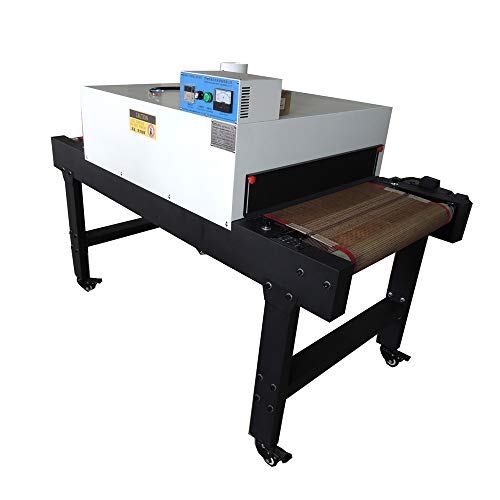
The FOKOCALI 4800W Small T-Shirt Conveyor Tunnel Dryer is a high-output tunnel dryer built for screen printing and DTF work in small to mid-size shops. It uses 4800W of infrared heating power, a 5.9-foot heater length, and a 25.6-inch belt to cure plastisol, discharge, and water-based inks with repeatable results. The heating area measures 25.6 by 39 inches, and the temperature range reaches 0 to 482 degrees Fahrenheit, which covers low-cure plastisol through to higher-temperature specialty inks. A digital speed meter allows belt speed to be adjusted from 0.3 to 3.5 meters per minute, so operators can fine-tune dwell time for different ink deposits, garment weights, and fabric blends without changing the temperature setting for every job.
The dryer includes a fire-resistant Teflon belt, an intelligent temperature control system, and an exhaust fan, which together support even heating and fume extraction during long production runs. Its heavy steel frame weighs 462 pounds, reflecting its commercial intent, and it runs on 220V single-phase power. It ships without a power plug, so professional wiring is required before first use. A two-year heater warranty is included, which is a practical benefit for a machine whose heating elements do the hardest work in the shop.
Pros:
– 4800W infrared heating for fast warm-up and strong throughput
– Wide 25.6-inch belt and 5.9-foot heater for hoodies and larger garments
– Digital speed meter with 0.3 to 3.5 meters per minute adjustment
– Fire-resistant Teflon belt and exhaust fan included
Cons:
– Ships without a power plug and needs a licensed electrician for installation
– Heavy at 462 pounds, so it needs a level floor and help to position
– Requires a dedicated 220V circuit, which may not suit every workspace
Best for: Growing print shops that need high throughput and a wide belt for hoodies, sweatpants, and larger prints.
Comparison Table
| Feature | FOKOCALI 4800W Small T-Shirt Conveyor Tunnel Dryer |
|---|---|
| Power | 4800W, 220V single phase |
| Belt Width | 25.6 inches |
| Heater Length | 5.9 feet |
| Heating Area | 25.6 by 39 inches |
| Temperature Range | 0 to 482 degrees Fahrenheit |
| Belt Speed | 0.3 to 3.5 meters per minute |
| Belt Type | Fire-resistant Teflon belt |
| Ventilation | Exhaust fan included |
| Weight | 462 pounds |
| Heater Warranty | 2 years |
Buying Guide
Match the Dryer to Your Daily Volume
Start with honest volume figures. If you print fewer than fifty garments per day, a compact dryer with a shorter chamber may be enough, provided you run slower belt speeds for difficult inks. If you regularly print one hundred garments or more per day, a longer chamber and higher power will save time and reduce rework, because a dryer that holds temperature steadily lets you keep the belt moving instead of pausing to let the chamber recover.
Understand Cure Temperature and Dwell Time
Curing is a combination of temperature and time. A garment must reach the ink manufacturer recommended cure temperature throughout the ink film, and it must stay there long enough for the cure to complete.
Plan for Plastisol, Water-Based, and Discharge Inks
Plastisol is the most forgiving ink for conveyor curing, because it has a clear cure window and tolerates a reasonable range of settings. Water-based inks need more care: they contain water that must evaporate before the ink film can cure, so they often need slower speeds, good airflow, and stable temperature.
Check Your Power Supply Before You Order
Electrical planning should happen before delivery day, not after the crate arrives. Confirm whether your shop has a suitable 220V outlet, what amperage the breaker can supply, and whether the panel has spare capacity.
Measure Space, Access, and Ventilation
Measure the full footprint, including infeed and outfeed belt extensions, and add working space on both sides. A dryer that fits on paper can still be awkward if the outfeed end faces a wall, a door, or a packing table.
Look After the Belt and Heating Elements
Regular maintenance keeps a conveyor dryer curing evenly. Clean the belt after each production run, following the manufacturer guidance for the belt material, and remove ink, lint, and adhesive residue before it bakes on.
Avoid Common First-Time Mistakes
The most common mistake is choosing a dryer by belt width alone and ignoring chamber length, power, and electrical needs. Another is running the belt too fast to meet a deadline, which leaves prints under-cured even when the surface feels dry.
Frequently Asked Questions
What is a conveyor dryer used for in screen printing?
A conveyor dryer cures ink on printed garments by moving them on a belt through a heated tunnel at a controlled speed. The heat brings plastisol, water-based, and discharge inks to their cure temperature for the correct dwell time, which makes prints wash-resistant, stretch-resistant, and durable. It replaces one-at-a-time curing under a flash dryer, so it suits shops that print in volume and need consistent results from the first shirt to the last shirt in a run.
How hot should a conveyor dryer run for plastisol ink?
Most plastisol inks cure around 320 degrees Fahrenheit, but always follow the ink manufacturer guidance for the exact product you are using, because low-cure and specialty plastisols have different requirements. The dryer temperature setting is only part of the answer: the ink film itself must reach cure temperature and hold it long enough. Belt speed, chamber length, garment thickness, and ink deposit all affect the result, so a wash test and a stretch test are useful checks after you set up a new combination.
What belt width do I need for hoodies and sweatpants?
An 18.5-inch belt suits most adult t-shirts, but hoodies and sweatpants often need more width to lie flat without folding. A 25.6-inch belt is a better choice if hoodies, oversized tees, and larger prints are a regular part of your work. Measure the widest garment you print, including the print area and any seams that must lie flat, and choose a belt that leaves a small margin on each side so the garment does not hang over the edge.
Do conveyor dryers need a 220V power supply?
Most compact screen-printing conveyor dryers in the 3500W to 4800W class run on 220V single-phase power, and many ship without a power plug. Confirm the exact voltage, amperage, and breaker requirement for the model you choose, and have a licensed electrician install a dedicated circuit if needed. A standard household outlet is not suitable for these machines, and running one on an undersized circuit can cause tripping, poor temperature control, and safety risks.
How do I know if a print is fully cured?
A fully cured plastisol print should survive washing without cracking, fading, or peeling, and it should pass a stretch test without the ink film splitting. For a simple check, stretch the printed area gently: if the ink cracks and does not retract, the cure may be incomplete. A wash test over several cycles is a stronger check, especially for customer orders. If prints fail, slow the belt, check that the chamber is reaching the set temperature, and confirm that garments are spending enough time inside the heated zone.
Can a conveyor dryer cure DTF transfers as well as screen prints?
Many screen-printing conveyor dryers are also used for DTF work, because the same heated tunnel can cure adhesive powder on DTF film and finish transfers on garments. The settings are not identical, so follow the DTF film and powder guidance for temperature and dwell time, and run a small batch first to confirm the result. Adjustable belt speed and temperature control make it easier to switch between screen printing and DTF jobs without changing equipment.
Conclusion
The best conveyor dryers for screen printing are the ones that match your volume, garment sizes, ink types, and power supply, rather than the ones with the largest headline figures. Power, belt width, chamber length, temperature control, and ventilation all work together to produce a full, repeatable cure, and a machine that is too small or too difficult to install will slow your shop down instead of speeding it up. Based on specifications, features, and user feedback, the FOKOCALI 4800W Small T-Shirt Conveyor Tunnel Dryer stands out for growing shops because it combines 4800W heating, a wide 25.6-inch belt, a 5.9-foot heater, a broad temperature range, and a digital speed meter in a single tunnel unit. Plan your electrical supply, measure your space, and record the settings that work for each ink and garment, and your conveyor dryer will become the most reliable step in your production line. Before you order, confirm the breaker size, measure doorways and floor space, and check that the outfeed end has room for cooling and packing, because those practical details decide whether a powerful dryer actually fits your daily workflow.
Write Your Review
No reviews yet. Be the first to share your experience!