
Cyclonic separation promises something filtered and bagged units cannot quite match: dirt spins out of the airstream into a canister, so no bag fills up and no filter clogs, and suction holds steadier across a cleaning session. Here is the honest complication. Genuine cyclonic whole-home power units are rare on Amazon, because the classic cyclonic brands sell through dealer networks rather than marketplace listings. So this guide does two jobs at once: it leads with the one true cyclonic unit Amazon lists, then presents the bagless and hybrid models buyers cross-shop against it, labeled plainly for what they are.

The readers in mind are homeowners tired of buying bags, owners whose filtered unit feels weaker between cleanings, and large-home households comparing dirt-handling systems for piping already in their walls. Every model below was chosen from its Amazon product page, with filtration wording, dirt capacity, and motor figures taken from listing data. Where a unit is not cyclonic, the text says so, because the wrong label leads to the wrong purchase.
Quick Picks
As an Amazon Associate we earn from qualifying purchases.
| Product | Best for | Key spec from title |
|---|---|---|
| Imperium CV7300 | The true cyclonic pick, with no bags or filter stages | 663 air watts, cyclonic filtration, 38 quart canister |
| Prolux CV12000 | Bagless capacity for very large homes | Over 130 CFM, washable HEPA filtration, 12,000 sq ft coverage |
| OVO 700 | Households that want the choice of bags or bagless | 700 air watts, hybrid filtration, 35 L canister |
How to Choose
What cyclonic separation actually changes
A true cyclonic unit throws dirt outward with centrifugal force the moment air enters the canister, so separation does not depend on a consumable. Suction therefore stays consistent from an empty canister to a nearly full one, and emptying means dumping loose dirt rather than replacing anything. The Imperium CV7300 is the only unit in this guide whose Amazon listing describes cyclonic filtration, and its maker uses the phrase true cyclonic. Understand, though, what cyclonic does not do: it does not raise peak power, and it does not remove the need to empty the canister on schedule.
How the alternatives handle dirt instead
Most bagless central vacuums are not cyclonic at all; they push air through filter stages. The Prolux CV12000 follows that route with three levels of filtration, including a washable micron pre-filter and a washable HEPA filter, so its suction depends on how faithfully you rinse and dry those pieces. The OVO 700 takes a hybrid path: a cloth filter lets it run bagless, yet it also accepts disposable bags when you want sealed disposal. Neither approach is a flaw. They simply shift the upkeep from buying bags to maintaining filters, or give you both options in one canister.
Dirt capacity and how emptying day feels
Capacity decides how often you carry dirt to the trash. The CV7300 holds 38 quarts in a separate canister with a liner system, the largest volume here. The OVO’s bottom-load canister takes 35 L, close behind, and its base-release design keeps lifting light. The Prolux chamber holds 16.1 L, noticeably smaller, though a clear view window shows the fill level at a glance. Consider where the unit will hang, too: a bottom-load design needs clearance beneath it, while a big separate canister needs floor space beside the unit. Match the emptying style to the room, not just the number.
Motor figures, and why brands report them differently
Comparing motors across brands trips up many buyers because the published numbers differ in kind. The CV7300 lists 663 air watts alongside 139 CFM and 132 inches of water lift, a complete picture. The OVO 700 states 700 air watts. Prolux does not publish air watts at all; its listing gives over 130 CFM and coverage up to 12,000 sq ft instead. Treat coverage ratings as the practical common ground, and be suspicious of any cross-brand ranking built on a single figure. A unit whose maker reports several measurements is easier to judge than one quoting a lone headline number.
The 3 Best Options
Imperium CV7300
This is the genuine article: the listing names cyclonic filtration directly and calls the design true cyclonic, with no bag and no filter stage doing the separation. Output is strong and fully documented at 663 air watts, 139 CFM, and 132 inches of water lift, driven by a tangential by-pass motor. The 38 quart canister uses a liner system, a utility inlet is included, and the maker rates coverage at 6,000 sq ft. Noise sits at 60 dB with the muffler kit fitted, and a 10-year warranty plus made-in-the-USA construction suit buyers planning to keep the unit for a long stretch of home ownership.
Specs
- 663 air watts, 139 CFM, 132 in water lift
- Cyclonic filtration; bagless design
- 38 quart dirt canister with can-liner system
- Coverage rated for 6,000 sq ft homes
- Tangential by-pass motor, 120 V, 14 A
- 60 dB with muffler kit; utility inlet included
- Made in the USA; 10-year warranty
Best for: Buyers who specifically want cyclonic separation and an end to buying bags or maintaining filter stages.
Watch out for: The quoted 60 dB assumes the muffler kit is fitted, and the canister’s liner system means you should confirm liner availability before ordering; emptying still means carrying loose dirt to the trash yourself.
ASIN: B00XYZSIV6
Prolux CV12000
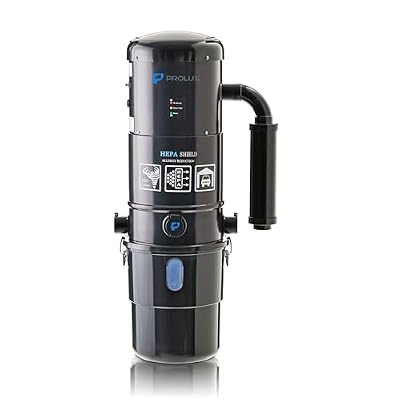
To be clear, the CV12000 is not a cyclonic unit, and this guide will not pretend otherwise. It is the bagless alternative most large-home buyers cross-shop: a 16.1 L dirt chamber with a clear view window, three levels of filtration built around washable micron and HEPA filters, and coverage the listing rates up to 12,000 sq ft, the largest figure here. An Ametek 2-stage bypass motor delivers over 130 CFM, a garage utility port adds utility beyond the wall inlets, and a muffler is included. Prolux publishes no air watts figure, so judge it on airflow and coverage rather than hunting for a number that does not exist.
Specs
- Bagless dirt chamber, 16.1 L, with clear view window
- Over 130 CFM per the listing
- Coverage up to 12,000 sq ft
- Washable HEPA filter and washable micron pre-filter; three levels of filtration
- Ametek 2-stage bypass motor, 12.5 A
- Powder-coated steel body, 22 lb, about 35 in H x 12 in W
- Garage utility port; muffler included
Best for: Very large homes that want bagless emptying with washable filters instead of a cyclonic design.
Watch out for: Ignore stray figures in the listing’s product-information fields, which contradict the listing’s own answers; those answers confirm it runs on a standard 120 V, 15 A household circuit. Its suction also depends on keeping the washable filters clean.
ASIN: B086687RBY
OVO 700

The OVO 700 is the hybrid alternative: its listing describes hybrid filtration that runs with or without disposable bags, over a cloth filter, so the same unit can operate bagless most of the year and switch to sealed bags whenever that suits the household. Power is ample at 700 air watts from a 5.7 inch, 2-stage flow-thru motor with gentle motor control at switch-on and shutdown. The 35 L bottom-load canister is rolled steel, and coverage reaches up to 8,000 sq ft. For households genuinely undecided between the bagged and bagless worlds, this flexibility is the entire argument, and it is a reasonable one.
Specs
- 700 air watts
- 35 L (9.25 gal) bottom-load rolled steel canister
- Hybrid filtration: runs with or without disposable bags; cloth filter type
- Coverage up to 8,000 sq ft
- 5.7 in, 2-stage flow-thru motor with soft start and stop
- 15 A
Best for: Households that want bagless running most days but the option of sealed bag disposal when they prefer it.
Watch out for: Coverage figures for this model family vary between listings, so plan around the 8,000 sq ft figure rather than the higher one; in bagless mode the cloth filter needs regular cleaning to hold suction.
ASIN: B074KQ54LM
Which One Fits Your Situation
You want suction that does not fade as the container fills
The Imperium CV7300 is your pick, and it is the only one of the three that earns the cyclonic label. Because separation happens by spin rather than through a bag or filter, performance stays even from the first room to the last, and the 38 quart canister stretches the interval between emptying days. This is the listing-based route to the classic cyclonic experience.
A very large home with heavy weekly cleaning
Choose the Prolux CV12000. Its coverage rating reaches 12,000 sq ft, beyond either rival here, and the washable HEPA filtration keeps ongoing costs at zero as long as you maintain the filters. The clear window on the 16.1 L chamber helps you time emptying before a big session, and the garage utility port handles car interiors without a second machine.
Your household swings between convenience and sealed disposal
The OVO 700 resolves the argument by refusing to pick a side. Run it bagless for everyday cleaning, then fit a disposable bag when pollen season, a renovation, or a dusty project makes sealed disposal worth it. The 35 L canister and 700 air watts mean the flexibility never feels like a compromise on capacity or power for homes up to 8,000 sq ft.
You are replacing a dealer-installed cyclonic system
Know the landscape first: the classic cyclonic brands sell through dealers, so their power units do not appear as Amazon listings with matching support. The CV7300 is the closest equivalent you can order directly, with documented output and a 10-year warranty. If exact brand continuity matters more than ordering convenience, a dealer quote for your original brand is the honest alternative.
Common Mistakes
- Assuming every bagless central vacuum is cyclonic, when most bagless designs actually separate dirt with filters.
- Ranking units by air watts alone, even though some makers publish CFM and coverage instead of air watts.
- Neglecting washable filters on a filtered bagless unit until suction fades, then blaming the motor.
- Expecting dealer-only cyclonic brands to have ordinary Amazon listings with the same support behind them.
- Buying capacity by headline volume without checking whether the emptying style fits the space under and around the unit.
Frequently Asked Questions
What makes a central vacuum truly cyclonic?
Air enters a chamber shaped so the stream spins at high speed, flinging dirt particles outward into the canister while cleaner air exits the center. No bag and no primary filter performs the separation, which is why suction stays consistent as dirt accumulates. The CV7300’s listing describes exactly this arrangement; units that rely on filter stages, however good, are doing something different.
Why are so few cyclonic power units sold on Amazon?
The established cyclonic brands built their businesses on dealer networks that handle design, installation, and service, and they have largely kept that model. Marketplace listings for those brands’ power units are therefore scarce or absent. What Amazon does stock are bagless filtered units, hybrids, and the occasional true cyclonic model like the Imperium, which is why careful label reading matters so much in this category.
Do the bagless and hybrid alternatives lose suction over time?
They can, but the cause is maintenance rather than design failure. Filtered bagless units depend on clean filters, so a neglected washable HEPA or cloth filter gradually chokes airflow. Rinsing or brushing those pieces on the maker’s schedule restores performance. The cyclonic CV7300 avoids that particular chore, though its canister still needs emptying before dirt reaches the fill limit.
Can one of these units run on my existing inlets and piping?
Usually, yes. A power unit is a standalone component, and swapping it in the garage or utility room leaves wall inlets and pipe runs untouched. Before ordering, confirm your hose and inlet voltage arrangement suits the new unit, check the electrical circuit available at the mounting spot, and measure clearance for the canister style you chose, especially bottom-load designs that open downward.
Write Your Review
No reviews yet. Be the first to share your experience!