
Our Short List of 3

- Best for: Drivers and home mechanics who want one kit for engine oil pressure and transmission line pressure.
- High-pressure gauge reads 0-400 PSI and 0-2800 kPa
- Low-pressure gauge reads 0-100 PSI and 0-700 kPa
- 3.5-inch chrome bezel gauges with rugged protective boots
- Built for static and on-road pressure checks

- Best for: Home mechanics who want a long hose and a wide-range gauge for engine and transmission diagnostics.
- Gauge reads up to 500 PSI / 35 Bar
- 60-inch rubber hose
- 6 brass fittings and 4 adapters included
- Brass extension tube included

- Best for: Occasional use across cars, trucks, motorcycles and ATVs where a simple engine oil pressure reading is the goal.
- Dual-scale gauge reads 0-140 PSI and 0-10 bar
- 10 threaded adapters included
- 4-foot nylon hose
- 90-degree elbow fitting included
All 3 Picks at a Glance
| Product | Specs | Action |
|---|---|---|
| 1. OTC 5610 Professional Transmission and Engine Oil Pressure Tester Kit |
| Check price on Amazon |
| 2. ABN Engine Oil Pressure and Transmission Fluid Diagnostic Tester Tool Kit |
| Check price on Amazon |
| 3. QUNNIE Oil Pressure Tester Kit, Pressure Gauge Kit, 0-140 PSI |
| Check price on Amazon |
A glowing oil light or a dashboard gauge that sits lower than usual leaves a driver with one real question: is the engine actually losing oil pressure, or is the sender lying? Guessing wrong can mean replacing a healthy oil pump, or worse, driving on with worn bearings while assuming the sensor is at fault. A mechanical oil pressure test kit answers that question directly by threading a gauge into the engine in place of the sender and showing the true pressure while the engine runs.
This guide covers three kits that fit home garages and small workshops. The OTC 5610 suits drivers who also want transmission readings, the ABN kit brings a wide 500 PSI gauge with a long hose, and the QUNNIE kit covers cars, trucks, motorcycles and ATVs with ten adapters. Each one pairs a mechanical gauge with brass fittings, so the reading comes straight from the oil gallery rather than through the dashboard wiring.
Quick Picks
As an Amazon Associate we earn from qualifying purchases
| Product | Best for | Key spec from title |
|---|---|---|
| OTC 5610 Professional Transmission and Engine Oil Pressure Tester Kit | Engine and transmission pressure checks | Dual gauges, 0-400 PSI and 0-100 PSI |
| ABN Engine Oil Pressure and Transmission Fluid Diagnostic Tester Tool Kit | A wide-range gauge with a long hose | 500 PSI / 35 Bar gauge, 60in hose |
| QUNNIE Oil Pressure Tester Kit, Pressure Gauge Kit, 0-140 PSI | Cars, trucks, motorcycles and ATVs | 0-140 PSI dual-scale gauge, 10 adapters |
How to Choose
Match the Gauge Range to the Job
Engine oil pressure on a healthy gasoline engine usually reads well under 100 PSI, so a gauge that tops out at 140 PSI gives a clear, easy-to-read needle position for most cars and trucks. Transmission line pressure runs higher, which is why dual-gauge kits pair a low-range gauge for the engine with a high-range gauge for the transmission. Buying a kit with only a 500 PSI gauge can make small engine-pressure changes hard to see, since the needle barely moves across the dial. Check the range before anything else, and pick the kit whose gauge matches the system you plan to check most often.
Count the Adapters and Check the Threads
Oil pressure ports use a mix of thread sizes, and the wrong adapter means the kit cannot connect at all. Common sizes include 1/8 NPT, R1/8, and metric threads from M10 through M18, with some engines needing a 90-degree elbow where the port sits close to the exhaust or firewall. A kit with ten or more adapters covers far more vehicles than a kit with three or four, and brass fittings seal more reliably than soft alloy ones. Before ordering, look up the sender thread on your own engine and confirm the kit lists it.
Look at Hose Length and Fittings
The gauge needs to sit where you can watch it while the engine runs, and a short hose forces you to lean over a hot engine bay. A hose of around four to five feet lets the gauge rest on the fender or windshield base in plain view. Quick-connect couplers make swapping adapters faster and reduce the chance of cross-threading a fitting, while an oil-resistant hose stands up to heat and stray oil without softening. A pressure relief valve is a useful extra, since it lets you bleed pressure down safely before disconnecting.
Pick a Gauge You Can Read Clearly
A mechanical gauge is only useful if the dial is legible at arm’s length. Larger dials with a dual PSI and bar scale are easier to read in a dim garage, and a rubber protective boot guards the gauge against knocks on a crowded workbench. Chrome bezels and clear markings help the needle position stand out, while a storage case keeps adapters sorted so the one you need is not lost between jobs. A kit that stays organised gets used; a loose pile of fittings in a drawer does not.
The 3 Best Options
1. OTC 5610 Professional Transmission and Engine Oil Pressure Tester Kit
- Best for: Drivers and home mechanics who want one kit for engine oil pressure and transmission line pressure.
- High-pressure gauge reads 0-400 PSI and 0-2800 kPa
- Low-pressure gauge reads 0-100 PSI and 0-700 kPa
- 3.5-inch chrome bezel gauges with rugged protective boots
- Built for static and on-road pressure checks
Drivers and home mechanics who want one kit for engine oil pressure and transmission line pressure.
Two gauges and a fuller adapter set mean a larger case to store than a single-gauge kit.
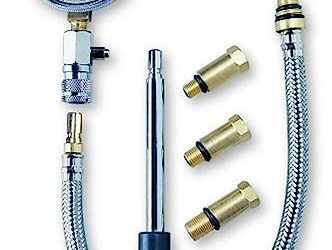
The OTC 5610 is the most versatile kit in this guide because it carries two gauges instead of one. The high-pressure gauge reads 0-400 PSI and 0-2800 kPa, while the low-pressure gauge reads 0-100 PSI and 0-700 kPa, so the same case covers engine oil pressure and automatic transmission line pressure. Both gauges use 3.5-inch chrome bezels with rugged protective boots, and the set is built for static checks at idle and on-road checks under load. Quick couplers on the hose make adapter changes straightforward.
Watch out for: Two gauges and a fuller adapter set mean a larger case to store than a single-gauge kit.
2. ABN Engine Oil Pressure and Transmission Fluid Diagnostic Tester Tool Kit
- Best for: Home mechanics who want a long hose and a wide-range gauge for engine and transmission diagnostics.
- Gauge reads up to 500 PSI / 35 Bar
- 60-inch rubber hose
- 6 brass fittings and 4 adapters included
- Brass extension tube included
Home mechanics who want a long hose and a wide-range gauge for engine and transmission diagnostics.
A 500 PSI gauge spreads the engine oil range across a small part of the dial, so low-pressure changes are harder to spot than on a 100 PSI gauge.
The ABN kit centres on a single large gauge that reads up to 500 PSI and 35 Bar, which suits high-pressure transmission checks as well as engine oil pressure work. A 60-inch rubber hose gives the gauge plenty of reach from the engine port to a spot where it can be watched safely. The case includes six brass fittings, four adapters and a brass extension tube, so the kit adapts to a wide spread of sender ports. A dual PSI and bar scale on the gauge keeps readings usable against specifications written in either unit.
Watch out for: A 500 PSI gauge spreads the engine oil range across a small part of the dial, so low-pressure changes are harder to spot than on a 100 PSI gauge.
3. QUNNIE Oil Pressure Tester Kit, Pressure Gauge Kit, 0-140 PSI
- Best for: Occasional use across cars, trucks, motorcycles and ATVs where a simple engine oil pressure reading is the goal.
- Dual-scale gauge reads 0-140 PSI and 0-10 bar
- 10 threaded adapters included
- 4-foot nylon hose
- 90-degree elbow fitting included
Occasional use across cars, trucks, motorcycles and ATVs where a simple engine oil pressure reading is the goal.
The 140 PSI ceiling means this kit is not the pick for high-pressure transmission line checks.
The QUNNIE kit is a straightforward single-gauge set aimed at the most common job: checking engine oil pressure on cars, trucks, motorcycles and ATVs. Its dual-scale gauge reads 0-140 PSI and 0-10 bar, a range that puts normal engine oil pressure in the middle of the dial where it is easy to read. Ten threaded adapters cover a broad spread of sender ports, and the 4-foot nylon hose plus a 90-degree elbow fitting help in tight engine bays. A shockproof cover protects the gauge, and a storage case keeps the set together.
Watch out for: The 140 PSI ceiling means this kit is not the pick for high-pressure transmission line checks.
Which One Fits Your Situation
You Only Need Engine Oil Pressure
Pick the QUNNIE kit. Its 0-140 PSI gauge places normal engine readings in the middle of the dial, and ten adapters cover most cars, trucks, motorcycles and ATVs. The 90-degree elbow helps where the sender sits in a tight spot. It is the simplest set here, and for a one-off diagnosis after an oil light scare, simple is enough.
You Also Check Transmission Pressure
Pick the OTC 5610. Its two gauges split the work cleanly: the low gauge for the engine and the high gauge for transmission line pressure. Quick couplers speed up swaps between the two, and the 3.5-inch gauges stay readable from the driver’s seat during an on-road check. It is the only kit here built for both systems.
You Want Reach and a Wide-Range Gauge
Pick the ABN kit. The 60-inch hose lets the gauge sit well clear of hot and moving parts, and the 500 PSI ceiling covers transmission pressures the other single-gauge kit cannot. Six brass fittings and an extension tube add fitment options, though the wide gauge range makes small engine-pressure changes harder to read.
You Work on Several Different Vehicles
Pick the kit with the widest adapter spread for your fleet. The QUNNIE set brings ten adapters, the ABN set brings four adapters plus six brass fittings, and the OTC set brings the broadest overall coverage with two gauges. Check your engines’ sender threads first, then choose the set that lists them all.
Common Mistakes
- Testing only on a cold engine, when oil is thick and pressure reads high; always compare hot idle and hot cruising readings against the maker specification.
- Forcing an adapter with the wrong thread, which can damage the sender port and cause a leak that looks like a pressure fault.
- Trusting the dashboard light alone without a mechanical reading, since a faulty sender can trigger the light on a healthy engine.
- Leaving the oil pressure sender unplugged or the port open after the check, which lets oil spray across a hot engine bay.
- Comparing the reading with a generic figure from memory instead of the vehicle maker’s specification for that engine and oil grade.
Frequently Asked Questions
What is normal engine oil pressure?
Normal oil pressure varies by engine, oil grade and oil temperature, so there is no single figure that fits every vehicle. The correct check is to compare a hot idle reading and a higher engine-speed reading against the vehicle maker’s specification in the service manual. A reading that sits well below the specified range at hot idle points toward a real lubrication problem rather than a gauge fault.
Can I drive with the oil light on?
Do not drive with the oil light on until a mechanical gauge confirms the true pressure. The light can mean a faulty sender, but it can also mean the engine is running with too little oil pressure to protect the bearings. A quick mechanical check takes little time and separates a cheap sender fault from a serious engine problem before more damage is done.
Where do I connect an oil pressure test kit?
Remove the oil pressure sender or switch from the engine block, then thread the kit’s matching adapter into that port and connect the gauge hose. The sender usually sits on the side of the block near the oil filter, though the exact spot varies by engine. Keep the hose clear of belts and hot exhaust parts while the engine runs.
Do I need to drain the oil before testing?
No draining is needed. Removing the sender lets only a small amount of oil escape, so have a rag ready and keep the opening covered until the adapter is threaded in. After the check, refit the sender with its seal, start the engine, and look for leaks around the sender before driving.
Write Your Review
No reviews yet. Be the first to share your experience!