
Top 3 Picks
Best overall: The ICEPURE 10″ x 4.5″ Whole House Sediment Activated Carbon Water Filter 3-Pack hits the sweet spot most households actually need — big-blue 4.5-inch diameter cartridges that handle whole-house flow without starving your shower or laundry, with graded sediment-plus-carbon media and a footprint that works in most standard 10-inch big-blue housings.
- Top 3 Picks
- Quick Comparison
- How We Chose
- 1. ICEPURE 1 Micron 2.5″ x 10″ CTO Carbon Whole House Water Filter 4-Pack – Best for Tight Filtration on a Budget
- 2. PUREPLUS 1 Micron 2.5″ x 10″ Whole House CTO Carbon Water Filter 4-Pack – Best Budget Twin to the ICEPURE Slim Block
- 3. ICEPURE 10″ x 4.5″ Whole House Sediment Activated Carbon Water Filter 3-Pack – Best Overall for Most Homes
- 4. PUREPLUS 5 Micron 10″x4.5″ Whole House Sediment & Carbon Water Filter 2-Pack – Best Mid-Range Big-Blue Entry
- 5. Culligan SCWH-5 Whole House Water Filter Cartridges – Best OEM Replacement for Culligan Systems
- 6. Filtrete Whole House Water Filter Replacement 3WH-STDCW-F02, 2-Pack – Best OEM Replacement for Filtrete Systems
- 7. Aquaboon 5 Micron 10 x 2.5 Carbon Block Water Filter Cartridge CTO – Best Mid-Range Slim Cartridge
- 8. Geekpure 20 Inch Whole House Carbon Block Water Filters 4.5″ x 20″ 5 Micron – Best for Large Homes and High Flow
- 9. ICEPURE 5 Micron 10″ x 4.5″ Whole House Sediment and Carbon Filter 2 Pack – Best Value Big-Blue 2-Pack
- 10. Pentair Pentek GAC-BB Big Blue Whole House Carbon Water Filter – Best for Chlorine Taste and Odor at High Flow
- 11. GE FXWTC Whole House Water Filter Replacement – Best OEM Replacement for GE Systems
- 12. SimPure DB10P 10″ x 4.5″ Whole House Sediment Water Filter Housing – Best for Building a Big-Blue System
- How to Choose
- Frequently Asked Questions
- Which One Should You Buy?
- Related Guides
Best budget: The ICEPURE 1 Micron 2.5″ x 10″ CTO Carbon Whole House Water Filter 4-Pack gives you true 1-micron carbon block filtration at the lowest cost per cartridge of anything in this roundup — ideal if you already own a 10-inch standard housing and want tight filtration on a tight budget.
Best premium: The Geekpure 20-Inch Whole House Carbon Block Water Filters (4.5″ x 20″, 5 micron) offer roughly double the media volume of a 10-inch big-blue cartridge, so they last far longer and flow better on large homes with multiple bathrooms running at once.
Quick Comparison
| Product | Best For | Key Specs | Price Tier |
|---|---|---|---|
| ICEPURE 1 Micron 2.5″ x 10″ CTO Carbon Filter 4-Pack | Tight filtration on a standard 10″ housing | 1 micron, 2.5″ x 10″, carbon block (CTO), 4 cartridges | Budget |
| PUREPLUS 1 Micron 2.5″ x 10″ CTO Carbon Filter 4-Pack | Budget buyers wanting the same 1-micron class from a value brand | 1 micron, 2.5″ x 10″, CTO carbon block, 4 cartridges | Budget |
| ICEPURE 10″ x 4.5″ Sediment + Activated Carbon Filter 3-Pack | Most homes wanting one cartridge that does sediment and carbon | 10″ x 4.5″ big-blue, graded sediment + activated carbon, 3 cartridges | Premium |
| PUREPLUS 5 Micron 10″ x 4.5″ Sediment & Carbon Filter 2-Pack | Mid-range big-blue upgrade with looser micron rating | 5 micron, 10″ x 4.5″, sediment + carbon, 2 cartridges | Mid-range |
| Culligan SCWH-5 Whole House Cartridges | Owners of Culligan whole-house systems | Standard-duty carbon, reduces sediment, standard diameter | Budget |
| Filtrete 3WH-STDCW-F02 Replacement 2-Pack | Owners of the Filtrete whole-house system | Standard-duty carbon block replacement, 2 cartridges | Budget |
| Aquaboon 5 Micron 10 x 2.5 Carbon Block CTO Cartridge | Standard housings wanting mid-tier carbon block | 5 micron, 10″ x 2.5″, CTO carbon block | Mid-range |
| Geekpure 20″ Whole House Carbon Block 4.5″ x 20″ 5 Micron | Large homes and high-flow systems | 5 micron, 4.5″ x 20″, carbon block, 4 cartridges | Premium |
| ICEPURE 5 Micron 10″ x 4.5″ Sediment and Carbon Filter 2-Pack | Big-blue owners wanting a mid-priced 5-micron pair | 5 micron, 10″ x 4.5″, sediment + carbon, 2 cartridges | Mid-range |
| Pentair Pentek GAC-BB Big Blue Carbon Filter | Chlorine taste/odor control at high flow | Granular activated carbon (GAC), big-blue 4.5″ format | Premium |
| GE FXWTC Whole House Replacement Filter | Owners of GE whole-house systems | NSF certified, reduces chlorine, OEM replacement | Budget |
| SimPure DB10P 10″ x 4.5″ Whole House Sediment Housing | Building a system from scratch, or replacing a cracked housing | 10″ x 4.5″ big-blue housing, sediment use | Premium |
How We Chose
Shopping for whole-house carbon filtration means wading through a lot of near-identical listings that hide important differences behind buzzwords. We built this roundup by comparing published specifications — media type, micron rating, cartridge dimensions, thread and housing compatibility, and pack quantity — against real household scenarios: how many bathrooms you run at once, whether you’re on city or well water, what housing you already own, and how much annual cartridge spend you’re willing to absorb.
Selection criteria came down to four things. First, category fit: does the cartridge actually solve a whole-house problem (chlorine, taste, odor, sediment) rather than serve a point-of-use niche? Second, spec clarity: products that state their micron rating and dimensions plainly rank above vague “premium carbon” claims. Third, system compatibility: OEM replacements for Culligan, Filtrete, and GE systems matter enormously to owners of those systems, and generic big-blue or standard cartridges serve everyone else. Fourth, upgrade path: a 2.5-inch cartridge is a starting point, a 4.5-inch big-blue is the mid-life move, and a 20-inch housing is the end-state for high-flow homes.
This is a research-based comparison drawn from manufacturer specifications and established facts about carbon media types. We did not test, benchmark, or handle any of these products. Prices shift constantly, so we flag tiers rather than figures — and we note where a cheaper cartridge costs more over a year because it clogs faster.
1. ICEPURE 1 Micron 2.5″ x 10″ CTO Carbon Whole House Water Filter 4-Pack – Best for Tight Filtration on a Budget
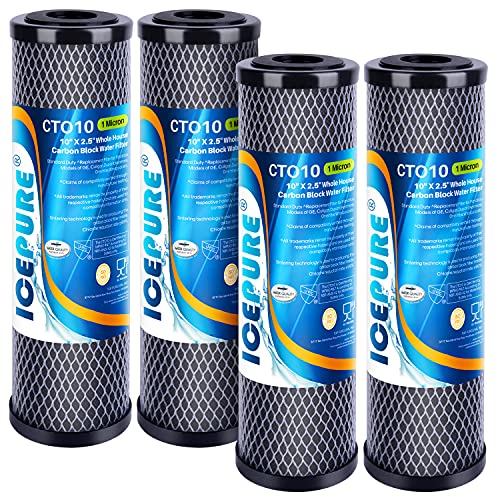
ICEPURE 1 Micron 2.5" x 10" CTO Carbon Whole House Water Filter 4 Pack
Included for 'Best Whole House Carbon Water Filters' as a relevant option in this category; details come from the product listing.
View on AmazonThis is the cartridge to buy if you already own a standard 10-inch slim housing — the ubiquitous 2.5-inch diameter filter canister found under sinks and on entry-level whole-house setups — and you want the tightest filtration carbon block can deliver without rebuilding your system. A 1-micron rating means the carbon block is compressed tightly enough to trap particles down to one micrometer, which captures the fine sediment, rust particles, and chlorine-attached organics that coarser filters let pass. For city water with a chlorine taste problem, that’s a meaningful step up from a 5-micron cartridge.
The trade-off is predictable: tighter media equals faster clogging equals shorter cartridge life, especially on well water or older municipal lines carrying rust. A 4-pack softens that blow because you’ll be swapping more often and buying in bulk keeps the per-cartridge cost down. This is the classic budget play — lowest upfront spend, highest change-out frequency.
Key Specs
- Filtration rating: 1 micron
- Dimensions: 2.5 inches diameter x 10 inches length
- Media type: CTO carbon block (compressed activated carbon)
- Pack size: 4 cartridges
- Housing compatibility: standard 10-inch slim housings
- Primary targets: chlorine, taste, odor, fine sediment
Strengths
The finest filtration rating in this roundup at the lowest cost tier. If your water is chlorinated but otherwise clean, 1-micron carbon block removes chlorine effectively and leaves you with noticeably better-tasting water from every tap. Carbon block also resists channeling better than granular carbon — water can’t carve a path around the media, so contact is more consistent through the cartridge’s life. Buying four at once means you’re stocked for a year or more on a slim housing setup, and the standard dimensions fit the widest range of inexpensive housings on the market.
Pros
- 1-micron rating catches fine particulate that 5-micron cartridges miss
- Cheapest per-cartridge cost of any product in this roundup
- Carbon block resists bypass and channeling
- Fits the most common slim housing size, so no plumbing changes needed
- 4-pack covers a full year of changes for a small household
Cons
- 2.5-inch diameter restricts flow — not suited to multi-bathroom simultaneous demand
- 1-micron media clogs faster on sediment-heavy water
- Shorter service life than big-blue cartridges, so more frequent swaps
- Slim housings often lack the pressure headroom of 4.5-inch systems
How It Compares
Against the PUREPLUS 1 Micron 4-Pack, this is nearly a coin flip — same micron rating, same dimensions, same budget tier, same 4-count packaging, meaning the decision usually comes down to whichever is available or priced better when you buy. The meaningful fork in the road is versus the ICEPURE 10″ x 4.5″ 3-Pack: if you own a big-blue housing, step up to 4.5-inch cartridges and accept a 3-pack, because flow rate and cartridge life both improve substantially. If you’re locked into a slim housing and can’t replumb, this cartridge is the right answer.
2. PUREPLUS 1 Micron 2.5″ x 10″ Whole House CTO Carbon Water Filter 4-Pack – Best Budget Twin to the ICEPURE Slim Block
PUREPLUS built its reputation on value-priced replacement cartridges, and this 4-pack is the direct equivalent of the ICEPURE 1-micron slim block above: same dimensions, same micron rating, same four-cartridge packaging, same budget positioning. If you’re shopping strictly on price and availability, these two products are functionally interchangeable in a standard 10-inch slim housing, and choosing between them is an exercise in comparing current shelf prices rather than performance.
What makes a 1-micron carbon block worth considering at all is the relationship between pore size and contaminant capture. Chlorine molecules themselves are tiny — far smaller than 1 micron — so carbon removal of chlorine is a chemical adsorption process, not a mechanical sieve. The micron rating matters for the particulate side: rust, silt, and the organic material that gives water a musty or earthy note. A tight 1-micron block wraps both functions into one cartridge, which is why budget-minded buyers gravitate to it.
Key Specs
- Filtration rating: 1 micron
- Dimensions: 2.5 inches diameter x 10 inches length
- Media type: CTO carbon block
- Pack size: 4 cartridges
- Housing compatibility: standard 10-inch slim housings
- Primary targets: chlorine, taste, odor, fine particulate
Strengths
Four cartridges at a budget price point means your cost per gallon stays low even with frequent changes. The standard dimensions slot into the same housings as the ICEPURE equivalent, so you can mix and match brands across purchases without touching your plumbing. PUREPLUS cartridges are widely stocked, so reordering your next 4-pack is rarely a scavenger hunt. For a small home, apartment, or a rental where you can’t modify the system, this is a sensible stock-up purchase.
Pros
- Budget tier with 1-micron filtration
- 4-pack reduces per-cartridge cost and reorder frequency
- Interchangeable with other standard 10-inch slim cartridges
- Carbon block construction avoids granular media channeling
- Easy to find and reorder
Cons
- Same flow limitations as any 2.5-inch slim cartridge
- 1-micron media loads up quickly on dirty water
- No sediment pre-filter stage — particulate and carbon compete for the same media
- Not appropriate for high-demand homes with three or more bathrooms
How It Compares
Directly against the ICEPURE 1-micron 4-pack, the difference is brand and price, not engineering. The more interesting comparison is against the Aquaboon 5-micron CTO cartridge: Aquaboon’s looser rating will last longer and flow slightly better, while this PUREPLUS block will catch finer particulate. If your water is visibly dirty or rusty, the looser micron rating paired with a dedicated sediment pre-filter is the smarter architecture; if your water is clear but chlorinated, the 1-micron block is the better single-cartridge solution.
3. ICEPURE 10″ x 4.5″ Whole House Sediment Activated Carbon Water Filter 3-Pack – Best Overall for Most Homes

ICEPURE 10" x 4.5" Whole House Sediment Activated Carbon Water Filter 3Pack
Included for 'Best Whole House Carbon Water Filters' as a relevant option in this category; details come from the product listing.
View on AmazonThis is the cartridge class that most whole-house owners should end up with. The 4.5-inch diameter roughly triples the cross-sectional area of a 2.5-inch slim cartridge, which translates directly into higher flow rate and lower pressure drop — meaning you can run a shower, a dishwasher, and a washing machine at the same time without noticing a pressure sag. The media blends graded sediment filtration with activated carbon, so one cartridge handles both the physical particulate that would otherwise clog your carbon and the chlorine/taste/odor problem carbon exists to solve.
The combined-media design is the practical appeal. Running a standalone carbon cartridge without sediment protection is one of the most common mistakes in whole-house filtration — the carbon surface blinds over with rust and silt within weeks, and you’re replacing cartridges long before their carbon capacity is exhausted. A graded sediment-plus-carbon cartridge front-loads the particulate capture and lets the carbon do its job deeper into the media bed.
Key Specs
- Dimensions: 10 inches length x 4.5 inches diameter (big-blue standard)
- Media type: graded sediment plus activated carbon
- Pack size: 3 cartridges
- Housing compatibility: standard 10-inch big-blue housings
- Primary targets: sediment, rust, chlorine, taste, odor
- Flow characteristics: high — suited to multi-fixture demand
Strengths
Big-blue dimensions are the single biggest upgrade most households can make without replumbing, because the housing standard is well established and cartridges are widely available from multiple brands. The dual-media construction extends effective life by protecting carbon from premature blinding. Three cartridges at a premium-tier price is a reasonable annual stock for a family home, and the 4.5-inch format keeps pressure drop low enough that you won’t get the “weak shower” complaint that plagues slim-cartridge systems on busy mornings.
Pros
- 4.5-inch diameter delivers high flow and low pressure drop
- Sediment plus carbon in one cartridge reduces change-out frequency
- Protects carbon media from premature particulate blinding
- Big-blue housing standard means broad replacement availability
- Handles simultaneous demand from multiple fixtures
Cons
- Premium price tier for a 3-pack
- Requires a big-blue housing, which is a larger upfront investment
- Not a 1-micron cartridge — fine particulate below its rating passes through
- Housing and cartridge both take up more mechanical-room space
How It Compares
Against the ICEPURE 5 Micron 10″ x 4.5″ 2-Pack and the PUREPLUS 5 Micron 10″ x 4.5″ 2-Pack, this 3-pack sits at the top of the big-blue 10-inch category because you get an extra cartridge and the combined sediment-plus-carbon construction. Those mid-range alternatives are legitimate choices if you want to pay less per order, but they’re 2-packs at a looser positioning. Against the Geekpure 20-inch cartridges, this loses on total media volume and flow ceiling but wins on housing cost and physical footprint — the 20-inch format is a bigger commitment.
4. PUREPLUS 5 Micron 10″x4.5″ Whole House Sediment & Carbon Water Filter 2-Pack – Best Mid-Range Big-Blue Entry

PUREPLUS 5 Micron 10"x4.5" Whole House Sediment & Carbon Water Filter,2PACK
Included for 'Best Whole House Carbon Water Filters' because the listing specifies 2PACK, details this guide uses to compare options.
View on AmazonIf you’re moving up from slim cartridges to big-blue but don’t want to commit to a premium 3-pack, this is the natural middle rung. The 4.5-inch diameter gives you the flow benefits of the big-blue format, while the 5-micron rating is a deliberate compromise: looser than 1-micron, so it passes finer particulate but flows better and lasts longer between changes. For homes on decent municipal water where sediment isn’t the primary enemy, 5 micron is often the more economical rating.
Two cartridges per pack means you’re buying roughly a year’s supply for a modest household, depending on water quality and usage volume. The sediment-and-carbon combination mirrors the approach of the premium ICEPURE 3-pack, just with a lower count and a looser micron rating, which is exactly what “mid-range” should mean here.
Key Specs
- Filtration rating: 5 micron
- Dimensions: 10 inches length x 4.5 inches diameter
- Media type: sediment plus carbon
- Pack size: 2 cartridges
- Housing compatibility: standard big-blue housings
- Primary targets: sediment, chlorine, taste, odor
Strengths
The 5-micron rating is the pragmatic choice for most municipal water supplies: it removes the visible sediment and the chlorine that drives taste and odor complaints, while resisting the rapid clogging that plagues 1-micron media on anything but pristine water. Big-blue dimensions keep pressure drop modest. Two cartridges keep the upfront order smaller than a 3-pack, which helps if you’re still calibrating how often your specific water supply demands a change.
Pros
- Big-blue flow performance at a mid-range price
- 5-micron media lasts longer than 1-micron equivalents
- Sediment and carbon combined in one cartridge
- Smaller upfront order than a 3-pack
- Fits the widely available big-blue housing standard
Cons
- 5 micron lets finer particulate through compared with 1-micron blocks
- Only two cartridges — heavier users will reorder sooner
- Mid-range pricing per cartridge than the most economical slim options
- Requires a big-blue housing investment
How It Compares
Set against the ICEPURE 5 Micron 10″ x 4.5″ 2-Pack, this is another same-class matchup — 5 micron, 4.5 x 10 inches, 2-count, mid-range — so price and availability decide it. Against the premium ICEPURE 10″ x 4.5″ 3-Pack, you’re trading one cartridge and a tighter overall specification package for a lower order total. And against the Pentek GAC-BB, the distinction is media type: this is a carbon block-style combined cartridge, while the Pentek is granular activated carbon tuned for high-flow chlorine reduction, which behaves differently over its service life.
5. Culligan SCWH-5 Whole House Water Filter Cartridges – Best OEM Replacement for Culligan Systems

Culligan SCWH-5 Whole House Water Filter Cartridges - Standard-Duty Carbon Replacement Filter Reduces Sediment, Rust, Scale & Dirt for Clean Drinking Water or for Cooking, 15,000 Gallons, Pack of 2
Included for 'Best Whole House Carbon Water Filters' because the listing specifies Standard-Duty Carbon Replacement Filter Reduces Sediment and Rust, details this guide uses to compare options.
View on AmazonWhole-house filtration is often an ecosystem problem, not a cartridge problem. If your home already has a Culligan whole-house system installed, the SCWH-5 is the standard-duty carbon replacement designed for it, and the case for buying OEM is straightforward: guaranteed fit, guaranteed seal, and no risk of a slightly-off cartridge letting water bypass the media. Culligan has been in residential water treatment for decades, and its system-plus-cartridge approach is built around predictable, standardized replacement.
Standard-duty means exactly that — it’s positioned for routine chlorine and sediment reduction on municipally treated water, not for heavy well-water sediment loads or extended contaminant lists. For the Culligan owner who just wants the system to keep doing what it did on day one, this is the straightforward answer, and it’s priced in the budget tier.
Key Specs
- Media type: standard-duty carbon
- Primary function: sediment reduction plus chlorine/taste/odor control
- System compatibility: Culligan whole-house systems
- Price tier: budget
- Best water source: municipally treated water
Strengths
OEM fit eliminates the most common cause of disappointing whole-house filter performance: a cartridge that doesn’t seat perfectly and lets unfiltered water slip past the gasket. Culligan’s replacement ecosystem is well documented, so finding the right part number is simple. Budget-tier pricing keeps annual maintenance predictable, and standard-duty media is adequate for the majority of city-water households that don’t have unusual sediment problems.
Pros
- Guaranteed OEM fit for Culligan whole-house systems
- Budget-tier replacement cost
- Reduces sediment along with chlorine taste and odor
- Straightforward, documented replacement path
- Appropriate for typical municipal water
Cons
- Works only in compatible Culligan systems — not a universal cartridge
- Standard-duty media is not designed for heavy sediment or well water
- Less media volume than big-blue alternatives
- Third-party cartridges for the same system may cost less
How It Compares
There’s no real cross-shopping here against the ICEPURE or PUREPLUS big-blue cartridges, because those don’t fit Culligan housings. The honest comparison is against the Filtrete 3WH-STDCW-F02: both are OEM budget replacements for their respective proprietary systems, and both exist because system owners need a guaranteed-fit part. If you own neither system, skip both and buy into the big-blue standard instead, where cartridge choice is far broader.
6. Filtrete Whole House Water Filter Replacement 3WH-STDCW-F02, 2-Pack – Best OEM Replacement for Filtrete Systems

Filtrete Whole House Water Filter Replacement 3WH-STDCW-F02, 2-Pack
Included for 'Best Whole House Carbon Water Filters' because the listing specifies 2-Pack, details this guide uses to compare options.
View on AmazonThe Filtrete 3WH-STDCW-F02 is the standard-duty carbon replacement for Filtrete’s whole-house water filtration system, sold in a 2-pack that covers a full replacement cycle for most households. Filtrete is best known for air filtration, but its water filtration line follows the same philosophy: standardized systems with clearly labeled replacement cartridges so homeowners don’t have to guess.
Like the Culligan SCWH-5, this is a proprietary-format cartridge — it fits Filtrete’s system and not much else. That’s not a flaw, it’s the trade-off of buying into a branded system: you get a documented, supported replacement path, and you accept a narrower aftermarket. For Filtrete system owners, this is the correct part.
Key Specs
- Media type: standard-duty carbon block
- Pack size: 2 cartridges
- System compatibility: Filtrete whole-house filtration systems
- Price tier: budget
- Primary targets: sediment, chlorine taste and odor
Strengths
A 2-pack simplifies maintenance scheduling — you replace, and you already have the next cartridge on the shelf. Budget-tier pricing is consistent with the standard-duty positioning, and the carbon block construction delivers consistent contact with the media rather than the channeling risk that granular carbon can develop. For a Filtrete system owner, reordering is frictionless and the fit is guaranteed.
Pros
- OEM fit for Filtrete whole-house systems
- 2-pack supports a complete replacement cycle
- Budget-tier pricing
- Carbon block construction resists media channeling
- Easy to identify and reorder
Cons
- Proprietary format — no cross-brand compatibility
- Standard-duty, so not ideal for heavy sediment or well water
- Smaller media volume than big-blue cartridges
- Limited third-party alternatives
How It Compares
The only sensible comparison is with the Culligan SCWH-5, its direct equivalent in another ecosystem. Both are OEM budget replacements, both are standard-duty carbon, both exist to serve system owners. If you’re building a system from scratch rather than maintaining one, neither is the right starting point — the SimPure DB10P big-blue housing plus a 4.5-inch cartridge gives you far more replacement flexibility over the life of the system.
7. Aquaboon 5 Micron 10 x 2.5 Carbon Block Water Filter Cartridge CTO – Best Mid-Range Slim Cartridge

Aquaboon 5 Micron 10 x 2.5 Carbon Block Water Filter Cartridge CTO Whole House Water Filter Replacement Compatible with WHKF-WHWC, FXWTC, 6-PACK
Included for 'Best Whole House Carbon Water Filters' because the listing specifies FXWTC and 6-PACK, details this guide uses to compare options.
View on AmazonAquaboon’s 5-micron carbon block is the upgrade pick within the slim 2.5-inch cartridge category — same physical footprint as the budget 1-micron slim blocks, but a looser micron rating that flows better and lasts longer. That’s a legitimate trade, and it’s the one to make if your water isn’t heavily sedimented and you’d rather change cartridges less often than catch particles at the finest possible threshold.
The CTO designation indicates compressed carbon block, which is the construction you want if consistent chlorine reduction matters to you. Granular media can settle and channel; a block can’t. For a slim housing system serving a small household, this is a well-balanced cartridge that sits between the rock-bottom budget options and the big-blue premium tier.
Key Specs
- Filtration rating: 5 micron
- Dimensions: 10 inches length x 2.5 inches diameter
- Media type: CTO carbon block
- Housing compatibility: standard 10-inch slim housings
- Primary targets: chlorine, taste, odor, moderate sediment
Strengths
Longer service intervals than 1-micron slim cartridges, with the same easy drop-in installation. Carbon block construction provides consistent media contact throughout the cartridge’s life. Mid-range pricing reflects the longer life rather than a premium for branding. If you’re running a slim housing because you can’t fit a big-blue unit, this rating is often the better everyday choice than a tight 1-micron block.
Pros
- 5-micron media lasts longer than 1-micron slim cartridges
- Carbon block avoids granular channeling
- Drops into standard slim housings
- Mid-range price reflects extended service life
- Good balance of flow and filtration for small homes
Cons
- Passes finer particulate compared with 1-micron blocks
- Slower flow than 4.5-inch cartridges
- Single cartridge, not a multi-pack
- Slim housing still limits simultaneous fixture demand
How It Compares
Against the ICEPURE and PUREPLUS 1-micron slim 4-packs, this trades filtration tightness for longevity — a reasonable swap if your water is clear. Against the PUREPLUS 5 Micron 10″ x 4.5″ 2-Pack, the Aquaboon is the slim-housing option, so it’s a smaller footprint but a lower flow ceiling. Choose based on what housing you own or plan to install, not on the micron rating alone.
8. Geekpure 20 Inch Whole House Carbon Block Water Filters 4.5″ x 20″ 5 Micron – Best for Large Homes and High Flow

Geekpure 20 Inch Whole House Carbon Block Water Filters-4.5" x 20"-5 Micron
Included for 'Best Whole House Carbon Water Filters' as a relevant option in this category; details come from the product listing.
View on AmazonWhen you double the length of a big-blue cartridge from 10 to 20 inches, you roughly double the media volume — and that changes the economics of whole-house filtration significantly. This Geekpure 20-inch cartridge, at 4.5 inches diameter and 5 microns, is designed for homes where flow rate actually matters: large houses with three or more bathrooms, households running irrigation or filling tubs, or anyone who’s been frustrated by pressure loss at the far end of the house.
More media volume means more chlorine-removal capacity before the cartridge is spent, and lower pressure drop across the filter bed. The practical result is fewer change-outs per year despite a higher cartridge price, which often makes the 20-inch format cheaper over a multi-year horizon than stacking up 10-inch replacements. The cost is physical: you need a 20-inch big-blue housing, and that demands more mechanical-room space and a sturdier mounting setup.
Key Specs
- Filtration rating: 5 micron
- Dimensions: 20 inches length x 4.5 inches diameter
- Media type: carbon block
- Pack size: 4 cartridges
- Housing compatibility: 20-inch big-blue housings
- Primary targets: chlorine, taste, odor, sediment
Strengths
The highest total media volume in this roundup, which translates to the longest service life per cartridge and the strongest flow performance. A 4-pack of 20-inch cartridges can represent years of filtration for a typical household, smoothing out the annual cost. Carbon block construction keeps media contact consistent. For a large home where every fixture needs decent pressure, the reduced pressure drop is a quality-of-life improvement you notice daily.
Pros
- Roughly double the media volume of 10-inch big-blue cartridges
- Lowest pressure drop of any format here — best for large homes
- 4-pack covers an extended service period
- Carbon block resists channeling
- Fewer change-outs per year reduces maintenance labor
Cons
- Requires a 20-inch housing — a larger upfront investment
- Takes up significant mechanical-room space
- Premium price tier
- 5-micron rating, not a 1-micron block
- Heavier cartridges to handle during replacement
How It Compares
This is the end-state upgrade from the ICEPURE 10″ x 4.5″ 3-Pack. If your home is small or medium and your current 10-inch big-blue system maintains acceptable pressure, there’s no reason to go to 20 inches. But if you’re building a system for a large home, or you’ve measured real pressure loss across a 10-inch filter, the 20-inch format pays back through fewer changes and better flow. Against the Pentek GAC-BB, the key difference is media type: block versus granular, with the block offering steadier contact and the GAC offering very high flow and excellent chlorine taste/odor performance.
9. ICEPURE 5 Micron 10″ x 4.5″ Whole House Sediment and Carbon Filter 2 Pack – Best Value Big-Blue 2-Pack

ICEPURE 5 Micron 10" x 4.5" Whole House Sediment and Carbon Filter 2 Pack
Included for 'Best Whole House Carbon Water Filters' as a relevant option in this category; details come from the product listing.
View on AmazonThis cartridge takes the big-blue formula — 4.5-inch diameter, 10-inch length, sediment plus carbon — and packages it as a 2-pack at mid-range pricing. It’s the practical middle ground for someone who has decided big-blue is the right format but isn’t ready to commit to the premium 3-pack or a 20-inch housing. The 5-micron rating keeps flow strong and service life reasonable.
Two cartridges is a modest stock, which has an advantage: if you don’t yet know your household’s actual replacement rhythm, you won’t over-buy a media type that turns out to clog faster or slower than expected. Once you learn your cadence, you can scale up.
Key Specs
- Filtration rating: 5 micron
- Dimensions: 10 inches length x 4.5 inches diameter
- Media type: sediment plus carbon
- Pack size: 2 cartridges
- Housing compatibility: standard big-blue housings
- Primary targets: sediment, chlorine, taste, odor
Strengths
Combined sediment and carbon media means one cartridge does two jobs, cutting the number of housings and change-outs in your system. Big-blue diameter keeps pressure drop low. Mid-range pricing makes it a low-risk experiment for households still figuring out their filtration needs. ICEPURE’s cartridge line is widely distributed, so reordering the same part is straightforward.
Pros
- Big-blue flow without a premium price
- Sediment and carbon combined in a single cartridge
- 5-micron rating balances filtration and service life
- 2-pack limits upfront spend while you calibrate
- Standard big-blue fit
Cons
- Fewer cartridges per order than the premium 3-pack
- 5 micron passes finer particulate
- Requires a big-blue housing
- Not enough supply for a full year in a heavy-use home
How It Compares
Versus the PUREPLUS 5 Micron 10″ x 4.5″ 2-Pack, this is a direct same-spec competitor and the choice comes down to price and stock. Versus the ICEPURE 10″ x 4.5″ 3-Pack, you’re getting one fewer cartridge and a slightly less comprehensive specification package — the 3-pack is the better buy if you’re confident about your household’s needs and want a longer runway between orders.
10. Pentair Pentek GAC-BB Big Blue Whole House Carbon Water Filter – Best for Chlorine Taste and Odor at High Flow

Pentair Pentek GAC-BB Big Blue Whole House Carbon Water Filter
Included for 'Best Whole House Carbon Water Filters' as a relevant option in this category; details come from the product listing.
View on AmazonGranular activated carbon is a different animal from carbon block, and Pentek’s GAC-BB is one of the best-known big-blue cartridges built around it. Instead of a compressed block, GAC cartridges hold loose carbon granules through which water flows with very little resistance. The result is excellent flow performance and strong chlorine taste and odor reduction — GAC’s specialty — at the cost of somewhat less consistent contact time and no meaningful particulate filtration.
Pentek is a long-established name in water treatment, and the Big Blue format is practically a standard in residential whole-house filtration. If chlorine is your primary complaint and you have a big-blue housing, this is a well-understood, widely supported choice. It also pairs naturally with a separate sediment pre-filter, which is the classic GAC architecture: sediment first, carbon second.
Key Specs
- Media type: granular activated carbon (GAC)
- Format: big-blue, 4.5-inch diameter
- Primary targets: chlorine, taste, odor
- Flow characteristics: very high — low pressure drop
- Housing compatibility: standard big-blue housings
- Price tier: premium
Strengths
GAC’s open structure means very low pressure drop, making it a strong choice for homes with high demand or borderline water pressure. Chlorine taste and odor reduction is GAC’s core competency, and the Big Blue format is supported by a huge range of housings and accessories. Pairing it with a sediment cartridge upstream is a well-proven configuration that extends both cartridges’ useful life.
Pros
- Excellent chlorine taste and odor reduction
- Very high flow with minimal pressure drop
- Standard big-blue format with broad housing support
- Well-established brand with wide availability
- Pairs well with a sediment pre-filter
Cons
- No meaningful particulate filtration on its own
- Granular media can settle or channel over time
- Premium price tier
- Requires a separate sediment stage for dirty water
- Less consistent contact than a carbon block
How It Compares
Against the Geekpure 20-inch carbon block, this is the classic block-versus-granular decision. GAC wins on flow and chlorine taste/odor performance; block wins on consistent contact and particulate capture. For a two-housing system — sediment first, carbon second — the GAC-BB is a natural fit in the second housing. For a single-housing setup where you want one cartridge to do everything, a combined sediment-plus-carbon block like the ICEPURE 10″ x 4.5″ 3-Pack is the more practical choice.
11. GE FXWTC Whole House Water Filter Replacement – Best OEM Replacement for GE Systems
The GE FXWTC is the replacement cartridge for GE’s whole-house water filtration system, and it carries NSF certification for chlorine reduction — a meaningful third-party verification that the cartridge performs as claimed. For GE system owners, this is the specified part, and using it keeps your warranty and system performance intact.
Like the Culligan and Filtrete cartridges in this roundup, the FXWTC is a proprietary-format replacement. It exists to serve an installed base of GE whole-house systems, and it does that job with certified performance and straightforward availability. Budget-tier pricing keeps maintenance predictable.
Key Specs
- Certification: NSF certified for chlorine reduction
- Primary function: chlorine, taste and odor reduction
- System compatibility: GE whole-house filtration systems
- Price tier: budget
- Format: proprietary GE replacement cartridge
Strengths
NSF certification is the standout feature — it means an independent body has verified the chlorine reduction claim against a published standard, which is more than can be said for many generic cartridges with vaguer marketing. OEM fit guarantees proper sealing in GE housings. Budget-tier pricing and broad retail availability make replacement simple.
Pros
- NSF certified for chlorine reduction
- OEM fit for GE whole-house systems
- Budget-tier replacement cost
- Widely available
- Straightforward replacement procedure
Cons
- Proprietary format — fits only compatible GE systems
- Focused on chlorine reduction rather than broad contaminant removal
- Not designed as a heavy-sediment cartridge
- No cross-brand flexibility
How It Compares
Among the three OEM replacements here — Culligan SCWH-5, Filtrete 3WH-STDCW-F02, and this GE FXWTC — the GE stands out for its NSF certification, which is the clearest third-party performance verification of the group. If you own a GE system, this is the confident pick. If you’re choosing a system to buy into, weigh how much you value certified claims against the replacement flexibility of the open big-blue standard.
12. SimPure DB10P 10″ x 4.5″ Whole House Sediment Water Filter Housing – Best for Building a Big-Blue System
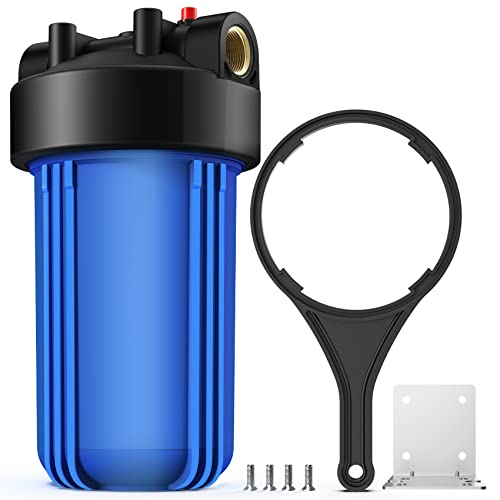
SimPure DB10P 10" *4.5" Whole House Sediment Water Filter Housing
Included for 'Best Whole House Carbon Water Filters' as a relevant option in this category; details come from the product listing.
View on AmazonSometimes the right purchase isn’t a cartridge at all — it’s the housing. The SimPure DB10P is a 10-inch big-blue housing designed to accept 4.5-inch diameter cartridges, which makes it the foundation piece if you’re assembling a whole-house system from scratch or replacing a cracked or leaking canister. Every cartridge recommendation in the big-blue category above assumes you have one of these in place.
A housing is a deceptively important component. It determines the maximum flow rate your system can support, the pressure rating it can tolerate, and the sealing quality that keeps unfiltered water from bypassing the cartridge. Buying a housing from a company that also sells filtration systems means parts and support come from the same source. Note that this unit is positioned for sediment service, so pair it with the appropriate cartridge for your water conditions.
Key Specs
- Format: 10-inch big-blue housing
- Accepts: 4.5-inch diameter cartridges
- Intended service: sediment filtration
- Compatibility: standard big-blue 10-inch cartridges from multiple brands
- Price tier: premium
Strengths
The big-blue standard is the key advantage: once you own a 10-inch 4.5-inch housing, you can run ICEPURE, PUREPLUS, Pentek, or any other compatible cartridge without changing hardware. That flexibility is worth real money over the life of a system. SimPure’s position as a filtration system brand means the housing is designed to work within a broader system architecture rather than as a standalone part.
Pros
- Accepts cartridges from multiple manufacturers
- Big-blue format supports high flow rates
- Standard dimensions make replacements easy to source
- Solid foundation for a modular, upgradeable system
- Useful as a replacement for failed housings
Cons
- A housing, not a filter — no filtration on its own
- Premium price tier relative to generic housings
- Requires plumbing work to install
- Takes up more space than a slim housing
How It Compares
This isn’t competing with the cartridges above — it’s the platform they sit in. Compare it instead against other big-blue housings on the basis of pressure rating, seal quality, mounting hardware included, and whether the wrench and fittings come in the box. If you’re planning a two-stage system, buy two: a sediment housing upstream and a carbon housing downstream, which is the configuration that gets the longest life out of every cartridge you buy.
How to Choose
The whole-house carbon filter market is confusing because most listings describe media that sounds similar while behaving very differently. The decision comes down to five variables: media type, micron rating, cartridge dimensions, your water source, and how many fixtures you run at once. Work through them in that order and the right choice usually makes itself obvious.
Start with media type: block versus granular
Carbon block cartridges compress activated carbon into a solid cylinder. Water is forced through the entire wall of the block rather than finding the path of least resistance, so contact with the carbon is consistent from the first gallon to the last. Block cartridges also filter particulate down to their micron rating, which means a 1-micron carbon block does double duty as a sediment filter. The trade-offs are higher pressure drop and faster loading when water is dirty.
Granular activated carbon (GAC) cartridges — like the Pentek GAC-BB — hold loose carbon granules. Water moves through them with very little resistance, which is why GAC is the format of choice for high-flow applications and for chlorine taste and odor problems specifically. The trade-off is that granular media can settle and channel, letting water bypass portions of the carbon bed over time, and GAC provides essentially no particulate filtration on its own.
The practical rule: if you want one cartridge to do everything and you’re willing to accept slightly lower flow, choose carbon block. If you’re building a two-stage system with a sediment filter first, a GAC cartridge in the second stage is an excellent, high-flow chlorine solution.
Then decide your micron rating
Micron ratings in this category cluster around two values: 1 micron and 5 micron. The difference matters more than the numbers suggest.
| Micron Rating | What It Catches | Flow Impact | Service Life | Best Water Source |
|---|---|---|---|---|
| 1 micron | Fine silt, rust particles, microbial-scale particulate, plus chlorine/taste/odor via carbon | Higher pressure drop | Shorter — loads quickly | Clear, municipally treated water |
| 5 micron | Visible sediment, larger rust flakes, chlorine/taste/odor via carbon | Lower pressure drop | Longer — resists clogging | Most city water; light sediment |
If your water is visibly clear and your complaint is taste and odor, a 1-micron block gives you the tightest filtration without much downside. If you can see sediment in a glass of water, or you’ve replaced a cartridge that came out caked in brown sludge, move to 5 micron and add a dedicated sediment pre-filter — you’ll spend less on carbon over the year because the carbon won’t be buried under particulate.
Match cartridge dimensions to your housing and your plumbing
This is where most buyers get stuck, and it’s the easiest constraint to resolve because it’s binary.
10-inch x 2.5-inch (slim): the entry-level format. Cheap housings, cheap cartridges, and the widest range of options — the ICEPURE and PUREPLUS 1-micron 4-packs, the Aquaboon 5-micron CTO, and dozens of others. The limitation is flow: a slim cartridge can’t pass enough water to keep three showers, a dishwasher, and a washing machine happy at the same time. Best for one- to two-bathroom homes, apartments, and rentals.
10-inch x 4.5-inch (big-blue): the mainstream upgrade. Roughly triple the cross-sectional area of a slim cartridge, which means substantially higher flow and lower pressure drop. The ICEPURE 10″ x 4.5″ 3-Pack, PUREPLUS 5-Micron 2-Pack, ICEPURE 5-Micron 2-Pack, and Pentek GAC-BB all live here, and the SimPure DB10P is a housing built for the format. Best for two- to three-bathroom homes and anyone who has noticed pressure sag when multiple fixtures run.
20-inch x 4.5-inch: the high-capacity format, represented by the Geekpure 20-inch cartridges. Double the media volume of a 10-inch big-blue cartridge, with the lowest pressure drop and longest service life. Requires a taller housing and more mechanical-room space. Best for large homes, four or more bathrooms, or anyone who wants to change cartridges as rarely as possible.
Assess your water source honestly
City water and well water demand different architectures. Municipal supplies are typically chlorinated and low in sediment, so carbon is the primary need and a single carbon block cartridge handles most of the job. Well water often carries sediment, iron, and manganese, which will destroy a carbon cartridge quickly if it isn’t filtered out first — and iron in particular can foul carbon media in ways that shorten its life dramatically. If you’re on a well, budget for a sediment pre-filter stage regardless of which carbon cartridge you choose.
If you don’t know what’s in your water, a basic water test is a small expense that prevents a lot of wasted cartridge money. Hardness, iron, and sediment levels all change which configuration makes sense. For anything beyond routine aesthetic issues — taste, odor, sediment — consult a water treatment professional rather than relying on a filter cartridge to solve a problem it wasn’t designed for.
Calculate the real cost, not the sticker price
The cheapest cartridge is often the most expensive over a year. Run the math before you buy.
Suppose a slim 1-micron cartridge costs $8 and needs replacing every two months because your water carries fine sediment, while a big-blue 5-micron cartridge costs $22 and lasts six months. Over a year, the slim option is six cartridges: about $48. The big-blue option is two cartridges: about $44 — and it delivers better flow the whole time. The big-blue housing costs more upfront, but over a three-year horizon the difference narrows considerably, and the daily experience of water pressure is better throughout.
Pack size matters in this calculation too. A 4-pack is not automatically better than a 2-pack — it’s better only if you’ll use all four before the media’s shelf life becomes a concern (generally not an issue, but storage space is). The honest approach is to buy a small quantity first, learn your replacement cadence from your actual water, then buy in the pack size that matches it.
Plan for the upgrade path
Whole-house filtration is rarely a one-purchase decision. The most sensible progression runs from a slim housing with a 1-micron or 5-micron block, to a big-blue 10-inch system, to a 20-inch system if your home demands it. At each step, your cartridge options widen and your pressure drop falls.
If you’re starting fresh, skip the slim housing and go straight to big-blue. The housing costs more, but the cartridge selection is better, the flow is better, and you won’t be re-plumbing in two years. If you already own a slim system and it works, don’t replace it — just choose the right micron rating for your water and accept the flow ceiling.
Three mistakes that shorten cartridge life
Skipping sediment pre-filtration on dirty water. Carbon exists to adsorb dissolved contaminants, not to serve as a catch basin for rust. When carbon does both jobs, it fails at the first one within weeks. On sediment-heavy water, always filter sediment first.
Over-tightening the housing. Overtightening deforms the O-ring, which is the most common cause of leaks at the housing seal. It also makes the next cartridge change a fight. Hand-tighten plus a quarter turn with the wrench is the standard approach; check the manufacturer’s instructions for your specific housing.
Ignoring pressure drop as a change-out signal. Cartridges don’t announce when they’re spent. If you notice water pressure declining at fixtures, the cartridge is loaded and should be replaced, regardless of how long it’s been installed. A pressure gauge on the system makes this measurable rather than a guess.
Frequently Asked Questions
How often should I replace a whole-house carbon filter cartridge?
It depends on your water quality and usage volume, but typical intervals run from two to three months for slim 1-micron cartridges on challenging water up to six to twelve months for 20-inch big-blue cartridges on clean municipal supply. The most reliable signal is pressure drop at your fixtures — when pressure falls noticeably, the cartridge is loaded. Many manufacturers specify a gallon capacity or month interval; treat it as a guideline and adjust based on what your water actually does.
Is a 1-micron or 5-micron cartridge better for my home?
Choose 1 micron if your water is clear and your complaint is chlorine taste and odor, because tighter media catches finer particulate at no meaningful cost in that situation. Choose 5 micron if you have visible sediment or you’re replacing cartridges too often, and add a sediment pre-filter. The looser rating lasts longer and flows better, which matters more on busy mornings than catching particles you can’t see.
Do I need a separate sediment filter if I’m using a carbon block cartridge?
If your water is clean, no — a carbon block already provides particulate filtration down to its micron rating. If your water carries visible sediment, iron, or rust, yes. Adding a sediment stage upstream protects the carbon from premature blinding, which is the single biggest factor in how long your carbon cartridges last. On well water, a sediment pre-filter is close to mandatory.
Will a whole-house carbon filter remove minerals or soften my water?
No. Carbon filtration targets chlorine, taste, odor, and organic compounds — it does not remove dissolved calcium and magnesium, which is what makes water hard. If you have hard water and want it softened, you need a water softener, which is different equipment. Carbon and softening address different problems and are often used together in a complete treatment setup.
How much flow rate do I need for a whole-house filter?
Size the filter to your household’s peak simultaneous demand, which is usually a shower plus a washing machine or dishwasher running at once. Slim 2.5-inch cartridges are appropriate for one- to two-bathroom homes. Big-blue 4.5-inch cartridges handle two to three bathrooms comfortably. Homes with four or more bathrooms, or any household that has experienced pressure loss across an existing filter, should look at 20-inch cartridges or a multi-stage system.
Can I mix cartridge brands in the same system?
Yes, as long as the dimensions match — that’s the advantage of the standard 10-inch slim and big-blue formats, where cartridges from ICEPURE, PUREPLUS, Pentek, and others interchange freely. The exception is proprietary systems like Culligan, Filtrete, and GE, which require their own cartridges. If you’re on a proprietary system and want cross-brand flexibility, you’d need to replace the housing rather than the cartridge.
Should I buy a multi-pack or single cartridges?
Buy a small pack first if you don’t know your replacement cadence, then scale up once you’ve measured it. Multi-packs lower the per-cartridge cost, but only if you’ll use the cartridges within a reasonable period and you’ve confirmed the micron rating and media type work for your water. Teams of four are a good fit for slim cartridges that need frequent changing; two-packs make sense for big-blue cartridges with longer service intervals.
Do I need a professional to install a whole-house filter?
A single big-blue housing installation is within reach of a confident DIYer with basic plumbing skills, since the work involves cutting into a supply line and fitting compression or threaded connections. Larger multi-stage systems, anything requiring a bypass loop, or installations where the main shutoff isn’t accessible are better handled by a plumber. If you’re unsure about your plumbing layout or your home’s pressure characteristics, getting a professional assessment first is money well spent.
Which One Should You Buy?
If you own a standard slim housing and want the tightest filtration for the least money, buy the ICEPURE 1 Micron 2.5″ x 10″ 4-Pack — or its PUREPLUS twin, whichever is priced better that day. If you’re running a slim system but replacing cartridges too often, switch to the Aquaboon 5 Micron CTO and accept slightly looser filtration for a longer service interval.
For most households, the right answer is big-blue. Buy the ICEPURE 10″ x 4.5″ Sediment Activated Carbon 3-Pack if you want the best balance of flow, combined media, and order size — or the ICEPURE or PUREPLUS 5-Micron 2-Pack if you’d rather start smaller and learn your cadence first. Pair either with a SimPure DB10P housing if you’re building from scratch.
If you own a Culligan, Filtrete, or GE system, stay in your ecosystem: the GE FXWTC leads on certified performance, while the Culligan SCWH-5 and Filtrete 3WH-STDCW-F02 are straightforward budget replacements. On high-demand water where chlorine taste and odor is the whole problem and you have a two-stage system, the granular Pentek GAC-BB delivers the highest flow in this roundup. And if you’re filtering a large home with four or more bathrooms — or you simply want to change cartridges as rarely as possible — the Geekpure 20-Inch Cartridges are worth the larger housing investment, because double the media volume means fewer change-outs and better pressure at every fixture in the house.






Write Your Review
No reviews yet. Be the first to share your experience!