
House fan vs attic fan: which home cooling solution reigns supreme in 2026? As summer days grow warmer, homeowners are searching for energy-efficient ways to lower indoor temperatures without running expensive AC units constantly. Our comprehensive face-off compares their costs, benefits, and cooling power to help you make the absolute best choice.
🛒 Best Price Today on Amazon
Prime members get fast, free shipping on everything above, plus member-only deals. New members get a 30-day free trial — cancel anytime.
Understanding the Core Differences: House Fan vs Attic Fan
Choosing the right ventilation system requires a clear understanding of how each option manipulates airflow within your specific residential structure. While both systems utilize powerful motors to move air, they target entirely different zones of your property and serve distinct structural purposes. Let us break down the mechanisms, operational workflows, and immediate cooling impacts of both options.
What Is a Whole House Fan and How Does It Function?
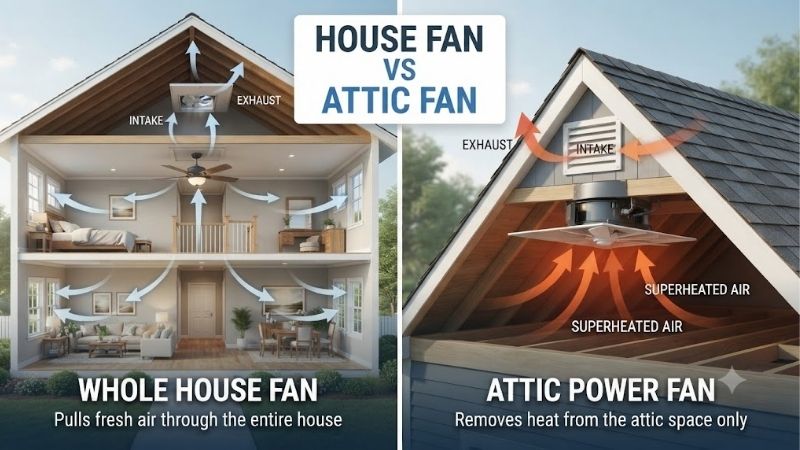
A whole house fan is mounted in the ceiling between the attic and the living space of your home. When turned on, it pulls cool, fresh outdoor air through open windows, draws it upward through the living areas, and pushes the hot indoor air out through the attic vents. This creates a continuous pathway of refreshing, active breeze that physically replaces stale indoor air in minutes.
In 2026, modern smart whole house fans feature quiet brushless motors and automated dampers that prevent heat loss when the fan is idle. These systems are highly effective in regions with cool evenings, as they allow you to flush out the daytime heat and pre-cool your entire house for the upcoming day. This active circulation lowers the perceived temperature immediately, making the living environment feel instantly more comfortable.
What Is an Attic Fan and How Does It Operate?
An attic fan, on the other hand, is installed directly on the roof or gable of your attic space. Its primary job is to exhaust the superheated air that accumulates under your roof, which can easily reach temperatures above 150 degrees Fahrenheit on hot summer days. By expelling this heat, the attic fan lowers the radiant heat transferring downward into your ceiling and living spaces.
Rather than cooling you directly with a breeze, an attic fan acts as a protective shield for your home’s thermal boundary. It works quietly in the background, reduces the thermal load on your primary air conditioning system, and prevents heat from radiating into your bedrooms. Modern attic fans in 2026 are frequently solar-powered, allowing them to run completely free of electricity costs during peak daylight hours.
The Quick Verdict: Which System Wins for Immediate Cooling?
If you want immediate, breezy relief that acts as a direct substitute for air conditioning during mild weather, the whole house fan is the clear winner. It physically cools your body and replaces the air in your living space up to twenty times per hour, providing a dramatic drop in indoor temperature. Homeowners looking to slash their active utility bills while enjoying a fresh outdoor breeze should prioritize this setup.
However, if your primary goal is to protect your roof structure, lower attic humidity, and assist your existing air conditioner by reducing radiant heat, the attic fan is your best bet. It is a set-it-and-forget-it solution that keeps your home’s attic space breathing properly throughout the year. For those ready to make a purchase, check out the top-performing, quiet options available today.
[Explore Highly-Rated Home Ventilation Solutions on Amazon]
Deep Dive Face-Off: Comparing Crucial Features and Efficiency
To make an informed financial investment, we must look at how these systems compare side-by-side across key operational categories. Each fan offers a unique set of technical specifications, installation requirements, and functional advantages that appeal to different household needs. Review our compiled comparison table below to see how these two systems match up across their core specifications.
| Feature / Metric | Whole House Fan | Attic Fan |
|---|---|---|
| Primary Placement | Ceiling (between living space and attic) | Roof or Attic Gable |
| Air Source | Open windows in living areas | Passive vents within the attic |
| CFM Range | 1,500 to 8,000+ CFM | 800 to 2,000 CFM |
| Acoustic Noise | Low to moderate (modern models are ultra-quiet) | Quiet to silent (located outside living space) |
| Installation Cost | Moderate to High ($1,000 – $2,500) | Low to Moderate ($300 – $800) |
| Power Source | Standard electrical grid | Solar-powered or standard grid |
Cooling Performance and Ventilation Efficiency Compared
When evaluating cooling performance, the whole house fan operates on a massive scale. It moves thousands of cubic feet of air per minute (CFM) to create a wind-chill effect that can make the indoor air feel up to ten degrees cooler than it actually is. This active cooling requires you to open windows, making it an excellent option for dry, breezy climates where outdoor air is pleasant.
Attic fans do not cool the occupants directly; instead, they lower the ambient temperature of your attic space. This reduces the heat transfer through your ceiling insulation, which helps your air conditioning unit run more efficiently. It is a passive form of cooling for your living spaces, but a highly active defense mechanism for your roof shingles and structural trusses.
Installation Complexity and Upfront Costs
Installing a whole house fan is a significant home improvement project that usually requires cutting a large opening in your central hallway ceiling. You must ensure your attic has sufficient exhaust venting (typically one square foot of venting per 750 CFM of fan capacity) to prevent attic pressurization. Because of these structural demands and electrical wiring, professional installation is highly recommended and can cost between $1,000 and $2,500.
An attic fan is much simpler and cheaper to install, with average costs ranging from $300 to $800. Roof-mounted attic fans require cutting a small hole in the roof deck and sealing it against leaks, while gable-mounted fans simply attach behind existing vents. Many homeowners with basic DIY skills can complete a gable attic fan installation over a weekend, making it a budget-friendly option.
Energy Consumption and Long-Term Savings
In terms of energy consumption, both systems are exceptionally efficient compared to standard central air conditioning units, which easily draw 3,500 to 5,000 watts of power. A high-efficiency whole house fan draws only 200 to 800 watts, allowing you to run it all night for pennies. This can reduce your seasonal cooling costs by up to ninety percent if used to replace AC during shoulder seasons.
Attic fans are even cheaper to operate, especially if you opt for a solar-powered model that costs absolutely nothing to run. Solar attic fans use a small photovoltaic panel mounted on top of the fan dome to drive the motor, meaning they operate at peak capacity when the sun is hottest. Traditional grid-tied attic fans only draw about 100 to 300 watts, keeping your monthly electric bills incredibly low.
[Check Out the Best Budget-Friendly Attic Fans on Amazon]
Pros, Cons, and Alternative Home Cooling Solutions
Every home ventilation upgrade comes with specific trade-offs that you must consider before finalizing your purchasing decision. Understanding the physical limitations and structural requirements of a house fan vs attic fan will prevent buyer’s remorse and ensure your home stays comfortable. Let us dive into the precise advantages, disadvantages, and potential alternatives available on the market today.
The Comprehensive Pros and Cons of a House Fan vs Attic Fan
The primary advantage of a whole house fan is its ability to rapidly cool your home and replace stale, indoor air with fresh outdoor air. However, its major drawback is that it cannot dehumidify or filter the incoming air, meaning it is not suitable for extremely humid days or high-pollen seasons. Additionally, you must actively manage your windows to operate it safely, as running the fan with closed windows can create backdrafts from your gas appliances.
An attic fan excels because it operates completely independently of your daily habits, turning on automatically via a thermostat when attic temperatures rise. The main downside is that it will not provide immediate, breeze-based cooling to your bedrooms on a hot night. Furthermore, if your attic floor is not properly air-sealed, a powerful attic fan can accidentally draw conditioned air out of your living space and increase your energy bills.
The Alternative: Smart Air Conditioners and Hybrid Ventilators
If neither of these ventilation systems fits your home’s layout or your local climate, there are excellent modern alternatives to explore. A smart window air conditioner or a mini-split heat pump provides targeted, dehumidified cooling to specific zones without requiring attic access or open windows. These systems use advanced inverter compressors to deliver precise temperature control while drawing minimal power compared to older, traditional cooling systems.
Another excellent alternative is a hybrid solar roof ventilator, which combines passive ventilation design with a low-power motorized fan. These units help maintain a healthy roof deck during both summer and winter by expelling moisture and heat without requiring major electrical overhauls. If you live in an apartment, a high-velocity dual window fan can mimic the flushing action of a whole house fan on a smaller, non-permanent scale.
Final Verdict & Buying Recommendations for Your Home
To make the right choice, analyze your local climate, your budget, and your existing HVAC system. If you live in an area with low humidity and cool nights, and you want to actively cool your living spaces without running AC, buy a whole house fan. It will transform your indoor air quality and pay for itself in energy savings within just a few hot summer seasons.
If you live in a humid climate where you must run your air conditioner constantly, an attic fan is the superior supporting addition. It will protect your roof structure from heat damage, prevent mold growth, and lower your AC workload without pulling humid air inside. Whichever path you choose, investing in quality ventilation is a guaranteed way to upgrade your home comfort.
[Browse Top-Tier Home Cooling Fans on Amazon Today]
Conclusion: Making Your Ultimate Home Cooling Choice
Finding the perfect balance between comfort and energy efficiency is easier than ever in 2026. Ultimately, comparing a house fan vs attic fan reveals that these two systems are not true competitors, but rather complementary solutions designed for different tasks. Investing in a high-quality, modern fan system will pay dividends in structural protection, indoor air quality, and daily comfort. Head over to Amazon to find the perfect quiet, high-efficiency fan model that fits your budget and start enjoying a cooler, fresher home today.
Frequently Asked Questions
What is the difference between a whole house fan and an attic fan?
A whole house fan pulls cool outdoor air through open windows, moves it through the living space, and exhausts it into the attic, actively cooling the house. An attic fan only exhausts hot attic air to lower attic temperature and reduce heat gain through the ceiling. They solve different problems and are not interchangeable.
As an Amazon Associate we earn from qualifying purchases at no extra cost to you.




Which one lowers my cooling bill more?
A whole house fan usually saves more, because it can replace air conditioning entirely during cool evenings and mornings in dry climates, cutting compressor runtime dramatically. Attic fans reduce ceiling heat gain and duct losses, which is meaningful in poorly insulated homes but modest where the attic is already well insulated and air sealed.
Can I use a whole house fan in a humid climate?
Only when outdoor conditions are actually favourable. Pulling in 78 degree air at a 72 degree dew point makes the house clammy and loads the air conditioner later. Check outdoor dew point, not just temperature, and only run the fan when outdoor dew point is below roughly 60 degrees and cooler than indoor air.
What airflow and ventilation do they need?
Whole house fans are sized at 2 to 3 CFM per square foot of living space, so a 2,000 square foot home needs 4,000 to 6,000 CFM, plus about one square foot of attic exhaust vent per 750 CFM. Attic fans use 0.7 to 1.0 CFM per square foot of attic with matching soffit intake area.
Are there safety concerns with either?
Yes. Both can depressurise the house if intake is inadequate, potentially backdrafting combustion gases from gas water heaters, furnaces, or fireplaces. Never run a whole house fan with windows closed. Ensure the unit has an insulated winter cover or automatic damper, and have a professional verify combustion appliance safety after installation.











Write Your Review
No reviews yet. Be the first to share your experience!