
A smoldering couch cushion or an overheating wire in the wall does not produce the same alarm signature as a flaming grease fire. This distinction matters because the majority of fatal home fires start as slow, smoky, smoldering events where the difference between early warning and no warning is the sensor inside your detector. A photoelectric smoke detector uses a light-scattering chamber to catch larger combustion particles, making it faster to trigger on those invisible-threat fires that fill a room with toxic smoke while you sleep.
What separates a worthwhile unit from a mediocre one is narrow: sealed-battery lifespan so you are not climbing ladders every six months, resistance to nuisance alarms from kitchen steam or bathroom humidity, and whether it interconnects so that a detector far from your bedroom still wakes you. This roundup for 2026 compares the options currently available on published specifications, listed prices, and aggregated owner feedback to help you match the right detector to your home’s wiring situation and budget.
As an Amazon Associate we earn from qualifying purchases at no extra cost to you.


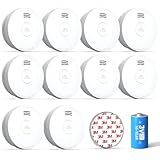

Quick Picks
| Product | Best for | Price |
|---|---|---|
| X-Sense SD2J0AX | Best overall standalone unit | under $30 |
| Kidde 20SD10 | Brand-name reliability with status LED | under $40 |
| Kidde Compact 10SDR | Small rooms on a tight budget | under $20 |
| First Alert Battery Alarm | Absolute lowest entry price | under $20 |
| SITERWELL Hardwired 1-Pack | Adding one unit to an existing wired loop | under $20 |
| Siterlink GS562A 6-Pack | Whole-home wired replacement | under $150 |
| SITERWELL 10-Year Battery Pack | Large wireless multi-room coverage | under $200 |
| SITERWELL 10-Year Product Life | Mid-range whole-home battery upgrade | under $90 |
How We Picked
We narrowed this list using four criteria that consistently drive owner satisfaction or frustration. First, power source: a sealed 10-year battery eliminates the most common complaint category, which is dead units discovered only during a false midnight chirp. Second, sensor type confirmation: every product here uses photoelectric detection rather than ionization, which matters for smoldering-fire response time. Third, false-alarm resilience: units with adjustable sensitivity or a dedicated silence/hush button score higher with owners who have open kitchens or wood-burning stoves. Fourth, interconnection capability: hardwired or radio-linked models earn a place because a single alarm in a hallway may not wake a sleeper behind a closed door.
The 8 Best Photoelectric Smoke Detector in 2026
X-Sense SD2J0AX
This unit hits the price-to-feature sweet spot for anyone who needs dependable photoelectric protection in a room without existing wiring. Owners consistently praise the sealed 10-year battery that removes annual replacement anxiety, and the ETL Listing confirms it meets recognized safety standards rather than self-certified claims. The compact profile keeps it low-profile on ceilings, which apartment renters appreciate.
- Sealed 10-year battery means zero maintenance through its rated life
- ETL Listed for independent safety verification
- No interconnection option limits whole-home coverage to one unit per purchase
Skip this if you need multiple alarms to trigger simultaneously; buy it if you are covering a single bedroom, garage, or rental unit on a modest budget.
Kidde 20SD10
Kidde carries name recognition that reassures buyers who prioritize proven track record over lowest price. The 20SD10 pairs a sealed 10-year battery with an 85 dB alarm that cuts through a closed bedroom door, and the LED status light gives a quick at-a-glance health check that is genuinely useful when you are verifying coverage after a move-in. Owners note fewer nuisance trips near kitchens compared to older Kidde models.
- Bright 85 dB output suitable for larger rooms and noisy environments
- LED status indicator simplifies at-a-glance functional verification
- Priciest standalone option in this roundup at nearly $33
Consider skipping if you are covering multiple rooms and each dollar matters; this is the unit to buy when you want brand assurance in one critical sleeping area.
Kidde Compact 10SDR
The 10SDR serves anyone who needs a second or third detector in a closet, hallway, or small bedroom without committing to sealed-battery pricing. Its AA battery compartment lets you swap cells in seconds, which owners in humid climates actually prefer since moisture can shorten sealed-battery life unpredictably. The slim profile fits neatly on a ceiling in tight spaces where a bulkier unit looks intrusive.
- Low price point makes it easy to deploy in multiple rooms
- AA battery swap is user-friendly and avoids end-of-life disposal confusion
- Periodic battery replacement is a maintenance task you must remember
Skip it if you tend to forget maintenance reminders; buy it for guest rooms or storage areas where a sealed unit would be overkill.
First Alert Battery Smoke Alarm
First Alert has decades of residential smoke alarm history, and this basic battery model lets owners access that reputation at the lowest ticket price here. It is photoelectric, so it is correctly targeted at smoldering-fire detection rather than the flammable-solid fires where ionization sensors have a slight edge. Owner feedback centers on reliability for the cost rather than premium features.
- Lowest price of any name-brand option in this list
- First Alert’s long support history and parts availability
- Limited published specification detail compared to newer competitors
Skip this if you want documented battery life ratings or specific alarm decibel figures; choose it when budget is the dominant constraint and you trust the brand name.
SITERWELL Hardwired 1-Pack
This is the practical solution when you are adding a single photoelectric unit to an existing hardwired loop in a home where the wiring is already in place but one detector failed. The 9V backup battery ensures continued protection during a power outage, and the test/silence button on the face lets you verify function or mute an alarm without a ladder trip to the breaker panel.
- 9V backup keeps protection active through power failures
- Interconnects with existing hardwired units in your home
- Requires compatible existing wiring; useless in a non-wired space
Skip it if your home has no smoke alarm wiring runs; it is the best value for a targeted single-unit replacement.
Siterlink GS562A 6-Pack
For a whole-home wired replacement project, buying six interconnected units at once beats purchasing singles repeatedly. The GS562A gives photoelectric detection with 9V battery backup in each unit, a test/silence button on every face, and radio or hardwired interconnection so that any triggered alarm sounds everywhere. Owner reviews highlight the cost-per-unit savings versus buying six separate retail packages.
- Lowest per-unit price for hardwired interconnected photoelectric coverage
- 9V backup in each unit provides redundancy without a centralized battery
- Requires a full wiring run or compatible existing loop for installation
Skip this if you only need one or two units or your home lacks wiring infrastructure.
SITERWELL 10-Year Battery Pack
When a homeowner wants to cover an entire large or multi-story house with sealed-battery convenience and no wiring project, a multi-pack like this delivers it in one purchase. The 10-year sealed cell in each unit matches the premium standalone options, and buying as a bundle removes the need to source detectors room by room over several months.
- 10-year sealed batteries across every unit in the pack
- Single-purchase convenience eliminates staggered replacement schedules
- Highest total cost of any option here for under $200
Skip it if your home already has hardwired loops; buy it when you want a complete wireless overhaul in one order.
SITERWELL 10-Year Product Life
This tier sits between the budget singles and the premium wireless packs, offering 10-year product life at roughly half the cost of the top-tier multi-pack. Owners choosing this range want long life without the highest price point, and the listing positions it as a mid-range whole-home solution. It appeals to buyers comparing value-per-year rather than sticker price alone.
- 10-year rated life provides extended maintenance-free operation
- Mid-range price balances longevity and affordability for full-home coverage
- Exact unit count and interconnection details are less clearly specified
Skip it if you need confirmed hardwired interconnection; consider it when you want long-life coverage without the premium bundle cost.
Buying Guide
Photoelectric vs. Dual-Sensor: Do You Need Both?
Photoelectric sensors respond faster to smoldering fires, which account for the majority of residential fire deaths according to published NFPA statistics. If your budget allows, a dual-sensor unit combining photoelectric with ionization covers both fire types. However, a well-placed photoelectric detector in every bedroom and one per floor is more effective than a single dual-sensor unit in a hallway. Choose photoelectric as your baseline and add ionization only near high-heat zones like kitchens or laundry rooms.
Sealed Battery vs. Replaceable: The Maintenance Trade-Off
A sealed 10-year battery guarantees power for the detector’s rated life and eliminates the leading cause of smoke alarm failure: a dead or removed 9V cell. Replaceable AA or 9V backups suit humid environments where sealed cells may degrade early, and they simplify disposal at end of life since you are not throwing away a lithium cell. If you own a home long enough to install detectors in several rooms, sealed batteries save time and improve reliability.
Interconnection: Why One Alarm in a Hallway May Not Wake You
A 2026 code-adopting jurisdiction increasingly requires interconnected alarms so that every unit sounds when any one triggers. In older homes, hardwired interconnection uses a dedicated third wire in the electrical box. Where wiring does not exist, RF-linked or wireless-interconnected models close the gap. For bedrooms with closed doors, interconnection is the single most important feature after choosing photoelectric detection, because a detector five doors away must still alert you within seconds.
Our Verdict
The X-Sense SD2J0AX is the top pick for most buyers because it combines a sealed 10-year battery, ETL certification, photoelectric detection, and a sub-$23 price without compromise. For the absolute lowest entry cost with a recognized brand, the First Alert Battery Smoke Alarm wins on price alone. If your home already has hardwired loops and you need to replace six failing units at once, the Siterlink GS562A 6-Pack delivers the lowest per-unit cost and full interconnection, making it the smarter buy for that specific scenario.
FAQ
What is a photoelectric smoke detector and how does it differ from ionization?
A photoelectric detector uses a light source and sensor chamber where smoke particles scatter the beam and trigger the alarm. Ionization detectors use a radioactive source to ionize air and detect disruption from tiny combustion particles. Photoelectric units respond faster to the larger particles produced by smoldering materials like foam and fabric, which is why they are preferred for bedroom and living-area placement.
How many photoelectric smoke detectors do I need in my home?
Current guidance calls for one in every bedroom, one outside each sleeping area, and one on every level including basements. Larger homes with long hallways or open floor plans benefit from additional units to minimize dead zones. If your bedrooms have closed doors, interconnection ensures all alarms sound simultaneously regardless of placement.
Should I choose hardwired or battery-powered photoelectric detectors?
Hardwired units never die from a dead backup battery because they draw mains power, but they require compatible wiring and are only practical during construction or renovation. Sealed battery-powered units install anywhere in minutes and now last a decade. Many owners in existing non-wired homes choose sealed battery models for simplicity while ensuring bedroom coverage with interconnected wireless versions.
How do I stop false alarms from cooking or shower steam?
Use the silence or hush button to mute the alarm temporarily, then ventilate the room. Install detectors at least ten feet from kitchens and bathrooms, and avoid placement near air returns or ceiling fans that blow particles toward the sensor. If nuisance trips persist despite correct placement, a photoelectric-only unit is often less trigger-happy than a dual-sensor model near steam sources.




Write Your Review
No reviews yet. Be the first to share your experience!