
Where Can I Sell My Graphics Card in 2026?
The fastest places to sell a graphics card in 2026 are peer-to-peer marketplaces like eBay and Facebook Marketplace, which typically pay the most but take 8–15% in fees, while trade-in programs and local buyer services pay 15–30% less in exchange for instant cash and zero effort. If you want the highest net payout and can wait a week, list it yourself; if you want money today, sell to a local buyer or trade-in service.
- Where Can I Sell My Graphics Card in 2026?
- Quick Comparison of Where to Sell
- Best Overall: Peer-to-Peer Marketplaces
- Best for Speed: Local Buyer Services
- Best for Convenience: Trade-In and Buyback Programs
- Preparing a Card Before Photos
- How to Choose Based on Your Situation
- Worked Example: Is the Extra Effort Worth It?
- Frequently Asked Questions
Quick Comparison of Where to Sell
| Option | Best for | Typical fees | Payout speed | Net payout vs. market value |
|---|---|---|---|---|
| eBay (auction or fixed price) | Maximum price, mid-to-high-end cards | ~13–15% final value fee + payment fees | 2–7 days after delivery | 85–95% |
| Facebook Marketplace / Craigslist | Local cash sale, no shipping risk | 0% (cash) or small listing fee | Same day | 90–100% |
| r/hardwareswap and similar forums | Enthusiasts who value clean, documented cards | Payment fees only (~3%) | 1–3 days | 90–97% |
| Local buyer / “we buy GPU” services | Instant cash, no listing work | None (built into the offer) | Same day | 60–75% |
| Trade-in / buyback programs | Convenience, store credit | None visible; credit only | 3–10 days | 55–70% |
| Prebuilt/system builders | Selling the whole PC instead | Varies | Depends on buyer | Depends on configuration |
Percentages are general market ranges and move with card generation, VRAM capacity, and whether the card was used for mining. A card with a documented non-mining history and original box consistently lands at the top of its range.
Best Overall: Peer-to-Peer Marketplaces
Marketplaces such as eBay, Facebook Marketplace, and dedicated hardware forums give you the highest payout because you’re selling directly to another person, not to a business that needs margin. eBay reaches the widest audience and is the strongest choice for cards that are expensive or niche enough that local demand is thin. Its main trade-off is fee drag: a card that sells for $500 nets you roughly $425–$440 after final value fees and payment processing.
Facebook Marketplace and Craigslist are the opposite trade: you keep nearly everything, but you’re limited to local buyers who show up, and you have to manage meetups. For a mid-range card worth $150–$300, the convenience usually wins.
Best for Speed: Local Buyer Services
Local “we buy electronics” shops and regional GPU buyers advertise instant quotes. They typically offer 60–75% of what the card would fetch on eBay, but they pay immediately, handle the paperwork, and don’t care about your listing photos. This is the right pick if the card is older, has cosmetic wear, or you simply don’t want the listing process. The trade-off is real money: on a $400 card, you’re giving up roughly $100–$160 for same-day cash.
Best for Convenience: Trade-In and Buyback Programs
Retailer trade-in programs and manufacturer-adjacent buyback services accept cards and issue store credit, usually within a week. They’re the lowest-effort option and the lowest-paying, often 55–70% of market value, and many pay in credit rather than cash. If you’re upgrading within the same retail ecosystem anyway, credit is nearly as good as cash. If you need money in your bank account, it isn’t.
Preparing a Card Before Photos
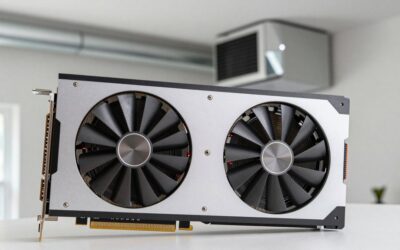
Buyers can’t inspect a GPU in person on most marketplaces, so photos do the negotiating. Dust in the cooler fins and on the backplate is the single most common reason a listing gets lowballed, because it reads as “used hard, possibly in a mining rig.” Cleaning takes 15–20 minutes and routinely moves the final price by 5–10%.
Step-by-Step Prep
- Power down and unplug the system. Wait a few minutes for the card and power supply to discharge before handling anything. Reason: capacitors hold charge briefly, and you don’t want to work around live power.
- Remove the card and set it on a non-static surface. A wooden table works; avoid carpets and plastic bags.
- Blow dust out of the cooler fins and fan blades. Use short bursts of compressed air held upright, sweeping from the backplate toward the I/O bracket. Reason: dust packed into the fins raises fan RPM and noise, and buyers know it. Hold fans still with a finger so they don’t overspin and damage the bearings.
- Wipe the backplate and shroud with a dry microfiber cloth. Skip alcohol on plastics and any printed labels.
- Inspect the PCIe connector fingers and the 8-pin/12VHPWR connectors. Clean them with a dry soft brush. Reason: scorched or discolored power connectors are a hard no for many buyers, and photographing them cleanly preempts the question.
- Photograph the card lit up in a running system. A photo of the card displaying in a system, plus a shot of the GPU-Z or vendor utility screen showing the model and VRAM, is worth more than any description.
- Note the cooler type and dimensions. Two-slot cards fit nearly every case; three-slot and 320mm+ cards don’t. Stating length and slot width in millimeters prevents half your messages.
- Include the original box and accessories if you have them. Boxes and correct power adapters measurably raise perceived condition and price.
How to Choose Based on Your Situation
| Your situation | Recommended route | Why |
|---|---|---|
| Card worth more than $400, you have the box | eBay auction with a reserve or fixed price | Widest buyer pool; fee drag is worth it at high value |
| Card worth $150–$300 | Facebook Marketplace local cash | Fees would eat too much of a smaller sale; local demand is usually adequate |
| You need money today | Local buyer service | Instant payment, no shipping, no disputes |
| You’re upgrading within one retailer | Trade-in program | Credit is spendable, and effort is near zero |
| Card has cosmetic wear or missing accessories | Local buyer or trade-in | Marketplace buyers discount visible wear heavily |
Worked Example: Is the Extra Effort Worth It?
Say a card’s fair market value is $450. On a marketplace, after roughly 13–15% in fees and $15–$25 shipping, you net about $370–$385. A local buyer offers 65% of market, or roughly $290, today. The difference is $80–$95, and the marketplace route takes 7–14 days including shipping and possible returns. If your time is worth $40/hour, the marketplace only wins if the listing, photos, packing, and messaging take under two hours. For most sellers, a cleaned card with good photos lists in about 45 minutes, which makes the marketplace the better economic choice for anything above roughly $250.
Frequently Asked Questions
How much can I get for a used graphics card in 2026?
Generally 50–75% of the original retail price for a card one generation old, dropping faster for older generations and higher for cards with plentiful VRAM. Cards still in strong demand for local AI workloads and high-VRAM models hold value noticeably better than gaming-only mid-range cards.
Do I need to clean the card before selling it?
It isn’t required, but dust in the cooler fins is the most common reason buyers negotiate down. A 15-minute compressed-air cleaning and clean photos of the backplate and power connectors typically recoup several percent of the sale price.
Should I sell my card on its own or sell the whole PC?
Selling the card alone almost always nets more per component, because buyers shopping for a GPU will pay closer to market than buyers shopping for a used complete system. Sell the whole PC only if the rest of the build is old enough that parting it out isn’t worth the effort.
What should I include in the listing to get a better price?
Exact model and VRAM capacity, cooler type and card length in millimeters, whether it was used for mining, and clear photos of the card running in a system. Buyers also want to see the PCIe connector fingers and power connectors, because scorch marks there signal a card that was run hard.
Is it safe to sell to a local buyer in person?
Meeting in a public place during daylight hours and accepting cash or a payment that clears instantly is the standard practice. Avoid shipping to a stranger without tracking, and be wary of overpayment offers or requests to move the conversation off the platform.
Do prices for used cards change much through the year?
Yes. Prices tend to soften right after a new generation launches, as early adopters flood the market with their old cards, and firm up in the months that follow once supply thins. If you’re not in a hurry, watching the weeks after a launch announcement usually pays off.



Write Your Review
No reviews yet. Be the first to share your experience!