
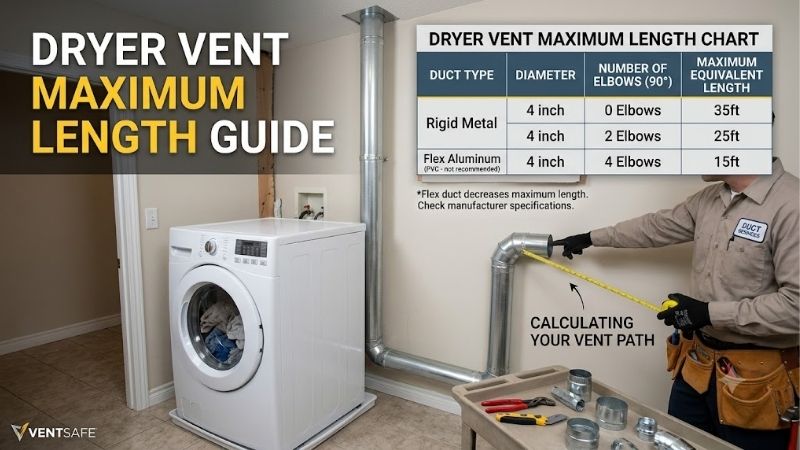
Dryer vent maximum length chart rules help homeowners measure exhaust duct restriction accurately across complex home layouts. Accounting for total physical distance and rigid elbow deductions ensures compliance with standard building safety codes. Precise duct evaluation protects appliances from hazardous thermal stress.
How to Choose the Right Dryer Vent Maximum Length Chart
Understanding a dryer vent maximum length chart allows property managers to verify that laundry ventilation complies with international residential code rules. Evaluating structural layouts, fitting reductions, and material friction prevents dangerous pressure drops. Using reliable guidelines maintains optimal ventilation.
Assess Total Physical Run Distance
Evaluating raw linear footage forms the foundational step when applying a dryer vent maximum length chart to home setups. Homeowners must measure every straight section from the laundry outlet to the exterior exit point. Clear physical measurements prevent underestimating total drag inside concealed wall cavities.
Accurate developed duct length tracking guarantees that total duct distance remains within safe operating bounds. Using tape measures or laser distance tools eliminates guesswork when plotting long runs through attics. Verifying straight piping limits protects appliance blowers from continuous mechanical strain.
Factor Standard Elbow Deductions
Bends in exhaust piping generate significant air turbulence that increases static pressure behind the drying unit. Applying standard elbow friction penalties subtracts five feet for every 90-degree metal turn installed. Accounting for these directional changes reflects true mechanical resistance throughout the duct.
Inspectors must evaluate 45-degree fittings by deducting two and a half feet from allowable distance thresholds. Summing physical lengths with fitting penalties reveals whether your configuration violates safety codes. Correct calculations ensure proper exhaust discharge at exterior wall outlets during operation.
Account for Transition Ducting
Evaluating flexible connectors behind the appliance prevents hidden airflow restrictions in compact utility spaces. Flexible metal foil bridges are limited to short runs and cannot pass into concealed wall cavities legally. Measuring transition ducting ensures full system safety during long drying cycles.
Crushed or excessively looped hoses increase backpressure resistance drastically during standard operational runs. Upgrading to semi-rigid aluminum connectors maintains clear internal pathways without collapsing against framing. Proper connector selection supports efficient moisture expulsion and prevents overheating.
Top Picks for Dryer Vent Calculation Equipment
Applying a dryer vent maximum length chart alongside quality tools optimizes residential ventilation safety checks. We evaluated top-rated angle gauges, wind speed meters, and booster fans on Amazon for home utility spaces. The following verified tools deliver dependable performance during routine duct audits.
Klein Tools 935DAG Digital Level and Angle Gauge
Ideal for technicians measuring precise elbow turns, this digital gauge simplifies duct friction calculations. Strong magnetic bases clamp firmly onto rigid metal piping to display instant angle readings on backlit screens. Durable housing withstands accidental drops on concrete utility floors effortlessly.
Initial calibration requires flat surface zeroing before taking overhead duct measurements in tight spaces. Nevertheless, its high precision helps users apply accurate elbow deductions when calibrating a dryer vent maximum length chart. It serves as a dependable tool for detailed home ventilation audits.
Proster Handheld Digital Anemometer
Designed for homeowners verifying exhaust flow, this handheld meter excels at airflow velocity test procedures. Bright LCD displays show real-time wind speed and CFM output at exterior termination hoods. Compact ergonomics allow effortless portability across multi-story residential inspection sites.
Navigating multi-button menus requires reading instructions briefly during initial setup in dim attic spaces. However, its accurate air volume readings confirm whether long duct runs suffer from excessive pressure drop. It provides quantifiable proof that your laundry exhaust maintains proper discharge velocity.
Komelon SL2825 Self Lock 25-Foot Tape Measure
Tailored for DIYers plotting long wall runs, this locking tape measure tracks exhaust lines accurately. Thick nylon-coated blades extend smoothly through floor joists and wall framing without collapsing prematurely. Ergonomic rubber casing provides a secure grip during complex duct layout checks.
The internal spring mechanism feels slightly stiff during rapid blade retraction on long distance measurements. Nonetheless, its self-locking mechanism simplifies solo linear measuring when checking total developed duct length. It remains an affordable essential for calculating physical run limits easily.
Tjernlund DB2F Dryer Booster Fan
Engineered for extended exhaust pathways, this automatic inline blower handles runs past the booster fan threshold. Pressure-sensing controls activate the fan automatically whenever the clothes dryer begins operating. Heavy-duty steel housing resists elevated temperatures and maintains continuous velocity.
Hardwired electrical installation requires basic wiring knowledge or professional electrician assistance during setup. Regardless, its powerful airflow boost allows long runs to exceed standard 35-foot limits safely. It offers an effective solution for complex residential layouts facing severe length limits.
Builder’s Best 4-Inch Semi-Rigid Aluminum Duct
Perfect for short transition bridges, this non-combustible tubing serves as an ideal transition duct connector. Class zero aluminum construction withstands heat while maintaining smooth internal pathways for moist air. Pre-formed ends fit standard four-inch appliance outlets without requiring custom adapters.
Handling raw aluminum edges demands work gloves to prevent accidental finger cuts during tight installations. Even so, its semi-rigid structure resists crushing far better than fragile vinyl accordion hoses. It serves as a dependable code-compliant bridge for compact laundry closet configurations.
| Equipment / Tool Name | Primary Function | Core Code Benefit | Best Suited For |
|---|---|---|---|
| Klein Tools Angle Gauge | Elbow angle measurement | Precise fitting deduction | Fitting calculation audits |
| Proster Anemometer | Discharge velocity test | Verifies pressure safety | Exterior airflow checks |
| Komelon Tape Measure | Linear distance tracking | Physical run measurement | DIY duct path mapping |
| Tjernlund Booster Fan | Auxiliary air velocity | Overcomes length limits | Runs exceeding 35 feet |
| Builder’s Best Duct | Transition wall connection | Non-combustible safety | Short appliance bridging |
Frequently Asked Questions
Reviewing a dryer vent maximum length chart raises frequent technical questions regarding home ventilation safety standards. Understanding elbow reductions, booster requirements, and duct materials ensures safe appliance operation over time. Below are clear expert answers regarding proper run length limits.
What is a dryer vent maximum length chart used for?
A reference chart helps homeowners determine the maximum allowable distance for exhaust piping based on fitting bends. Standard building codes set the maximum straight distance at 35 feet before accounting for elbows. Consulting these guidelines ensures your exhaust termination cap discharges air freely outdoors.
Calculating developed distance prevents excessive static pressure that forces dryers to run long, costly drying cycles. Keeping overall resistance low protects internal thermal fuses from failing under heavy heat loads. Following standard chart recommendations safeguards your property from structural fire risks.
How do 90-degree elbows affect total allowed length?
Every 90-degree metal bend reduces total allowable duct length by five feet due to internal air turbulence. Residential safety rules enforced by international residential code guidelines mandate these standard deductions. Subtracting fitting penalties ensures moving air maintains sufficient velocity to clear wall exits.
Installing multiple sharp bends restricts exhaust flow drastically, effectively shortening your permitted linear piping run. Opting for smooth 45-degree transitions instead reduces the penalty to only two and a half feet per fitting. Designing direct exhaust routes keeps system static pressure within safe parameters.
When is an inline booster fan necessary?
An inline booster fan becomes mandatory whenever total developed duct length exceeds the standard 35-foot code allowance. Long concealed pathways create high backpressure resistance that standard appliance blowers cannot overcome alone. Auxiliary fans restore necessary CFM output to push moist exhaust air outside.
Pressure-actuated switches turn the auxiliary fan on automatically when exhaust air flows through the main line. Installing certified booster equipment prevents moisture condensation from collecting inside long ceiling cavities. Proper fan integration extends appliance life while maintaining complete safety compliance.
Can flexible vinyl hoses be used for wall runs?
Flexible vinyl or foil accordion hoses are strictly prohibited inside concealed wall or floor spaces by building codes. Ribbed interior walls catch loose fibers easily, creating a severe lint accumulation hazard over time. Thin plastic materials also melt quickly when exposed to high dryer exhaust temperatures.
Homeowners must install smooth rigid galvanized piping inside wall cavities to ensure proper airflow and fire resistance. Rigid metal ducts maintain consistent diameters that prevent crushing and structural airflow collapse. Upgrading non-compliant flexible hoses remains a critical step during home inspections.
Final Thoughts
Following a dryer vent maximum length chart ensures your home exhaust line maintains adequate velocity and fire safety. Calculating straight runs alongside elbow deductions keeps your utility setup compliant with building codes. Regular evaluations protect homes from a severe lint accumulation hazard while extending appliance performance.
As an Amazon Associate we earn from qualifying purchases at no extra cost to you.


#3 Pick





Write Your Review
No reviews yet. Be the first to share your experience!