
Choosing the right dryer vent snake is mostly a matter of measuring the vent path—not simply buying the longest tool available. A snake that is too short will leave lint behind, while an unnecessarily long one can be harder to control, tangle more easily, and cost more.
The Short Answer
For most dryers, a 15-foot snake is enough when the vent runs directly through an exterior wall. Choose a 25-foot model for a longer wall run, a laundry room located away from an outside wall, or a route with one or two bends. A 35-foot snake is a practical choice for many homes with attic or crawl-space routing. Choose 50 feet only when you have measured a genuinely long vent path or need to reach multiple sections.
As an Amazon Associate we earn from qualifying purchases at no extra cost to you.


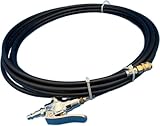
As a buying rule, measure the complete route from the back of the dryer to the exterior termination, then add approximately 3 to 6 feet for bends, maneuvering, and the section inside the dryer connection. Do not assume that the length printed on the package equals usable cleaning reach; some of the snake may remain outside the vent while you feed and control it.
For a typical single-family home, a 15- to 25-foot kit costing about $15 to $80 is usually sufficient. Longer kits tend to cost more, and professional-style systems with air blowguns or reinforced memory material can be substantially more expensive.
Standard Sizes
| Snake length | Length in inches | Length in centimeters | Best for |
|---|---|---|---|
| 15 feet | 180 inches | 457.2 cm | Short, straight runs through an exterior wall |
| 25 feet | 300 inches | 762 cm | Average longer runs, one or two turns, or a nearby attic route |
| 35 feet | 420 inches | 1,066.8 cm | Longer attic, crawl-space, or multi-turn vent paths |
| 50 feet | 600 inches | 1,524 cm | Very long runs or difficult access points |
Most consumer dryer vent cleaning kits use a flexible brush connected to interlocking rods or a continuous flexible shaft. The cleaning head and shaft are commonly around 1.5 to 3 inches in diameter, although the exact size varies. The vent itself is usually a nominal 4-inch diameter, so the tool should pass freely without scraping aggressively against the duct.
Example price points illustrate the usual spread. A 15-foot Holikme kit is listed at about $14.99, while a 35-foot version is about $20.99. A 50-foot Holikme kit is about $35.99. A 25-foot On-Site Duct Supplies snake with a blowgun and 3/8-inch outside-diameter flexible memory material is about $78.25. Prices can vary by seller and kit contents.
How to Measure Your Space
- Unplug the dryer. Turn off the gas supply if you have a gas dryer and can do so safely. Pull the appliance forward enough to access the vent connection.
- Disconnect the dryer hose. Loosen the clamp and remove the flexible transition duct from the dryer outlet. Do not use the flexible transition hose as a substitute for the permanent wall duct.
- Identify the vent direction. Look into the wall opening, then locate the exterior termination. The duct may travel horizontally, vertically, through an attic, or down into a crawl space.
- Measure each section. Use a tape measure for accessible areas. Record the distance from the dryer to the wall, the wall thickness, and any attic or crawl-space segment.
- Account for bends. A 90-degree turn adds more than its visual width because the snake must curve around it. Add roughly 12 to 24 inches for each significant bend, depending on the duct layout.
- Add a handling allowance. Add 3 to 6 feet to your total. This gives you enough extra length to hold the snake, work it back and forth, and reach the far end without losing control.
- Round up to the next standard size. If your measured route is 18 feet, choose 25 feet—not 15 feet. If the route is 28 to 30 feet, a 35-foot kit is the safer choice.
If you cannot see the full route, start with the dryer’s installation location and inspect the exterior wall cap, attic, basement, or crawl space. A borescope camera can help confirm the direction, but never drill into a duct or force a snake when you do not know where it leads.
By Room or Use Case
Laundry Closet on an Exterior Wall
This is the simplest installation. If the dryer sits within 3 to 8 feet of the wall opening and the duct exits almost straight outside, a 15-foot snake is usually adequate. Measure around the transition hose, rather than measuring only from the dryer to the wall. Choose a kit with a brush head that fits inside a 4-inch duct without excessive force.
Laundry Room Near the Exterior Wall
A laundry room that is close to an outside wall but not directly against it commonly needs 15 to 25 feet. The duct may run behind cabinets, along a wall, or through a short ceiling cavity. A 25-foot kit provides useful extra reach and is often easier than trying to work with a tool at its maximum extension.
Basement or Interior Laundry Room
Dryers in basements and interior rooms often vent upward or sideways before reaching an exterior wall. Start with a route measurement and generally consider 25 to 35 feet. If the duct passes through a finished ceiling or several joist bays, the 35-foot option gives more working room. Avoid adding length based only on the size of the basement; the relevant measurement is the duct route.
Attic, Crawl Space, or Roof Termination
A vent that rises into an attic or travels through a crawl space may need 35 feet, especially when it has multiple turns. A 50-foot snake may be appropriate for a long roof-termination route, but it is not automatically better. Long flexible tools can buckle at bends, so use a controlled feed-and-retract motion rather than forcing the shaft.
Shared or Commercial-Style Duct Access
Longer systems, multiple access points, or rigid commercial ductwork may call for a 25- to 50-foot professional snake. Some models accept an air line or blowgun, while others are intended for hand use. Confirm the tool’s shaft diameter, connector style, and manufacturer instructions before using compressed air. Do not direct high-pressure air into an occupied room or toward an unsecured exterior vent cover.
Common Sizing Mistakes
- Measuring in a straight line: The snake follows the duct, including bends and vertical sections. A straight-line estimate can be several feet short.
- Buying exactly the measured length: You need extra length to hold, rotate, and pull back the tool. Round up to the next available size.
- Assuming a 50-foot tool cleans better: Excess length can make feeding and retrieval difficult, particularly in flexible or sharply angled ductwork.
- Ignoring the brush diameter: A shaft may be long enough but still unsuitable if the brush is too large for the duct or cannot pass a turn.
- Using a drill without checking compatibility: Some rod systems are designed for hand use only. A drill can loosen connectors, kink the shaft, or damage the duct.
- Cleaning only from the dryer side: Lint can collect near the exterior cap. Inspect and clean the termination separately, and make sure the flap opens freely.
- Forcing a blocked snake: Stop if the tool will not advance. A crushed duct, bird nest, screw, or disconnected section may require professional inspection.
FAQ
Is a 15-foot dryer vent snake long enough?
It is long enough for many direct wall exits. If the total duct route is under about 10 to 12 feet and has few bends, a 15-foot kit usually leaves adequate handling room. Choose 25 feet if the route is close to 15 feet or its direction is uncertain.
Should I buy a 25-foot or 35-foot dryer vent snake?
Choose 25 feet for a known route of roughly 18 to 22 feet. Choose 35 feet when the route is about 23 to 30 feet, travels through an attic or crawl space, or includes several bends. The extra length is worthwhile only if the duct actually requires it.
Can a dryer vent snake go through bends?
Most flexible snakes can navigate gradual bends, but sharp 90-degree turns, crushed flexible duct, and poorly aligned connections can stop them. Feed slowly, rotate only as the instructions allow, and never force the tool. Disconnecting an accessible section may be safer than pushing through a difficult joint.
How often should I clean a dryer vent?
Inspect and clean the vent at least once a year, or sooner if drying times increase, clothes feel unusually hot, the lint screen collects less lint than normal, or the exterior flap barely opens. Homes with frequent laundry, long vents, or several bends may need more frequent cleaning.
Ready to decide? Our #1 pick for 2026 is the 15 feet.
Live price & availability on Amazon.




Write Your Review
No reviews yet. Be the first to share your experience!