
A diesel particulate filter cleaner is only worth buying when the problem is soot. Short trips, cold starts and long idling load the filter faster than normal driving can burn it clean, and that is the gap a fuel-borne cleaner is meant to close: it lowers the temperature at which trapped soot burns, so an ordinary drive can finish the regeneration the vehicle keeps starting. The real decision is whether your filter needs that chemical help, a workshop cleaning, or a repair no bottle can perform.
This shortlist serves three groups: pickup and SUV owners seeing early DPF warnings, drivers whose short-trip routine never lets regeneration finish, and fleet caretakers building a fixed treatment interval. Every candidate was checked against its Amazon listing name, model number and stated specs, and only products whose listing explicitly names diesel particulate filter cleaning or regeneration support were kept. Anything that was a general diesel additive with no DPF claim, a gasoline cleaner, or a replacement filter unit was excluded.
Quick Picks
As an Amazon Associate we earn from qualifying purchases
| Product | Best for | Key spec from title |
|---|---|---|
| Rislone 4744 DPF Clean Diesel DPF, Exhaust & Emissions System Cleaner | Short-trip diesels with frequent, unfinished regenerations | 16.9 fl oz bottle, one dose every 5,000 miles |
How to Choose
Match the Cleaning Method to the Soot Problem
Cleaners reach the filter in three ways, and they are not interchangeable. A fuel additive like the Rislone below rides through combustion and works on soot while you drive, which suits early loading and prevention. Sensor-port foams attack heavier deposits directly but need exhaust access and a soak period. Pressurized purge fluids are workshop products sprayed into an installed filter with dedicated equipment. Pick the method that matches how loaded the filter is: a warning light that appears after weeks of city driving is additive territory, while a filter already restricting exhaust flow belongs in a shop, not in a shopping cart.
Read the Dose and Treatment Interval on the Label
Two bottles that look identical can cover very different amounts of driving. Some additives treat one tank and are done; others, including the pick here, state a repeat interval of 5,000 miles, which turns the purchase into a maintenance schedule rather than a one-off fix. Check how much fuel one bottle treats, whether a large truck tank needs a double dose, and whether the maker expects use at every fill-up or only at intervals. A stated interval also protects you from overdosing, because pouring in extra additive does not clean faster and can waste the whole bottle on a single tank.
Confirm Fuel and Emissions System Compatibility
A modern diesel rarely has a DPF on its own. The same exhaust line usually carries a diesel oxidation catalyst upstream and, on newer trucks, an SCR unit with DEF dosing downstream. The listing for any cleaner you buy should state plainly that it is safe for that whole chain, not just the filter. Fuel matters too: confirm the product is approved for ultra-low sulfur diesel and for the biodiesel blends you actually pump, such as B5 or B20. The Rislone listing covers all of those points in writing, which is exactly the level of detail to demand before an additive goes into the tank.
Know What No Cleaner Can Fix
Every product in this category cleans soot, the soft carbon that regeneration burns away. Ash is different: it is the incombustible residue left behind after thousands of miles, and no additive dissolves it. A cracked, melted or collapsed filter substrate is a parts problem, and a failed differential pressure sensor can make a healthy filter look clogged. If a cleaner and a completed regeneration do not change the warning, the next step is a scan and an inspection, not a second bottle. Buying with that limit in mind keeps a modest maintenance product from being judged against a repair it never claimed to do.
The 1 Best Options
Rislone 4744 DPF Clean Diesel DPF, Exhaust & Emissions System Cleaner
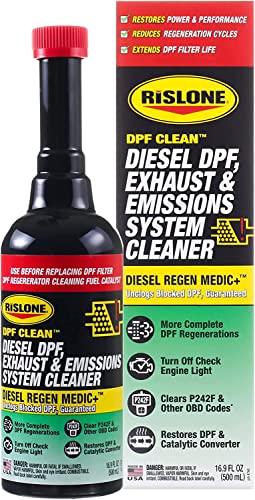
This is the pick for owners whose filter loads up because the truck never gets a long, hot run. The formula uses detergents and heavy-duty cleaning solvents aimed at soot, carbon and oily residue across the fuel, exhaust and emissions systems, and its stated job inside the filter is to lower the ignition temperature of trapped soot so regeneration completes at normal driving temperatures. The listing also names the outcome short-trip drivers actually chase: fewer regeneration cycles, restored power, and clearing the P242F code and similar OBD codes that a soot-loaded filter triggers.
Specs
- Brand: Rislone
- Part number: 4744
- Bottle size: 16.9 fl oz (500 ml), 1-pack
- Item form: Liquid
- Item weight: 1.1 lb
- Included components: 4744, 1 bottle
- Dose: one bottle for cars, SUVs and pickup trucks; larger vehicles may require a higher dose
- Treatment interval: regular use every 5,000 miles
- Fuel compatibility: all diesel and biodiesel fuels, including ULSD and B2, B5 and B20 blends
- Emissions hardware: stated safe for DOC, DPF, SCR and DEF systems
- Code support: clears P242F and other OBD codes, per the listing
- Bottle design: works in fuel tanks fitted with misfueling devices
- Recommended uses: fleet and plant maintenance
- Country of origin: made in the United States
Best for: Diesel cars, SUVs and pickups that clog their filters on short, low-speed trips and need a documented 5,000-mile treatment routine.
Watch out for: It works through regeneration, so the truck still needs driving after the dose; a filter loaded with ash or physically damaged will not respond to any fuel additive.
ASIN: B0BS49X7N5
Which One Fits Your Situation
Your Filter Warning Follows a Short-Trip Routine
When the DPF light keeps company with school runs and short commutes, the filter is soot-loaded rather than broken, and exhaust temperatures simply never stay high long enough. The Rislone 4744 fits that pattern because its stated purpose is lowering the soot burn temperature so normal driving can finish regeneration. Dose the tank, then give the vehicle one sustained drive so the cleaning cycle the additive supports can actually run to completion.
A P242F Code Is Already Stored
A stored P242F points at a filter too loaded with soot to regenerate normally, and it is the one code this class of product openly targets. The Rislone listing names P242F and similar OBD codes directly, which makes it the logical first step before paying for a forced regeneration at a shop. Treat it as a first step, though: if the code returns quickly after a completed cycle, have the pressure sensor and filter inspected instead of repeating doses.
You Maintain Several Diesel Vehicles
Fleet and plant caretakers need a treatment that can be written into a service schedule, and the listing recommends this bottle for exactly that work. A fixed 5,000-mile interval, one bottle per light vehicle, and written compatibility with DOC, DPF, SCR and DEF hardware make it easy to standardize across mixed trucks and vans. The same paperwork trail also helps when a warranty question asks what has been poured into the tank.
You Are Choosing Between a Bottle and a Workshop Cleaning
Choose the bottle when the truck still drives normally, regenerations still complete, and the only symptom is that they happen too often. Choose the workshop when power is already limited, the filter restricts flow, or mileage is high enough that ash is the likely load. The Rislone treatment is the low-effort trial that tells you which case you have: improvement after one dose points to soot, while no change points to bench cleaning or inspection.
Common Mistakes
- Buying a general diesel additive with no DPF claim anywhere on its listing and expecting it to clean the filter, when its detergents were blended for injectors and fuel lines rather than for soot trapped in an exhaust filter.
- Treating ash buildup like soot buildup, when only soot burns off during regeneration and ash keeps accumulating until the filter comes off the vehicle for a bench cleaning or a replacement.
- Dosing the tank and then idling or making another short trip, so the regeneration the cleaner supports never completes and the treated fuel burns away at low exhaust temperatures that leave the soot exactly where it was.
- Repeating bottle after bottle when a warning returns, instead of checking the differential pressure sensor, the exhaust backpressure readings and the filter itself for the fault that keeps setting the warning in the first place.
- Ignoring fuel compatibility and using a product that never states it suits biodiesel blends or SCR and DEF hardware, then blaming the additive when a sensitive aftertreatment component reacts badly to a formula that was never cleared for it.
Frequently Asked Questions
How often should a diesel particulate filter cleaner be used?
Follow the interval printed on the product you buy, because dosing schedules differ by formula. The Rislone 4744 listing calls for regular use every 5,000 miles, which suits maintenance on a vehicle that already regenerates normally. Using it more often does not clean faster; the treatment works as the treated fuel burns, so the schedule is set by miles driven rather than by how impatient the warning light makes you.
Can a fuel additive clear a P242F code?
The Rislone listing states that the product clears P242F and similar OBD codes, a claim aimed at filters overloaded with soot. The code clears when a successful regeneration brings the measured soot load back down, which the additive supports by lowering the soot burn temperature. If a failed sensor or damaged filter set the code instead, no additive will clear it, and diagnosis comes before another dose.
Will a DPF cleaner damage the SCR or DEF system?
A cleaner for modern diesels should say so on its listing, and that statement is worth checking before purchase. The Rislone 4744 listing states it is designed and safe for vehicles with a diesel oxidation catalyst, a DPF, an SCR device or a DEF system, and works in all diesel and biodiesel fuels including ULSD. If a product is silent about SCR and DEF hardware, choose a different bottle.
When is an additive the wrong answer for a clogged filter?
An additive is the wrong answer when the load is ash rather than soot, when the filter substrate is cracked or melted, or when the truck sits in a reduced-power mode that blocks normal regeneration. Those cases need the filter removed for bench cleaning or replacement, plus a check of the sensors. A bottle is a maintenance tool for a working system, and using it that way keeps it cost-effective.

Write Your Review
No reviews yet. Be the first to share your experience!