
Our Short List of 3
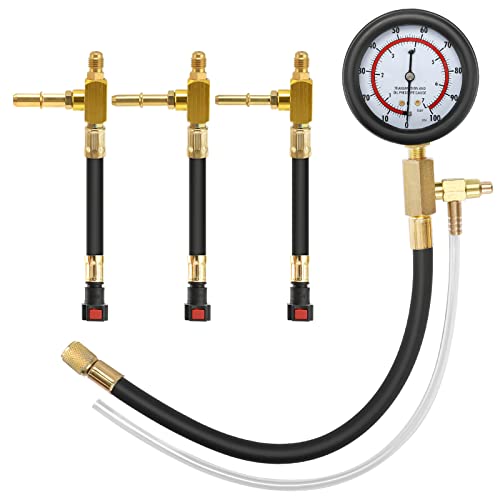
- Best for: Home mechanics who need a compact, basic pressure tester for gasoline vehicles.
- Dual-scale gauge: 0-7 bar and 0-100 psi
- Brass and rubber construction
- Fittings in 9.49, 7.89, and 6.30 sizes
- Part number HW9116

- Best for: Owners of several vehicles who want one kit with broad adapter coverage.
- Dual-scale gauge: 0-140 psi and 0-10 bar
- 15 adapters included
- Shockproof rubber casing on the gauge
- Reinforced hoses rated to 300 psi

- Best for: DIY owners who want a proven kit with a long hose and a relief valve for safer testing.
- 2.5-inch gauge with 0-100 psi and 0-700 kPa scales
- 6-foot hose to reach test points
- Adapters for most domestic and import applications
- Pressure relief valve for safe, clean testing
All 3 Picks at a Glance
| Product | Specs | Action |
|---|---|---|
| BETOOLL 0-100 PSI Fuel Pressure Test Kit |
| Check price on Amazon |
| Orion Motor Tech 0-140 PSI Fuel Pressure Gauge |
| Check price on Amazon |
| Actron CP7838 Professional Fuel Pressure Tester |
| Check price on Amazon |
A fuel pressure tester answers a question that guesswork cannot: is the fuel pump delivering the pressure the engine needs? Low pressure causes hard starts, stalling, and lost power, while a healthy reading points the diagnosis toward ignition or sensors instead. A good kit connects to the fuel rail test port in minutes and gives a clear number on the gauge, which makes it one of the most useful diagnostic tools in a home garage. A quick reading can save hours of swapping parts that were never faulty.
This guide is for home mechanics and DIY owners who diagnose fuel delivery problems on gasoline vehicles, from a no-start truck to a car that stumbles under load, and owners of trucks where fuel problems appear with age. The kits below were chosen from the names and specifications shown on their Amazon product pages, with attention to gauge range, hose length, included adapters, and the relief valve that makes testing safer.
Quick Picks
As an Amazon Associate we earn from qualifying purchases
| Product | Best for | Key spec from title |
|---|---|---|
| BETOOLL 0-100 PSI | A compact kit for basic fuel pressure checks | 0-100 psi dual scale, brass fittings |
| Orion Motor Tech 0-140 PSI | A full kit with 15 adapters | 0-140 psi, 15 adapters, 300 psi hoses |
| Actron CP7838 | A classic kit with a long hose | 0-100 psi, 6-ft hose, relief valve |
How to Choose
Gauge Range and Readability
The gauge range decides whether the tester can read the pressures a gasoline fuel system actually produces. Most port-injected gasoline engines run well below 100 psi, so a 0-100 psi gauge covers the common range with a readable needle position. A 0-140 psi gauge adds headroom for higher-pressure systems while keeping the scale easy to read. A dual scale showing both psi and bar helps when the service manual lists specifications in metric units, and a large dial with clear markings is easier to read in a crowded engine bay. A gauge with a needle that sits mid-scale at normal pressure is easier to read than one pinned near the top.
Adapters and Vehicle Coverage
A pressure gauge is useless without the right adapter for the fuel rail test port, so the adapter set matters as much as the gauge. Kits with more adapters cover more vehicle makes and fuel rail designs, from Schrader valve ports to threaded fittings at the fuel filter or throttle body. Check the listing for the fitting sizes included, and compare them with the test port on the vehicle before ordering. A kit that covers most domestic and import applications saves a second purchase when the next vehicle in the household needs testing. Keep the adapter set together in the case, since a missing adapter turns a quick test into a delayed one.
Hose Length and Relief Valve
Fuel testing involves gasoline under pressure, so the hose and the relief valve deserve attention. A longer hose lets the gauge sit where it can be read from the driver’s seat while the engine runs, and a 6-foot hose reaches test points that a short hose cannot. A pressure relief valve lets fuel drain safely into a container after the test, rather than spraying when the adapter is removed. Look for reinforced hoses with a stated pressure rating above the gauge range, since a hose failure under pressure is a serious hazard. A hose that kinks under the hood can give a false low reading, so route it clear of hot and moving parts.
Safe Handling Around Fuel
Working with a pressurized fuel system demands care, and the kit design should support safe practice. Use the relief valve to release pressure into a suitable container before disconnecting anything, and keep the work area clear of sparks, open flames, and hot exhaust parts. Work outdoors or in a well-ventilated space, and keep a fire extinguisher within reach. Never smoke near an open fuel system, and wipe up any spilled fuel before starting the engine. Store fuel-soaked rags outside the garage, away from ignition sources. A kit with a storage case keeps the gauge, hose, and adapters together and protected, so nothing is missing or damaged when the next diagnosis comes around.
The 3 Best Options
BETOOLL 0-100 PSI Fuel Pressure Test Kit
- Best for: Home mechanics who need a compact, basic pressure tester for gasoline vehicles.
- Dual-scale gauge: 0-7 bar and 0-100 psi
- Brass and rubber construction
- Fittings in 9.49, 7.89, and 6.30 sizes
- Part number HW9116
Home mechanics who need a compact, basic pressure tester for gasoline vehicles.
The kit is not for diesel engines, so check the vehicle fuel type before ordering.
The BETOOLL 0-100 PSI kit is a compact analog tester for gasoline fuel systems, with a dual-scale gauge reading 0 to 7 bar and 0 to 100 psi. Brass and rubber construction gives the fittings and hose a solid feel, and the kit includes fittings in 9.49, 7.89, and 6.30 sizes for common fuel rail connections. The part number is HW9116, and the listing states clearly that the kit is not for diesel engines, which run far higher pressures. It is a straightforward choice for owners who need a basic pressure reading without a large adapter collection. Its compact size suits a crowded toolbox.
Watch out for: The kit is not for diesel engines, so check the vehicle fuel type before ordering.
Orion Motor Tech 0-140 PSI Fuel Pressure Gauge
- Best for: Owners of several vehicles who want one kit with broad adapter coverage.
- Dual-scale gauge: 0-140 psi and 0-10 bar
- 15 adapters included
- Shockproof rubber casing on the gauge
- Reinforced hoses rated to 300 psi
Owners of several vehicles who want one kit with broad adapter coverage.
With 15 adapters, confirm the right one for the vehicle before connecting, since a wrong adapter will not seal.
The Orion Motor Tech kit is the most complete option in this guide, with 15 adapters that cover a wide range of import and domestic gasoline vehicles. The dual-scale gauge reads 0 to 140 psi and 0 to 10 bar, and the shockproof rubber casing protects the gauge from drops on a concrete garage floor. Reinforced hoses rated to 300 psi carry fuel from the rail to the gauge, and a storage case keeps the adapters, hoses, and gauge organized between jobs. Model FBA-MFK2022FS suits a home mechanic who works on more than one vehicle and wants one kit to cover them all.
Watch out for: With 15 adapters, confirm the right one for the vehicle before connecting, since a wrong adapter will not seal.
Actron CP7838 Professional Fuel Pressure Tester
- Best for: DIY owners who want a proven kit with a long hose and a relief valve for safer testing.
- 2.5-inch gauge with 0-100 psi and 0-700 kPa scales
- 6-foot hose to reach test points
- Adapters for most domestic and import applications
- Pressure relief valve for safe, clean testing
DIY owners who want a proven kit with a long hose and a relief valve for safer testing.
The gauge tops out at 100 psi, so it does not cover high-pressure direct-injection systems.
The Actron CP7838 is a long-standing professional tester kit with a 2.5-inch gauge reading 0 to 100 psi and 0 to 700 kPa. A 6-foot hose reaches test points that shorter hoses cannot, and the kit includes adapters to fit most domestic and import fuel-injected applications. A pressure relief valve allows safe, clean testing by releasing fuel pressure into a container before disconnection, and a handy pouch stores the gauge and adapters. The CP7838 is designed for fuel-injected systems and measures pressure with the engine running or off, which covers the standard diagnostic sequence. The long hose is the feature that sets it apart for road testing.
Watch out for: The gauge tops out at 100 psi, so it does not cover high-pressure direct-injection systems.
Which One Fits Your Situation
First-Time Fuel System Diagnosis
A first diagnosis calls for a simple kit that connects quickly and reads clearly. The BETOOLL 0-100 PSI tester covers the common gasoline range with a dual-scale gauge and a small set of fittings, which is enough for most port-injected vehicles. The Actron CP7838 is the alternative when a longer hose and a relief valve matter, since both features make the first test easier and safer for a beginner.
Multi-Vehicle Household
A household with several cars of different makes needs adapter coverage more than anything else. The Orion Motor Tech kit includes 15 adapters and a 0-140 psi gauge, so it handles the widest range of fuel rail designs in this guide. The storage case keeps the adapter set organized, which matters when the kit is shared between vehicles and drivers in one household.
Truck That Stumbles Under Load
A truck that runs fine at idle yet stumbles under load often has a fuel delivery problem, and the diagnosis needs a gauge readable while driving. The Actron CP7838 with its 6-foot hose lets the gauge sit where a helper can watch it during a road test. The BETOOLL kit works for a static pressure check at idle, yet the long hose is what turns a guess into a confirmed reading under load.
Occasional Use in a Home Garage
A tester that sits on the shelf for months should still work when it is needed, and a simple analog kit fits that pattern well. The BETOOLL kit has no battery or display to fail, and the Actron CP7838 is built around the same simple analog principle with a pouch for storage. Either one is ready the moment it comes off the shelf, with no charging or setup required at all.
Common Mistakes
- Testing a diesel engine with a gasoline pressure tester that cannot handle the pressure.
- Connecting the wrong adapter and getting a false low reading.
- Removing the adapter without relieving pressure first and spraying fuel across the engine bay.
- Reading the gauge with the engine off only and assuming the pump is fine under load.
- Storing the gauge loose in a drawer, so the adapters and hose go missing before the next job.
Frequently Asked Questions
What fuel pressure should my car have?
It depends on the vehicle and the fuel system design, and the service manual lists the figure for that exact year, make, and model. Most port-injected gasoline engines run well within the 0-100 psi range of the kits in this guide. Compare the gauge reading with the manual specification, engine running and key on with engine off, since both readings matter.
Can I test fuel pressure with the engine off?
Yes, and the key-on engine-off reading is part of the standard diagnostic sequence. It shows whether the pump primes and holds pressure when the system is sealed and ready. The Actron CP7838 is designed to measure pressure with the engine running or off, which covers both parts of the test in one session.
Do I need adapters for my car?
Most vehicles need an adapter between the tester and the fuel rail test port, and the right one depends on the port design. Kits with more adapters cover more vehicles, and the Orion Motor Tech kit includes 15. Check the fitting sizes in the listing against the test port on the vehicle before ordering, since a missing adapter delays the diagnosis by days.
Is fuel pressure testing dangerous?
It involves gasoline under pressure, so it demands care. Always relieve pressure through the relief valve into a suitable container before disconnecting, keep sparks and flames away, and work in a ventilated space. A kit with a relief valve and reinforced hoses, like the Actron and Orion Motor Tech models here, supports safer practice than a bare gauge alone in the garage.
Write Your Review
No reviews yet. Be the first to share your experience!