
The best vinyl replacement windows for most homes are well-built double-pane, Low-E, argon-filled units with a whole-window U-factor of about 0.25 to 0.30, an NFRC-certified design, welded frames, and professional installation matched to the opening and climate.
- Best Vinyl Replacement Windows by Homeowner Situation
- Frame Construction: What Separates Better Vinyl Windows
- Insulation Values and Glass Packages
- Ventilation Features: Useful, but Not a Substitute for Fresh-Air Design
- Installation Requirements That Affect Performance
- Cost and Long-Term Ownership
- Bottom Line
Best Vinyl Replacement Windows by Homeowner Situation
| Situation | Best choice | Specifications to prioritize | Why it fits |
|---|---|---|---|
| Lowest practical installed cost | Standard double-hung vinyl window | Welded frame, double pane, Low-E coating, U-factor 0.27–0.32 | Widely available, repairable, and suitable for many moderate climates |
| Cold winters | Insulated premium vinyl window | Double or triple pane, argon or krypton fill, U-factor 0.20–0.27 | Reduces heat loss and improves interior comfort near the glass |
| Hot, sunny climate | Solar-control Low-E window | SHGC approximately 0.20–0.35, U-factor about 0.25–0.30 | Limits unwanted solar heat while preserving daylight |
| Noise from traffic | Acoustic-oriented replacement window | Laminated glass, dissimilar glass thicknesses, tight weather seals | Helps reduce certain outdoor sounds more effectively than ordinary dual-pane glass |
| Frequent cleaning or upper floors | Double-hung window with tilt-in sashes | Removable or tilt-in upper and lower sashes | Allows cleaning from indoors without ladders |
| Large opening or modern design | Sliding, picture, or fixed vinyl unit | Reinforced meeting rails, structural support, correctly sized glass area | Provides broad views, but large operable sections can require stronger reinforcement |
Frame Construction: What Separates Better Vinyl Windows
Vinyl frames are usually made from rigid PVC with internal chambers that slow heat transfer. A quality frame should be extruded rather than assembled from thin, flexible pieces, and welded corner joints generally provide better resistance to air and water leakage than mechanically fastened corners.

NOTASA Vinyl Single Hung Sliding Window 24" x 36" White
Included for 'Best Vinyl Replacement Windows for Your Home' as a relevant option in this category; details come from the product listing.
View on Amazon
COLORPAPA 30" x 36" Vinyl Single Hung Window, White
Included for 'Best Vinyl Replacement Windows for Your Home' because the listing specifies White, details this guide uses to compare options.
View on Amazon
NeatiEase Basement Window, 30" x 12" Heavy Duty Vinyl Sliding Windows with Double Pane Insulated Tempered Glass and Fiberglass Screen for Basement, Bathroom, Garage, Shed, Home Replacement (White)
Included for 'Best Vinyl Replacement Windows for Your Home' because the listing specifies Bathroom and Garage, details this guide uses to compare options.
View on Amazon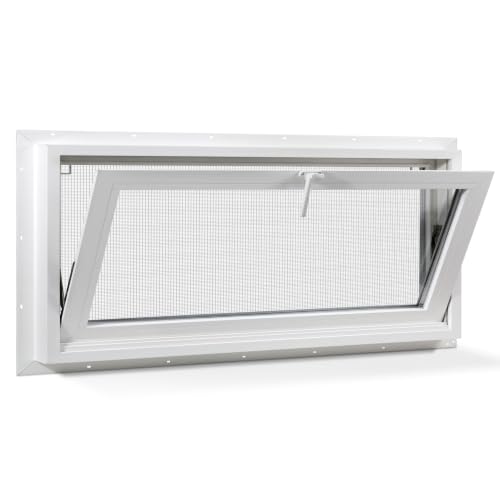
COLORPAPA Vinyl Hopper Basement Window 32" x 14" White
Included for 'Best Vinyl Replacement Windows for Your Home' as a relevant option in this category; details come from the product listing.
View on AmazonLook for multiple internal chambers, reinforced meeting rails, and metal or composite reinforcement where the sash or frame must span a wide opening. More chambers do not automatically mean a better window; the whole-window NFRC ratings and the quality of the corners, weatherstripping, and installation matter more than a chamber count printed in a brochure.
Brands such as Simonton, Milgard, JELD-WEN, Pella, and Andersen offer vinyl replacement lines or vinyl-clad alternatives in different markets. Availability, product series, and warranty terms vary by region, so compare the exact model rather than relying on the brand name alone.
Replacement insert versus full-frame installation
An insert, or pocket, replacement fits inside the existing frame. It is often less disruptive and can cost less, but it preserves the old frame, sill, flashing, and any hidden water damage. It also reduces the visible glass area slightly.
A full-frame replacement removes the existing window down to the rough opening. This allows the installer to inspect framing, insulation, and flashing, but it involves more interior and exterior finish work. Full-frame installation is usually the safer choice when the old frame is rotten, badly out of square, leaking, or poorly insulated.
Insulation Values and Glass Packages
Compare the whole-window U-factor, not only the center-of-glass rating. A lower U-factor means better resistance to heat transfer. For many replacement projects, a practical target is 0.25 to 0.30. Very cold regions may justify 0.20 to 0.25, while a budget window with a rating near 0.30 can be reasonable in a mild climate.
SHGC, or solar heat gain coefficient, indicates how much solar heat enters through the window. Lower values are usually preferable on sunny west- and south-facing elevations in hot climates. In a cold climate, a moderate SHGC can allow useful winter sunlight, particularly on south-facing windows.
- Double-pane Low-E glass: The best value for many homes. It usually has two panes separated by an insulating spacer and an argon-filled cavity.
- Triple-pane glass: Adds another pane and insulating cavity. It can improve U-factor and indoor sound comfort, but it is heavier, thicker, and more expensive.
- Laminated glass: Uses a bonded inner layer and can improve security and reduce some noise. It is not the same as triple-pane insulation.
- Warm-edge spacers: Nonmetal or thermally improved spacers reduce heat loss around the perimeter of the glass and can reduce interior-edge condensation.
- Low-E coatings: Different coatings balance winter heat retention, visible light, and solar control. The lowest SHGC is not automatically best for every orientation.
| Configuration | Typical whole-window U-factor | Typical SHGC range | Approximate weight for a 3-by-5-foot unit | Relative cost |
|---|---|---|---|---|
| Double-pane clear glass | 0.45–0.55 | 0.55–0.70 | 65–85 lb | Low |
| Double-pane Low-E, argon-filled | 0.25–0.32 | 0.25–0.50 | 70–95 lb | Moderate |
| Double-pane Low-E with laminated pane | 0.27–0.35 | 0.25–0.50 | 85–115 lb | Moderate to high |
| Triple-pane Low-E, argon-filled | 0.18–0.25 | 0.20–0.45 | 100–140 lb | High |
These are common planning ranges rather than guarantees for every model. Exact values depend on size, sash design, spacer, grille pattern, and glass coating. Request the NFRC label for the exact configuration being quoted.
Ventilation Features: Useful, but Not a Substitute for Fresh-Air Design
For everyday ventilation, a double-hung window is usually more flexible than a horizontal slider because both sashes can open and create a larger vertical airflow path. Casement windows can direct air inward when the sash is opened, making them effective where wind direction is favorable. Awning windows can ventilate during light rain, although their opening area is often smaller.
Some windows offer optional trickle vents or integrated background ventilators. These provide a controlled small opening but may reduce sound insulation and increase air leakage if poorly designed. A fixed picture window provides no intentional ventilation and must be paired with another operable window or a mechanical ventilation system.
Do not use an open window as the solution for a room with persistent moisture, combustion-safety concerns, or poor indoor air quality. A qualified contractor can determine whether exhaust ventilation, balanced ventilation, or air-sealing work is more appropriate.
Installation Requirements That Affect Performance
Accurate measurement is more important than ordering a nominal “same-size” window. Measure width at the top, middle, and bottom and height at both sides and the center. Use the smallest measurements, then follow the manufacturer’s deduction for the required installation clearance. Do not subtract a guessed amount because the correct allowance depends on the product and installation method.
- Inspect the sill, jambs, header, and surrounding sheathing for rot or movement.
- Confirm that the rough opening is square by comparing diagonal measurements.
- Use compatible sill pan flashing or another manufacturer-approved water-management method.
- Set the window level and plumb before fastening; an out-of-square frame can cause difficult operation and uneven weather seals.
- Insulate the perimeter gap with low-expansion window-and-door foam, leaving drainage paths clear.
- Apply exterior flashing and sealant according to the wall cladding and window instructions.
- Operate every sash, lock, and screen before the interior and exterior trim are completed.
Replacement windows cannot compensate for a failing wall, missing flashing, or a rough opening that moves. In older homes, investigate lead paint requirements, asbestos-containing materials, and concealed water damage before work begins.
Cost and Long-Term Ownership
As a broad 2026 planning range, a standard installed vinyl replacement window often falls around $500 to $1,200 per opening. Premium triple-pane, oversized, laminated, specialty-shape, or full-frame installations can reach roughly $1,200 to $2,500 or more per opening. Regional labor, access, trim repair, disposal, and structural work can change the total substantially.
Consider a simple energy comparison before paying for a premium package. If upgrading ten windows reduces heating and cooling costs by an estimated $12 per window per year, the annual saving is $120. A $3,000 upgrade would have a simple payback of 25 years before financing, maintenance, and energy-price changes. Comfort, condensation control, noise reduction, and durability may still justify the upgrade, but energy savings alone may not.
The parts most likely to wear first are balances, rollers, locks, weatherstripping, insect screens, and insulating glass seals. A failed seal can appear as fogging or moisture between panes; cleaning the surfaces will not correct it. Ask whether the warranty covers glass, hardware, labor, and transfer to a future owner separately.
- Wash vinyl frames with mild soap and water; avoid solvents and abrasive pads.
- Vacuum tracks before adding a small amount of manufacturer-approved lubricant.
- Keep weep holes clear so rainwater can drain from the sill.
- Do not paint vinyl frames or block drainage channels with caulk.
- Check exterior sealant annually for cracks or separation.
- Never force a sash that binds; movement can indicate settlement, poor installation, or a distorted frame.
Bottom Line
Choose standard double-pane Low-E vinyl windows for value, triple-pane units when cold-climate performance or added comfort justifies the cost, and laminated glass when noise or impact resistance is a major concern. Prioritize whole-window NFRC ratings, welded and reinforced construction, usable ventilation, correct flashing, and an installer who will document measurements and warranty coverage. The best vinyl replacement window is the one whose glass package, frame, opening style, and installation method match the room rather than the one with the longest feature list.








Write Your Review
No reviews yet. Be the first to share your experience!