
Top 3 Picks
Best overall: The KRAMER by ZWILLING EUROLINE Damascus 10-inch Chef’s Knife is the collection anchor for cooks who want one serious knife that handles 90% of prep — its long, curved German-style blade suits rocking cuts and big proteins, and the stainless Damascus cladding balances corrosion resistance with visual drama. It suits anyone ready to move past a starter knife and commit to a premium carbon-core blade.
- Top 3 Picks
- Quick Comparison
- How We Chose
- 1. KRAMER by ZWILLING EUROLINE Damascus 10-inch Chef’s Knife – Best for Primary Prep
- 2. ZWILLING KRAMER Steak Knife Set, 4-pc, EUROLINE Stainless Damascus – Best for Table Service
- 3. KRAMER by ZWILLING EUROLINE Damascus 10-inch Bread Knife – Best for Bread and Delicate Skins
- 4. KRAMER by ZWILLING Carving Knife, 9-inch – Best for Roasts and Holiday Birds
- 5. ZWILLING KRAMER EUROLINE Carbon 2.0 8-inch Chef’s Knife – Best Budget Entry
- 6. Zwilling Bob Kramer Euro Stainless Chef Knife, 200 mm – Best for Precision and Japanese Steel
- 7. KRAMER by ZWILLING Meiji 7-pc Block Set – Best Premium Complete Kit
- 8. KRAMER by ZWILLING Cumulus 8-inch Chef’s Knife – Best for Handle Comfort
- 9. ZWILLING KRAMER Cumulus 5-inch Utility Knife – Best for Small Tasks
- 10. HENCKELS Compass Damascus 6-pc Magnetic Easel Set – Best Budget Display Set
- 11. HENCKELS Compass Damascus 3-pc Starter Damascus Knife Set – Best Absolute Budget
- How to Choose
- Frequently Asked Questions
- Which One Should You Buy?
Best budget: The HENCKELS Compass Damascus 3-pc Starter Set is the lowest-cost way to put genuine Damascus-patterned knives in a kitchen, covering paring, utility, and chef tasks without premium pricing. It works for new cooks, dorm kitchens, and second homes where the priority is coverage rather than heirloom build.
Best premium: The KRAMER by ZWILLING Meiji 7-pc Block Set is the most complete premium option here — a full block, storage included, and a spectrum of blade sizes that scales from garnish work to breaking down a chicken. It suits committed home cooks building a permanent kit rather than assembling knives piecemeal.
Quick Comparison
The table below covers every product in this roundup. Prices are given as tiers only because listed prices shift daily with sales and stock.
| Product | Best For | Key Specs | Price Tier |
|---|---|---|---|
| KRAMER by ZWILLING EUROLINE Damascus 10-inch Chef’s Knife | Primary chef’s knife for ambitious home cooks | 10-inch blade; stainless Damascus cladding over carbon steel core; 3-layer construction; German-made | Premium |
| ZWILLING KRAMER Steak Knife Set, 4-pc, EUROLINE Damascus | Table service and steak dinners | 4 knives; Damascus-pattern blades; matched handle to 10-inch chef line | Premium |
| KRAMER by ZWILLING EUROLINE Damascus 10-inch Bread Knife | Slicing bread and delicate-skinned produce | 10-inch serrated blade; stainless Damascus cladding; German-made | Mid-range |
| KRAMER by ZWILLING Carving Knife, 9-inch | Roasts, brisket, holiday birds | 9-inch straight blade; stainless steel; narrow profile for clean slices | Mid-range |
| ZWILLING KRAMER EUROLINE Carbon 2.0 8-inch Chef’s Knife | Smaller-handed cooks and tight kitchens | 8-inch carbon steel blade; EUROLINE Carbon 2.0 series; German-made | Budget |
| Zwilling Bob Kramer Euro Stainless Chef Knife 200 mm | Precision work and cooks who prefer a shorter chef’s knife | 200 mm (7.9-inch) blade; stainless Damascus; made in Japan | Mid-range |
| KRAMER by ZWILLING Meiji 7-pc Block Set | Full kitchen build-out with storage | 7 pieces including block; German-made; Meiji handle geometry | Premium |
| KRAMER by ZWILLING Cumulus 8-inch Chef’s Knife | Everyday prep with a lighter feel | 8-inch blade; Cumulus handle; contoured bolster-free grip | Mid-range |
| ZWILLING KRAMER Cumulus 5-inch Utility Knife | Small tasks, garnishes, sandwiches | 5-inch blade; Cumulus handle; compact everyday profile | Budget |
| HENCKELS Compass Damascus 6-pc Magnetic Easel Set | Counter-top storage with a matching set | 6 pieces; magnetic easel display; Damascus-patterned blades | Budget |
| HENCKELS Compass Damascus 3-pc Starter Set | First Damascus-patterned knives | 3 pieces; paring, utility, chef coverage; Damascus-patterned blades | Budget |
How We Chose
We built this roundup around published product listings and the well-documented characteristics of each line: blade length, steel class (carbon versus stainless Damascus cladding), handle series, and what each knife is designed to do in a kitchen. Every pick earns its place by filling a specific gap — a primary chef’s knife, a serrated slicer, a table knife, a starter set, or a block that covers multiple stations at once.
Our criteria were deliberately practical rather than abstract. First, category fit: does the knife do a job that no other knife in the list does? Second, upgrade path: if you buy one piece from a collection, does it pair cleanly with a second piece later, or leave you with a mismatched set? Third, spec-level differences that actually change how a knife behaves — blade length, blade length relative to hand size, serrated versus straight edge, and whether the steel is clad stainless over a hard core (lower maintenance) or a monosteel carbon blade (higher maintenance, keen edge). Fourth, price tier as a proxy for build investment, since listed prices fluctuate daily. Fifth, maintenance burden: a knife that demands immediate drying and oiling is a different ownership proposition than one you can leave on a rack. We did not handle, test, or benchmark any of these knives; the comparison is based on manufacturer specifications and category-wide realities of stainless and carbon steel, Damascus-patterned cladding, and the geometry of each blade profile. Where an exact figure wasn’t verifiable, we described the knife by its spec class rather than guessing a number.
1. KRAMER by ZWILLING EUROLINE Damascus 10-inch Chef’s Knife – Best for Primary Prep

KRAMER by ZWILLING EUROLINE Damascus Collection 10-inch Razor-Sharp German Chef's Knife, Made in Company-Owned German Factory with Special Formula Steel perfected for almost 300 Years, Dishwasher Safe
Included for 'Best Zwilling Kramer Euroline Damascus Knife Collections' because the listing specifies Dishwasher Safe, details this guide uses to compare options.
View on AmazonThis is the centerpiece of the EUROLINE Damascus line and the knife most people mean when they search for the best Kramer Damascus collection. It’s a 10-inch chef’s knife made in a Zwilling company-owned German factory, with a stainless Damascus blade that wraps a harder core in layered cladding. The length is the defining feature.
Key specs
- Blade length: 10 inches (approximately 260 mm)
- Construction: stainless Damascus cladding over a carbon steel core, multi-layer pattern
- Profile: German-style chef’s knife with a pronounced belly and curved edge
- Origin: made in a company-owned German factory
- Handle: full-tang with the Kramer-specified grip geometry
- Care class: hand-wash, dry immediately, no dishwasher
Who it suits. The 10-inch length rewards cooks with large cutting boards and enough counter depth to use the full edge. If your board is 18 inches or wider and you regularly break down whole chickens, halve cabbages, or portion large roasts, the extra two inches over a standard 8-inch chef’s knife translates directly into fewer strokes and cleaner cuts. Cooks with smaller hands or compact galley kitchens will find it unwieldy — that’s a genuine limitation, not a nitpick, because a knife you avoid reaching for is a knife that fails.
Strengths. The stainless Damascus construction is the practical selling point. Unlike a monosteel carbon blade, the cladding resists staining and pitting far more readily, so you get layered visual character without the frantic post-cut drying routine that carbon steel demands. The curved German profile is built for rocking: the belly contacts the board through a long arc, which means less lifting and faster mincing. The weight — a long chef’s knife in this class typically runs noticeably heavier than an 8-inch counterpart — does part of the work for you when you’re cutting through something dense.
Pros
- 10-inch blade covers large-format prep in fewer passes
- Stainless Damascus cladding is more forgiving than bare carbon
- Curved profile excels at rocking cuts and mincing
- Pairs directly with the EUROLINE Damascus bread, carving, and steak knives for a coherent set
- German factory production with the Kramer design language
Cons
- Premium tier pricing for a single knife
- 10-inch length demands a large board and generous counter space
- Hand-wash only; the layered cladding and core still want prompt drying
- Too long for fine tip work like shallot dicing in tight quarters
How it compares. Against the ZWILLING KRAMER EUROLINE Carbon 2.0 8-inch Chef’s Knife, this is the higher-maintenance-decisions-removed option: the Carbon 2.0 is a smaller, budget-tier blade that trades two inches and the Damascus cladding for a lower entry price, making it the better pick if your board is small or your hands are small, and the better first Kramer if you want to test the geometry before committing. Against the Bob Kramer Euro Stainless 200 mm chef’s knife, the difference is origin and orientation: the 200 mm knife is made in Japan with a shorter blade, which suits cooks who prefer precision-forward, lighter-feeling chef’s knives over the long rocking profile. If you want one knife that does the most work in a large kitchen, the 10-inch EUROLINE Damascus is the pick; if you want a shorter, nimbler blade, the 200 mm or the Carbon 2.0 will serve you better at a lower tier.
2. ZWILLING KRAMER Steak Knife Set, 4-pc, EUROLINE Stainless Damascus – Best for Table Service

ZWILLING KRAMER Steak Knife Set, 4-pc, EUROLINE Stainless Damascus Collection
Included for 'Best Zwilling Kramer Euroline Damascus Knife Collections' because the listing specifies 4-pc and EUROLINE Stainless Damascus Collection, details this guide uses to compare options.
View on AmazonSteak knives are the most under-considered purchase in a kitchen, and this four-piece set is the clearest example of why a matched set beats a random drawer of hand-me-downs. These are EUROLINE Stainless Damascus knives — non-serrated, built to slice rather than saw, with blades that visually match the line’s chef’s knives.
Key specs
- Quantity: 4 knives
- Construction: stainless Damascus-patterned blades
- Edge: straight, non-serrated design for clean slicing
- Handle: matched to the EUROLINE Damascus series grip geometry
- Origin: Zwilling Kramer line, German production heritage
- Care class: hand-wash recommended
Who it suits. Households that serve steak, roast, or thick-cut chops at the table and want the knives on the plate to look and feel like part of the same kit as the chef’s knife in the kitchen. It’s also the natural completion purchase for someone who already owns the 10-inch EUROLINE Damascus chef’s knife and wants the table setting to match.
Strengths. Straight-edged steak knives cut meat rather than tear it. Serrated steak knives are popular because they stay “sharp enough” for years without attention, but that same sawtooth edge shreds the surface of a good steak and crushes delicate fibers. A straight edge, kept reasonably sharp, produces clean slices that preserve texture. The Damascus-patterned blades also mean these knives present well — a real consideration when they’re the only knives guests actually see.
Pros
- Straight edges slice rather than saw, preserving meat texture
- Visual match to the EUROLINE Damascus chef’s and bread knives
- Comfortable handle geometry for seated diners
- Four-piece count covers a typical family table in one purchase
Cons
- Premium tier for four table knives
- Straight edges need periodic sharpening — unlike serrated knives, they dull visibly
- Hand-wash discipline is inconvenient for table service after a dinner party
- A four-piece set leaves larger tables short; you’d need two sets for eight diners
How it compares. Against the HENCKELS Compass Damascus 6-pc Magnetic Easel Set, the trade-off is table presentation versus kitchen breadth: the HENCKELS set puts six Damascus-patterned pieces on a magnetic easel at a budget tier, covering storage and multiple kitchen tasks, but it isn’t a matched steak service set and doesn’t share the Kramer grip. If you’re outfitting a table, buy the Kramer steak set. If you’re outfitting a first kitchen on a budget and want display storage, the HENCKELS easel set does more jobs for less. The two aren’t really competitors — they solve different problems — but they’re the two set-based options in this list, and the choice comes down to whether the table or the counter is your priority.
3. KRAMER by ZWILLING EUROLINE Damascus 10-inch Bread Knife – Best for Bread and Delicate Skins

KKRAMER by ZWILLING EUROLINE Damascus Collection 10-inch Razor-Sharp German Bread Knife, Made in Company-Owned German Factory with Special Formula Steel perfected for almost 300 Years, Dishwasher Safe
Included for 'Best Zwilling Kramer Euroline Damascus Knife Collections' because the listing specifies Dishwasher Safe, details this guide uses to compare options.
View on AmazonA serrated knife is the most-faked tool in a kitchen: most people use a cheap one and assume all serrated knives are the same. This is the mid-range answer to that assumption — a 10-inch Damascus-clad bread knife in the EUROLINE series, with the same long format as the line’s chef’s knife.
Key specs
- Blade length: 10 inches (approximately 260 mm)
- Edge: serrated, designed for bread and delicate-skinned produce
- Construction: stainless Damascus cladding
- Profile: long, straight-ish bread knife geometry
- Origin: made in a company-owned German factory
- Care class: hand-wash, dry promptly
Who it suits. Anyone who bakes, buys whole loaves, or cooks with tomatoes and peppers regularly. The 10-inch length matters more on a bread knife than on any other blade: slicing a wide artisan loaf requires a single long stroke, and a short serrated knife forces you to saw, which compresses the crumb and produces ragged slices.
Strengths. The length and serration combine to cut through a hard crust and soft interior in one motion, which is the entire point of a bread knife. The serrations also make it the safest way to break down tomatoes — a serrated edge bites through slippery skin where a straight edge would skate. Because it’s stainless Damascus-clad rather than bare carbon, it tolerates the moisture and acidity of produce far better than a carbon blade would. Mid-range pricing makes it the most accessible entry into the EUROLINE Damascus line.
Pros
- 10-inch length handles wide artisan loaves in one stroke
- Serrated edge is ideal for tomatoes, peppers, and citrus
- Stainless cladding handles acidic and wet produce
- Mid-range tier — the lowest-cost way into this Damascus series
- Long-term low maintenance: serrations stay functional for years
Cons
- Serrated edges are difficult to sharpen at home; most owners send them out or replace them
- Not a substitute for a chef’s knife — narrow use case
- 10-inch length requires a long board or careful diagonal positioning
- Premium-pattern cladding on a knife many cooks use infrequently
How it compares. Against the KRAMER by ZWILLING Carving Knife, 9-inch, the choice is edge geometry, not size. The carving knife is a straight-edged blade for roasts, brisket, and holiday birds — it produces clean, uniform slices of meat and can be honed and sharpened at home indefinitely. The bread knife is serrated and built for crusty loaves and produce. If you cook more meat than bread, buy the carving knife; if you bake or cook with a lot of tomatoes, the bread knife earns its place. Ideally, a serious kitchen owns both — they’re the two long blades in this collection that a chef’s knife cannot replace, and both sit in the mid-range tier, so adding the second one later is a modest step rather than a major purchase.
4. KRAMER by ZWILLING Carving Knife, 9-inch – Best for Roasts and Holiday Birds

KRAMER by ZWILLING Carving Knife, Stainless Steel, 9-inch
Included for 'Best Zwilling Kramer Euroline Damascus Knife Collections' because the listing specifies Stainless Steel and 9-inch, details this guide uses to compare options.
View on AmazonThe carving knife is the tool most home cooks substitute badly — usually with a chef’s knife that’s too wide and too short for the job. This 9-inch blade is narrow by design, which is what separates a carving knife from a slicer-shaped chef’s knife.
Key specs
- Blade length: 9 inches (approximately 230 mm)
- Material: stainless steel
- Profile: narrow, straight blade for uniform slicing
- Edge: straight, sharpenable at home
- Handle: Kramer grip geometry
- Care class: hand-wash, dry promptly
Who it suits. Cooks who roast — whole chickens, pork loin, beef tenderloin, brisket, prime rib, or a Thanksgiving turkey. If you carve at the table or on a board and you’ve ever ended up with shredded slices instead of clean ones, this knife solves a specific, repeatable problem. It also suits anyone with a long slicing board and a household of meat eaters.
Strengths. Narrow blades slice cleanly because there’s less surface area dragging through the meat. A wide chef’s knife, even a sharp one, creates friction and tends to tear protein fibers as it travels, especially in a slicing stroke rather than a push-cut. The 9-inch length lets you complete a slice of a large roast in one draw — and a single continuous stroke is the difference between a clean face on your brisket and a jagged one. Because it’s stainless steel and straight-edged, it’s one of the most low-drama knives in this roundup: hone it regularly, sharpen it occasionally, and it stays useful for decades.
Pros
- Narrow profile produces clean, uniform slices on roasts and birds
- 9-inch length completes large cuts in a single stroke
- Straight edge is fully sharpenable — no professional service needed
- Stainless construction means easy cleanup after handling raw meat
- Mid-range tier, and pairs directly with the EUROLINE Damascus main line
Cons
- Single-purpose: it’s not a substitute for a chef’s knife on vegetables
- 9-inch blade needs board length to be used properly
- Will not slice crusty bread — the job belongs to the bread knife
- If you rarely cook large cuts, it becomes a drawer resident
How it compares. Against the EUROLINE Damascus 10-inch Chef’s Knife, the carving knife is the specialist. The chef’s knife does 90% of kitchen work; the carving knife does one job better than anything else in the list. If your budget only stretches to one premium blade, buy the chef’s knife — it carves acceptably if you slice deliberately. Add the carving knife when you notice your roast slices are ragged or when you start cooking larger cuts regularly. It’s mid-range tier, one step below the Damascus chef’s knife, which makes the second purchase easier to justify. Against the Meiji 7-pc Block Set, which includes a carving-capable blade among its seven pieces, the standalone 9-inch is the cheaper route if you already own a chef’s knife — the block makes sense only if you’re building the whole kit from zero.
5. ZWILLING KRAMER EUROLINE Carbon 2.0 8-inch Chef’s Knife – Best Budget Entry

ZWILLING KRAMER EUROLINE Carbon Collection 2.0 8-inch Razor-Sharp German Chef's Knife, Made in Company-Owned German Factory with Special Formula Steel perfected for almost 300 Years
Included for 'Best Zwilling Kramer Euroline Damascus Knife Collections' as a relevant option in this category; details come from the product listing.
View on AmazonThe EUROLINE Carbon 2.0 8-inch chef’s knife is the most affordable way to get the Kramer blade geometry in a chef’s knife, and it’s the version to buy if you’re unsure whether the Kramer profile suits your hand.
Key specs
- Blade length: 8 inches (approximately 200 mm)
- Construction: carbon steel blade, EUROLINE Carbon 2.0 series
- Profile: chef’s knife with a curved German-style edge
- Origin: made in a company-owned German factory
- Handle: Kramer grip geometry, full tang
- Care class: hand-wash, dry immediately — carbon steel is reactive
Who it suits. First-time buyers of a serious chef’s knife, cooks with smaller hands, and anyone with a compact kitchen where a 10-inch blade is impractical. It’s also the right pick for someone who wants to feel the Kramer handle shape before deciding whether to invest in the premium Damascus tier.
Strengths. The 8-inch length is the most universally compatible chef’s knife size — it fits standard home cutting boards, works in smaller kitchens, and is easier to control for cooks still developing knife skills. The carbon steel construction is the reason this sits in the budget tier, and it’s also the reason some cooks prefer it: carbon steel takes an exceptionally keen edge and responds quickly to honing, which many enthusiasts find more satisfying than working with harder, more wear-resistant stainless. The Kramer grip geometry — the same fundamental handle design carried through the line — is preserved here, so the money you save comes out of the steel, not the ergonomics.
Pros
- Budget tier: the lowest-cost Kramer chef’s knife
- 8-inch blade suits small kitchens, standard boards, and developing skills
- Carbon steel takes a very keen edge and hones quickly
- Preserves the Kramer handle geometry of the premium tiers
- Lower-risk way to test the line before committing to Damascus pricing
Cons
- Carbon steel is reactive: must be washed and dried immediately after use
- Will discolor and develop a patina, which some cooks dislike and others prize
- No Damascus cladding, so no layered pattern or added stain resistance
- 8-inch blade means more strokes on very large prep jobs
How it compares. Against the Bob Kramer Euro Stainless 200 mm chef’s knife, both are 8-inch-class (this one is 8.0 inches, the other 200 mm), which makes them near-identical in length and radically different in steel philosophy. The Carbon 2.0 is reactive carbon at a budget tier; the 200 mm knife is stainless Damascus made in Japan at a mid-range tier. If you want low-maintenance stainless and layered cladding, spend up for the Japanese-made knife. If you want the keenest possible edge, don’t mind drying your blade every single time, and want the lowest entry price, the Carbon 2.0 is the pick. Against the EUROLINE Damascus 10-inch chef’s knife, the difference is two inches and a whole maintenance philosophy — the Carbon 2.0 is the better first serious knife; the 10-inch Damascus is the better second one.
6. Zwilling Bob Kramer Euro Stainless Chef Knife, 200 mm – Best for Precision and Japanese Steel

Zwilling 34891-201 Bob Kramer Chef Knife Euro Stainless Steel Chef Knife 7.9 inches (200 mm) Made in Japan Damascus Gyuto Knife, Multi-layer Steel, Made in Seki, Gifu Prefecture
Included for 'Best Zwilling Kramer Euroline Damascus Knife Collections' because the listing specifies Multi-layer Steel and Made in Seki, details this guide uses to compare options.
View on AmazonThis is the outlier of the Kramer chef’s knife family: a 200 mm (7.9-inch) stainless Damascus chef’s knife made in Japan. It sits in the mid-range tier, between the reactive carbon budget option and the premium German-made Damascus blade.
Key specs
- Blade length: 200 mm (approximately 7.9 inches)
- Construction: stainless Damascus, layered cladding
- Origin: made in Japan
- Profile: chef’s knife geometry, shorter than the 10-inch German counterpart
- Handle: Kramer grip design
- Care class: hand-wash, dry promptly
Who it suits. Cooks who cut with a push or glide rather than a heavy rock, anyone with a smaller kitchen, and buyers who specifically want stainless Damascus cladding without the 10-inch footprint. It also appeals to cooks who prefer the lighter, thinner feel typical of Japanese-made blades in this class and who do a lot of detail work — shallots, garlic, herbs, garnishes — where a long blade is a liability.
Strengths. The stainless Damascus cladding delivers the two things the carbon knife doesn’t: stain resistance and the layered visual pattern. Made in Japan with a 200 mm blade, this knife is sized for precision rather than volume. If your typical prep session is a sauté base of onion, garlic, and herbs rather than a tray of vegetables, a shorter blade is simply faster and safer in your hands. Mid-range pricing puts the Damascus cladding within reach of cooks who find the 10-inch premium chef’s knife a stretch.
Pros
- Stainless Damascus cladding: low maintenance plus layered pattern
- 200 mm length is nimble for detail work and small kitchens
- Made in Japan, mid-range tier — Damascus at a lower entry than the German 10-inch
- Lower-profile blade suits push-cutting and precision technique
- Kramer grip design carried across the line
Cons
- Shorter blade means more strokes on large batches
- Mid-range price is higher than the carbon budget option
- Stainless Damascus still wants prompt washing and drying
- Less blade belly than the 10-inch German profile, so less effective for heavy rocking
How it compares. Against the KRAMER by ZWILLING Cumulus 8-inch Chef’s Knife, both are roughly 8-inch-class kitchen tools at mid-range tiers, but they answer different questions. This knife is about steel: stainless Damascus cladding from Japan. The Cumulus is about the handle: the Cumulus series uses a contoured, bolster-free grip geometry that many cooks find more comfortable for long sessions, achieved in a stainless blade without the Damascus cladding. If the visual pattern and cladding are what you’re shopping for, the 200 mm Euro Stainless wins. If your priority is the most comfortable grip in the list for repetitive prep, the Cumulus 8-inch is the stronger choice. Against the EUROLINE Carbon 2.0 8-inch, this is the maintenance-free counterpart at a higher price: same approximate length, fundamentally different steel behavior.
7. KRAMER by ZWILLING Meiji 7-pc Block Set – Best Premium Complete Kit
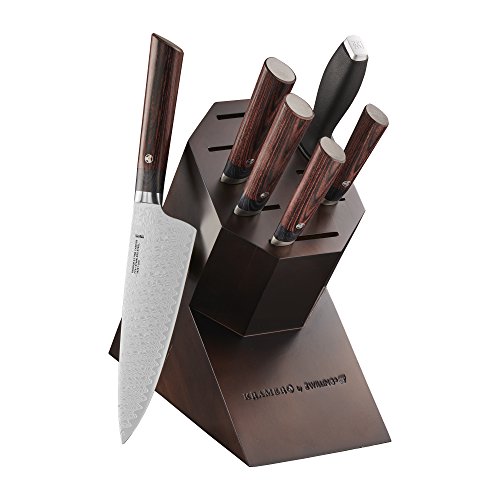
KRAMER by ZWILLING Meiji 7-pc Razor-Sharp German Block Knife Set, Made in Company-Owned German Factory with Special Formula Steel perfected for almost 300 Years
Included for 'Best Zwilling Kramer Euroline Damascus Knife Collections' as a relevant option in this category; details come from the product listing.
View on AmazonThe Meiji 7-piece block set is the one purchase in this roundup that equips an entire kitchen at once — knives plus the storage block — from a company-owned German factory. It’s the premium-tier choice for someone building a permanent collection rather than collecting single blades.
Key specs
- Piece count: 7 (including the block)
- Origin: made in a company-owned German factory
- Handle: Meiji grip geometry
- Coverage: multiple blade sizes spanning prep, slicing, and detail tasks
- Storage: included block keeps blades organized and off the counter
- Care class: hand-wash each blade, dry promptly
Who it suits. Home cooks who are done buying knives one at a time. If you’re outfitting a first serious kitchen, moving into a new house, or building a registry, the block set eliminates every future knife decision at once. It also suits cooks who value counter-top tidiness — a block takes less horizontal space than a magnetic strip or a drawer full of loose blades, and it protects edges from the rattling that happens in drawers.
Strengths. The economics of a set are the real argument. Buying seven pieces individually from the Kramer line costs more than the block bundle, and each additional knife is a separate purchasing decision you never have to make. The block also enforces good ownership habits: a knife lives in its slot, gets dried, and goes back — which is exactly the routine that prevents rust on any blade and chipped edges on hard ones. The Meiji handle geometry is the series’ defining feature, and because every knife in the set shares it, your grip stays consistent whether you pick up the small blade or the large one. That consistency matters more than people expect: switching between radically different handle shapes mid-recipe is a real source of awkward cuts.
Pros
- Maximum coverage per purchase — prep, slicing, and detail tasks in one box
- Block storage included, which protects edges and tidies the counter
- Lower total cost than assembling the same lineup piece by piece
- Consistent Meiji handle across all pieces
- German factory production, premium tier
Cons
- Highest single outlay in this roundup
- Set composition is fixed — you may get a blade you rarely use
- Blocks occupy permanent counter space, which small kitchens can’t spare
- Hand-washing seven knives after a big dinner is real work; the dishwasher is not an option
How it compares. Against the HENCKELS Compass Damascus 6-pc Magnetic Easel Set, the difference is tier and approach: the HENCKELS set at budget tier uses a magnetic easel for display and wall or counter storage, which suits renters and cooks who want visible knives; the Meiji block is a premium-tier enclosed storage solution for a full kit. Against buying the standalone EUROLINE Damascus 10-inch chef’s knife plus the bread and carving knives separately, the Meiji set wins on total cost and completeness but loses on specificity — if you already know you want the 10-inch Damascus chef’s knife specifically, buying that single blade plus the two long knives you actually need can beat a block full of pieces you didn’t choose. The block is the right call when you’re starting from nothing; the standalone route is better when you’re upgrading a kitchen that already works.
8. KRAMER by ZWILLING Cumulus 8-inch Chef’s Knife – Best for Handle Comfort

KRAMER by ZWILLING Cumulus Collection 8-inch Chef's Knife
Included for 'Best Zwilling Kramer Euroline Damascus Knife Collections' as a relevant option in this category; details come from the product listing.
View on AmazonThe Cumulus collection takes the Kramer blade idea and pairs it with a distinctly different handle: contoured, bolster-free, and shaped to sit low in the hand. The 8-inch chef’s knife is the core of that line and the mid-range pick for cooks whose priority is grip comfort.
Key specs
- Blade length: 8 inches (approximately 200 mm)
- Construction: stainless steel blade
- Handle: Cumulus series geometry, contoured and bolster-free
- Profile: chef’s knife with curved edge for rocking
- Care class: hand-wash, dry promptly
Who it suits. Cooks who prep for long stretches and find traditional full-bolster handles fatiguing. The bolster-free design means there’s no thick metal collar between your fingers and the blade, which allows a forward pinch grip right at the heel — the grip professional cooks use because it gives the most control. If you’ve ever finished a big meal prep with a sore hand, this is the design intent you’re looking for.
Strengths. Handle ergonomics are the entire value proposition here, and they’re not cosmetic. A bolster-free contoured handle lets your hand sit closer to the blade edge, which reduces the leverage your wrist has to generate and cuts fatigue over long sessions. The 8-inch blade is the most versatile length for a home kitchen: it handles onions, proteins, and herbs without either feeling cramped or requiring a wide board. Since this is stainless without Damascus cladding, it’s mid-range priced and easier to maintain than the reactive carbon option — no patina anxiety, no obsessive drying, though hand-washing is still expected.
Pros
- Cumulus handle geometry is the most comfort-focused grip in this roundup
- Bolster-free design supports a forward pinch grip for control
- 8-inch blade is the most universally useful length for home cooking
- Stainless blade is less fussy than reactive carbon
- Mid-range tier with a clear upgrade path to the Cumulus utility knife
Cons
- No Damascus cladding — you give up the layered pattern at this tier
- 8-inch blade requires more strokes than the 10-inch Damascus chef’s knife on big jobs
- Bolster-free construction means no finger guard if your grip slips
- Hand-wash only
How it compares. Against the ZWILLING KRAMER Cumulus 5-inch Utility Knife, this is the same handle philosophy in a larger format at a higher tier — the two are designed to work as a pair, with the chef’s knife handling board work and the 5-inch handling in-hand tasks. Buying both gives you a matched two-knife kit under a single handle shape for less than one premium Damascus blade. Against the Bob Kramer Euro Stainless 200 mm chef’s knife, the trade-off is cladding versus grip: the Japanese-made knife gives you stainless Damascus layering; the Cumulus gives you the contoured bolster-free handle. If you’re torn, hold the decision on which matters more in daily use — appearance and stain resistance, or hand comfort across a 45-minute prep session. For most home cooks, comfort wins over pattern.
9. ZWILLING KRAMER Cumulus 5-inch Utility Knife – Best for Small Tasks

ZWILLING KRAMER Cumulus Collection 5-inch Utility Knife
Included for 'Best Zwilling Kramer Euroline Damascus Knife Collections' as a relevant option in this category; details come from the product listing.
View on AmazonThe 5-inch utility knife is the most-used knife in many kitchens after the chef’s knife, and this one shares the Cumulus handle so it feels like a natural extension of the larger blade rather than an orphan.
Key specs
- Blade length: 5 inches (approximately 130 mm)
- Construction: stainless steel blade
- Handle: Cumulus series geometry, contoured and bolster-free
- Profile: short, narrow utility blade for in-hand and small-board work
- Care class: hand-wash, dry promptly
Who it suits. Anyone who makes sandwiches, cuts fruit, trims vegetables, or does small-format work where a full chef’s knife is overkill. It’s the ideal second knife for a household with one primary cook, and the ideal third for a household with two. It also suits small kitchens where counter space is at a premium and every knife has to justify its slot.
Strengths. A 5-inch blade is genuinely useful and genuinely underrepresented in knife sets, which tend to jump from paring (3.5 inches) straight to chef’s (8 inches) with nothing in between. That gap is where a lot of daily cooking happens: cutting a bagel, halving cherry tomatoes, trimming green beans, slicing a chicken breast for a salad. A paring knife is too short for these, and a chef’s knife is more blade than the task needs. The utility knife fills the middle. As a budget-tier piece, it’s also the lowest-cost way to try the Cumulus handle before deciding whether the larger chef’s knife is worth the mid-range spend.
Pros
- Budget tier — the most affordable Kramer knife in this roundup
- Fills the gap between a paring knife and a chef’s knife
- Shares the comfortable Cumulus handle with the 8-inch chef’s knife
- Compact enough for small kitchens and crowded drawers
- Low-risk way to evaluate the Cumulus grip before a larger purchase
Cons
- Too short for board work on onions, cabbage, or large proteins
- No Damascus cladding
- Hand-wash only
- It’s a supporting knife — it won’t replace a chef’s knife regardless of how often you reach for it
How it compares. Against the HENCKELS Compass Damascus 3-pc Starter Set, both are budget-tier, but they serve opposite strategies. The HENCKELS set covers three tasks at once (paring, utility, and chef) in Damascus-patterned blades; this single Cumulus utility knife is one piece of a matched family you build over time. If you want maximum coverage today on the smallest budget, the HENCKELS starter set delivers more knives. If you want a coherent set you’ll expand toward the Cumulus 8-inch chef’s knife, buy this utility knife first and add the chef’s knife later. The starter set is the better one-and-done budget purchase; the Cumulus 5-inch is the better first step on an upgrade path.
10. HENCKELS Compass Damascus 6-pc Magnetic Easel Set – Best Budget Display Set

HENCKELS Compass Damascus 6-pc Magnetic Easel Damascus Knife Set
Included for 'Best Zwilling Kramer Euroline Damascus Knife Collections' as a relevant option in this category; details come from the product listing.
View on AmazonThis is the budget-tier set for cooks who want Damascus-patterned knives visible on the counter. The magnetic easel is the distinguishing feature: it holds six pieces at an angle, keeps edges off the counter surface, and takes up less footprint than a block.
Key specs
- Piece count: 6
- Blades: Damascus-patterned steel
- Storage: magnetic easel included
- Brand: HENCKELS
- Coverage: multiple blade sizes spanning common kitchen tasks
- Care class: hand-wash, dry promptly
Who it suits. Renters who can’t drill into a wall, cooks in small apartments where counter space is tight, and anyone outfitting a first kitchen who wants a coordinated look without premium pricing. The easel format also appeals to cooks who like seeing their knives — a visible rack tends to mean knives get used rather than forgotten.
Strengths. Six pieces at a budget tier is the highest knife-per-cost ratio in this roundup, and adding display storage in the same purchase means you don’t spend extra on a block or strip. The magnetic easel holds blades apart, which prevents the edge-to-edge contact that chips knives in drawers. Damascus-patterned blades at this price point give you visual character that plain stainless doesn’t, which matters if the knives are going to be on display. Because the blades are on an angled easel rather than tucked in a block, they dry more readily after washing — a small ownership advantage that reduces the chance of the moisture problems that plague any stored knife.
Pros
- Budget tier with six pieces — best knife-per-cost ratio here
- Magnetic easel included: storage and display in one purchase
- Blades held apart, avoiding the edge contact that damages drawer-stored knives
- No drilling required — suits renters
- Open storage lets blades air-dry after washing
Cons
- Damascus-patterned blades at this tier are not the same build class as premium Damascus cladding
- Exposed blades on a counter are a safety consideration in households with children
- Easel needs counter space and a clear wall or backsplash area
- HENCKELS handle geometry differs from the Kramer lines — not a matched fan-out if you later buy Kramer
How it compares. Against the HENCKELS Compass Damascus 3-pc Starter Set, this is the same brand and tier with double the knives and storage included — the six-piece is the better value if you have the counter space, while the three-piece is the better choice for a dorm room, a tiny galley, or a second home where three knives is genuinely all you need. Against the KRAMER by ZWILLING Meiji 7-pc Block Set, the comparison is tier versus completeness: the Meiji set is premium, includes a block, and shares a consistent Meiji handle across pieces designed to work as a system; the HENCKELS easel set is budget and oriented toward display and coverage. If you’re building a permanent premium kitchen, the Meiji block is the destination. If you’re furnishing a first kitchen today on a limited budget, the HENCKELS six-piece easel set gets you cooking with knives you’ll be happy to look at.
11. HENCKELS Compass Damascus 3-pc Starter Damascus Knife Set – Best Absolute Budget
The three-piece starter set is the lowest-commitment way into Damascus-patterned knives. It covers the three tasks that account for most home cooking: paring, utility, and chef work.
Key specs
- Piece count: 3
- Blades: Damascus-patterned steel
- Coverage: paring, utility, and chef-class blades
- Brand: HENCKELS
- Tier: budget
- Care class: hand-wash, dry promptly
Who it suits. First-apartment kitchens, dorm rooms, campers and RVs, guest houses, and anyone replacing a worn-out knife block with a minimal, functional set. It’s also the sensible pick for a household where one person does light cooking and doesn’t need a full battery of blades.
Strengths. Three knives at a budget tier is the lowest possible entry into this category, and the blade selection is deliberate: a chef-class blade for board work, a utility blade for mid-size tasks, and a paring blade for in-hand work. That trio handles the overwhelming majority of everyday cooking — you can cook a full dinner for four with just these three. Damascus-patterned blades at this price mean you get visual interest without paying for premium cladding, and because it’s only three knives, the after-dinner hand-wash routine is short enough that you’ll actually keep up with it, which is the single biggest factor in whether any knife survives long-term.
Pros
- Lowest-cost entry into Damascus-patterned knives in this roundup
- Three blades cover paring, utility, and chef tasks
- Compact storage footprint — no block or easel required
- Short cleanup list encourages consistent hand-washing and drying
- Good choice for secondary kitchens, rentals, and small households
Cons
- No storage included
- Three knives is a real ceiling — no bread knife, no carving knife
- Budget-tier construction won’t match premium Damascus cladding for edge retention
- HENCKELS handles don’t coordinate with Kramer collections if you plan to upgrade within a single line
How it compares. Against the six-piece HENCKELS Compass Damascus set with the magnetic easel, the decision is simple arithmetic: the three-piece costs less and takes up no storage room, while the six-piece doubles your knife count and includes display storage for a modest step up. Buy the three-piece if you have drawer space and only need the core knives. Buy the six-piece if you want the easel and the broader range. Against the ZWILLING KRAMER Cumulus 5-inch Utility Knife at the same budget tier, the comparison is coverage versus consistency: this set gives you three knives across three task types; the single Cumulus utility knife gives you one knife that belongs to a matched family you can grow. If you’re building toward a Cumulus or EUROLINE collection later, start with the Cumulus piece. If you need a working set today and upgrades are hypothetical, this starter set delivers more usable edges for the money.
How to Choose
Choosing among these knives comes down to six decisions, and getting them in the right order saves both money and regret.
Step 1: Decide what your primary knife needs to do
Almost every kitchen needs one chef-class knife above all else, and picking it first determines everything downstream. The variables are blade length and steel type. On length, the practical benchmarks are:
- 6 to 7 inches: small kitchens, small boards, cooks with smaller hands, or anyone who mostly preps vegetables and salads.
- 8 inches (200 mm): the most versatile home size. Works on standard 12- to 15-inch boards and fits most hands. Both the EURORLINE Carbon 2.0 8-inch and the Cumulus 8-inch sit here, as does the 200 mm Japanese-made Euro Stainless.
- 10 inches (260 mm): large boards (18 inches and up), generous counter depth, and regular work with big proteins and high-volume vegetable prep. The EUROLINE Damascus 10-inch is the premium expression of this size.
On steel, the fork is carbon versus stainless Damascus. Carbon steel takes a keener edge and sharpens and hones more readily, but it is reactive — it will patina, and it must be washed and dried immediately after every use. Stainless Damascus cladding wraps a hard core in layered stainless, which resists staining and pitting and shows the characteristic wavy pattern; the trade-off is price. If you’re honest with yourself about whether you’ll dry a knife within sixty seconds of every use, that answer decides between the EUROLINE Carbon 2.0 and everything above it.
Step 2: Choose a handle family and stay in it
Handle consistency is the most underrated factor in knife buying. If your chef’s knife and your utility knife have different handle shapes, your grip changes mid-recipe, and that’s how slips happen. The three handle philosophies in this roundup are:
- Kramer EUROLINE / Meiji geometry: a fuller, more traditional grip with a pronounced bolster area on the EUROLINE pieces and the Meiji’s own contoured profile. Good for cooks who like a substantial, secure-feeling handle.
- Cumulus geometry: contoured and bolster-free, letting your fingers sit right at the blade heel for a forward pinch grip. Good for cooks who prep for long stretches and want reduced fatigue.
- HENCKELS Compass: a budget-tier handle shape with its own feel — comfortable, but not interchangeable with Kramer grip families.
Pick one family and buy within it where you can. The Cumulus 8-inch and Cumulus 5-inch pair together, as do the EUROLINE Damascus chef’s, bread, carving, and steak knives. Crossing families mid-build is the fastest way to end up with a drawer that feels like it belongs to three different people.
Step 3: Map your cooking to the specialist blades
Beyond the chef’s knife, three blades earn their place in different kitchens:
- Bread knife (10-inch serrated): buy it if you bake, buy whole loaves, or cook regularly with tomatoes and peppers. The long serrated edge does jobs no straight blade can. Expect to replace rather than sharpen it — serrations resist home sharpening.
- Carving knife (9-inch straight): buy it if you roast whole birds, briskets, or large cuts at least monthly. The narrow blade produces clean slices that a wide chef’s knife cannot. It sharpens at home indefinitely.
- Utility knife (5-inch): buy it if you make sandwiches, cut fruit, or do constant small-format work. It fills the gap between paring and chef’s knives that most sets ignore.
A useful rule: if you cook fewer than three meals a week at home, one good chef’s knife and one utility knife will cover nearly everything, and specialist blades will sit unused. If you cook daily and roast or bake regularly, the bread and carving knives stop being luxuries and start being the difference between good results and frustrating ones.
Step 4: Match your purchase format to your situation
Three formats are represented in this roundup, and they suit different buyers:
- Single knives: best if you’re upgrading one blade at a time, or if you already own a foundation and want to add a specialist. Highest cost per knife, maximum specificity.
- Small sets (3 to 4 pieces): best for first kitchens and secondary kitchens. Lowest cost per knife, adequate coverage, limited ceiling.
- Block or easel sets (6 to 7 pieces): best if you’re starting from zero and want it finished in one purchase. Best cost-per-knife including storage, but fixed composition and a larger upfront outlay.
Run the arithmetic before you decide. If you’re choosing between a seven-piece block and buying the four blades you actually want individually, the block usually wins on total price — but only if you’ll genuinely use five or more of its pieces. A block with three knives you never touch is a worse deal than four individual knives you use constantly, even if the block’s price per knife is lower.
Step 5: Plan for ownership, not just purchase
Knives are consumables in slow motion, and what wears first depends on the blade:
- Straight edges (chef’s, carving, utility, steak) wear through honing and sharpening. A home cook using one knife daily typically needs honing every few uses and sharpening a few times a year. Budget for a honing rod at minimum; a pull-through sharpener will get you by, and whetstones produce better results if you’re willing to learn.
- Serrated edges (bread knife) wear far more slowly because the points do the work, but they’re hard to sharpen at home. In practice, most owners use a serrated knife for years and then replace it.
- Handles and bolsters generally outlast the blade. The failure points are the junction where the handle meets the tang — where moisture and food particles collect — and the handle material itself if it’s repeatedly soaked. Rinse, wash, dry, and store; that’s the whole routine.
The common mistakes are consistent across every knife in this roundup: leaving blades wet in a sink or drying rack, storing them loose in a drawer where edges knock against each other, cutting on glass or stone boards that destroy edges instantly, and putting them in a dishwasher where heat, detergent, and rattling combine to wreck both handle and edge. Avoid all four and any knife here will outlast its owner’s interest in knives.
Step 6: Set your budget by tier, not by brand
The tiers in this roundup represent real construction differences: budget knives are single-steel or lightly patterned, mid-range adds stainless Damascus cladding or premium grips, and premium adds full Damascus construction, larger formats, and set storage. The right spend is the tier you can maintain properly. A premium Damascus blade that gets left wet in the sink will look worse in two years than a budget blade that gets dried and stored correctly. Buy within the tier you’ll actually care for.
Frequently Asked Questions
Is Damascus steel actually sharper than regular stainless?
Not inherently. Damascus-patterned blades are typically a hard core clad in layered stainless, and the edge performance comes from the core steel and the sharpening angle, not the cladding. What cladding does provide is stain resistance and the visual pattern. A well-maintained carbon steel blade can take an equally keen or keener edge than a Damascus-clad knife; the difference is maintenance, not maximum sharpness.
Can I put these knives in the dishwasher?
No — none of them. Dishwasher heat warps handles, detergent attacks steel surfaces, and the rattling against other items chips edges. This applies even to the budget-tier HENCKELS pieces. Wash by hand, dry immediately, and store the knife so the edge isn’t touching anything hard.
How often will I need to sharpen a Kramer Damascus knife?
For typical home use — one meal a day, one primary knife — expect to hone every few uses and sharpen a few times a year. Heavier use shortens that interval. Serrated blades like the bread knife are the exception: they hold a usable edge for years and are generally replaced rather than sharpened at home.
What’s the difference between the EUROLINE Carbon 2.0 and the EUROLINE Damascus line?
Steel construction and price tier. The Carbon 2.0 is a reactive carbon steel blade at the budget tier — keener edge, more maintenance, no layered pattern. The EUROLINE Damascus pieces are stainless Damascus-clad at mid-range and premium tiers — stain resistant, layered pattern, easier day-to-day ownership. Both share the Kramer design language and grip philosophy.
Should I buy a block set or individual knives?
If you’re starting from nothing and will use five or more of the pieces, a block set like the Meiji 7-piece usually costs less than assembling the same lineup individually and includes storage. If you already own a chef’s knife and only need a bread or carving knife, buying individual blades is cheaper and avoids paying for pieces you won’t use.
Is a 10-inch chef’s knife too big for a home kitchen?
It depends on your board and counter more than your skill. A 10-inch blade needs roughly an 18-inch board and enough counter depth to complete a stroke without hitting the wall. Cooking in a galley kitchen or on a 12-inch board, an 8-inch or 200 mm blade will be faster and safer. In a large kitchen with room to work, the 10-inch covers more ground per stroke and is genuinely more efficient.
What wears out first on a knife like this?
The edge, by a wide margin. Straight blades lose their keenness through normal use and need periodic honing and sharpening; handles, bolsters, and tangs generally outlast the blade by years. The second-most common failure is damage rather than wear — chips from glass cutting boards or drawer storage, and rust from leaving a blade wet. Both are prevention problems, not quality problems.
Do the different Kramer handle shapes matter enough to affect which I buy?
Yes, if you prep for long stretches. The Cumulus bolster-free contoured handle supports a forward pinch grip that reduces wrist fatigue over a long session; the fuller EUROLINE and Meiji grips suit cooks who prefer a more substantial, traditional hold. Both are comfortable, but they’re comfortable in different ways, and since you’ll hold the knife daily, the handle is worth prioritizing over the blade’s appearance.
Which One Should You Buy?
If you’re equipping one kitchen and want the single best blade, buy the KRAMER by ZWILLING EUROLINE Damascus 10-inch Chef’s Knife — provided you have an 18-inch board and enough counter to use it. If your board or kitchen is smaller, buy the Bob Kramer Euro Stainless 200 mm or the Cumulus 8-inch instead. If hand fatigue is your main complaint, the Cumulus 8-inch Chef’s Knife is the pick, and the Cumulus 5-inch Utility Knife makes a natural companion. If you’re building a full kitchen from zero, the Meiji 7-pc Block Set finishes the job in one purchase. If you’re on the tightest budget, the HENCKELS Compass Damascus 3-pc Starter Set gets you cooking today, and the 6-pc Magnetic Easel Set upgrades that with more knives and storage. If you roast and bake regularly, add the 9-inch Carving Knife and the 10-inch Bread Knife — those two cover the jobs a chef’s knife genuinely can’t. And if you already own a chef’s knife and want the table to match, the 4-pc Steak Knife Set completes the EUROLINE Damascus picture. Whatever you choose, dry the blade and skip the dishwasher — that single habit determines how long any of these knives stays worth owning.





Write Your Review
No reviews yet. Be the first to share your experience!