
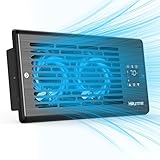
- Top Pick: Orabriz AC Vent Booster Fan 4" x 10" Register, Improves Airflow for Rooms
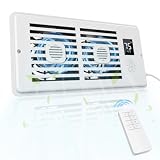
- Best Value: Hisummer Register Booster Fan for 4" x 10" Floor Register, Quiet 10-Speed Vent Fan Booster with Temp Sensor, 150 CFM Airflow, Improves Heating & Cooling, Remote Control, Only Fits 4×10 Duct Openings
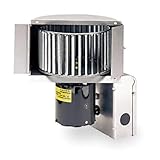
- Premium Choice: Tjernlund DB-2 Duct Booster Fan for Heating and Cooling Airflow, 275 CFM
Every home seems to have that one room that never gets enough heat in winter or cool air in summer, no matter how you adjust the thermostat. An air duct booster fan is an inexpensive, effective fix that mounts at the register or inside the duct to actively push more conditioned air into that stubborn space.
- Watch: How to Install an Air Duct Booster Fan for Improved Airflow in Stubborn Rooms — Video Review
- Choose the Right Type of Booster Fan
- Measure Your Register or Duct
- Install a Register Booster Fan
- Install an In-Line Duct Booster Fan
- Test and Adjust
- Tips
- Frequently Asked Questions
- Conclusion
- Related Articles
- Related Guides
This guide covers the two main types of booster fans, how to choose the right size, and step-by-step installation for both register-mounted and in-line models, so you can improve airflow to a problem room in an afternoon without calling an HVAC contractor.
As an Amazon Associate we earn from qualifying purchases at no extra cost to you.



⚡ Save on Your Next PC — Amazon Prime
Prime members get fast free shipping on the systems above, plus early access to Prime Day & Black Friday PC deals. New members get a 30-day free trial.
Watch: How to Install an Air Duct Booster Fan for Improved Airflow in Stubborn Rooms — Video Review
Choose the Right Type of Booster Fan
There are two main styles. Register booster fans like the Orabriz AC Vent Booster Fan sit on top of your existing floor or wall register and are the easiest to install. In-line duct fans such as the Tjernlund DB-2 mount inside the duct run itself for stronger, whole-run boosting. For most single-room problems, a register fan is the simplest effective choice.
Measure Your Register or Duct
Register fans are sized to standard vent openings, most commonly 4×10 inches, so measure your existing register before buying a model like the Hisummer Register Booster Fan for 4×10 vents. For in-line fans, measure the duct diameter so the fan matches your round or rectangular duct exactly.
Install a Register Booster Fan
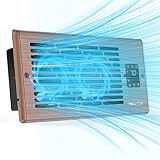
Remove your existing register cover, place the booster fan over the opening, and secure it per the instructions, then plug it into a nearby outlet. Many models, including thermostat-equipped units, turn on automatically when they sense conditioned air moving, so you can set it and forget it.
Install an In-Line Duct Booster Fan
For an in-line fan like the Tjernlund DB-2, cut into the accessible duct run, mount the fan in line with the airflow direction marked on the housing, seal the connections with foil tape, and wire it to power. This is more involved but delivers a stronger boost for long or restricted runs.
Test and Adjust
Once installed, run your HVAC system and confirm airflow to the target room has improved. Adjust any speed or thermostat settings on the fan, and if a register model still falls short, an in-line fan mounted further up the run usually provides the extra push a difficult room needs.
Tips
- Match a register fan to your exact vent size, most commonly 4×10 inches
- Choose a thermostat-controlled model so the fan runs only when conditioned air flows
- Seal in-line fan connections with UL-listed foil tape to prevent new leaks
- Clean the fan blades periodically, as dust buildup reduces airflow over time
Frequently Asked Questions
Do air duct booster fans really work?
Yes, for rooms that are underserved by weak airflow. A booster fan actively pulls more conditioned air into the space, and register models install in minutes for a quick, noticeable improvement.
Register-mounted or in-line, which should I choose?
Register fans are easiest and fix most single-room issues. In-line fans mount inside the duct for a stronger boost and suit long or heavily restricted runs where a register fan is not enough.
Will a booster fan raise my energy bill much?
Very little. Booster fans draw modest power, and thermostat-controlled models run only when your HVAC system is active, so the efficiency gain from balanced airflow often offsets the small added cost.
Do I need an electrician to install one?
Register booster fans simply plug into a nearby outlet, so no electrician is needed. Hardwired in-line models may require basic wiring, so hire a pro if you are not comfortable with that step.
Conclusion
An air duct booster fan is one of the cheapest, fastest ways to fix a room that your HVAC system just cannot satisfy. Start with a properly sized register fan for a plug-and-play solution, step up to an in-line model for stubborn long runs, and enjoy even, comfortable airflow throughout your home.




Write Your Review
No reviews yet. Be the first to share your experience!