
Duct damper position guide helps homeowners adjust HVAC airflow levers for summer and winter efficiency. Setting manual volume dampers properly eliminates hot spots, balances room temperatures, and lowers energy bills. Understanding handle direction protects your blower motor while optimizing comfort across every zone in your residence.
How to Choose the Right Duct Damper Position Guide
Learning how to choose the right duct damper position guide allows you to manage indoor temperatures with total precision. Before making seasonal adjustments, evaluate how your supply lines route conditioned air throughout multi-story layouts. Proper assessment prevents static pressure spikes while keeping your utility costs manageable.
Evaluating Manual Volume Levers Versus Motorized Controls
Selecting between a manual volume damper and an automated motor unit depends on your home layout and budget. Manual levers require simple seasonal adjustments by hand, making them budget-friendly for standard sheet metal trunks. Motorized units integrate directly with thermostats, offering automated control for hard-to-reach ceiling ducts.
For basic single-family homes, manual handles located on main trunk lines provide plenty of airflow control. If your branch lines sit inside finished drywall, motorized zone valves eliminate the need to cut access panels. Evaluating how often you rebalance airflow helps determine whether automation justifies the extra electrical setup.
Inspecting Handle Indicator Lines and Wing Nut Lock Mechanisms
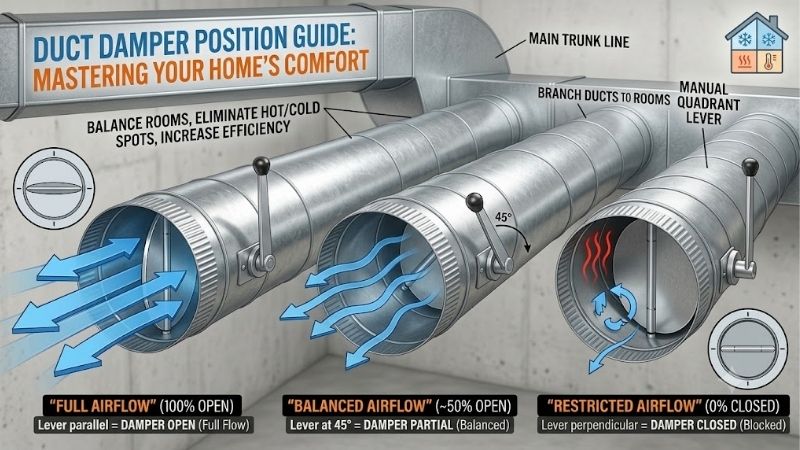
Most manual dampers feature an external metal lever secured by an adjustable ductwork wing nut on the duct exterior. The direction of this handle mirrors the internal metal blade orientation inside the pipe shell. A handle aligned parallel to duct length means fully open, while a perpendicular position indicates a closed damper setting.
High quality damper assemblies include stamped arrow marks or notch indicators directly on the rotating center rod end. Always loosen the wing nut slightly before turning the control arm to prevent stripping the inner spindle threads. Tightening the nut firmly after adjustment locks the blade against vibration and unwanted airflow movement.
Balancing Seasonal Temperature Variances for Upper Floors
Managing summer heat requires directing more chilled air toward upper story bedrooms as hot air naturally accumulates upstairs. Closing basement branch vents slightly forces cool air upward, creating a balanced heating and cooling balance throughout the house. Following a duct damper position guide ensures proper air distribution during summer.
During winter heating cycles, reverse your strategy by opening lower level dampers to let warm air rise naturally from below. Leaving upstairs dampers partially open prevents severe pressure buildup while keeping upper rooms comfortable. Making small incremental handle movements yields better temperature control than sudden drastic adjustments.
Top Picks for High Efficiency Duct Dampers
Discovering the ideal hardware simplifies maintaining your duct damper position guide setup across all four seasons. Modern dampers incorporate sturdy galvanized construction, silicone seals, and precise positioning levers to streamline air distribution. The following selections deliver durable airflow management for home HVAC ducts.
Suncourt ZoneMaster 6-Inch Motorized Damper ZC206
Ideal for homeowners who want automated zone control damper performance without adjusting attic levers manually every season. This 24V normally closed motorized unit opens smoothly when powered, directing supply air only when your thermostat demands heat or AC. Sturdy galvanized housing ensures long-lasting structural rigidity.
Installing this motorized damper requires low-voltage wiring skills and access to a 24VAC transformer power source. While the initial investment exceeds simple manual dampers, automated convenience eliminates manual ladder trips completely. It remains a top choice for hard-to-reach duct branches requiring seasonal airflow adjustments.
Aulmscn 6-Inch Manual Volume Damper with Seal
Designed for homeowners who prefer reliable hands-on airflow regulation using an inline duct damper in round branch pipes. Premium stainless steel construction prevents rust formation while integrated silicone perimeter seals block unwanted air leakage. The smooth external lever locks securely using a heavy-duty wing nut fastener.
Manual adjustments require physically reaching your exposed basement or attic ductwork to turn the handle indicator. However, the airtight internal rubber seal prevents annoying whistling sounds even under high blower fan speeds. It offers outstanding value for budget-conscious homeowners balancing room temperatures manually.
AC Infinity 4-Inch Backdraft Damper AC-BDD4-B
Perfect for preventing cold outdoor drafts from entering exhaust vents while maintaining smooth one-way airflow ventilation. Spring-loaded aluminum blades open with minimal air pressure, closing tightly as soon as fan operation stops completely. Powder-coated galvanized steel housing provides superior protection against ambient humidity.
Because this unit operates automatically using spring tension, it cannot be locked open for standard manual volume balancing. Installing it upside down can impair flap closure, so paying attention to airflow direction arrows is mandatory. It excels at keeping outdoor air from entering your bathroom or kitchen exhaust lines.
PATIKIL 4-Inch Manual Volume Air Duct Damper
Suited for compact 4-inch ventilation runs needing simple air control to prevent excessive register vent airflow in small rooms. Lightweight aluminum flap blades move easily inside a durable stainless steel collar fitted with silicone seals. The external control handle features distinct stop points for accurate positioning.
Sizing is strictly limited to 4-inch ducting, which makes it unsuitable for primary furnace main distribution trunks. Nevertheless, its simple slide-in setup and rustproof hardware make balancing smaller branch lines quick and affordable. It provides precise airflow restriction without causing excessive noise or air turbulence.
Fantech RSK-6 6-Inch Spring Loaded Backdraft Damper
Great for residential HVAC systems where preventing backdrafts and managing air pressure drop is essential for efficiency. Engineered with lightweight aluminum shutter blades and a central neoprene foam gasket for quiet operation. Sturdy galvanized steel sleeve ensures a tight press-fit installation into standard 6-inch rigid metal pipe.
The internal return spring requires adequate static air pressure from booster fans to open completely without restriction. Weak airflow systems may experience slight volume reduction if fan velocity falls below optimal operating levels. Overall, it delivers professional reliability for keeping unwanted outdoor air from entering ductwork.
| Product Model | Damper Type | Diameter | Housing Material | Best For |
|---|---|---|---|---|
| Suncourt ZC206 | 24V Motorized | 6 Inch | Galvanized Steel | Automated Zone Control |
| Aulmscn Manual | Manual Volume | 6 Inch | Stainless Steel | Tight Manual Sealing |
| AC Infinity BDD4 | Spring Backdraft | 4 Inch | Alloy & Powder Steel | Draft Prevention |
| PATIKIL Manual | Manual Volume | 4 Inch | Stainless & Aluminum | Small Room Airflow |
| Fantech RSK-6 | Spring Backdraft | 6 Inch | Galvanized & Neoprene | Silent Exhaust Protection |
Frequently Asked Questions
Understanding your duct damper position guide helps resolve temperature inconsistencies and prevents unnecessary HVAC system strain. Below are clear answers to common questions regarding handle orientation, seasonal adjustments, and furnace safety. Reviewing these facts ensures smooth seasonal transitions for your entire home.
Which Direction Should the Damper Handle Face for Open Airflow?
The external handle on a manual damper aligns directly parallel to the internal metal blade inside your duct pipe. When the handle sits parallel with the length of the ductwork, the damper is fully open for maximum airflow. Turning the lever perpendicular to duct length completely closes the interior passage to restrict supply air.
Achieving effective HVAC airflow balance usually requires positioning levers at partial angles like 45 degrees. Setting handles at a diagonal angle allows partial air volume to pass while directing extra velocity toward distant rooms. Always tighten the locking wing nut after finding your desired angle to maintain consistent settings.
Should I Close Basement Duct Dampers During Cold Winter Months?
Closing basement dampers during winter is generally discouraged because cold air settles naturally in lower floor levels. Opening basement supply vents during heating season ensures lower spaces stay warm while heat rises naturally into upper stories. Following a duct damper position guide prevents freezing pipes in unheated basements.
In contrast, summer cooling benefits from closing or dampening basement vents to force cold air up to top floors. Since cold AC air sinks, opening basement dampers in summer creates overly freezing basements while leaving bedrooms warm. Rebalancing these branch lines twice per year maintains comfortable temperatures on every level.
How Do Seasonal Settings Differ Between Summer and Winter Seasons?
Seasonal damper adjustment strategies focus on counteracting natural heat convection throughout your living space. In summer, open upper level dampers fully while closing basement dampers to roughly 20 percent open position. This forces dense chilled air upward, allowing it to cool top floor bedrooms before descending downstairs.
When winter arrives, reverse the process by opening basement and main floor supply dampers to maximum capacity. Partially close upper story dampers to prevent heat from over-accumulating upstairs while lower rooms stay cold. Marking damper seasonal settings directly on ductwork metal with a marker makes annual adjustments effortless.
Can Closing Too Many Duct Dampers Damage My Heating Furnace?
Closing more than 20 percent of your total duct dampers creates high static pressure inside system trunk lines. Excessive air resistance restricts airflow across your heat exchanger, causing the furnace safety limit switch to trip. Repeated high-limit shutoffs strain blower motors and accelerate expensive mechanical component failures.
To avoid damaging equipment, never fully seal off multiple branch lines even if rooms are rarely occupied. Instead, adjust dampers to partial positions that maintain baseline airflow while gently redirecting excess volume elsewhere. Maintaining proper airflow balance preserves heating system longevity while keeping home comfort consistent.
Final Thoughts
Following a proper duct damper position guide gives you complete control over home comfort and energy consumption throughout the year. Taking time to adjust manual levers seasonally balances air temperature differences between floors without overloading your furnace blower motor. Invest in quality hardware today to achieve steady heating and cooling balance.
As an Amazon Associate we earn from qualifying purchases at no extra cost to you.











Write Your Review
No reviews yet. Be the first to share your experience!