
How to balance dampers by room helps homeowners regulate indoor temperatures across living zones. Adjusting manual volume levers inside supply trunks optimizes airflow distribution across your entire house. Fine-tuning individual branch lines lowers energy costs while eliminating uncomfortable hot spots.
How to Choose the Right How to Balance Dampers by Room Equipment
Learning how to balance dampers by room requires assessing your home layout and ductwork configuration. Measuring supply air velocity across each register helps determine required branch adjustments. Selecting appropriate measurement tools and manual controls ensures accurate temperature management.
Evaluating Manual Levers and Inline Branch Dampers
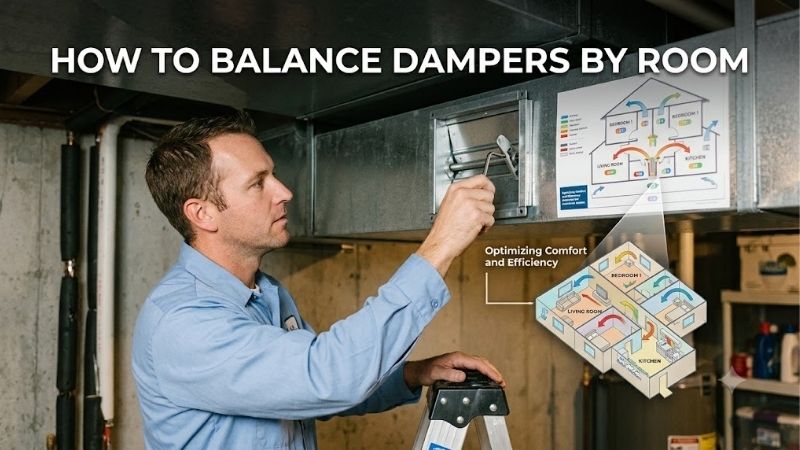
Inspecting exposed trunk lines helps locate manual volume dampers serving specific bedrooms. Heavy steel handles with wing nut fasteners allow precise blade positioning inside round metal pipes. Selecting durable inline branch dampers prevents annoying air whistling while maintaining secure lever settings under high blower fan pressure.
Evaluating handle direction clarifies whether internal blades sit fully open or closed. A handle aligned parallel to the duct length permits maximum air movement through supply registers. Checking mechanical integrity before seasonal adjustment prevents stripped spindle threads and ensures long-term airflow balance control.
Measuring Airflow Velocity with Anemometer Devices
Utilizing a digital anemometer measurement tool allows homeowners to quantify exact output from room vents. Holding sensor impellers directly against register grilles reveals velocity drops across distant upstairs branches. Accurate readings help quantify needed damper adjustments rather than relying on rough estimates.
Recording feet per minute values across every room establishes a baseline system balance profile. Comparing air delivery numbers highlights restricted supply channels needing wider damper openings. Consistent airflow measurement ensures balanced thermal comfort without overloading electric furnace blower fan motors.
Managing Ductwork Static Pressure and Resistance
Closing too many supply line dampers creates excessive ductwork static pressure inside main trunks. High internal resistance restricts air volume moving across furnace heat exchangers, triggering safety shutoff switches. Maintaining balanced system pressure protects blower motors while delivering consistent room comfort.
Keeping at least eighty percent of total supply branch lines open prevents system strain. Incremental damper adjustments prevent drastic pressure spikes while redirecting surplus air to upper stories. Balancing pressure levels ensures quiet HVAC operation while extending valuable mechanical component lifespan.
Top Picks for Balancing Room HVAC Dampers
Discovering reliable air balancing tools simplifies mastering how to balance dampers by room in multi-story houses. High precision anemometers, manual volume dampers, and register booster fans optimize room temperatures. The following verified Amazon products deliver dependable airflow management for residential systems.
BTMETER BT-100 Handheld Digital Anemometer
Ideal for homeowners needing precise digital anemometer measurement readings at register vent louvers. Dual temperature and wind velocity sensors display real-time feet per minute output across individual room vents. Using this compact meter streamlines learning how to balance dampers by room with exact numerical data.
Compact LCD screens require clear line of sight when measuring high ceiling supply registers. Nevertheless, high accuracy impellers and tripod mounting threads provide excellent testing versatility for home HVAC tuning. It offers outstanding value for DIYers seeking accurate room airflow balancing diagnostics.
Aulmscn 6-Inch Manual Volume Damper with Seal
Designed for home DIYers installing durable inline branch dampers in round supply pipes. Heavy stainless steel construction prevents rust while integrated silicone perimeter seals eliminate unwanted air leakage. The sturdy external handle locks securely using heavy wing nut fasteners during seasonal HVAC adjustments.
Manual lever adjustments require reaching exposed attic or basement ductwork directly by hand. However, air-tight internal rubber gaskets block annoying whistling sounds even under maximum blower air velocity. It delivers professional structural reliability for budget-conscious homeowners balancing duct lines.
Suncourt ZoneMaster 6-Inch Motorized Damper ZC206
Perfect for homeowners seeking automated zone control without adjusting attic manual volume dampers seasonally. This 24V normally closed motorized unit opens smoothly when powered, directing supply air only when thermostats demand. Galvanized steel housing ensures long-lasting durability in unconditioned attics.
Installing low-voltage wiring requires basic electrical knowledge and dedicated transformer connections. Regardless, automated convenience eliminates hazardous ladder trips when managing seasonal multi-story temperature differential issues. It remains a top choice for hard-to-reach ducts needing automated balance.
AC Infinity AIRVENTURE T6 Quiet Register Booster Fan
Suited for distant bedrooms experiencing weak airflow velocity due to long ductwork runs. Intelligent thermostat controls adjust quiet PWM fan speeds automatically based on supply air temperatures. Installing this register fan restores comfortable room temperature control without closing main trunk dampers.
Requires plugging an external power adapter into nearby wall outlets near floor register grilles. Even so, whisper-quiet operation and customizable fan speeds pull trapped conditioned air effectively into cold bedrooms. It offers high-value localized air distribution help for poorly balanced home HVAC zones.
PATIKIL 4-Inch Manual Air Volume Damper
Great for small residential branch lines requiring precise airflow restriction in compact rooms. Lightweight aluminum shutter blades move smoothly inside a durable stainless steel collar fitted with rubber seals. Using this compact damper prevents excessive air delivery through small bedroom register vent louvers.
Narrow 4-inch collar sizing limits installation strictly to smaller residential supply branches. Nevertheless, smooth handle operation and rustproof materials ensure long-term reliability without air turbulence noise. It provides budget-friendly airflow control for fine-tuning smaller living spaces easily.
| Product Model | Tool Type | Size / Rating | Key Feature | Best For |
|---|---|---|---|---|
| BTMETER BT-100 | Digital Anemometer | Handheld Unit | Dual Temp & Velocity | Register Output Testing |
| Aulmscn Manual | Volume Damper | 6 Inch Collar | Silicone Perimeter Seal | Inline Branch Control |
| Suncourt ZC206 | Motorized Damper | 6 Inch / 24V | Automated Power Open | Hard-to-Reach Ducts |
| AC Infinity T6 | Register Booster | 4×10 Register | Thermostat Fan Control | Distant Bedroom Vents |
| PATIKIL Manual | Volume Damper | 4 Inch Collar | Rustproof Aluminum | Small Room Restriction |
Frequently Asked Questions
Mastering how to balance dampers by room resolves persistent home comfort issues and improves overall HVAC efficiency. Below are clear expert answers to common queries regarding handle positions, seasonal adjustments, and pressure safety. Reviewing these facts ensures smooth seasonal airflow balancing.
Which Direction Should Damper Levers Face for Maximum Airflow?
External control handles align directly with internal metal blades inside sheet metal duct pipes. When the lever sits parallel to the length of the ductwork, the damper is fully open for maximum air movement. Turning the handle perpendicular completely restricts supply air flowing toward room register vent louvers.
Achieving proper room temperature control often requires setting handles at diagonal angles like 45 degrees. Partial opening angles direct extra air velocity to distant rooms while maintaining baseline airflow. Tightening wing nuts securely prevents handle shifting from furnace blower vibration over time.
How Do Seasonal HVAC Adjustments Differ Between Summer and Winter?
Managing multi-story temperature differential issues requires altering damper positions twice per year. During summer cooling, open upper floor dampers fully while closing basement dampers to roughly 20 percent open. This forces dense chilled air upward, allowing it to cool upper story bedrooms before descending.
When winter heating arrives, reverse your damper settings by opening lower level supply lines completely. Allowing warm air to rise naturally from basement registers creates balanced room temperatures everywhere. Following a routine seasonal HVAC adjustments schedule maintains year-round home comfort effortlessly.
Can Closing Too Many Branch Dampers Harm My Heating Furnace?
Closing more than twenty percent of total branch line dampers raises ductwork static pressure significantly. Excessive air resistance restricts volume passing across heat exchangers, causing safety switches to trip. Repeated high-limit shutoffs strain blower fan motors and accelerate expensive mechanical failures.
To protect equipment, never completely seal off multiple branch lines even in unused guest rooms. Instead, set handles to partial diagonal positions that maintain baseline air movement through all ducts. Safe airflow distribution protects furnace longevity while eliminating severe room temperature swings.
How Do I Identify Which Damper Controls a Specific Room?
Tracing branch lines from main distribution trunks toward individual floor boots helps identify supply routes. Having a helper tap on room registers while listening at exposed ductwork confirms connection pathways easily. Knowing how to balance dampers by room starts with labeling trunk levers with permanent markers.
Using a digital anemometer measurement device at room registers confirms airflow changes instantly when turning levers. Marking summer and winter handle positions directly on sheet metal simplifies annual balancing routines. Proper labeling saves hours of troubleshooting during seasonal temperature transitions.
Final Thoughts
Understanding how to balance dampers by room gives you complete control over indoor home comfort and energy consumption throughout the year. Adjusting manual levers seasonally balances air temperature differences between floors without overloading your furnace blower motor. Invest in quality tools today to keep your home comfortable.
As an Amazon Associate we earn from qualifying purchases at no extra cost to you.











Write Your Review
No reviews yet. Be the first to share your experience!