
How to measure airflow at a vent provides essential diagnostic data when assessing heating and cooling efficiency across your living space. Capturing precise ventilation output helps locate distribution bottlenecks, balancing HVAC performance while reducing energy waste. Following proven measurement steps ensures consistent comfort.
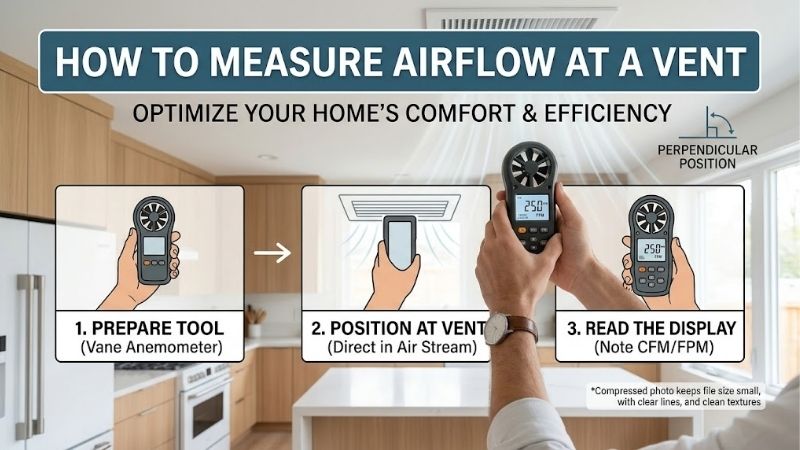
How to Choose the Right Method for How to Measure Airflow at a Vent
Learning how to measure airflow at a vent requires choosing between direct velocity sensors, capture hoods, and digital meters. Selecting suitable diagnostic equipment ensures accurate readings across floor grilles and ceiling supply lines.
Evaluating Air Velocity Meters Versus Flow Hoods
Selecting testing gear depends on whether you measure linear speed or total cubic feet per minute volume directly. Vane anemometers calculate surface speed, while specialized capture hoods enclose entire grilles to collect complete discharge. Choosing the right tool configuration matches your specific ventilation testing goals.
Handheld vane devices offer budget-friendly portability for quick spot checks across standard home registers. However, calculating total volumetric output with handheld tools requires multiplying fpm air velocity by effective grille surface area. Capturing precise data prevents incorrect HVAC system balancing.
Assessing Instrument Accuracy and Sensor Sensitivity
Sensor quality directly impacts airflow diagnostics, especially when checking low-velocity branch lines. High-grade vane anemometer instruments register subtle airflow changes that basic wind gauges miss entirely. Choosing calibrated sensors prevents skewed measurements when balancing multi-story home HVAC networks.
Thermal hot-wire anemometers excel at detecting tiny draft variations inside restricted branch lines. However, delicate sensor wires require careful handling compared to rotating mechanical impellers. Matching sensor durability to your typical testing environment guarantees long-term measurement consistency.
Calculating Duct Area for Accurate CFM Conversion
Transforming linear velocity readings into volume output requires accurate physical duct dimensions. Using a digital airflow meter simplifies data collection, but manual math remains essential for verification. Multiplying average feet per minute by free grille area yields total cubic feet per minute delivery.
Grille louvers reduce actual open area compared to total frame dimensions. Failing to adjust for net free area leads to inflated volume calculations across supply vents. Applying accurate correction factors ensures your calculated airflow reflects actual conditioned air delivery into every room.
Factoring System Static Pressure and Resistance
Branch duct resistance directly influences register output velocity during active furnace operation. Measuring duct static pressure alongside velocity readings isolates internal obstructions from blower failure. Comprehensive pressure evaluation prevents unnecessary equipment repairs and targeted fixes.
High static resistance starves distant supply vents, dropping room discharge velocity significantly. Utilizing differential pressure manometers helps detect hidden duct restrictions before rebalancing dampers. Evaluating system resistance ensures your airflow measurements translate into effective solutions.
Top Picks
Mastering how to measure airflow at a vent starts with dependable, accurate measurement tools. The comparison table below highlights reliable anemometers and diagnostic meters tested for residential HVAC performance. Equipping yourself with verified instruments simplifies air distribution checks across all room registers.
| Product | Category | Key Benefit | Ideal Solution For |
|---|---|---|---|
| Testo 410i Smart Wireless Vane Anemometer | Smart Vane Anemometer | App-connected volume calculation | Wireless mobile vent diagnostics |
| BTMETER BT-846A Pro CFM Anemometer | Pro Vane Anemometer | Large duct probe & memory logging | Detailed whole-house airflow audits |
| HoldPeak HP-866B Digital Anemometer | Compact Wind Gauge | Backlit screen & tripod mount | Quick DIY register speed checks |
| BTMETER BT-100 Handheld Anemometer | Budget Vane Meter | High-precision 8-blade impeller | Economical supply register testing |
| Proster Handheld Digital Anemometer | Portable Air Meter | Compact design & multi-unit display | Fast spot-checking register vents |
Testo 410i Smart Wireless Vane Anemometer
This compact Bluetooth anemometer suits technicians needing smart wireless logging on smartphone screens. The precision vane head measures velocity while automatically calculating supply register output via mobile application menus. Utilizing wireless data transfer streamlines multi-vent balancing during home inspection routines.
The small sensor housing requires holding your mobile phone nearby to view real-time readings during testing. In addition, reliance on battery-powered Bluetooth connectivity means keeping spare AAA batteries stored in your tool case. Still, its automated volume calculations make it an outstanding HVAC diagnostic tool.
BTMETER BT-846A Pro CFM Anemometer
This professional-grade airflow meter suits home auditors measuring large return grilles and supply vents. Featuring an extended sensor cable and custom duct entry, it simplifies testing hard-to-reach ceiling registers. Using an hvac flow hood or extended probe ensures accurate volume calculations across branch lines.
The tethered sensor cord can tangle if stored carelessly inside crowded utility bags between jobs. Furthermore, the larger body requires two-handed operation when navigating tight attic crawl spaces or floor openings. Nevertheless, its memory logging capacity provides unmatched accuracy for full system audits.
HoldPeak HP-866B Digital Anemometer
This lightweight digital wind gauge suits budget-conscious DIYers checking room register velocity quickly. Featuring an easy-to-read backlit display, it measures feet per minute speed while calculating vent discharge rate effortlessly. The built-in tripod mount enables hands-free continuous monitoring during furnace cycles.
The plastic housing feels lightweight and requires protective storage to prevent impeller wheel damage. Additionally, calculating total volumetric CFM requires entering duct dimensions manually into external calculators. Despite these factors, its reliable accuracy makes it ideal for quick register troubleshooting.
BTMETER BT-100 Handheld Vane Anemometer
This versatile handheld meter suits home dwellers seeking an affordable, accurate air velocity sensor. Equipped with an eight-blade impeller wheel, it records subtle airflow shifts across floor registers accurately. Using a thermal wind gauge or vane meter helps isolate underperforming branches without expensive tools.
The compact display screen lacks wireless connectivity, requiring manual recording of velocity data on paper. Also, testing high ceiling vents requires standing on step ladders because the unit lacks extension poles. Even so, its budget-friendly price and responsive sensor deliver reliable everyday performance.
Proster Handheld Digital Anemometer
This portable digital meter suits homeowners needing fast, hassle-free velocity readings at floor registers. Featuring multiple unit selections, it measures linear speed while supporting simple ventilation volume test procedures. Its compact body fits comfortably inside shirt pockets between room testing locations.
The small impeller opening requires careful positioning directly in the primary register airstream path. Moreover, the unit does not store extensive historical logs, requiring immediate reading notes during testing. Regardless, its straightforward operation and crisp screen provide exceptional diagnostic value.
Frequently Asked Questions
Understanding how to measure airflow at a vent helps resolve diagnostic confusion during HVAC testing. Below are direct answers addressing common questions regarding instrument setup, CFM conversion formulas, and reading accuracy. Clarifying these technical details ensures reliable data collection across your entire duct network.
How do I convert register air velocity into total CFM volume?
Converting linear velocity to volume requires multiplying measured feet per minute by the register’s net free area in square feet. Using a digital meter simplifies this process, but verifying manual math ensures accurate cubic feet per minute output calculations for balanced room conditioning.
Always measure velocity across multiple points on the grille face to calculate a true average speed. Multiplying this average velocity by the open surface area prevents overestimating air volume delivery. Accurate mathematical conversion guarantees reliable performance assessments across all supply lines.
Why are my register airflow readings inconsistent across the grille?
Airflow across supply grilles is rarely uniform due to internal damper angles and elbow duct turbulence. Placing a vane anemometer at a single spot captures localized speed rather than total output. Taking multi-point grid measurements ensures balanced average velocity calculations across irregular vents.
Internal louver positioning creates air jets that inflate velocity readings directly above open slots. Using capture hoods or taking averaged multi-point readings smooths out velocity spikes effectively. Consistent testing methods prevent misdiagnosing healthy HVAC branches as restricted lines.
Can I learn how to measure airflow at a vent without pro tools?
While professional capture hoods yield exact volume metrics, budget handheld anemometers provide highly reliable residential results. Following systematic measurement steps allows homeowners to evaluate supply line output accurately without hiring contractors or purchasing commercial equipment.
DIY testing methods require careful attention to free area calculations and multi-point averaging techniques. Taking time to measure register dimensions accurately compensates for basic equipment limitations. Methodical testing yields dependable data for identifying uneven home heating or cooling zones.
How often should I measure register airflow in my home?
Measuring vent output annually or whenever seasonal comfort shifts occur helps detect emerging HVAC distribution problems early. Recording baseline velocity data allows you to spot sudden duct leaks, clogged filters, or slipping blower belts before severe comfort issues or high utility bills develop.
Performing airflow checks after changing air filters or altering damper positions confirms proper system balancing. Keeping a written log of register velocities across seasons simplifies future troubleshooting. Regular airflow monitoring ensures efficient operation and long-term HVAC system reliability.
Final Thoughts
Learning how to measure airflow at a vent empowers you to diagnose heating and cooling imbalances across your home efficiently. By selecting reliable anemometers, calculating net free area, and measuring fpm air velocity systematically, you restore balanced air distribution while protecting your HVAC efficiency long term.


Write Your Review
No reviews yet. Be the first to share your experience!