
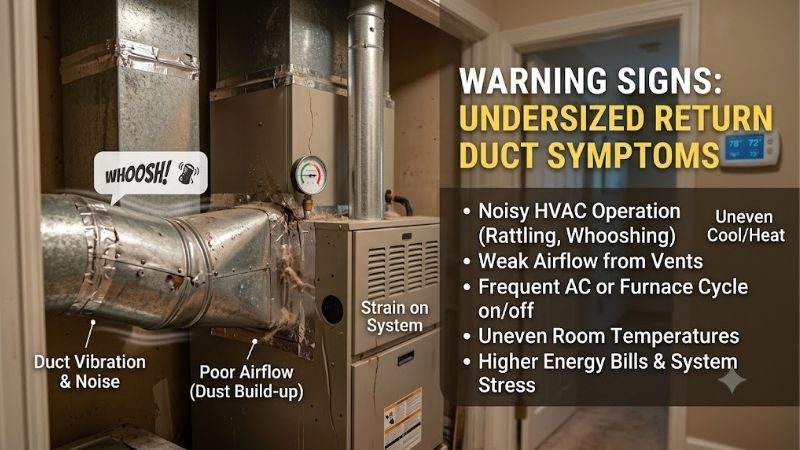
Undersized return duct symptoms can severely damage your HVAC system by choking airflow across the central heat exchanger. When your return plenum lacks sufficient volume, the blower motor struggles against excessive vacuum pressure inside ductwork. Spotting early signs keeps repair costs manageable and protects equipment.
How to Choose Solutions for Undersized Return Duct Symptoms
Selecting the right tools to diagnose undersized return duct symptoms requires evaluating your home’s total air intake capacity. Accurately measuring airflow restriction allows homeowners to determine whether duct enlargement or airflow amplification is required. Proper monitoring protects your blower motor from strain.
Static Pressure Diagnostics and Measurement
Accurate static pressure measurement is the most reliable way to confirm severe restricted airflow in return vents. High negative pressure indicates that your system blower is starving for intake air, forcing the motor to consume excess wattage. Diagnostic manometers quickly isolate exact plenum restriction points.
Investing in a precise digital pressure gauge helps you measure pressure drops across air filters and return drops. Comparing real-time readings with manufacturer specifications prevents unexpected system shutdowns during peak seasons. Consistent testing ensures optimal heating and cooling balance throughout.
Airflow Velocity and Distribution Capability
Evaluating air velocity across individual return grilles helps identify severe uneven home cooling across multiple floors. Low cubic feet per minute airflow indicates insufficient duct diameter or excessive duct bends. Portable anemometers deliver instant feet-per-minute readings at every return vent.
Monitoring velocity trends empowers homeowners to make informed decisions before replacing expensive central HVAC equipment. Identifying starved return runs allows targeted duct modifications or booster fan installations. Balanced velocity restores comfortable temperature gradients in distant bedrooms.
Filter Resistance and System Compatibility
High-density air filters often exacerbate an existing air duct restriction by increasing total system resistance. Standard single-return systems require low-resistance pleated media to maintain sufficient blower intake volume. Selecting filters with low initial pressure drop mitigates severe airflow starvation.
Proper filter selection balances essential particle filtration with necessary HVAC volumetric airflow requirements. Checking filter MERV ratings prevents unnecessary strain on delicate electronic control boards and fan motors. Replacing dense filters improves total circulation without major duct renovation costs.
Top Picks for Resolving Undersized Return Duct Symptoms
Solving undersized return duct symptoms demands proven diagnostic tools and targeted airflow enhancement devices. Our top recommendations focus on verified products that help homeowners detect pressure imbalances, boost return airflow, and lower blower resistance efficiently. Guard your system against expensive winter breakdowns.
| Product | Category | Key Feature | Best For |
|---|---|---|---|
| HTI-XINTAI Digital Manometer | Pressure Testing | Dual Port ±2.999 PSI Range | Static Pressure Diagnosis |
| AC Infinity AIRVENT T6 Fan | Vent Boosting | Smart Thermostat & PWM Control | Room Airflow Amplification |
| Tjernlund M-6 Duct Booster | In-Line Boosting | 500 CFM Galvanized Steel | Return Duct Enhancement |
| BTMETER BT-100 Anemometer | Velocity Gauge | Dual Temp & CFM Wind Sensor | Return Vent Air Velocity |
| Filterbuy MERV 8 Air Filter | Low Resistance | Electrostatically Charged Pleats | Airflow Restrict Relief |
HTI-XINTAI Digital Manometer Pressure Gauge
This handheld digital manometer is ideal for technicians and DIYers diagnosing high utility bills from starved return ducts. It features dual differential pressure ports, a backlit screen, and eleven selectable measurement units. Users value its fast response time when measuring static pressure across air filters.
The included flexible tubing requires careful attachment to test ports to prevent air leakage during high-vacuum testing. Nevertheless, its high precision makes it an essential tool for relieving undersized return duct symptoms before major motor failure occurs. Highly recommended for accurate HVAC troubleshooting.
AC Infinity AIRVENT T6 Register Booster Fan
Designed for rooms with poor intake circulation, this quiet return air grill booster pulls stagnant air through restrictive vents. It features an intelligent thermal controller, custom fan speeds, and a premium aluminum frame. Homeowners love how effectively it balances temperatures in distant upper bedrooms.
The digital display screen brightness can feel slightly intrusive in dark bedrooms unless dimmed via wall controller settings. Overall, its efficient whisper-quiet motor delivers impressive relief for undersized return duct symptoms without requiring invasive sheet metal duct expansion project work.
Tjernlund M-6 In-Line Duct Booster Fan
This heavy-duty metal inline fan helps homeowners prevent severe furnace overheating caused by constricted air intake pathways. It features a high-torque motor housed in galvanized steel to deliver up to 500 CFM of continuous assist airflow. Ideal for long return duct runs with multiple tight elbow bends.
Hardwired electrical connections mean installation requires basic wiring knowledge or professional electrician assistance. Despite the installation effort, its rugged construction provides reliable assistance for undersized return duct symptoms across demanding multi-story residential HVAC installations.
BTMETER BT-100 Handheld Anemometer Airflow Meter
This portable wind speed gauge helps homeowners investigate return air vent whistling caused by extreme airflow velocity through narrow grilles. It offers real-time velocity tracking, ambient temperature readings, and an easy backlit LCD display. Users love its quick setup for balancing register openings.
Calculating exact cubic feet per minute requires manually entering vent surface dimensions into your calculations. Nevertheless, its accurate sensor probe helps pinpoint starved intake locations and undersized return duct symptoms across complex home floor plans. Essential for home HVAC performance tuning.
Filterbuy MERV 8 High Flow Air Filter 4-Pack
These low-resistance synthetic pleated air filters help prevent frozen evaporator coil issues in air intake restricted systems. Manufactured in the USA with durable electrostatically charged media, they trap dust while maintaining high volumetric airflow. Perfect for homes with compact return filter grilles.
Higher MERV ratings may be necessary for households requiring advanced allergen and smoke filtration performance. However, maintaining these free-flowing filters offers immediate relief against undersized return duct symptoms while protecting sensitive compressor units from continuous vacuum strain.
Frequently Asked Questions
Understanding HVAC air balance helps homeowners distinguish between simple air filter clogs and major intake duct deficiencies. Below are expert answers to frequent questions regarding system static pressure, noise issues, and airflow solutions. Use these guidelines to maintain efficient indoor environmental comfort.
Can an Undersized Return Duct Cause Compressor Failure?
Yes, restricted airflow severely limits heat absorption across the evaporator coil, causing liquid refrigerant to flood back to your compressor. This continuous thermal stress causes frequent AC short cycling and premature compressor motor failure. Ensuring adequate return air volume extends cooling equipment life.
Homeowners should check return duct sizing whenever replacing an outdoor AC condenser unit with higher tonnage equipment. Increasing cooling capacity without enlarging return intake ducts creates destructive pressure imbalances. Early duct modifications prevent costly compressor replacement expenses down the road.
Why Does My Return Vent Make a Loud Whistling Noise?
A sharp return air vent whistling sound occurs when a powerful blower pulls large air volumes through narrow, undersized grille openings. High air velocity creates localized high-pitch resonance across stamped metal louvers. Installing high-velocity return grilles reduces air noise significantly.
Checking for clogged air filters or obstructed intake grilles should always be your first troubleshooting step. If whistling persists after filter replacement, adding an additional return duct drop lowers intake velocity. Silencing return noise restores quiet indoor operating conditions in living areas.
How Do I Know if My HVAC System Needs More Return Air?
Key indicators include noisy return grilles, hot spots in rooms, and doors slamming shut when the central HVAC system engages. Severe restricted airflow causes internal cabinet flexing, excessive dust accumulation, and elevated monthly energy bills. Measuring static pressure confirms air starvation accurately.
Consulting an HVAC technician to perform a complete static pressure test verifies total intake capacity across all floors. Adding return air drops in master bedrooms or hallways balances system intake pressure. Proper return volume ensures smooth airflow and consistent room temperatures nationwide.
Will a Lower MERV Filter Help with Restricted Airflow?
Switching to a lower MERV filter immediately reduces total HVAC static pressure, allowing more air volume to reach your furnace blower. High-density media filters restrict intake air severely when installed in compact return drops. Standard MERV 8 filters offer an ideal balance of filtration and airflow.
While lower resistance filters cannot enlarge physically tight ductwork, they minimize overall system restriction significantly. Replacing thick fiberglass or dense MERV 13 filters keeps static pressure within safe manufacturer operating limits. Regular filter swaps protect equipment from motor overheating.
Final Thoughts
Addressing undersized return duct symptoms promptly prevents severe equipment failure and lowers high utility bills during peak operating seasons. Utilizing accurate digital manometers, booster fans, and low-resistance air filters maintains optimal system intake balance. Prioritize airflow testing to keep your home comfortable.
As an Amazon Associate we earn from qualifying purchases at no extra cost to you.






Write Your Review
No reviews yet. Be the first to share your experience!