
Quick answer: Our top pick in 2026 is the Replace the HVAC filter and vacuum accessible grilles — our #1 rated choice. See the full ranked comparison, alternatives and buying advice below.
The Short Answer
Yes—rotary duct cleaning is worth it when your home has substantial, reachable buildup and the contractor uses the right brush for your duct material. It is not an automatic upgrade for every house: light dust, a sealed system, and no odor or airflow problem usually do not justify a several-hundred-dollar service.
Rotary duct cleaning uses a motorized brush, commonly attached to flexible rods, to loosen dust and debris inside supply and return ducts. A powerful vacuum system should run at the same time, capturing loosened material instead of allowing it to circulate through the house. The quality of the work depends less on the phrase “rotary cleaning” than on the equipment, access points, technician training, and whether the entire system—not just a few visible registers—is addressed.
As an Amazon Associate we earn from qualifying purchases at no extra cost to you.

What You Actually Get
A legitimate appointment usually begins with an inspection. The technician should look at the supply and return sides, blower compartment, evaporator coil area, filter slot, plenums, and accessible duct runs. A camera may be used, although a camera is not essential for every job. Ask for photos of actual buildup before approving work.
For rotary cleaning, the technician opens or creates access points near the main trunks and uses a rotating brush sized for the duct. Common residential tools use brush heads roughly 4 to 8 inches in diameter, flexible rods, and a vacuum hose connected to a negative-air machine. The brush dislodges material; the vacuum pulls it toward a collection container fitted with a filter. Registers and grilles should be removed and cleaned separately.
A thorough service may include the following:
- Covering furniture, floors, and nearby openings.
- Cleaning supply ducts, return ducts, trunk lines, and accessible plenums.
- Vacuuming the air-handler cabinet, blower compartment, and accessible coil area when appropriate.
- Cleaning registers and grilles rather than simply vacuuming around them.
- Sealing access holes with appropriate metal panels or mastic after the work.
- Replacing a dirty filter and explaining any damaged insulation, leaks, or disconnected sections.
It does not automatically include mold remediation, pest removal, asbestos abatement, coil replacement, duct repair, or sanitizing chemicals. Those are separate services. A contractor who promises to “kill all mold” with a quick spray should be treated cautiously, especially if there is no testing, moisture correction, or removal plan.
Pros
- Removes heavy, physical buildup. Rotary brushes can reach farther than a standard hose vacuum when ducts contain construction dust, pet hair, drywall particles, or visible debris.
- Can improve airflow when debris is blocking a passage. Cleaning will not make an undersized system larger, but clearing a clogged return, register, or trunk line can help restore lost capacity.
- Useful after remodeling. Drywall dust and sawdust can enter uncovered ductwork. Removing that material is more sensible than repeatedly changing filters after the project.
- Helps after pest or water events. Rodent nesting material, insect debris, or isolated water-damaged sections may require professional cleaning and repair.
- Can reduce visible dust at registers. This is most likely when the dust is coming from dirty ducts, leaking connections, damaged insulation, or an inadequate filtration setup.
- Provides an opportunity to find defects. A careful inspection may reveal disconnected ducts, crushed flex duct, missing insulation, or leaks that cleaning alone would not solve.
Cons
- It can be expensive. A typical residential job may cost about $300 to $700, while a large home, difficult access, severe contamination, or multiple HVAC systems can push the price to $800 to $1,500 or more. Prices vary substantially by region and scope.
- Cleaning is not the same as fixing. Leaky ducts, a weak blower, poor return design, dirty coils, and high indoor humidity can continue causing problems after the brushes are gone.
- Some duct materials are vulnerable. Aggressive brushing can damage brittle fiberglass liner, internal insulation, or aging flex duct. The contractor should identify the material before selecting a brush and pressure level.
- Access holes may be necessary. Those openings need to be sealed properly. Poorly sealed access panels can leak conditioned air into an attic, crawlspace, or wall cavity.
- Benefits are often overstated. Duct cleaning is not a guaranteed allergy treatment, energy-saving solution, or cure for an odor source. It also does not remove contamination that remains in the air handler or comes from ongoing moisture.
- Scams are common. Extremely low advertised prices may cover only a few vents, followed by high-pressure upsells for mold treatment, ozone, or “whole-system” fees.
Who Should Buy It
Rotary duct cleaning is a reasonable purchase if you can document a specific problem and the contractor can reach the affected sections safely. Consider it when:
- You recently completed construction or a dusty renovation while the HVAC system was operating.
- You see a significant layer of debris inside ducts, not merely a small amount of settled dust near a grille.
- Rodents, insects, or other pests contaminated the ductwork.
- Water entered the system or there is a confirmed moisture problem that has already been corrected.
- Airflow dropped because a return or supply path appears obstructed.
- You are moving into a neglected home and want the system inspected before regular occupancy.
Get at least two written estimates. A useful estimate identifies the number of HVAC systems, ducts or zones included, access methods, equipment used, protection for the home, and what happens if damaged insulation or mold-like growth is found. For a typical one-system home, a quote in the $300-to-$700 range is more believable than an unusually cheap “whole-house” offer, but price alone does not establish quality.
Who Should Skip It
Skip routine rotary cleaning when the ducts are reasonably clean, the home has no unusual odors or airflow loss, and the HVAC system is maintained with a properly sized filter. There is no universal schedule requiring duct cleaning every one, two, or five years.
Also postpone the service if the real problem is an active roof leak, wet crawlspace, recurring condensation, failing insulation, or a dirty evaporator coil. Correct the moisture or mechanical issue first. Otherwise, contamination can return quickly and the cleaning becomes an expensive temporary measure.
Homes with old, fragile internal duct insulation require extra caution. Ask whether cleaning can be done without disturbing the liner. If the material is deteriorating, replacement of the affected section may be safer than brushing it.
Cheaper Alternatives
| Option | Cost | Trade-off |
|---|---|---|
| Replace the HVAC filter and vacuum accessible grilles | $10-$40 for a filter and basic supplies | Good maintenance, but it cannot remove debris deep inside trunks or returns. |
| Professional HVAC inspection without full duct cleaning | About $75-$200 | Can identify leaks, coil problems, and airflow restrictions before you pay for cleaning. |
| Targeted dryer-vent cleaning | About $100-$250 professionally, or $20-$35 for a consumer kit | Addresses a fire and drying-efficiency concern, not central HVAC duct contamination. |
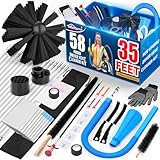
| Sealegend 58-Pieces, 35-Feet Dryer Vent Cleaner Kit | $34.99 | Useful for a compatible dryer vent, but its rods and brushes are not a substitute for negative-air HVAC duct equipment. |
| Holikme Dryer Vent Cleaner Kit, 30-Foot Flexible Fireplace Chimney Brushes | $19.99 | Lower-cost option for suitable dryer vents or narrow flues; limited reach, control, and containment for whole-house ducts. |
| Clean only accessible registers and short duct sections | $10-$60 for a vacuum attachment and brushes | Affordable for light surface dust, but easy to push debris farther into the system without proper collection. |
The two consumer kits above are dryer-vent tools, not rotary HVAC duct-cleaning systems. A dryer vent is usually a single narrow route, often 4 inches in diameter. Central air ducts can include large trunks, multiple branches, insulation, dampers, and turns that require different equipment and containment.
FAQ
Does rotary duct cleaning improve air quality?
It can reduce airborne debris when dirty ductwork is the source, but it is not guaranteed to improve allergy symptoms or eliminate all indoor-air pollutants. Filtration, ventilation, humidity control, cleaning habits, and source removal usually matter more. If occupants have persistent symptoms, consult a medical professional rather than relying on duct cleaning.
How long does rotary duct cleaning take?
A straightforward one-system home commonly takes about 2 to 5 hours, including setup and cleanup. Larger homes, two HVAC systems, difficult access, severe debris, or damaged ductwork can take longer. A company that promises to clean every component of a large system in 30 minutes is probably offering a limited service.
Can rotary brushes damage ducts?
Yes, if the brush is too aggressive or used on fragile internal insulation and aging flex duct. Ask the technician to identify your duct material and explain the brush type, access points, and safeguards. Flexible duct should not be stretched, crushed, or treated like rigid sheet-metal duct.
What should I ask before hiring a cleaner?
Ask exactly what areas are included, whether the vacuum runs while brushing, how access holes will be sealed, and whether the price covers one HVAC system or the entire home. Request before-and-after photos, proof of insurance, and a written scope. Avoid companies that promise guaranteed health benefits, insist on unnecessary chemical treatments, or cannot explain how they will protect your home.
Ready to decide? Our #1 pick for 2026 is the Replace the HVAC filter and vacuum accessible grilles.
Live price & availability on Amazon.


Write Your Review
No reviews yet. Be the first to share your experience!