
If you are asking, “what size dryer vent brush do I need,” start with your duct’s diameter and the distance from the dryer to the exterior vent. Most residential dryers use a 4-inch (10.2-centimeter) vent duct, so a brush made for a 4-inch duct is the usual choice. The right length depends on whether you are cleaning only through the indoor connection or the entire run to the outside.
The Short Answer
For most homes, buy a dryer vent brush with a 4-inch (10.2-centimeter) brush head and enough flexible rod or hose to cover the duct length. A 15-foot (4.6-meter) kit is suitable for a short, straight run. Choose 30 feet (9.1 meters) for a typical longer run, or 35 feet (10.7 meters) if the dryer is far from an exterior wall or the duct has several turns.
As an Amazon Associate we earn from qualifying purchases at no extra cost to you.


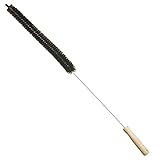
For the lint-trap opening, use a narrow brush about 1 to 2 inches (2.5 to 5.1 centimeters) wide with a handle roughly 24 to 30 inches (61 to 76 centimeters) long. This is a separate tool from a full duct-cleaning kit.
Do not choose a brush simply because it has the longest cable. An oversized or overly stiff head can catch on screws, foil ducting, or sharp bends. The brush should fill the duct enough to loosen lint but remain easy to push and pull.
Standard Sizes
| Brush or kit type | Typical dimensions | Best for |
|---|---|---|
| Standard duct brush head | 3.5–4 inches diameter (8.9–10.2 cm) | Most residential 4-inch dryer ducts |
| Large duct brush head | 4.5–5 inches diameter (11.4–12.7 cm) | Oversized rigid ducts or commercial-style installations; verify clearance first |
| Lint-trap brush | 1–2 inches wide and 24–30 inches long (2.5–5.1 cm wide and 61–76 cm long) | Cleaning the chute behind the dryer’s lint screen |
| Short flexible kit | 15 feet long (4.6 m), usually with a 4-inch head | Short runs, apartments, and cleaning from both ends |
| Medium flexible kit | 20–30 feet long (6.1–9.1 m), usually with a 4-inch head | Most standard homes and moderate bends |
| Long flexible kit | 35 feet long (10.7 m), usually with a 4-inch head | Long runs, crawl-space routes, and multiple access points |
Many kits use screw-together fiberglass or nylon rods. A 15-foot kit may include several short sections that connect to form one longer shaft, while 30- and 35-foot kits usually include more sections. Check the assembled length rather than counting pieces.
Current retail examples range from about $7 to $21, depending on rod length, brush attachments, a drill adapter, and the number of included tools. A basic long pipe brush can cost around $6.99, while 15-foot kits often sell near $14.99 and 30- to 35-foot kits commonly fall between $19.99 and $20.99. Price does not prove that one brush cleans better; construction, flexibility, and fit matter more.
How to Measure Your Space
- Confirm the duct diameter. Unplug the dryer and carefully pull it forward. Measure across the inside opening of the rigid or semi-rigid duct, not the outside of a connector collar. A measurement close to 4 inches (10.2 cm) indicates a standard residential duct.
- Inspect the indoor connection. Measure the distance from the back of the dryer to the wall or floor opening. Add enough length to reach into the duct without forcing the rod at an extreme angle.
- Trace the route to the exterior. If accessible, measure the approximate path through the wall, floor, attic, or crawl space. Include vertical sections and horizontal turns. A 10-foot (3-meter) straight run may need more than 10 feet of brush because you need working room at the opening.
- Count the bends. Add approximately 1 to 2 feet (30 to 61 cm) for each significant 90-degree turn. A brush can negotiate gentle curves, but sharp elbows increase resistance and may require cleaning from both ends.
- Measure the exterior vent opening. The exterior hood usually has a flap or screen. Confirm that the opening can accept the brush head before pushing it inward. Remove a removable screen only if the manufacturer allows it and the vent is safely accessible.
- Choose a little extra length. Select a brush at least 3 to 5 feet (0.9 to 1.5 m) longer than the estimated duct route. Extra length lets you work the brush back and forth instead of stopping at the far end.
Never run a rotating brush through a duct while the dryer is operating. Disconnect power first, and avoid drilling through an unknown wall or floor. If the duct is crushed, disconnected, heavily corroded, or inaccessible, a professional cleaning or duct repair may be safer than forcing a brush through it.
By Room or Use Case
Standard laundry room on an exterior wall
A 4-inch brush head and a 15-foot kit are often enough when the dryer sits close to the outside wall. Measure from the dryer outlet to the exterior hood, then clean from both ends if the route is shorter than the kit. A flexible nylon or fiberglass shaft is useful for one or two gentle bends.
Basement laundry area
Basement dryers commonly vent upward or across a ceiling before exiting outdoors. Start with a 30-foot kit unless you have measured a very short route. A drill-compatible brush can help rotate the head, but use the lowest practical speed and follow the kit’s instructions. Too much force can separate duct joints or damage flexible material.
Apartment or compact laundry closet
Use a narrow lint-trap brush for routine cleaning and a 15-foot duct kit only if you can safely access the rear connection or exterior vent. Tight closets leave little room to bend a stiff rod. Look for short, flexible sections and a brush head no larger than about 4 inches (10.2 cm).
Long crawl-space or attic run
Choose a 30- or 35-foot kit after measuring the route. Long runs often have several turns, so cleaning from both ends may be easier than pushing one brush the entire distance. If the duct length exceeds the kit or has inaccessible sections, professional equipment may be more appropriate.
Lint chute only
If your goal is removing lint below the dryer’s screen, do not buy a 30-foot chimney-style kit just for that job. A 24- to 30-inch (61- to 76-centimeter) lint brush with a slim, flexible head is easier to control. Vacuum loose lint after brushing, keeping the vacuum nozzle from damaging the chute.
Common Sizing Mistakes
- Assuming every duct is exactly 4 inches. Most residential systems are nominally 4 inches, but measure before buying, especially in older homes or converted spaces.
- Matching the brush length to the duct length exactly. You need extra working length and may need to clean from both ends.
- Buying the biggest head available. A 5-inch head can bind in a standard duct and may stress joints or elbows.
- Confusing a lint-trap brush with a duct brush. A slim screen-cleaning brush cannot scrub the full duct effectively, while a long duct kit may not fit through the lint chute.
- Using a rigid rod in sharp bends. Flexible sections are better for curves, but a severe bend can still block the brush. Never ram it forward.
- Ignoring duct condition. Thin foil, crushed sections, loose seams, and screws protruding into the airflow can snag bristles. Repair the duct before deep cleaning.
FAQ
Is a 4-inch brush too large for a dryer vent?
No, if your duct is the common 4-inch size and the brush head is designed for that duct. Look for a head around 3.5 to 4 inches rather than one substantially larger. It should make contact with the walls without wedging tightly.
How long should a dryer vent brush be?
Use a 15-foot brush for a short route, 20 to 30 feet for many homes, and 35 feet for a long or difficult run. Measure the route and add 3 to 5 feet for handling. You can also clean from the dryer and exterior ends separately.
Can I use a drill with a dryer vent brush?
Only when the kit specifically includes or supports a drill adapter. Use a low speed, keep the brush moving, and stop if you feel strong resistance. High speed or excessive pressure can damage ductwork, loosen connections, or twist the rods apart.
How often should I use a dryer vent brush?
Clean the lint screen after every load and inspect the vent at least once a year. Homes with long runs, multiple bends, heavy laundry use, or noticeable drying-time increases may need more frequent cleaning. If clothes remain damp, the dryer becomes unusually hot, or airflow outside is weak, stop using it until the vent is inspected.
Ready to decide? Our #1 pick for 2026 is the Standard duct brush head.
Live price & availability on Amazon.





Write Your Review
No reviews yet. Be the first to share your experience!