
- Top Pick: Klein Tools 50061 Quick-Adjust Tubing Cutter
- Runner-up: RIDGID 29963 Model 35S Stainless Steel Tubing Cutter
- Also consider: RIDGID 32985 Model 104 Close Quarters Tubing Cutter
A tube cutter earns its place in a toolbox the first time it is used. A clean, square cut means a fitting slides on without a fight and a joint seals the first time. A ragged cut from a hacksaw does the opposite, leaving burrs that restrict flow and joints that leak. For HVAC work, where copper lineset, condensate drains, and refrigeration tubing all demand precise ends, the right cutter is the difference between a professional result and a callback.
The best tube cutter depends on the tubing being cut. Copper lineset calls for a wheel cutter with a smooth feed, stainless steel needs a dedicated wheel and bearing-supported rollers, and PEX calls for a sharp scissor-style cutter rather than a wheel. Tight spaces call for a compact close-quarters design, while open runs reward a larger quick-adjust model. This guide compares five cutters that cover those jobs.
As an Amazon Associate, we earn from qualifying purchases.
Quick Answer
For most HVAC and plumbing work, the Klein Tools 50061 is the best tube cutter overall, with a quick-adjust button, a wide 1/8-inch to 1-5/8-inch capacity, and a built-in deburring tool. For stainless steel tubing, the RIDGID 35S is the dedicated pick. For tight spaces, the RIDGID 104 fits where full-size cutters cannot. Match the cutter to the tubing material first, then to the space available.
Top 5 Tube Cutters
1. Klein Tools 50061 Quick-Adjust Tubing Cutter

The Klein Tools 50061 is the most versatile cutter in this roundup. A fast-action button adjusts the cutting capacity in seconds, so moving between a small condensate line and a larger copper lineset does not mean spinning a feed screw through its full travel. It handles copper and aluminum tubing from 1/8 inch to 1-5/8 inch outside diameter, with capacity up to 1-1/2 inch inside diameter, covering nearly every residential HVAC and plumbing size.
The standout feature is the retractable telescoping deburring tool built into the body. After a cut, it folds out and cleans the inside edge of the tube in a few twists, so there is no need to carry a separate reamer. That matters on a rooftop or in a crawl space, where every extra tool is one more thing to drop. The zinc alloy frame is sturdy without being heavy, and at 7.4 by 3 by 1.22 inches it fits a tool pouch.
Specs
- Cutting capacity: 1/8 inch to 1-5/8 inch outside diameter, up to 1-1/2 inch inside diameter
- Materials: copper and aluminum tubing
- Frame: zinc alloy
- Deburring tool: retractable telescoping, built in
- Adjustment: fast-action button for quick size changes
- Dimensions: 7.4 x 3 x 1.22 inches
- Weight: 1.47 pounds
2. RIDGID 29963 Model 35S Stainless Steel Tubing Cutter

Stainless steel tubing defeats ordinary copper cutters. The harder material scores instead of cutting cleanly, dulls standard wheels quickly, and leaves a rough edge that makes fitting a joint a struggle. The RIDGID 35S is built specifically for stainless steel, and that specialization shows in every part of its design.
Six individual bearings replace the traditional rollers found on standard cutters, reducing drag as the tool travels around the tube for a smoother cut with less effort. A specially designed stainless steel cutter wheel carries bearings in its hub, further reducing drag. The contoured frame makes alignment easy, and the ergonomic X-CEL knob allows quick capacity changes. The 35S cuts stainless steel tube from 1/4 inch to 1-3/8 inch in diameter, making it the right choice for refrigeration lines and appliance hookups where a copper cutter would struggle.
Specs
- Cutting capacity: 1/4 inch to 1-3/8 inch stainless steel tubing
- Rollers: six individual bearings instead of traditional rollers
- Cutting wheel: stainless steel wheel with bearings in the hub
- Frame: contoured for easy alignment during adjustment
- Knob: ergonomic X-CEL knob for quick capacity changes
- Weight: 227 grams
3. RIDGID 32985 Model 104 Close Quarters Tubing Cutter

Some cuts happen in spaces where a full-size cutter simply cannot swing. Behind a water heater, inside a wall cavity, or under a sink, the RIDGID 32985 Model 104 earns its place. This close-quarters cutter is small and compact, yet it delivers clean, precise cuts on copper, brass, aluminum, and plastic tubing from 3/16 inch to 15/16 inch in diameter.
The compact design is the whole point. The cutter needs little room to rotate around the tube, so it works in restricted spaces where a standard screw-feed cutter would hit a joist or a wall. The aluminum body keeps the tool light at 5.3 ounces, which matters when working overhead or with one hand in an awkward position. The trade-off is capacity: the 104 tops out at 15/16 inch, so it is best kept as a second cutter alongside a full-size model.
Specs
- Cutting capacity: 3/16 inch to 15/16 inch
- Materials: copper, brass, aluminum, and plastic tubing
- Body: aluminum
- Weight: 5.3 ounces
- Design: close quarters for restricted spaces
4. IWISS iCrimp PEX Pipe Cutter
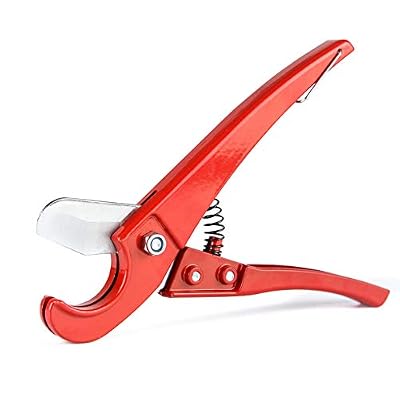
PEX tubing should not be cut with a wheel cutter. The flexible plastic needs a sharp scissor-style blade that slices cleanly without crushing the wall, and the IWISS iCrimp PEX pipe cutter is designed exactly for that job. It cuts PEX tubing from 1/8 inch to 1 inch in diameter and works with PEX A, B, and C pipe.
A spring-loaded handle keeps the cutter open and ready between cuts, which speeds up repetitive work such as running a new PEX manifold or replacing a section of radiant floor tubing. The tool provides a sturdy grip, so long cutting sessions do not tire the hand, and the clean slice it produces means the PEX end is ready for a fitting without extra trimming. Note that this cutter is a PEX specialist: it is not suitable for cutting PVC pipe, and the edge can dull when used on CPVC lines.
Specs
- Cutting capacity: 1/8 inch to 1 inch PEX tubing
- Compatibility: PEX A, B, and C pipe
- Handle: spring-loaded for easy opening
- Grip: sturdy, well-designed handle
- Best for: PEX water lines and hydronic heating
5. Edward Tools Harden Pro Mini Pipe Cutter

The Edward Tools Harden Pro mini pipe cutter is a compact, heavy-duty option for small-diameter work. It cuts aluminum, hard and soft copper, brass, and plastic tubing from 1/8 inch up to 7/8 inch, which covers condensate lines, brake lines, fuel lines, and small refrigeration tubing. The heavy-duty steel blades hold an edge through repeated use, and the sturdy construction stands up to daily carry in a tool bag.
Its compact size and bright orange color make it easy to find in a crowded toolbox, and its versatility goes beyond plumbing. It also works as an arrow cutter, brake line cutter, and fuel line cutter, which makes it a useful multi-purpose tool for technicians who work across trades. Two quirks are worth knowing: some users find the knob needs pliers to tighten fully.
Specs
- Cutting capacity: 1/8 inch to 7/8 inch
- Materials: aluminum, copper, brass, and plastic tubing
- Blades: heavy-duty steel
- Multi-use: also works as a brake line, fuel line, and arrow cutter
- Design: compact mini cutter with adjustable width
How to Choose a Tube Cutter
Start with the tubing material. Copper and aluminum work well with standard wheel cutters, stainless steel needs a dedicated wheel and bearing-supported rollers, and PEX needs a scissor-style blade. Using the wrong cutter for the material produces rough cuts, dulls the wheel, and wastes fittings.
Next, match the capacity to the largest tube on the job. A cutter that tops out at 1 inch cannot finish a 1-1/8-inch lineset, and a large cutter is clumsy on small condensate lines. Check the outside diameter range before buying, and leave a little headroom for the biggest size expected.
Consider the workspace. Tight spots behind appliances, inside walls, and under cabinets call for a close-quarters or mini cutter that needs little room to rotate. Open runs reward a full-size quick-adjust model. Look for a built-in deburring tool, since a burr left inside a copper tube restricts flow and can damage a joint. Finally, keep a spare wheel in the toolbox so a dull wheel never stops a job.
Who Should Skip a Tube Cutter
A tube cutter is not the right tool for every cutting job. Anyone who mainly cuts PVC, CPVC, or ABS drain pipe should buy a ratcheting plastic pipe cutter or a saw instead, since a metal wheel cutter can crack or crush plastic pipe. A tube cutter is also the wrong choice for cutting threaded steel pipe, which needs a cutter rated for steel or a reciprocating saw.
Homeowners who only need to cut one piece of tubing a year may be better served by borrowing a cutter or buying the least expensive mini model rather than investing in a professional-grade tool.
Frequently Asked Questions
What size tube cutter do I need for HVAC work?
Most residential HVAC work uses copper tubing from 1/4 inch to 7/8 inch outside diameter, so a cutter with a range of 1/8 inch to 1-5/8 inch covers nearly every lineset, condensate drain, and refrigeration connection.
Can one tube cutter cut copper, PEX, and stainless steel?
No single cutter handles all three well. Wheel cutters work on copper, aluminum, and brass, while stainless steel needs a dedicated wheel and bearing-supported rollers. PEX needs a scissor-style blade, since a wheel cutter can crush the flexible wall. Buy the cutter that matches the material cut most often, and add a specialist for the rest.
How do I get a clean cut with a tube cutter?
Mark the cut location, place the tubing between the rollers and the cutting wheel, and tighten the feed knob just enough to score the surface. Rotate the cutter around the tube for one or two full turns, then tighten the knob about a quarter turn and repeat. Tighten gradually rather than forcing the wheel, and deburr the inside edge after the cut so the joint seals properly.
How often should I replace a tube cutter wheel?
Replace the wheel when cuts start to wander, the wheel skips instead of tracking in its groove, or the cut edge turns rough. A dull wheel forces the user to over-tighten, which can deform thin-wall tubing. Keeping a spare wheel on hand means a worn wheel never delays a job.
Final Verdict
The best tube cutter is the one matched to the tubing and the space. For most HVAC and plumbing work, the Klein Tools 50061 is the strongest all-around choice, with quick adjustment, wide capacity, and a built-in deburring tool that finishes each cut in one step. The RIDGID 35S is the pick for stainless steel, the RIDGID 104 is the pick for tight spaces, the IWISS iCrimp is the pick for PEX, and the Edward Tools mini is a handy compact backup. Buy for the material cut most often, and every joint will start with a clean, square end.








Write Your Review
No reviews yet. Be the first to share your experience!