
- Top Pick: Uniweld RHP800 Nitrogen Regulator
- Runner-up: Uniweld RHP400 Nitrogen Regulator
- Also consider: YESWELDER Nitrogen Regulator with Hose
A nitrogen regulator controls the flow of dry nitrogen from a high-pressure cylinder down to a level that is safe for HVAC work. Without one, cylinder pressure is far too high for purging a line set, holding pressure during a leak check, or keeping oxygen out of a joint while brazing.
- Quick Answer
- 1. Uniweld RHP800 Nitrogen Regulator
- 2. Uniweld RHP400 Nitrogen Regulator
- 3. YESWELDER Nitrogen Regulator with Hose
- 4. BETOOLL Nitrogen Regulator with 78.7-Inch Hose
- 5. Siasky Nitrogen Regulator with 78.7-Inch Hose
- How to Choose a HVAC Nitrogen Regulator
- Who Should Skip
- Frequently Asked Questions
- Final Verdict
Choosing the right model comes down to delivery range, gauge readability, fittings, and whether a hose is included. A regulator rated for 400 PSI suits low-pressure purging and brazing, while a model rated for 600 or 800 PSI covers pressure testing as well. The five regulators below cover that full range, from a compact low-pressure unit to heavy-duty models built for daily service work.
As an Amazon Associate, we earn from qualifying purchases.
Quick Answer
For most HVAC work, the Uniweld RHP800 is the strongest all-round pick, with a delivery range of 0 to 800 PSI, a CGA580 inlet, and a rugged brass body. If most of the work is low-pressure purging and brazing, the Uniweld RHP400 costs less and covers 0 to 400 PSI. For a ready-to-connect setup with a hose included, the YESWELDER, BETOOLL, and Siasky models are practical alternatives.
1. Uniweld RHP800 Nitrogen Regulator
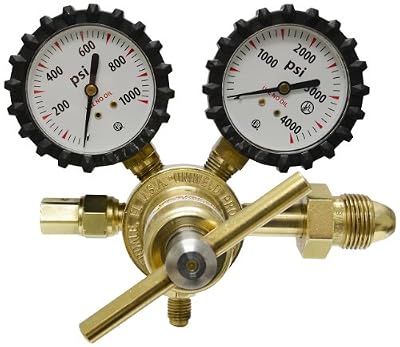
The Uniweld RHP800 is the classic high-pressure nitrogen regulator for HVAC and refrigeration service. It is built around a brass body with a metal cylinder diaphragm, a large T-handle, and a stainless steel pressure-adjusting screw, a combination that suits technicians who reach for a regulator every day. Its delivery range of 0 to 800 PSI covers nitrogen purging, brazing, and pressure testing in one tool.
The two-inch gauges are easy to read at arm’s length, and protective rubber gauge boots help the gauges survive knocks in a tool bag or on a job site. A self-reseating relief valve adds protection against an accidental overpressure setting. The CGA580 inlet fits standard nitrogen cylinders, and the quarter-inch male flare outlet connects directly to common HVAC charging hoses. This is a premium-grouping regulator aimed at working technicians rather than occasional users.
Specs
- Delivery pressure: 0 to 800 PSI
- Inlet connection: CGA580
- Outlet connection: 1/4-inch male flare
- Body: brass with metal cylinder diaphragm
- Gauges: 2-inch gauges with protective rubber boots
- Relief valve: self-reseating
- Handle: large metal T-handle with stainless steel adjusting screw
- Grouping: premium
2. Uniweld RHP400 Nitrogen Regulator

The Uniweld RHP400 shares the same design as the RHP800 but is aimed at lower-pressure work. Its delivery range of 0 to 400 PSI is more than enough for nitrogen purging while brazing, low-pressure leak checks, and general inerting of HVAC and refrigeration systems. A narrower range also means finer control at the low pressures used during brazing, where a small change in flow makes a real difference to the quality of the joint.
Like its larger sibling, the RHP400 uses a solid brass body, two-inch gauges with rubber boots, a self-reseating relief valve, and a large T-handle. The quarter-inch male flare outlet and CGA580 inlet match standard HVAC hoses and nitrogen cylinders. Published descriptions also note that the unit can be used with carbon dioxide as well as nitrogen. This is a budget-grouping regulator and a sensible choice for a second unit or for a kit that already has a high-pressure regulator for testing.
Specs
- Delivery pressure: 0 to 400 PSI
- Inlet connection: CGA580
- Outlet connection: 1/4-inch male flare
- Body: solid brass
- Gauges: 2-inch gauges with protective rubber boots
- Relief valve: self-reseating
- Handle: large metal T-handle
- Also suitable for: carbon dioxide service
- Grouping: budget
3. YESWELDER Nitrogen Regulator with Hose

The YESWELDER nitrogen regulator arrives as a ready-to-connect setup, with a hose included in the box. Its delivery range of 0 to 600 PSI sits between the two Uniweld models, covering purging, brazing, and most pressure testing without stepping up to an 800 PSI unit.
Two gauges show cylinder pressure up to 4000 PSI and delivery pressure up to 600 PSI, so the remaining gas in the cylinder and the working pressure are visible at a glance. The CGA580 inlet fits standard nitrogen cylinders, and the quarter-inch male flare outlet matches common HVAC hoses. The model number is WX-YQD-CGA580. This is a mid-range grouping regulator and a practical pick for technicians who want a complete setup in one purchase.
Specs
- Delivery pressure: 0 to 600 PSI
- Inlet gauge: 0 to 4000 PSI
- Inlet connection: CGA580
- Outlet connection: 1/4-inch male flare fitting
- Included: nitrogen regulator with hose
- Model number: WX-YQD-CGA580
- Grouping: mid-range
4. BETOOLL Nitrogen Regulator with 78.7-Inch Hose

The BETOOLL regulator is built for precise pressure control, with a delivery range of 0 to 600 PSI and an inlet gauge that reads up to 4000 PSI. Its long 78.7-inch hose gives extra reach between the cylinder and the system under test, which helps when the nitrogen tank has to stay clear of the work area.
The regulator uses a solid brass body with a piston-style diaphragm, a CGA580 inlet, and a quarter-inch male flare outlet. Two-inch gauges with protective rubber boots are easy to read, and a self-reseating relief valve is fitted. The model number is BET-16-HW9005N. This is a budget-grouping regulator that offers strong value for technicians who want hose length and a 600 PSI delivery range without paying for a premium brand name.
Specs
- Delivery pressure: 0 to 600 PSI
- Inlet gauge: 0 to 4000 PSI
- Inlet connection: CGA580
- Outlet connection: 1/4-inch male flare
- Hose length: 78.7 inches
- Body: solid brass with piston diaphragm
- Gauges: 2-inch gauges with protective rubber boots
- Relief valve: self-reseating
- Model number: BET-16-HW9005N
- Grouping: budget
5. Siasky Nitrogen Regulator with 78.7-Inch Hose
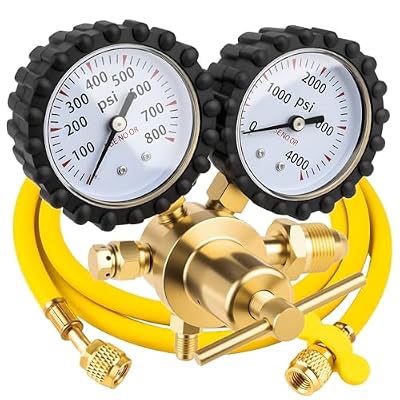
The Siasky regulator pairs a high delivery range with a hose-included kit. Its delivery gauge reads 0 to 800 PSI, which covers pressure testing as well as purging and brazing, and the included 78.7-inch hose means the regulator is ready to connect as soon as it is fitted to the cylinder. A built-in relief valve vents automatically if outlet pressure rises too high.
The brass body uses a CGA580 inlet and a quarter-inch male flare outlet, the standard pairing for HVAC nitrogen work. An ergonomic T-handle allows fine adjustment of delivery pressure with one hand. The unit measures 7 by 7 by 5.6 inches and weighs about 3 pounds. The model number is SY2445. This is a mid-range grouping regulator for technicians who want the widest delivery range in a hose-included kit.
Specs
- Delivery pressure: 0 to 800 PSI
- Inlet connection: CGA580
- Outlet connection: 1/4-inch male flare
- Hose length: 78.7 inches
- Body: brass
- Relief valve: automatic venting at high outlet pressure
- Handle: ergonomic T-handle
- Dimensions: 7 by 7 by 5.6 inches
- Weight: about 3 pounds
- Model number: SY2445
- Grouping: mid-range
How to Choose a HVAC Nitrogen Regulator
Start with the delivery range the work demands. Purging and brazing need only a few PSI of flow, so a 400 PSI regulator gives fine low-end control. Pressure testing needs more, so look for 600 or 800 PSI if leak checks are part of the routine. A regulator with a range far above the working pressure can be harder to set accurately at low flow, so match the range to the job rather than buying the highest number available.
Check the fittings next. A CGA580 inlet is the standard nitrogen cylinder connection in North America, and a quarter-inch male flare outlet connects to the charging hoses most HVAC technicians already carry. Confirm both before ordering, because an adapter adds cost and another possible leak point. Two-inch gauges with rubber boots are easier to read and harder to damage than small bare gauges.
Consider whether a hose is included. A regulator-only purchase suits a technician who already owns hoses, while a kit with a hose included is ready to work out of the box. Finally, weigh build and service life: a brass body, a metal diaphragm, and a self-reseating relief valve are signs of a regulator built for repeated use. Always close the cylinder valve and bleed pressure from the regulator before disconnecting it, and never use oil on a nitrogen regulator or its fittings.
Who Should Skip
A dedicated nitrogen regulator is not the right purchase for everyone. Homeowners who only need nitrogen once for a single repair are better served by hiring a technician who already owns the full setup, including the cylinder, regulator, and hoses. The cylinder itself is a separate purchase, and a regulator alone cannot do the job.
Technicians who already own a reliable regulator with the right delivery range should skip this list too, since a second regulator adds little unless the first one is damaged or lacks the range for pressure testing. Anyone working only with refrigerants and never with nitrogen purging or pressure testing has no use for this tool at all. Finally, skip any regulator that does not match the cylinder connection on hand: a CGA580 regulator will not fit a cylinder with a different valve.
Frequently Asked Questions
What delivery pressure do I need for nitrogen purging during brazing?
Purging needs only a low, steady flow, typically a few PSI, just enough to keep oxygen out of the joint while brazing. A regulator with a 400 PSI delivery range gives the finest control at those low pressures. Higher-range regulators also work, but their low end can be harder to set precisely.
What is a CGA580 connection?
CGA580 is the standard cylinder valve connection for nitrogen in North America. A regulator with a CGA580 inlet screws directly onto a nitrogen cylinder with the matching valve. Check the cylinder valve before ordering, because other gases use different CGA numbers and the connections are deliberately not interchangeable.
Can one nitrogen regulator handle both purging and pressure testing?
Yes, if its delivery range covers both jobs. A regulator rated for 600 or 800 PSI can purge at low pressure and then be set higher for a pressure test. A 400 PSI regulator handles purging well but cannot reach the pressures used for many leak checks.
Do I need a hose with my nitrogen regulator?
A hose is needed to connect the regulator to the system, but it does not have to come with the regulator. Technicians who already own a suitable charging hose can buy a regulator on its own. A kit with a hose included is convenient for a first purchase, and a longer hose adds reach when the cylinder must stay away from the work area.
Final Verdict
The best HVAC nitrogen regulator depends on the work it will do most often. The Uniweld RHP800 is the strongest all-round choice, with an 800 PSI delivery range, a brass body, and a design proven in daily service work. The Uniweld RHP400 is the better pick for low-pressure purging and brazing, where its 400 PSI range gives finer control at a lower grouping. For a ready-to-connect kit, the YESWELDER and BETOOLL models cover 600 PSI with a hose included, while the Siasky reaches 800 PSI with a hose and an automatic relief valve.







Write Your Review
No reviews yet. Be the first to share your experience!