
Our Short List of 3

- Link: https://www.amazon.com/dp/B078Y7G6TN
- Scale: 1:72
- Subject: Supermarine Spitfire Mk.Ia
- Parts: 36, per the listing

- Link: https://www.amazon.com/dp/B01KZA225A
- Scale: 1:48
- Subject: Grumman F-14A Tomcat
- Kit number: Tamiya 61114

- Link: https://www.amazon.com/dp/B002X79LRQ
- Scale: 1:72
- Subject: Dassault Rafale C
- Parts: 115, per the listing
All 3 Picks at a Glance
| Product | Specs | Action |
|---|---|---|
| 1. Airfix A01071B Supermarine Spitfire Mk.Ia, 1:72 — Best for Beginners |
| Check price on Amazon |
| 4. Tamiya 61114 Grumman F-14A Tomcat, 1:48 — Best Modern Naval Jet |
| Check price on Amazon |
| 5. Hobby Boss Dassault Rafale C, 1:72 — Best Compact Modern Fighter |
| Check price on Amazon |
Aircraft model kits cover an enormous range: a small Second World War fighter with a few dozen parts that a newcomer can finish in a weekend, a four-engine bomber with a detailed interior, and a modern carrier jet in a large scale that will occupy a bench for weeks. That variety is the hobby’s strength, but it also means there is no single best kit for everyone. The right choice depends on your experience, the space you have to display the finished model, the era of aviation that interests you, and how much of a project you actually want.
This guide compares the best aircraft model kits that can be verified as listed on Amazon US, chosen to cover the main decision points a buyer faces. The selection includes a beginner-friendly 1:72 fighter, a mid-sized 1:72 heavy bomber, the same bomber in a much larger 1:48 edition, a modern naval jet in 1:48, and a compact modern European fighter in 1:72. Every entry is a plastic aircraft assembly kit — no diecast models, no snap-together toys of other subjects and no kits of ships, armour or vehicles have been mixed in. Read the guidance sections first if you are new, because the differences between scales and parts counts matter more than the differences between brands.
As an Amazon Associate we earn from qualifying purchases.
How to Choose an Aircraft Model Kit
Start With Scale
Scale describes how small the model is compared with the real aircraft, and it drives almost everything else: finished size, parts count, detail and build time. In 1:72 scale, a single-seat fighter is roughly fifteen to twenty centimetres long, while a large bomber can exceed forty centimetres in wingspan. In 1:48 scale, the same subjects are half again as large, with cockpits you can genuinely detail and surfaces that show careful paintwork to full effect. In 1:32 scale, kits become major display pieces with prices and parts counts to match, and they are best left until you know you enjoy the process. Most collections settle on one main scale so aircraft can be displayed together with honest size relationships, and 1:72 and 1:48 are the two scales with the widest kit choice.
Match the Kit to Your Experience
Manufacturers grade their kits by skill level, and those grades are worth respecting. A low-parts-count fighter with a simple colour scheme teaches the core skills — cutting parts cleanly from the sprue, joining fuselage halves, filling a seam, masking a canopy and applying decals — without punishing early mistakes. A kit with several hundred parts, photo-etched details or a full interior adds weeks of work and many more opportunities for something to go wrong. There is no shame in a simple kit; a cleanly built simple model looks far better than an abandoned complex one. If you are buying for a younger modeller, check the age guidance on the listing and plan to supervise the knife and cement stages.
Parts Count and What Is in the Box
Parts count is a rough proxy for build time and complexity. Under fifty parts usually means a weekend project. One hundred to two hundred parts means a multi-evening or multi-week project with proper sub-assemblies. Several hundred parts means a long-term centrepiece. Just as important is what the box includes. Some starter and gift sets include paints and a brush, which removes the first supply hurdle for a beginner. Most standard kits include only the plastic parts, decals and instructions, with glue, paints and tools sold separately. Always check the listing for your specific kit rather than assuming, because two kits of the same aircraft from different ranges can differ completely in what is supplied.
Subject and Era
Aircraft modelling divides naturally into eras, and most builders gravitate to one or two. Second World War aircraft offer famous subjects, varied camouflage and strong decal interest. Cold War and modern jets offer sleek shapes, grey finishes that test your seam and paint work, and extensive underwing stores. Civil aircraft, helicopters and First World War subjects each have their own followings and techniques. Choosing a subject you genuinely care about is not a soft consideration — interest is what carries a build through the tedious sanding stage. The kits below lean toward the most popular military subjects, because that is where verified choice is widest.
Decals, Markings and Finishing
Decals give a finished aircraft its identity: the unit, the period and often a specific individual machine with its own history. Check how many marking options a kit provides and whether they match the variant in the box. A kit with two or more schemes lets you choose, and gives you a spare set if one decal tears. Remember that decals sit best on a gloss surface and usually need a final clear coat to blend their edges into the paint, so factor clear coats into your paint list alongside the main colours.
The Best Aircraft Model Kits
1. Airfix A01071B Supermarine Spitfire Mk.Ia, 1:72 — Best for Beginners
- Link: https://www.amazon.com/dp/B078Y7G6TN
- Scale: 1:72
- Subject: Supermarine Spitfire Mk.Ia
- Parts: 36, per the listing
The Airfix Spitfire Mk.Ia in 1:72 scale is the classic entry point into aircraft modelling, and the listing details show why. Airfix describes this gift-set edition with 36 precision-moulded plastic parts and its lowest skill level, aimed at adults and children aged eight and above. Thirty-six parts is enough to teach every basic technique — fuselage join, wing assembly, canopy masking, a three-colour camouflage scheme and a proper decal session — while keeping the whole project achievable in a few sittings. The subject needs no introduction: the Mk.Ia is the Battle of Britain Spitfire, one of the most documented aircraft in history, so reference photographs and painting guidance are easy to find when you want them.
Because it is sold as a gift set, check the listing for exactly which paints and accessories are bundled with the current edition before assuming you need to buy everything separately. The finished model is small enough for a desk or a child’s bedroom shelf, and its modest size makes it a forgiving first attempt at camouflage demarcation, whether you brush or spray. For a first aircraft kit, or a first kit to build alongside a younger modeller, this is the strongest starting point in this guide.
2. Revell 04283 B-17G Flying Fortress, 1:72 — Best Mid-Size Bomber
Revell’s 1:72 B-17G Flying Fortress, kit 04283, steps the project size up considerably without leaving the most popular scale. The listing describes 152 precision pieces, a super-detailed cockpit, movable weapon turrets and an opening bomb bay. Those features matter because a big four-engine bomber can otherwise become a long grey tube; interior and bomb bay detail give the build structure and give the finished model points of interest beyond its silhouette. Even in 1:72, a B-17 is a large model with a broad wingspan, so measure your display space before committing — it will dominate a shelf that a fighter merely occupies.
The B-17G is the definitive late-war version of the Flying Fortress, with the chin turret that distinguishes it from earlier marks, so this kit suits builders interested in the Eighth Air Force daylight campaign and the aircraft that flew it. Expect the build to divide naturally into stages: interior and fuselage, the four engines and wing, turrets and glazing, then the demanding job of painting and decaling a large airframe. Patience with masking the extensive nose and cockpit glazing will decide how sharp the finished model looks. This is a satisfying second or third kit for a builder who has mastered a small fighter and wants a bigger canvas.
- Link: https://www.amazon.com/dp/B0032ALYJQ
- Scale: 1:72
- Subject: Boeing B-17G Flying Fortress
- Parts: 152, per the listing
3. Revell B-17G Flying Fortress, 1:48 — Best Large Bomber Project
The same aircraft in 1:48 scale is a different class of project altogether. Revell’s long-running 1:48 B-17G is one of the largest mainstream aircraft kits a modeller can choose: four engines, a full crew compartment layout to build and paint, and a finished wingspan that requires a serious display plan. Where the 1:72 kit is a substantial weekend-plus build, the 1:48 version is a centrepiece that rewards builders who enjoy interior work, because much more of the inside of this model can be seen and appreciated through its glazing and open positions.
This kit is best approached with some completed models behind you. Large wing and fuselage parts demand careful alignment, the sheer area of plastic makes seam cleanup and paint coverage real jobs rather than formalities, and the finished model needs a home decided in advance — a wide shelf, a cabinet or a wall-mounted display — rather than discovered afterwards. For a modeller whose main interest is Second World War heavy bombers and who wants one definitive build, this is the pick. Confirm the current listing’s contents before ordering, as long-running kits are reissued in different boxings over the years.
- Link: https://www.amazon.com/dp/B0006JNS5E
- Scale: 1:48
- Subject: Boeing B-17G Flying Fortress
4. Tamiya 61114 Grumman F-14A Tomcat, 1:48 — Best Modern Naval Jet
- Link: https://www.amazon.com/dp/B01KZA225A
- Scale: 1:48
- Subject: Grumman F-14A Tomcat
- Kit number: Tamiya 61114
Tamiya’s 1:48 F-14A Tomcat, kit 61114, represents the modern end of this guide: a large carrier-based fleet defence fighter with swing wings, twin tails and a two-seat cockpit. Tamiya’s aircraft kits are known in the hobby for careful engineering and clear instructions, and a big modern jet is where that matters most, because the airframe is built from many panels, intakes and moving-wing components that all have to align. The Tomcat’s variable-sweep wing also gives the finished model a display choice most aircraft do not offer — wings forward or swept — which changes the whole stance of the model on the shelf.
Choose this kit if modern naval aviation is your subject and you want a substantial, technically interesting build rather than a quick one. The two-seat cockpit is a natural focus for extra care with paint and decals, and the airframe’s panel detail responds well to restrained weathering and careful clear coats. As a 1:48 jet it pairs naturally with other large-scale modern aircraft and dwarfs 1:72 fighters displayed beside it, so plan its shelf companions accordingly. Check the listing for the current boxing and its included marking options before you buy.
5. Hobby Boss Dassault Rafale C, 1:72 — Best Compact Modern Fighter
- Link: https://www.amazon.com/dp/B002X79LRQ
- Scale: 1:72
- Subject: Dassault Rafale C
- Parts: 115, per the listing
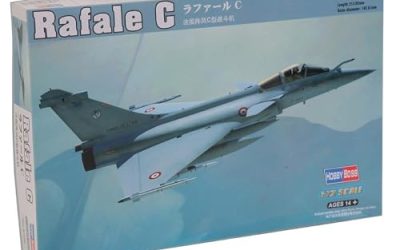
For a modern jet in the smaller scale, the Hobby Boss Rafale C in 1:72 offers a contemporary European subject as a counterpoint to the American and British aircraft above. The listing gives 115 precision parts and finished dimensions of about 8.35 by 5.9 inches, which makes it a manageable project that still includes the cockpit, stores and surface detail a modern fighter needs. The Rafale’s delta wing and canards give it a shape unlike anything else on most shelves, and its overall grey finish makes it an excellent test of seam work and smooth paint application.
This kit suits a builder who wants a modern subject without committing to a large-scale project, or a collector building a matched 1:72 lineup of current fighters from different air forces. It also makes a good first modern jet: the parts count is moderate, the airframe has no propellers or extensive glazing to mask, and the lessons it teaches — intake joins, canopy care, decal work over grey — transfer directly to any other modern type. Paints and adhesives are sold separately, as is standard for kits in this class.
Aircraft Kits Compared
| Kit | Scale | Subject | Parts | Best for |
|---|---|---|---|---|
| Airfix Spitfire Mk.Ia A01071B | 1:72 | WWII fighter | 36 | Beginners and first builds |
| Revell B-17G 04283 | 1:72 | WWII heavy bomber | 152 | A bigger second project |
| Revell B-17G | 1:48 | WWII heavy bomber | Not stated in listing summary | A large centrepiece build |
| Tamiya F-14A Tomcat 61114 | 1:48 | Modern naval jet | Not stated in listing summary | Modern carrier aviation fans |
| Hobby Boss Rafale C | 1:72 | Modern fighter | 115 | A compact modern jet |
The pattern across the table is the real lesson of this guide: subject, scale and parts count together decide the experience. Two kits of the same bomber in different scales are different hobbies in miniature, and a small fighter and a large jet ask for different benches, budgets and display plans.
Tools and Supplies Every Kit Needs
Whichever kit you choose, a basic toolkit makes the difference between frustration and a clean build. You will want side cutters for removing parts from the sprue, a sharp hobby knife for trimming, files or sanding sticks for seams, tweezers for small parts and decals, and plastic cement suited to styrene kits. For painting, a small set of brushes covers most 1:72 work, while larger scales reward an airbrush if you have access to one — but brush painting with thinned coats remains perfectly viable at any scale. Add masking tape for canopies and camouflage, a decal setting solution if you plan heavy stencil work, and clear gloss and matt coats for the decal and finishing stages. None of this needs to be bought at once; the beginner kit above can be completed with the basics, and tools accumulate naturally across projects.
Frequently Asked Questions
What is the best aircraft model kit for a complete beginner?
Start small and simple. The Airfix Spitfire Mk.Ia in this guide, with its low parts count and beginner skill grading, is designed for exactly that role. A first kit should teach cutting, joining, filling, painting and decaling on a model small enough to finish, because finishing a simple kit teaches more than abandoning a complex one.
Which scale is better, 1:72 or 1:48?
Neither is better in absolute terms. Choose 1:72 for lower parts counts, faster builds, smaller display footprints and large matched collections. Choose 1:48 for cockpit and surface detail, stronger shelf presence and longer projects. Most modellers eventually keep one main scale so their aircraft display together consistently.
Do aircraft model kits include glue and paint?
Sometimes, and only in certain ranges. Starter and gift sets often bundle a few paints and a brush, while standard kits usually contain only plastic parts, decals and instructions. The listings in this guide note where that distinction matters, but always confirm the contents on the listing for the exact kit you are ordering.
How long does an aircraft model kit take to build?
It depends on parts count and how far you take the finish. A small fighter can be completed over a weekend of short sessions. A kit in the 150-part range usually spreads over several evenings or a few weekends. A large 1:48 bomber or modern jet is realistically a project of weeks, especially once painting and decaling are done in stages with proper drying time between them.
Conclusion
The best aircraft model kit is the one matched to your bench, your shelf and your patience. Begin with the Airfix Spitfire if you are new, step up to the 1:72 Revell B-17G for a larger Second World War project, choose the 1:48 B-17G or Tamiya’s F-14A Tomcat when you are ready for a centrepiece, and add the Hobby Boss Rafale C for a compact modern fighter with a very different silhouette. Pick the subject you care about, respect the skill grading, read the instructions before cutting plastic, and every one of these kits will repay the effort you put into it.

Write Your Review
No reviews yet. Be the first to share your experience!