
As an Amazon Associate we earn from qualifying purchases.
Fuel injectors meter gasoline in a fine, timed mist, and even a thin layer of carbon, gum, or varnish on the injector tip can distort that spray pattern. The symptoms usually arrive gradually: a rougher idle, a small hesitation when pulling away, harder cold starts, and fuel economy that quietly slips. The simplest form of fuel injector cleaning does not involve removing any parts. It is a detergent additive poured into the fuel tank, carried through the pump, lines, and injectors as you drive, and this guide covers that in-tank approach only.

That scope matters, because “fuel injector cleaning” can also mean pressurized canister services, ultrasonic bench cleaning of removed injectors, or a mechanic’s induction service. Those are workshop jobs with different costs and different evidence behind them. The products below are all pour-in gasoline additives from the same family, chosen because they name fuel injectors as a primary target, publish a clear treat rate and dosing interval, and are still listed for sale. Only two products cleared every check applied here, including a screen against a large library of injector and fuel-system cleaners already covered elsewhere, so this is a short, deliberately strict list rather than a padded one.
What In-Tank Injector Cleaning Can and Cannot Do
A pour-in cleaner works wherever the fuel itself travels. Dissolved detergents pass through the injector nozzles, so deposits on injector tips are directly in the cleaner’s path. The same treated fuel also reaches the combustion chamber and, on port-injected engines, washes over the backs of the intake valves. That is why a good injector cleaner is often described as a fuel system cleaner: the injectors are the headline target, but the whole fuel path gets some benefit.
The limits are just as important. On a gasoline direct-injection (GDI) engine, fuel is sprayed straight into the cylinder and never washes the intake valves, so no in-tank additive can scrub carbon off those valves. An additive also cannot repair a mechanically failed injector, a weak fuel pump, worn spark plugs, or a vacuum leak. If the engine has a persistent misfire, a warning light, or a cylinder-specific fault code, cleaning chemistry is the wrong tool and diagnosis comes first. Used on an engine that is fundamentally healthy but dirty, though, a detergent treatment is a reasonable, low-effort maintenance step.
How These Picks Were Chosen
Every candidate had to meet the same conditions. It had to be a pour-in additive for gasoline engines, not a shop tool, a pressurized rail cleaner, or a diesel-only product. Injector cleaning had to be a stated purpose of the formula, not a passing mention. The listing had to publish practical dosing information: bottle size, how many gallons one bottle treats, and how often the maker says to repeat the treatment. Finally, the exact product had to be confirmed as a real, currently listed item, and it had to be distinct from the many well-known injector cleaners already used in earlier guides, which ruled out most of the famous names in this category.
That last filter is why this list is short. The best-known PEA cleaners from several major brands were excluded on duplication grounds, not quality grounds, and rather than substitute unverified products, this guide presents the two additives that passed every screen. Both happen to come from the same maker, which is a real limitation worth stating plainly: they are different formulas with different jobs, but a reader who wants a different brand entirely will not find one here, and the buying advice below explains how the two differ so the choice between them is still meaningful.
The Picks
STP Ultra 5-in-1 Fuel System Cleaner and Stabilizer
This is the broader of the two treatments: a full fuel-system cleaner built around a proprietary blend of PEA and PIBA detergents, with fuel stabilization and friction-fighting additives in the same bottle. PEA, or polyetheramine, is the detergent class most associated with injector and combustion-chamber deposit removal because it stays active at combustion temperatures, while PIBA is a lighter-duty detergent suited to keeping intake-side deposits from forming. Combining the two positions this bottle as both a cleaner and a keep-clean maintenance treatment, and the maker rates it for any gasoline engine, including turbocharged, direct-injection, and hybrid applications, as well as cap-less fuel systems.
The dosing is simple. One 12 fl oz bottle treats up to 35 gallons of gasoline according to the manufacturer’s product page, poured into a tank that is at least half full, and the recommended repeat interval is every 4,000 miles. That generous treat rate makes it the more practical of the two picks for trucks and SUVs with large tanks, where a smaller bottle would need doubling up. The stabilizer component is a secondary benefit for vehicles that sit between uses, since it is intended to help keep stored fuel fresher while the detergents do their work. Drivers whose main complaint is a general loss of smoothness and economy across the whole system, rather than one specific injector symptom, are the natural audience for this formula.
Details
- Brand: STP
- Formula type: Pour-in gasoline fuel system cleaner with PEA and PIBA detergents
- Bottle size: 12 fl oz
- Treat rate: Up to 35 gallons of gasoline per bottle, per the manufacturer
- Dosing: Pour into a tank at least half full; repeat every 4,000 miles
- Compatibility: Gasoline engines, including turbo, direct-injection, and hybrid; cap-less fuel systems
- Extra functions: Fuel stabilization and friction reduction alongside cleaning
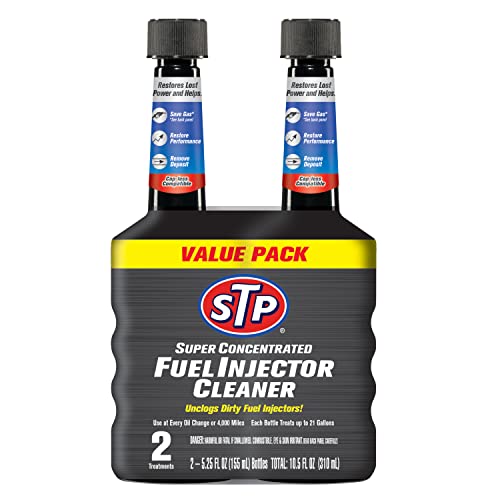
STP Super Concentrated Fuel Injector Cleaner
Where the first pick spreads its effort across the whole fuel system, this one is the narrower, injector-first formula. It is a concentrated detergent treatment carried in jet fuel, a high-quality solvent carrier the maker uses to deliver the active ingredients, and its stated job is to unclog dirty fuel injectors and dissolve the carbon, gum, and varnish deposits linked to hard starts, lost acceleration, and rough idling. The maker also describes it as tested safe for oxygen sensors and suitable for cap-less gas systems, and it is positioned for routine use in any fuel-injected gasoline engine across cars, trucks, and SUVs.
Each 5.25 fl oz bottle treats up to 21 gallons of gasoline, which matches a typical passenger-car tank more closely than the larger bottle above, and the guidance is to add it at every oil change or roughly every 4,000 miles. The listing checked for this guide is the twin-bottle configuration of the maker’s 78577 product, which suits that repeat schedule: one bottle for the current treatment and one on the shelf for the next interval. Because the formula is gasoline-only and not recommended for diesel engines, diesel owners should skip it entirely. For a driver whose symptoms point specifically at the injectors — a lumpy idle and flat spots in acceleration on an otherwise healthy engine — this is the more targeted of the two options here.
Details
- Brand: STP
- Formula type: Concentrated pour-in fuel injector cleaner, jet fuel carrier
- Bottle size: 5.25 fl oz bottles, twin-bottle listing
- Model: 78577
- Treat rate: Up to 21 gallons of gasoline per bottle
- Dosing: Add to the fuel tank; repeat at every oil change or about every 4,000 miles
- Compatibility: Fuel-injected gasoline engines, including cap-less fuel systems; not for diesel
- Sensor note: Maker describes the formula as tested safe for oxygen sensors
PEA, PIBA, and Solvent Cleaners: Reading the Label
Detergent chemistry is the single most useful thing to understand before buying any injector cleaner. PEA is the heavy lifter: it survives combustion-chamber heat, so it can work on injector tips and combustion deposits and then keep working rather than burning off instantly. Products built around PEA are the ones aimed at engines that are already dirty. PIBA detergents break down at lower temperatures, which limits them to the cooler intake side of port-injected engines, but they are effective at preventing new deposits there. Many balanced formulas, including the first pick above, blend the two.
A third group relies mainly on solvents rather than detergents. Solvent-heavy cleaners can dissolve gum and varnish in the tank and lines, but they generally do less against hard, baked-on injector carbon than a PEA formula. When a label leads with PEA content or names polyetheramine in its description, that is a meaningful signal. When it only promises to “clean the fuel system” without naming a detergent, expectations should be lower. Neither pick in this guide is a pure solvent product, and both publish their detergent approach, which is part of why they were selected.
How to Use an In-Tank Injector Cleaner Properly
Technique is simple but not irrelevant. Add the bottle at the fuel station, either into a nearly empty tank just before filling or into a tank at the level the label specifies — the first pick here asks for a tank at least half full, while many concentrated cleaners prefer a near-empty tank so the incoming fuel mixes the dose thoroughly. What matters is following the specific bottle’s instruction rather than a generic habit, because treat rates are calculated against a stated fuel volume. Too much fuel dilutes the detergent; far too little concentrates it beyond the intended ratio.
Then drive normally and use the whole treated tank before refilling, so the detergents get maximum contact time at full strength. A longer highway run is fine but not required; ordinary commuting works. Avoid stacking two different cleaners in the same tank, and do not shorten the repeat interval in the hope of faster results — both picks here are formulated around an interval of roughly 4,000 miles or an oil-change cycle, and more frequent dosing adds cost without a stated benefit. Store unused bottles sealed, upright, and away from heat and ignition sources, and keep them out of reach of children.
Signs Your Injectors May Need Cleaning
Deposit-related injector problems tend to share a pattern: they develop slowly, affect general smoothness rather than causing a sudden failure, and often appear first at idle or light throttle. A vibration at stoplights that was not there before, a slight stumble when pulling away, longer cranking on cold mornings, and a gradual drop in fuel economy are the classic cluster. None of these proves the injectors are dirty — ignition wear, airflow sensor drift, and vacuum leaks can imitate them — but on a higher-mileage engine with no fault codes and no single-cylinder misfire, deposits are a plausible first suspect, and a detergent treatment is a cheap, reversible first step before paying for diagnosis.
The reverse logic matters too. If a full treated tank produces no change at all, repeating the same treatment is unlikely to help. At that point the problem is probably not surface deposits, and the money is better spent on a scan and a mechanic’s inspection. Bench cleaning or injector replacement belongs to that later stage, not to routine maintenance.
Buying Checklist
Before ordering any injector cleaner, confirm five things. First, fuel type: gasoline and diesel additives are not interchangeable, and one pick here is explicitly gasoline-only. Second, detergent type: look for PEA if the goal is cleaning existing injector deposits. Third, treat rate versus your tank size, so one bottle is actually a full dose for your vehicle. Fourth, engine compatibility, especially for direct-injection, turbocharged, and hybrid models, and for cap-less filler necks that need a compatible bottle spout. Fifth, the repeat interval, since a cleaner designed for every 4,000 miles is a maintenance product, while a one-tank shock treatment is a different commitment. Both products in this guide publish all five points, which made them easy to compare honestly.
Frequently Asked Questions
How often should I use a fuel injector cleaner?
Follow the product label. Both picks in this guide are maintenance treatments with an interval of about every 4,000 miles or at each oil change. Engines that run mostly on short city trips build deposits faster than highway-driven engines, but shortening the interval below the label guidance is not recommended by the makers.
Will an in-tank cleaner fix a misfire?
Only if the misfire is caused by deposit-restricted injector flow, which is one possibility among many. A misfire with a warning light, a flashing check-engine indicator, or a stored cylinder-specific code needs diagnosis first. Additives address deposits, not failed coils, plugs, or injectors.
Can these cleaners help a direct-injection engine?
They can clean the injectors themselves, since the treated fuel passes through them, and both picks are rated by their maker for direct-injection engines. What they cannot do is wash the intake valves, because GDI engines do not pass fuel over those valves. Intake-valve carbon on a GDI engine needs a different, intake-side service.
Is it safe for oxygen sensors and catalytic converters?
The injector-focused pick here is described by its maker as tested safe for oxygen sensors, and mainstream PEA detergent cleaners are generally formulated to be sensor- and catalyst-safe when used at the stated dose. The practical rule is to use the labeled amount rather than doubling up.
Should I add cleaner to a full tank or an empty one?
Follow the individual label, because the two approaches in this guide differ: one specifies a tank at least half full, while concentrated formulas commonly ask for a near-empty tank followed by a fill-up. Either way, add the cleaner at the pump and then drive the treated tank down before refilling.
Conclusion
For most drivers, the best fuel injector cleaning is the boring kind: a PEA-based detergent poured into the tank on a regular interval, matched to the tank size, and given a full tank of driving to work. The STP Ultra 5-in-1 suits drivers who want one bottle to clean the whole fuel system, stabilize fuel, and cover a large tank in a single dose. The STP Super Concentrated Fuel Injector Cleaner suits drivers whose symptoms point specifically at clogged injectors and who want a smaller, targeted bottle on a repeat schedule. Both are gasoline treatments with published treat rates and intervals; confirm the current listing details before ordering, and treat a complete lack of improvement after one treated tank as a sign to get the engine diagnosed rather than dosed again.
Disclosure
Disclosure: This article contains affiliate links. If you buy through those links, a commission may be earned at no additional cost to you. Product information was taken from the listings and manufacturer details available at the time of writing, and specifications should be confirmed on the live listing before purchase.


Write Your Review
No reviews yet. Be the first to share your experience!