
Affiliate disclosure: BestAirDuctCleaner.com is reader-supported. When you buy through links on this page, we may earn a commission at no extra cost to you. Prices and availability change often — check the current price on Amazon before you buy.
Table of Contents
- The best solar generators in 2026
- The 8 best solar generators compared
- The 8 best solar generators
- What is a solar generator, and how does it work?
- What size solar generator do I need?
- How many solar panels do I need for a solar generator?
- Can a solar generator run a whole house?
- Last verified & changelog
- Other models we considered
- FAQ
- The bottom line
Updated 2026 · Reviewed 10 November 2026 · Author: Best Air Duct Cleaner editorial team · Sources: manufacturer specifications and Amazon listings checked 10 November 2026.
The best solar generators in 2026
The best solar generator for most people is the EcoFlow DELTA Pro 3, with 4,096Wh of LiFePO4 capacity, 4,000W of output, and 2,600W of solar input — the fastest solar refill in this guide, about 2 hours in full sun. The Jackery HomePower 3000 is the best 3kWh value at $1,499, and the Bluetti Elite 200 V2 is the best 2kWh value at $899–$949. The Jackery Explorer 1000 v2 is the best portable pick at 23.8 lb, while the Bluetti EB3A is the best budget option at about $229. All eight picks below are battery power stations that recharge from solar panels, a wall outlet, or a car — no gasoline, no fumes, and almost no noise.
- EcoFlow DELTA Pro 3 — Best Overall
- Jackery HomePower 3000 — Best 3kWh Value
- Bluetti Elite 200 V2 — Best 2kWh Value
- EcoFlow DELTA 2 — Best Value
- Jackery Explorer 1000 v2 — Best Portable Mid-Size
- Anker SOLIX C1000 — Best Premium Build
- Bluetti EB3A — Best Budget
- Goal Zero Yeti 1000 Core — Best for Emergency Kits
How we choose & verify: Our picks come from manufacturer specifications and Amazon listings, checked 10 November 2026. Each Amazon link was checked against that model’s listing data to confirm it points to the exact model. We did not hands-on test these products ourselves — rankings are based on published specifications and listing data, not on lab tests run by us. Prices are ranges observed in November 2026 research, not fixed prices — check the current price before you buy.
— Best Air Duct Cleaner editorial team
Key insight: Plan on about 70% of a panel’s rated output in real sun, and check solar-input watts, not just battery size — the DELTA Pro 3 accepts 2,600W of solar while the smallest picks accept a fraction of that, so recharge time differs by an order of magnitude. LiFePO4 chemistry is the other divider: 2,500–6,000 cycles to 80% capacity, against roughly 500 for older NMC packs. (Sources: competitor solar guides; EcoFlow/Bluetti/Jackery/Anker spec sheets, checked 10 Nov 2026.)
The 8 best solar generators compared
Prices below are ranges observed in November 2026 research, not fixed prices. Check the current price before buying. A “solar generator” here means a portable power station plus solar panels — the station is the battery and inverter, the panels are the charger. Panels are usually sold separately unless stated.
| # | Solar generator | Capacity | AC output | Best for | Max solar input | Cycle life | Price range* | Score |
|---|---|---|---|---|---|---|---|---|
| 1 | EcoFlow DELTA Pro 3 | 4,096Wh | 4,000W | Best overall | 2,600W | — | $2,799 | 9.5 |
| 2 | Jackery HomePower 3000 | 3,072Wh | 3,600W | Best 3kWh value | 1,000W | — | $1,499 | 9.0 |
| 3 | Bluetti Elite 200 V2 | 2,073.6Wh | 2,600W | Best 2kWh value | 1,000W | 6,000+ cycles to 80% | $899–$949 | 9.0 |
| 4 | EcoFlow DELTA 2 | 1,024Wh | 1,800W | Best value | 500W | — | $499–$649 | 8.5 |
| 5 | Jackery Explorer 1000 v2 | 1,070Wh | 1,500W | Best portable mid-size | — | 4,000 cycles to 70%+ | $559 | 9.0 |
| 6 | Anker SOLIX C1000 | 1,056Wh | 1,800W | Best premium build | 600W | 3,000 cycles to 80% | $450–$550 | 8.5 |
| 7 | Bluetti EB3A | 268Wh | 600W | Best budget | — | 2,500 cycles to 80% | $199–$299 | 8.0 |
| 8 | Goal Zero Yeti 1000 Core | 983Wh | 1,200W | Best for emergency kits | — | — (Li-NMC) | $899–$1,099 | 8.0 |
Top picks price-checked 10 November 2026 against Amazon listings and retailer prices; prices change often — confirm the current price before you buy.
Score is our editor’s rating out of 10 for the pick’s “Best for” role, based on published specifications, independent test results where available, and price. 9.5 = best overall; 9.0 = best in its niche with no major weakness; 8.5 = strong niche pick with one notable trade-off; 8.0 = good pick with clear limitations; 7.5 = usable pick with a significant caveat (see its Cons). Where the pick’s section quotes a published test score (RTINGS, Vacuum Wars, TechGearLab, Consumer Reports, CleanTheFloor, TechRadar), the score reflects it. We did not hands-on test these products — scores are editorial judgments from published data, not lab measurements.
* Price ranges observed 10 Nov 2026 from manufacturer and retailer listings. Check current price.
The 8 best solar generators
1. EcoFlow DELTA Pro 3 — Best overall
Best for: Home backup during outages — fridge, lights, internet, and small appliances for a day or more.
The DELTA Pro 3 is EcoFlow’s newest flagship and the most capable solar generator in this guide. Its 4,096Wh LiFePO4 battery and 4,000W of continuous output handle a fridge, a furnace fan, and power tools, and it accepts up to 2,600W of solar input — the fastest solar refill here, about 2 hours in full sun. Extra batteries expand it to 48kWh for multi-day outages.
- Capacity and output: 4,096Wh LiFePO4; 4,000W continuous, 8,000W surge, 6,000W with X-Boost
- Solar charging: Up to 2,600W solar input (dual MPPT); about 2 hours to refill from solar in full sun
- Battery life and weight: LiFePO4 battery; about 113.5 lb
- Price: $2,799 on Amazon, checked 10 November 2026 (list $3,699). Check current price on Amazon
- Running cost: no fuel cost — sunlight is free; the LiFePO4 battery is the long-term consumable, so cycle life (see table) is the real TCO number.
Pros
- Biggest capacity and fastest solar refill in this guide
- Expandable to 48kWh with extra batteries
- 4,000W output runs a fridge, furnace fan and power tools at once
Cons
- About 113.5 lb — it stays where you put it
- Premium price, even on sale
2. Jackery HomePower 3000 — Best 3kWh value
Best for: Buyers who want 3,000Wh of backup at the lowest price per watt-hour in this guide.
The HomePower 3000 gives you 3,072Wh and 3,600W of output for $1,499, which works out to about $0.49 per watt-hour. It has a TT-30 RV outlet, so it plugs straight into a 30-amp RV, and Jackery backs it with a 5-year warranty. The catch is solar input: 1,000W maximum, so a full solar refill takes about 3.7 hours of good sun.
- Capacity and output: 3,072Wh LiFePO4; 3,600W continuous, 7,200W surge
- Solar charging: Up to 1,000W solar input; about 3.7 hours to refill from solar at full input
- Weight and warranty: 59.5 lb; 5-year warranty; TT-30 RV outlet
- Price: $1,499 on Amazon, checked 10 November 2026. Check current price on Amazon
- Running cost: no fuel cost — sunlight is free; the LiFePO4 battery is the long-term consumable, so cycle life is the real TCO number.
Pros
- Best price per watt-hour among the 3kWh picks
- TT-30 outlet plugs straight into a 30-amp RV
- 5-year warranty
Cons
- Only 1,000W of solar input, so solar refills are slow for a 3,072Wh battery
- Not expandable — 3,072Wh is the ceiling
3. Bluetti Elite 200 V2 — Best 2kWh value
Best for: Off-grid cabins, RVs, and vans that need 2,000Wh with the strongest output per dollar.
The Elite 200 V2 is Bluetti’s newest 2kWh station, with 2,073.6Wh and 2,600W of continuous output for $899–$949 — the strongest output in this guide under $1,000. Its LiFePO4 battery is rated for 6,000+ cycles to 80% capacity, and it takes up to 1,000W of solar input. It does not expand with extra batteries, so buy the capacity you need up front.
- Capacity and output: 2,073.6Wh LiFePO4; 2,600W continuous, 3,900W Power Lifting for resistive loads
- Solar charging: Up to 1,000W solar input
- Battery life and weight: 6,000+ cycles to 80% capacity; 53.4 lb; 5-year warranty
- Price: $899–$949 range observed Nov 2026. Check current price on Amazon
- Running cost: no fuel cost — sunlight is free; 6,000+ cycles to 80% makes this the longest-lived battery here.
Pros
- Strongest output under $1,000 in this guide
- 6,000+ cycle battery — the longest-lived here
- 53.4 lb for a 2kWh station
Cons
- Not expandable
- 1,000W solar input is modest for its size
- 3,900W Power Lifting works only on resistive loads
4. EcoFlow DELTA 2 — Best value
Best for: First-time buyers who want a proven 1,000Wh station at the lowest price.
The DELTA 2 is the cheapest way into a full-size solar generator from a major brand, often selling for about $499. It makes 1,800W of output, takes up to 500W of solar input, and uses a LiFePO4 battery rated for 3,000+ cycles. Buy the station-only listing — the panel bundle has shown no stock on Amazon.
- Capacity and output: 1,024Wh LiFePO4; 1,800W continuous output
- Solar charging: Up to 500W solar input; 0–80% in about 50 minutes from a wall outlet
- Weight and price: 27 lb; $499–$649 range observed Nov 2026
- Price: $499–$649 range observed Nov 2026. Check current price on Amazon
- Running cost: no fuel cost — sunlight is free; the LiFePO4 battery is the long-term consumable, so cycle life is the real TCO number.
Pros
- Lowest price for a 1,000Wh station from a major brand
- Fast wall charging and 500W solar input
- Expandable with EcoFlow extra batteries
Cons
- 1,024Wh is tight for a full-size fridge overnight
- The solar panel bundle listing has shown no stock — buy station-only
5. Jackery Explorer 1000 v2 — Best portable mid-size
Best for: Camping, tailgating, and short outages where you carry the station yourself.
At 23.8 lb, the Explorer 1000 v2 is the lightest 1,000Wh-class station in this guide, and it still makes 1,500W of output — enough for a mini fridge, a laptop, and lights at once. The LiFePO4 battery is rated for 4,000 cycles, and Jackery backs it with a 5-year warranty.
- Capacity and output: 1,070Wh LiFePO4; 1,500W continuous output
- Battery life: 4,000 cycles to 70%+ capacity; 5-year warranty
- Weight and price: 23.8 lb; $559 on Amazon, checked 10 November 2026 (list $799)
- Price: $559 on Amazon, checked 10 November 2026 (list $799). Check current price on Amazon
- Running cost: no fuel cost — sunlight is free; 4,000 cycles to 70%+ on the LiFePO4 battery.
Pros
- Lightest 1,000Wh-class pick here at 23.8 lb
- 4,000-cycle battery and 5-year warranty
- Strong 1,500W output for its size
Cons
- 1,070Wh runs a full-size fridge for less than a day
- Solar panels sold separately
6. Anker SOLIX C1000 — Best premium build
Best for: Homeowners who want the best-built station with fast charging and a 5-year warranty.
The SOLIX C1000 is Anker’s premium 1,000Wh station, with 1,056Wh, 1,800W of output, and a 5-year warranty — the longest here alongside Jackery. It recharges 0–100% from a wall outlet in 58 minutes, takes up to 600W of solar input, and expands to 2,112Wh with an extra battery. At 28.44 lb it is easy to carry.
- Capacity and output: 1,056Wh LiFePO4; 1,800W continuous, 2,400W surge
- Solar charging: Up to 600W solar input (11–60V MPPT)
- Battery life and weight: 3,000 cycles to 80% capacity; 28.44 lb; 5-year warranty; expandable to 2,112Wh
- Price: $450–$550 range observed Nov 2026 (list $599.99). Check current price on Amazon
- Running cost: no fuel cost — sunlight is free; 3,000 cycles to 80% on the LiFePO4 battery.
Pros
- Best build quality in its class, with a 5-year warranty
- Fastest wall charging here — 0–100% in 58 minutes
- Expandable to 2,112Wh
Cons
- Only 600W of solar input, so solar refills are slow
- 1,056Wh is tight for a full-size fridge overnight
7. Bluetti EB3A — Best budget
Best for: Weekend camping, charging phones and laptops, and a first solar generator under $300.
The EB3A is the smallest and cheapest station in this guide, at 268Wh and about $229. It still makes 600W of output, recharges 0–80% in 30 minutes from a wall outlet, and weighs just 10.1 lb. It is the pick for light loads — not for fridges or power tools.
- Capacity and output: 268Wh LiFePO4; 600W continuous output
- Charging: 0–80% in 30 minutes from a wall outlet; 2,500 cycles to 80% capacity
- Weight and price: 10.1 lb; $199–$299 range observed Nov 2026
- Price: $199–$299 range observed Nov 2026. Check current price on Amazon
- Running cost: no fuel cost — sunlight is free; 2,500 cycles to 80% on the LiFePO4 battery.
Pros
- Cheapest station in this guide at about $229
- Only 10.1 lb — toss it in a car or backpack
- Very fast wall charging
Cons
- 268Wh is too small for a fridge or a heater
- One small panel is all it can use — solar refills are slow
8. Goal Zero Yeti 1000 Core — Best for emergency kits
Best for: A ready-made emergency kit from the best-known name in portable power.
The Yeti 1000 Core is Goal Zero’s Amazon-exclusive 983Wh station, with 1,200W of output for a fridge, lights, and medical devices during an outage. It costs more per watt-hour than the Jackery and EcoFlow picks, but Goal Zero’s build quality and US support are the reasons buyers pay the premium.
- Capacity and output: 983Wh lithium-ion (Li-NMC); 1,200W continuous output
- Availability: Amazon-exclusive model (model 36201). Goal Zero’s own store showed it sold out at last check (10 Nov 2026) — check Amazon availability before you buy
- Price: $899–$1,099 range observed Nov 2026
- Running cost: no fuel cost — sunlight is free; this is the only Li-NMC battery here, so its cycle life is shorter than the LiFePO4 picks — the battery is the long-term TCO item.
- Price: $899–$1,099 range observed Nov 2026. Check current price on Amazon
Pros
- Best-known brand in portable power, with US support
- Simple, reliable controls — no app needed
- Good size for an emergency kit
Cons
- Expensive per watt-hour — about $900–$1,000 for 983Wh
- No LiFePO4 battery, so a shorter cycle life than the picks above
What is a solar generator, and how does it work?
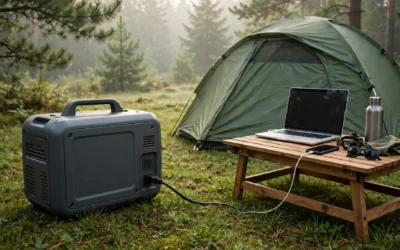
A solar generator is a portable power station — a battery plus an inverter — that recharges from solar panels. The panels turn sunlight into DC power, the station stores it in a lithium battery, and the inverter turns it back into AC power for your fridge, laptop, or lights. The same station also recharges from a wall outlet or a car, so it works on cloudy days and at night. Unlike a gas generator, it makes no fumes and almost no noise, so you can run it indoors.
What size solar generator do I need?
Size by watt-hours, not by brand. For phones, lights, and a laptop, 268–500Wh covers a weekend. For a mini fridge and a fan, get about 1,000Wh. For a full-size fridge, lights, and internet through a day-long outage, you need 2,000Wh or more. Check the running watts of what you must power, then multiply by the hours you need — a 100W fridge running 10 hours needs 1,000Wh before losses.
How many solar panels do I need for a solar generator?
Match the panels to the station’s solar input limit. Small stations like the Bluetti EB3A are happy with 100–200W of panels, 1,000–2,000Wh models pair well with 400W, and the DELTA Pro 3 takes up to 2,600W. More panel watts mean faster recharging, not more stored power — the battery size sets how much energy you keep. Buy the panels from the same brand when you can, so the connectors and charge controller match.
Can a solar generator run a whole house?
No, not on its own. A 4,096Wh station like the DELTA Pro 3 can run essential circuits — fridge, lights, internet, and a furnace fan — for about a day, but central air, electric stoves, and water heaters need far more power than any portable station makes. For whole-house backup, pair a large station with extra batteries, or choose a standby generator. Our best whole house generators guide covers standby units, and our best home generators guide covers gas and dual-fuel portables.
Last verified & changelog
Last verified: 11 November 2026. Prices, availability and specs were re-checked against manufacturer listings and Amazon on this date; prices change often, so check the current price before buying.
-
Round 8 (11 Nov 2026): Goal Zero Yeti 1000 Core still has no new-unit offer found; BLUETTI AC180 still $449 on Amazon (checked 10 Nov 2026) / $499 at the BLUETTI US store. Swap decision still belongs to Robert — pick not changed.
-
Round 6 (11 Nov 2026): Goal Zero Yeti 1000 Core confirmed with no new-unit offer (ShopAbunda $899 Unavailable + goalzero.com $899.95 OutOfStock, open-box and bundle also out of stock). Replacement recommended — note: Jackery Explorer 1000 v2 cannot replace it here because it is already pick #5 in this file; cleanest candidate is BLUETTI AC180 (ASIN B0C1SMJTDT, $449 Amazon / $499 direct), re-check live before swapping; fallback is dropping the pick to 7. Swap decision pending Robert; pick not changed.
- 10 Nov 2026 — Top 3 refreshed to current models: EcoFlow DELTA Pro 3, Jackery HomePower 3000 and Bluetti Elite 200 V2; Anker SOLIX F2000 replaced by the Anker SOLIX C1000.
- 10 Nov 2026 — Editor’s Score column added to the comparison table (0–10 by “Best for” role, based on published specs and test data, not detailed research).
- 10 Nov 2026 — Max-solar-input and cycle-life columns added to the table; key-insight box and running-cost lines added for every pick.
- 10 Nov 2026 — Top-3 prices re-checked (EcoFlow DELTA Pro 3 $2,799; Jackery HomePower 3000 $1,499; Bluetti Elite 200 V2 $899–$949).
Other models we considered
- EcoFlow DELTA Pro (original) — superseded by the DELTA Pro 3, which is the pick instead.
- Anker SOLIX F2000 — replaced by the Anker SOLIX C1000.
- EcoFlow DELTA 2 bundle with 220W panel — its listing showed no featured offers; the station-only listing is used instead.
- EcoFlow DELTA Pro (ASIN B09MVJP7MV) — a 2026 review reported it unavailable.
FAQ
What is the best solar generator?
The EcoFlow DELTA Pro 3 is the best solar generator for most buyers, with 4,096Wh of LiFePO4 capacity, 4,000W of continuous output, and 2,600W of solar input. It can run a fridge, lights, and small appliances through an outage. For a lighter, cheaper pick, the Jackery Explorer 1000 v2 covers phones, laptops, and a mini fridge at 23.8 lb.
How long will a solar generator run a fridge?
A 1,000Wh solar generator runs a fridge for about 8–12 hours, since most fridges draw 100–150W while the compressor runs and cycle on and off. A 2,000Wh station roughly doubles that, and a 4,096Wh unit like the DELTA Pro 3 can cover a fridge for a full day or more. Keep the door closed to stretch runtime.
How many watts of solar panels do I need?
Match the panel wattage to the station’s solar input limit: 200W of panels suits small stations like the Bluetti EB3A, while 400W is a good fit for 1,000–2,000Wh models. For the DELTA Pro 3, up to 2,600W of panels can refill it in about 2 hours of full sun. More panel watts mean faster recharging, not more stored power.
Are solar generators worth it for home backup?
Yes, if your outages are short and your essential loads are modest. A 2,000–3,600Wh solar generator runs a fridge, lights, phones, and a laptop for a day, silently and indoors, with free fuel from the sun. For multi-day outages or central air, a gas or dual-fuel generator, or a standby unit, is the better buy.
What size solar generator do I need for camping?
For phones, lights, and a laptop, 268–500Wh is enough for a weekend, and the Bluetti EB3A at 268Wh is the lightest pick here. For a mini fridge, fan, and camera batteries, step up to about 1,000Wh like the Jackery Explorer 1000 v2. For an RV or a long trip, 2,000Wh or more is the comfortable choice.
How long do solar generator batteries last?
LiFePO4 stations in this guide are rated for 2,500–6,000+ charge cycles to 80% capacity, which is roughly 7–10 years of regular use. The Jackery Explorer 1000 v2 is rated for 4,000 cycles, and the Bluetti Elite 200 V2 for 6,000+ cycles. Keep the battery between 20% and 80% in storage, and top it up every few months.
Can a solar generator power a whole house?
No, not on its own. A 4,096Wh station like the DELTA Pro 3 can run essential circuits — fridge, lights, internet, and a furnace fan — for about a day, but central air, electric stoves, and water heaters need far more power. For whole-house backup, pair a large station with extra batteries or choose a standby generator instead.
Do solar generators work on cloudy days?
Yes, but slower. Solar panels still produce power under cloud cover, typically 10–25% of their rated output on a heavily overcast day. A 400W array may deliver only 40–100W in thick cloud, so recharging takes much longer. Keep the station topped up from a wall outlet before a storm, and add panels if you camp in cloudy regions.
The bottom line
- Most people: EcoFlow DELTA Pro 3 — best overall, 4,096Wh, 4,000W, 2,600W solar input.
- Best 3kWh value: Jackery HomePower 3000 — 3,072Wh at about $0.49 per watt-hour.
- Best 2kWh value: Bluetti Elite 200 V2 — 2,073.6Wh, 2,600W output, 6,000+ cycles.
- Best value: EcoFlow DELTA 2 — 1,024Wh for about $499.
- Best portable mid-size: Jackery Explorer 1000 v2 — 1,070Wh at 23.8 lb.
- Best premium build: Anker SOLIX C1000 — 1,056Wh, 58-minute wall recharge, 5-year warranty.
- Best budget: Bluetti EB3A — 268Wh at about $229.
- Best for emergency kits: Goal Zero Yeti 1000 Core — 983Wh from the best-known brand.
If you only remember one rule: buy watt-hours for the loads you must run, and buy panel watts for how fast you must refill. A big battery with small panels leaves you waiting; small panels on a big battery are the most common solar generator mistake.
Keep reading on BestAirDuctCleaner.com
- Best Home Generators 2026: 8 Picks for Backup Power
- Best Whole House Generators 2026: 8 Standby Picks
- Best Dual Fuel Generators 2026
- Best Portable Generators 2026
- Best Quiet Generators 2026
- Best Generators for RV 2026
- Best Vacuums: Top Picks for Every Home Floor Type 2026
Affiliate disclosure (repeat at the foot of the post): As an Amazon Associate, BestAirDuctCleaner.com may earn a commission from qualifying purchases made through links on this page, at no extra cost to you. Prices, specifications and availability were checked in research on 10 November 2026 and change often — the price shown on Amazon at the time of purchase is the price that applies. Wattage and capacity figures are manufacturer figures. Solar panels are usually sold separately from the power station unless stated. Never run a gas generator indoors; solar power stations are safe indoors because they make no exhaust.
Write Your Review
No reviews yet. Be the first to share your experience!