
Quick answer: Our top pick in 2026 is the Use the existing working gauge — our #1 rated choice. See the full ranked comparison, alternatives and buying advice below.
The Short Answer
It depends: you need a filter pressure gauge if you have a pressurized pool filter and want a reliable way to tell when the filter needs attention. A gauge is not essential for every pool, but it is one of the simplest tools for monitoring a sand, cartridge, or DE filter. It shows the water pressure inside the filter tank, giving you a useful reference point before and after cleaning.
When pressure rises noticeably above your clean-filter reading, the filter is usually collecting debris and restricting water flow. That does not automatically mean the gauge itself will tell you exactly what repair is needed, but it gives you an early warning that maintenance may be due. For most residential pools, a replacement gauge costs roughly $8 to $25, making it a relatively inexpensive troubleshooting tool.
As an Amazon Associate we earn from qualifying purchases at no extra cost to you.

What You Actually Get
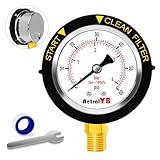
A pool filter pressure gauge is a small, usually round dial that screws into a threaded port on the filter tank or its attached multiport valve. Common models use a 1/4-inch NPT connection, although you should verify the thread size and mounting position on your equipment before ordering.
The dial displays pressure in pounds per square inch, or psi. Many replacement gauges are rated from 0 to 60 psi, a range that covers typical residential pool-filter readings. The actual operating pressure varies by pool plumbing, pump size, filter type, water level, and the cleanliness of the filter. The important number is not a universal “normal” pressure. It is your own clean-filter baseline.
To establish that baseline, install the gauge or confirm that the existing gauge works, clean or backwash the filter according to the filter manufacturer’s instructions, and run the pump with the pool equipment operating normally. Record the pressure. A common maintenance rule is to clean the filter when pressure rises about 8 to 10 psi above that baseline, but follow your filter manufacturer’s recommendation when it differs.
For example, if your clean pressure is 12 psi, a reading around 20 to 22 psi may indicate that the filter is becoming clogged. A gauge does not measure water cleanliness, pump efficiency, or filter condition directly. It measures pressure at one point in the system. That distinction matters: a low reading can also point to an air leak, blocked skimmer basket, low water level, clogged pump basket, or pump problem.
Basic replacement gauges are small enough to fit most equipment pads. The AetralYB 60Psi Pool Filter Pressure Gauge has a 2-inch dial, an IP67 waterproof rating, and a 1/4 NPT connection. It is listed at $7.99. The SENCTRL 0-60 Psi Pool Filter Pressure Gauge also uses a 1/4 NPT lower mount and is listed at $8.99. These are examples of the low-cost replacement category, not a guarantee that either model fits every filter.
Pros
- Provides an objective maintenance signal. Instead of guessing when to clean a filter, you can compare the current reading with the clean-filter baseline.
- Helps protect water circulation. A rising pressure reading can alert you to a loaded filter before poor circulation becomes obvious.
- Inexpensive to replace. Many basic 0-60 psi gauges cost about $8 to $15, while upgraded or brand-specific versions may cost $20 to $40.
- Easy to read. A 2-inch dial is generally easier to see than a very small gauge, especially when the equipment pad is in a shaded or awkward location.
- Useful for troubleshooting. Pressure changes can help distinguish a dirty filter from some low-flow problems, particularly when you compare pressure and return-jet strength.
- Works without electricity. A mechanical gauge does not need batteries, wiring, or a separate app. It simply responds to water pressure.
- Can reveal a failing component. A gauge that stays at zero, jumps erratically, or shows an unexpected reading may point to a blocked gauge port, damaged gauge, or wider equipment issue.
Cons
- It is not a complete diagnostic tool. The pressure reading alone cannot identify every pump, plumbing, air-leak, or filter problem.
- Readings are system-specific. Two pools with similar equipment may have different normal pressures because of different pipe lengths, fittings, elevation, and pump settings.
- Installation requires compatibility. A 1/4 NPT gauge may not fit a port with another thread standard. Forcing the wrong connection can damage the filter housing or create a leak.
- The gauge can fail. Sun exposure, freezing temperatures, vibration, water intrusion, and internal wear can make a gauge stick or become inaccurate.
- Some locations are hard to view. A gauge installed behind plumbing or below the equipment lid may technically work but still be inconvenient to monitor.
- A pressure increase does not always mean “clean immediately.” You should first check water level, baskets, valves, and the filter manufacturer’s instructions before taking action.
- It adds one more leak point. The threaded connection needs to be installed carefully and checked periodically for drips or moisture.
Who Should Buy It
Buy a filter pressure gauge if you own a pool with a pressurized filtration system and do routine maintenance yourself. It is especially worthwhile for owners who have a sand or DE filter that needs periodic backwashing, or a cartridge filter whose cleaning schedule varies with weather, leaves, and swimmer load.
You should also consider one if your current gauge is fogged, stuck, cracked, difficult to read, or permanently parked at one number. A cheap replacement can restore useful information to an otherwise functioning equipment pad. Choose the correct pressure range, connection size, mounting style, and physical clearance. A 0-60 psi model is common, but your filter documentation should take priority.
It is a sensible purchase for seasonal pool owners, too. At the start of the season, the gauge helps establish a fresh baseline after the filter and plumbing are checked. During the season, it provides a quick visual check before and after maintenance.
Who Should Skip It
Skip a separate replacement gauge if your filter already has a clear, functioning gauge and the reading is stable. Buying another gauge will not improve filtration simply because it is newer.
You may also skip one if you do not have a pressurized pool-filter system, rarely operate the equipment, or rely on a professional who already inspects and services the system. A gauge is less useful when nobody records the baseline or responds to changing readings.
Do not buy one based only on a low price. An $8 gauge is not a bargain if the thread, mounting direction, pressure range, or dial size is wrong. Confirm the filter model and port specifications first.
Cheaper Alternatives
| Option | Cost | Trade-off |
|---|---|---|
| Use the existing working gauge | $0 | Cheapest choice, but only useful if the gauge is readable and accurate enough to establish a baseline. |
| Visual flow check at the return jets | $0 | Can reveal weak circulation, but it is subjective and will not give you a psi reading. |
| Record cleaning dates and water conditions | $0 to $5 | A simple log helps predict maintenance, but weather and debris levels can change the schedule. |
| Basic 0-60 psi replacement gauge | $8 to $15 | Low cost and practical, but verify 1/4 NPT compatibility and expect basic materials and limited features. |
| Branded or upgraded gauge | $20 to $40 | May offer better fit, visibility, or construction, but costs more without guaranteeing a more useful reading. |
FAQ
What pressure should my pool filter gauge read?
There is no single correct number for every pool. Establish the reading after the filter is clean and the pump is operating normally, then use that number as your baseline. A rise of roughly 8 to 10 psi is a common signal to inspect or clean the filter, but your equipment manual may specify a different threshold.
Can I run a pool filter without a pressure gauge?
Usually, the filter can operate without a working gauge, but you lose a convenient way to monitor restriction and maintenance needs. Do not ignore a missing gauge if the filter housing has an open port or leaks. Install the correct replacement, or have a pool professional cap and inspect the port safely.
How do I know whether a replacement gauge will fit?
Check the filter or valve manual for the thread size, connection type, and mounting position. Many residential replacements use 1/4-inch NPT threads, including the AetralYB and SENCTRL examples, but that does not make them universally compatible. Confirm that the gauge has enough clearance and that its pressure range suits the equipment.
What should I check if the pressure reading looks wrong?
First check the pool water level, skimmer basket, pump basket, valve position, and filter condition. Make sure the pump is fully primed and look for air bubbles or leaks. If the gauge remains at zero, fluctuates sharply, or disagrees with the system’s behavior, shut down the pump before removing it and have the gauge or equipment inspected. A pressure reading is a clue, not a diagnosis.
Ready to decide? Our #1 pick for 2026 is the Use the existing working gauge.
Live price & availability on Amazon.


Write Your Review
No reviews yet. Be the first to share your experience!