
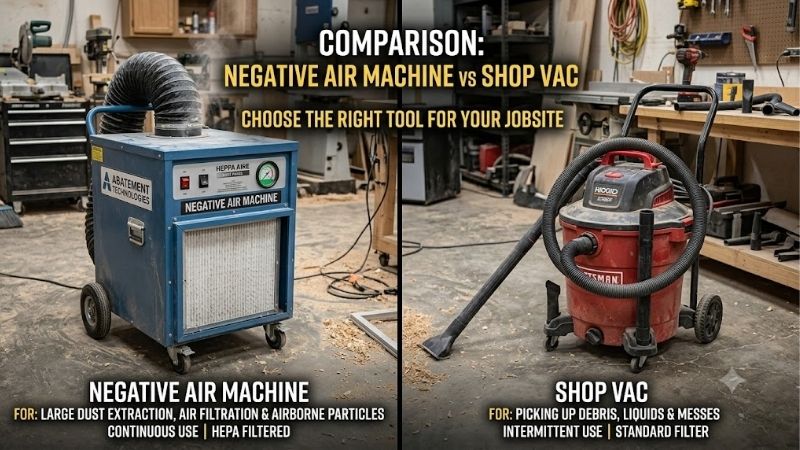
Negative air machine vs shop vac decisions impact both air quality and jobsite safety during heavy remodeling. A heavy-duty shop vacuum handles direct surface cleanup, whereas a dedicated air scrubber maintains proper ventilation throughout enclosed spaces. Understanding these tools ensures effective hazardous dust mitigation.
How to Choose the Right Negative Air Machine vs Shop Vac
Evaluating negative air machine vs shop vac equipment requires matching machine mechanics with target jobsite hazards. Surface debris collection demands high suction lift, while removing hazardous airborne contaminants requires steady volume exchange. Choosing correctly avoids blowing hazardous micro-particles across clean zones.
Filtration Standards and HEPA Efficiency
Selecting proper filtration prevents dangerous microscopic dust from re-entering your active workspace environment. Commercial air scrubbers utilize sealed HEPA filtration channels to trap tiny mold spores and lead particles. Investing in verified multi-stage filtration guarantees that toxic airborne hazards remain trapped securely.
Standard utility vacuums often lack fully sealed housings, allowing fine drywall dust to exhaust back out freely. Upgrading your vacuum with certified HEPA cartridges improves surface cleanup, though airflow remains focused on spot extraction. Always verify filtration efficiency specs before tackling toxic restoration work.
CFM Airflow and Volume Capabilities
Airflow volume determines how quickly a machine can clear suspended dust particles from an enclosed room. High CFM airflow ratings enable air scrubbers to recirculate thousands of cubic feet per hour across large job sites. High volumetric exchange rate ensures continuous air cleansing during intense sanding or demolition.
Shop vacuums deliver minimal CFM because their motors focus on generating concentrated suction pressure through narrow hoses. This design excels at pulling concrete chips off floors but cannot filter ambient room air effectively. Match CFM output to room dimensions to achieve rapid dust clearance across working areas.
Air Pressure Differential and Static Lift
Creating an air pressure differential prevents contaminated air from leaking into adjacent, clean living spaces during work. Dedicated negative air equipment vents filtered air outside containment barriers to pull clean air inward continuously. Maintaining stable depressurization is crucial for certified mold and asbestos abatement.
Utility vacuums generate impressive static water lift to pull dense sludge, water, and heavy sawdust through long hoses. However, their high suction pressure cannot maintain balanced depressurization across plastic containment zones. Relying solely on vacuums for room isolation risks tearing delicate plastic barrier walls.
Versatility for Surface vs Airborne Dust
Understanding negative air machine vs shop vac application boundaries ensures efficient cleanup workflow from start to finish. Heavy dust collection requires pulling debris directly from tools and floor surfaces before dust becomes airborne. Combining spot vacuuming with continuous ambient filtering yields a pristine work environment.
Using an air scrubber for bulk floor cleanup quickly clogs expensive HEPA filters with large wood chips and plaster pieces. Conversely, using a shop vacuum to process floating ambient airborne particles causes rapid thermal motor overload. Operating each unit within its engineered domain maximizes equipment operational lifespan.
Comparison Matrix and Key Differences
Comparing negative air machine vs shop vac features highlights essential differences in engineering and functional purpose. The detailed comparison matrix below outlines primary operational metrics, filtration layers, and airflow performance. Reviewing these distinct parameters helps contractors select the proper machinery.
| Feature / Metric | Negative Air Machine / Air Scrubber | Shop Vacuum / Wet-Dry Vac |
|---|---|---|
| Primary Focus | Ambient room air filtration & pressure containment | Direct surface debris & liquid extraction |
| Airflow Capacity (CFM) | High (500 – 2,000+ CFM) | Low to Moderate (80 – 180 CFM) |
| Suction Pressure (Water Lift) | Low (Designed for high volume exchange) | High (60 – 100+ inches of water lift) |
| Filtration Setup | Multi-stage (Pre-filter, Carbon, True HEPA) | Standard pleated or optional HEPA cartridge |
| Containment Exhaust | Integrated ducting ports for negative pressure | Open exhaust port (exhausts back into room) |
| Duty Cycle | Continuous 24/7 commercial operation | Intermittent spot cleaning & tool attachment |
Air Cleaning Mechanism vs Point Source Suction
Air scrubbers pull massive ambient air volumes through wide intake grills to eliminate suspended respirable dust particles continuously. They filter entire room volumes multiple times per hour, scrubbing the atmosphere without requiring manual direction. This hands-free filtration keeps jobsite air breathable throughout tasks.
Shop vacuums rely on narrow hoses to concentrate high suction at a specific point on floors or power tools. They excel at picking up nails, wood shavings, and liquid spills directly from surfaces where material settles. However, point suction cannot filter fine dust drifting near ceilings or distant room corners.
Continuous Duty Cycles and Motor Endurance
Commercial negative air units feature industrial-grade blower motors built to run continuously for days during remediation. Heavy-duty rotomolded housings and thermal protection prevent overheating during uninterrupted operation. This durability is vital when maintaining negative pressure containment environments overnight.
Shop vacuum motors utilize high-RPM universal brushes designed for short-burst cleaning sessions rather than nonstop running. Running a wet dry vacuum continuously for hours risks motor burnout and severe filter clogging from fine dust. Rest vacuum motors periodically to prevent costly electrical motor damage during jobs.
Ducting Capabilities and Spatial Containment
Negative air machines feature specialized intake and exhaust collars designed to clamp securely to flexible lay-flat ducting. This allows technicians to vent filtered exhaust air outdoors, creating true depressurization inside sealed rooms. Proper ducting prevents dangerous mold spores from escaping into non-work areas.
Shop vacuums generally lack standardized exhaust collars suited for long-distance air ducting setups across jobsites. Exhaust air vents directly through motor louvers back into the surrounding room, which can stir up settled floor dust. Without containment ducting, vacuums cannot establish negative pressure zones.
Top Picks for Jobsite Dust Control and Air Filtration
Choosing between negative air machine vs shop vac products depends on your specific jobsite requirements and project scope. The real-world equipment listed below highlights top-performing air scrubbers and heavy-duty shop vacuums available on Amazon. Each option offers reliable performance for professional contractors.
Dri-Eaz DefendAir HEPA 500 Air Scrubber
This commercial air scrubber suits restoration contractors needing dependable variable speed airflow up to 500 CFM. Its stackable rotomolded polyethylene housing withstands rough jobsite transport while delivering certified HEPA filtration efficiency. Integrated daisy-chain outlets allow linking multiple units on a single circuit.
However, replacement HEPA filters represent a significant ongoing cost during long remediation projects. Additionally, the unit weighs nearly 44 pounds, making overhead carrying tiring without a second technician. It remains an industry standard choice for professional environmental containment work.
DEWALT DXV12P 12 Gallon Poly Wet/Dry Vacuum
Ideal for woodworkers and general contractors, this wet dry vacuum excels at heavy floor surface cleanup tasks. It features a powerful 5.5 Peak HP motor that generates massive suction to clear liquid spills, screws, and sawdust. Sturdy rubberized swiveling casters ensure smooth mobility across cluttered jobsite floors.
Unfortunately, standard stock filters let fine plaster particles pass through, requiring separate HEPA filter upgrades. The rigid plastic hose can also kink under heavy twisting during detailed overhead dust extraction. Nonetheless, it remains an essential utility tool for daily surface debris management.
XPOWER X-3400A Commercial HEPA Air Scrubber
Designed for mold remediators and Painters, this compact unit offers effective 600 CFM particulate extraction capability. It features a 3-stage filtration system including a washable nylon pre-filter to extend main HEPA lifespan. Its lightweight ABS plastic casing and low amp draw make setup effortless across residential sites.
On the downside, the outer plastic housing feels slightly less rugged than heavy rotomolded options under extreme jobsite abuse. The fan speed dial can also feel delicate when operated while wearing heavy work gloves. Overall, it delivers outstanding ambient air purification value for mid-sized restoration jobs.
RIDGID 16 Gallon 6.5 Peak HP Stainless Steel Wet/Dry Vacuum
Remodeling crews requiring raw suction power will appreciate this 16-gallon heavy-duty stainless steel shop vacuum. Its 6.5 Peak HP motor delivers impressive lift to clear standing water, wet mud, and heavy construction debris. Built-in accessory storage keeps attachments organized and easily accessible during floor cleanup.
However, the stainless drum adds considerable weight, making loading into service vans cumbersome for solo operators. The motor produces high decibel noise levels during extended operation, requiring hearing protection. Still, it provides unmatched suction reliability for heavy surface material removal.
BlueDri BD-AS-550-BL Commercial Air Scrubber
This robust air scrubber suits water damage restoration specialists managing large mold remediation projects efficiently. It delivers 500 CFM airflow through a sealed multi-stage filter setup that captures ultrafine particulates. Roto-molded construction offers extreme durability, surviving frequent drops and rough job site handling.
However, the unit lacks an automated filter change indicator light, requiring manual inspection of pre-filters. The power cord wrap design can also allow cords to unwind during transit across bumpy truck beds. It remains a top-tier choice for creating reliable depressurized air containment environments.
Frequently Asked Questions
Addressing common negative air machine vs shop vac queries helps clarify optimal jobsite dust control setups. The following answers address core technical questions regarding airflow mechanics, filter selection, and proper depressurization. Understanding these facts ensures maximum safety and equipment efficiency.
Can a Shop Vac Be Used as a Negative Air Machine?
A standard shop vac cannot function as a true negative air machine because it lacks continuous high-CFM volume capacity. Vacuums focus high suction through small nozzles, which fails to exchange room air volumes rapidly. Venting a vacuum outside also creates inconsistent pressure that can collapse plastic barriers.
Additionally, utility vacuums lack sealed exhaust housings, allowing fine dust particles to bypass basic filter elements. Without proper ducting attachments, vacuum exhaust recirculates hazardous dust back into the work zone. Relying on shop vacuums for spatial containment violates standard safety protocols.
When Do You Need True HEPA Air Scrubbing Onsite?
True HEPA air scrubbing is essential whenever projects generate toxic airborne contaminants like silica, lead, or mold spores. Airborne hazards remain suspended in room air for hours, posing severe respiratory risks to workers without filtration. Deploying a dedicated air scrubber purifies ambient air continuously during active demo.
Contractors working within occupied homes also require air scrubbing to protect residents from migrating renovation dust. Running air scrubbers during drywall sanding keeps fine dust from settling across adjacent furnish rooms. It provides essential protection that standard point-source vacuums simply cannot replicate.
How Do You Calculate CFM for Dust Containment?
Calculating required CFM involves multiplying total room volume in cubic feet by desired air changes per hour, then dividing by 60. Most remediation standards require a minimum of 4 to 6 complete air changes per hour within containment areas. Matching machine CFM to space volume guarantees effective pressure differentials.
For example, a 2,000 cubic foot room needing 6 air changes per hour requires an air scrubber rated at 200 CFM minimum. Factoring in filter resistance and long duct runs recommends selecting a 500 CFM unit for optimal safety margin. Proper volume calculations ensure compliance with occupational health guidelines.
Do Both Units Require Frequent Pre-Filter Swaps?
Yes, replacing pre-filters regularly is vital for protecting high-efficiency primary filters in both equipment types. Air scrubbers rely on inexpensive stage-one pre-filters to capture coarse dust before reaching expensive HEPA media. Swapping pre-filters frequently maintains high CFM airflow and prevents blower strain.
Similarly, shop vacuums require clean foam sleeves or paper collection bags to prevent fine dust from clogging main cartridges. Neglecting pre-filter maintenance drastically reduces suction pressure and shortens motor operational lifespan. Establishing routine filter inspection protocols preserves equipment performance.
Final Thoughts
Understanding negative air machine vs shop vac differences empowers contractors to maintain clean, safe, compliant worksites. While wet dry vacuums handle heavy surface debris extraction, negative air machines scrub floating airborne contaminants continuously. Combining both machines guarantees complete dust collection and air safety.
Product links and buying checks
As an Amazon Associate, we earn from qualifying purchases.
- BlueDri Air Shield 550, blue BD-AS-550 on Amazon — Check the exact model, selected variant and seller before ordering.
Prices, availability and included accessories can change. Review the current listing and the compatibility guidance above before purchasing.
As an Amazon Associate we earn from qualifying purchases at no extra cost to you.




Write Your Review
No reviews yet. Be the first to share your experience!