
If you are wondering, “are duct cleaning whips worth it,” the honest answer is: sometimes. A duct whip is worth buying only if you already have a suitable air compressor, accessible duct sections, and a realistic expectation that it will loosen debris rather than provide a complete, professional HVAC cleaning.
Quick answer: Our top pick in 2026 is the Register vacuuming with a brush and household vacuum — our #1 rated choice. See the full ranked comparison, alternatives and buying advice below.
The Short Answer
Yes, duct cleaning whips can be worthwhile for targeted cleaning jobs, especially short runs, dryer vents, workshop ducts, and accessible supply or return branches. The one condition is that you must have enough compressed air, the right fittings, and a way to collect loosened dust with a properly rated vacuum.
As an Amazon Associate we earn from qualifying purchases at no extra cost to you.


Without those pieces, a whip is little more than a $47 to $300 accessory. It may stir dust without removing it, fail to reach the dirtiest parts of the system, or damage fragile duct liner. For a whole-house cleaning, hiring a qualified professional is usually the more practical choice.
What You Actually Get
An air duct cleaning whip is a flexible hose or stem fitted with rubber tentacles, cables, or a specialized cleaning head. Compressed air travels through the tool, causing the ends to move rapidly inside the duct. That motion agitates dust, lint, and light debris so airflow can carry it toward an opening or a connected vacuum.
The inexpensive option in this category is a Flexible 8 Tentacles Air Duct Cleaning Whip. It is 14 inches long, uses a forward-air-flow design, and has a 1/8-inch connector. At $46.95, it is aimed at occasional users who already own compatible equipment.
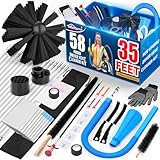
A more complete option is a professional air duct and dryer vent cleaning kit priced at $299.95. It includes five flexible rods measuring 3/8 inch outside diameter, forward- and reverse-action skipper balls, several air whips, and an air-controlled blowgun. The rods offer more reach and flexibility than a short whip, while the different heads are useful for cleaning both directions or working through a longer passage.
Neither product is a powered vacuum, an inspection camera, or a complete HVAC service. You still need compressed air, access points, collection equipment, protective gear, and enough time to seal nearby openings. The tool also does not automatically remove mold, grease, water damage, or firmly bonded construction debris.
Pros
- Lower equipment cost than frequent professional visits. A basic whip costs about $40 to $75, while a multi-piece kit commonly falls between $200 and $350. That can make sense for a homeowner, landlord, or small maintenance business with repeated cleaning needs.
- Good for targeted problems. Whips are useful for dusty branch lines, lint-filled dryer vents, short flexible ducts, and localized buildup around grilles. They can also help clean small ventilation runs in workshops, garages, and recreational vehicles.
- Reaches around bends. Flexible rods and tentacles can travel farther than a rigid brush, especially when the duct has moderate curves. Reverse-action heads may help pull material back toward the access opening.
- No motor in the cleaning head. The whip itself does not require a separate electric motor. That can be convenient in damp or cramped areas, although the air compressor still requires electricity and safe placement.
- Reusable. With cleaning and inspection after each job, a quality tool can be used many times. Replaceable heads or rods may extend the useful life of a larger kit.
- Useful beyond HVAC ducts. Some kits can handle dryer vents, dust-collection lines, and other smooth, appropriately sized passages. Always confirm the tool’s diameter and material compatibility first.
Cons
- Compressed air is the main limitation. A small tire inflator or compact compressor may not deliver the volume needed for consistent cleaning. Check the tool’s air-pressure and cubic-feet-per-minute requirements before buying. Pressure alone is not enough; the compressor must maintain airflow while the whip is running.
- It can spread dust. If the duct system is not sealed and connected to adequate collection equipment, the tool may push debris into rooms instead of removing it. Wear eye protection and a properly fitted respirator appropriate for the dust involved.
- Access is still required. You may need to remove registers, cut service openings, or reach the air handler. Creating new openings in insulated or lined ductwork can introduce sealing and insulation problems.
- Potential for damage. Aggressive tentacles can tear flexible duct, loosen internal insulation, damage dampers, or scratch delicate surfaces. Never force a whip through a restriction or use it on material you cannot identify.
- It does not clean the entire HVAC system by itself. Coils, blower compartments, drain pans, plenums, filters, and heat exchangers need separate inspection and cleaning procedures. A visibly clean register does not prove the whole system is clean.
- The learning curve is real. Effective cleaning depends on sealing, airflow direction, access planning, and knowing when to stop. The $299.95 kit offers more capability, but it also requires more setup and storage space than a single $46.95 whip.
Who Should Buy It
Buy a duct cleaning whip if you fit one or more of these situations:
- You already own a compressor that meets the tool’s air-delivery requirements.
- You have a recurring cleaning need, such as rental properties, a workshop, a small commercial space, or multiple dryer vents.
- You are comfortable removing grilles, sealing openings, using a vacuum, and inspecting the duct interior.
- The ducts are accessible and generally smooth, with light to moderate dust rather than water damage, mold growth, or heavy construction debris.
- You want a supplemental tool for maintenance rather than a one-time solution for an entire house.
The $46.95 short whip is the sensible starting point for occasional, localized work. The $299.95 kit is easier to justify for frequent jobs because it provides multiple lengths and cleaning heads. However, do not buy the larger kit simply because it looks more professional. Its value depends on repeated use and compatible air equipment.
Who Should Skip It
Skip a duct whip if you do not have a suitable compressor or if you expect it to transform a neglected HVAC system in one afternoon. It is also a poor choice for ducts with significant internal insulation damage, severe mold concerns, standing water, vermin contamination, or unknown hazardous debris.
Homeowners with asthma, severe allergies, or respiratory sensitivity should be especially cautious. Agitating settled dust can temporarily worsen indoor air quality. In those cases, professional containment and high-efficiency collection may be more important than the price of the cleaning head.
Skip it, too, if the only available access point is a tiny grille and you cannot verify where the tool is traveling. A camera inspection before cleaning is often more valuable than buying a stronger whip.
Cheaper Alternatives
| Option | Cost | Trade-off |
|---|---|---|
| Register vacuuming with a brush and household vacuum | $10–$40 for attachments or brushes | Affordable and low-risk for visible dust, but it reaches only a short distance and does not clean deep duct runs. |
| Drill-powered vent brush kit | $15–$45 | Useful for many dryer vents and straight sections; less suitable for fragile flexible ducts or complex HVAC layouts. |
| Shop vacuum with a long hose and soft brush | $100–$300 | Provides collection power and can be useful for accessible areas, but it may not agitate compacted debris deep inside a duct. |
| Rental vacuum or duct-cleaning equipment | $40–$150 per day, depending on equipment | More capable for a one-time project, but availability, setup, hose sealing, and operating instructions vary. |
| Professional duct cleaning | About $300–$700 for many homes | Highest upfront cost, but includes specialized collection, access planning, and cleaning of more system components. |
FAQ
Can a duct cleaning whip replace professional duct cleaning?
Usually, no. A whip can agitate debris in selected duct sections, but professional cleaning may also address the air handler, blower, coils, plenums, return system, and supply branches. A whip is best viewed as one tool in a cleaning process, not a complete service.
Do I need a shop vacuum with an air duct whip?
You need some form of effective debris collection. A shop vacuum may work for accessible residential sections if the hose, filter, and seals are appropriate, but a small household vacuum can clog quickly and may exhaust fine dust back into the room. Use the vacuum manufacturer’s filter guidance and do not run it without the required filter.
Are short, eight-tentacle whips effective?
They can be effective for short, accessible sections and localized dust. A 14-inch whip is not designed to reach every part of a large duct system. Its usefulness depends more on access, airflow, and debris collection than on the number of tentacles alone.
Is the $299.95 cleaning kit worth the upgrade?
It is worth considering if you expect to clean multiple ducts or dryer vents and already have compatible compressed-air equipment. The five 3/8-inch rods, forward and reverse heads, multiple whips, and blowgun provide more versatility than a single $46.95 head. For a one-time household job, renting equipment or hiring a professional will often deliver better value.
Bottom line: duct cleaning whips are worthwhile for informed users handling specific, accessible cleaning jobs. They are not a shortcut around proper inspection, containment, and whole-system cleaning. In 2026, the best buying decision is to match the tool to your compressor, duct material, access points, and actual cleaning goal—not simply choose the most powerful-looking kit.
Ready to decide? Our #1 pick for 2026 is the Register vacuuming with a brush and household vacuum.
Live price & availability on Amazon.


Write Your Review
No reviews yet. Be the first to share your experience!