
A dryer vent cleaning kit can look like a simple purchase: a flexible rod, a brush, and perhaps a vacuum adapter. In practice, the wrong kit can bend at the first turn, disconnect inside the duct, scratch a rigid vent, or leave a dangerous layer of lint behind. The best choice depends less on the number of pieces in the box than on the length, flexibility, connector design, and tools you will actually use.
One common mistake is buying the longest kit available without checking the route from the dryer to the exterior wall. Another is assuming that a 58-piece set offers more useful cleaning power than a six-piece kit with stronger rods. Shoppers also overlook whether the brush diameter fits a 4-inch dryer duct, whether the rods are compatible with a drill, and whether the kit includes a vacuum adapter rather than unrelated accessories.
As an Amazon Associate we earn from qualifying purchases at no extra cost to you.


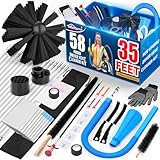

This dryer vent cleaning kit buying guide for 2026 focuses on the specifications that affect safety, reach, control, and value. It is intended for routine homeowner maintenance. If the vent is crushed, inaccessible, unusually long, shared by multiple dryers, or packed with heavy debris, hire a qualified professional instead of forcing a brush through it.
Decide These 3 Things First
- Measure the route. Estimate the distance from the back of the dryer to the exterior termination, including vertical sections and bends. A 12- to 15-foot kit may be sufficient for a short, straight run; a 30- to 35-foot kit provides more useful reach for many detached homes. Do not count on the advertised maximum if the rods cannot navigate your bends.
- Choose hand cleaning or drill-assisted cleaning. Hand-powered kits offer better control in fragile or sharply angled ducts. Drill-compatible rods can rotate the brush and loosen compacted lint, but they require a low-speed setting and careful tightening. A kit without a secure drill connection should not be used with a power drill.
- Decide whether vacuum extraction matters. Brushing breaks debris loose, but a vacuum attachment helps remove it. If you already own a shop vacuum, prioritize a kit with a usable adapter and a brush that can reach through the lint screen housing. Otherwise, a basic rod-and-brush kit may be enough for an exterior vent cleaning.
Size and Reach
Most residential dryer ducts have a nominal 4-inch diameter, so a brush around 4 to 4.5 inches wide is a practical starting point. A brush that is too small may skim over lint along the walls; one that is too large can bind, especially in a flexible or slightly crushed duct. Look for a rounded or tapered brush head rather than a rigid, oversized cylinder.
Common consumer kits measure 12, 20, 30, or 35 feet when all rods are connected. A 30- or 35-foot rating does not mean the tool is ideal for a 35-foot run. Every coupling adds some flex, and long assemblies can be difficult to push around bends. For a vent under 10 feet, a shorter kit is usually easier to control. For a route of 15 to 25 feet, 20- to 30-foot coverage is more practical. Buy extra length only when you have measured the route and can store the kit neatly.
Check the individual rod length as well. Rods measuring about 12 to 18 inches are easier to feed and remove than very long sections. They also let you stop if the brush meets resistance. A kit advertised as 35 feet may contain roughly two dozen short rods, so storage space and assembly time deserve attention.
Material and Brush Design
Look for rods made from fiberglass, nylon, or another corrosion-resistant flexible material. Fiberglass rods generally provide more stiffness for long runs, while nylon can feel more forgiving around bends. Metal rods may be durable, but uncoated metal can scratch duct interiors, damage foil-style transition hoses, or conduct electricity if used carelessly near an appliance.
Brush bristles should be firm enough to dislodge lint without being so stiff that they catch on seams. Nylon bristles are a common choice for routine cleaning. A brush head with bristles extending evenly around the circumference is more useful than one with sparse tufts. Confirm the connection between the brush and the first rod: it should be threaded, pinned, or otherwise mechanically secured rather than simply friction-fit.
For the transition hose behind the dryer, use extra care. Thin foil or semi-rigid ducting can tear when a brush is pushed aggressively. Remove and inspect the hose when possible, clean it separately, and replace it if it is crushed or damaged.
Construction and Connection Security
Construction quality matters most at the couplings. Threads should engage for at least several turns, and the assembled rod should not wobble excessively. A coupling that loosens while inside the duct can leave a brush or rod section stuck in the vent. Some kits include locking rings or small fasteners; these add setup time but improve security.
Before purchase, check whether the rods connect with clockwise or counterclockwise threads. If a drill spins the rods in the loosening direction, the assembly may separate during use. A kit designed for rotation should identify the correct direction and include a drill-compatible end with a hex shank or another secure interface.
Count the useful pieces, not just the total. A 58-piece set may include many rods, adapters, brushes, and small cleaning tools, but the core components are the rod sections, main brush, vacuum adapter, and drill connector. More parts can be worthwhile if they solve a specific access problem; otherwise, they may add clutter without improving results.
Comfort and Cleaning Performance
Cleaning a vent involves repeated pushing, pulling, twisting, and reassembly. A complete 30- to 35-foot rod assembly can become awkward, so a comfortable kit should allow you to add sections gradually. Threaded connections with knurled or textured surfaces are easier to tighten while wearing work gloves.
For drill-assisted use, select a low-speed setting—generally no more than about 600 revolutions per minute unless the manufacturer specifies otherwise. Keep the brush moving slowly, avoid forcing it past a tight bend, and reverse the rotation only when the instructions allow it. Never operate a rotating brush while the dryer is connected to power, and keep loose clothing, hair, and hands away from the drill.
A vacuum attachment is most useful when its opening fits your vacuum hose without a large air leak. Adapters commonly accommodate hose diameters around 1.25 to 2.5 inches, but compatibility varies. Measure your shop-vac hose before relying on an adapter included in a kit.
Price Tiers
Budget kits typically cost about $15 to $25. They often include a 12- to 30-foot rod assembly and one brush. A listing such as the approximately $19.99 Holikme 30-foot kit represents this category. These sets can work well for short, straight runs, provided the connections are secure and the brush matches the duct.
Midrange kits generally fall between $25 and $40. They are more likely to include a vacuum adapter, drill connector, multiple brush shapes, and enough rods for a 30- to 35-foot route. Examples in this range include kits priced around $28.49 and $34.99, as well as a roughly $20.99 kit when it is sold with fewer accessories or a simpler configuration. Compare the actual contents rather than assuming a higher price guarantees stronger construction.
Premium consumer kits usually cost about $40 to $70 or more. The value should come from better couplings, clearer compatibility information, replacement parts, a sturdy storage case, or a specialized brush—not merely a larger piece count. For occasional maintenance, a well-built midrange kit is often the sensible compromise.
Warranty and Replacement Support
A warranty is useful only when its terms are clear. Look for a stated coverage period of at least 12 months, a return window of 30 days or more, and a seller that identifies how replacement rods, brushes, or adapters are obtained. Some listings provide a satisfaction guarantee but exclude bent rods, worn bristles, or damage caused by drill use.
Check whether the warranty applies to every component or only the main tool. Save the receipt and inspect the kit immediately. If a rod is warped, a thread is incomplete, or the brush is detached from its fitting, request a replacement before assembling the full length. Do not continue using a kit after a coupling has repeatedly loosened.
Delivery and Assembly
Most kits require assembly, but the amount varies considerably. A 30-foot kit made from 15 two-foot sections takes longer to connect than one using fewer, longer rods. That is not automatically a disadvantage: shorter sections are easier to store and replace. Look for included instructions that explain assembly order, drill direction, brush attachment, and cleaning limits.
When ordering, confirm the package includes every adapter shown in the product photos. Marketplace listings can have multiple versions under nearly identical names. Check the delivered length, brush diameter, connector type, and vacuum opening before discarding the packaging. Store the rods dry and loosely coiled or straightened; sharp bends can permanently distort flexible sections.
Spec Checklist
| Spec | Budget | Mid | Premium |
|---|---|---|---|
| Typical price | $15–$25 | $25–$40 | $40–$70+ |
| Advertised reach | 12–30 ft | 20–35 ft | 30–40 ft |
| Brush diameter | 3.5–4 in | 4–4.5 in | 4–4.5 in, often with extras |
| Rod sections | 8–20 sections | 15–30 sections | Replaceable, reinforced sections |
| Drill connector | Not always included | Usually included | Secure hex or locking connector |
| Vacuum adapter | Sometimes included | Usually included | Multiple sizes or tighter fit |
| Warranty/support | Varies; verify | Often 12 months | 12 months or longer; verify |
Red Flags
- The listing gives a total length but not the number or length of individual rods.
- The brush diameter, bristle material, or duct compatibility is not specified.
- Photos show a drill connector, vacuum adapter, or storage case that is missing from the written contents list.
- Threads are described only as “universal,” with no warning about rotation direction.
- The seller promises professional or complete cleaning without explaining access limits or safe-use instructions.
- The kit includes metal rods with no information about protecting flexible foil ducting.
- There is no clear return policy, warranty contact, or replacement-parts information.
- The brush is visibly wider than the intended duct and has no tapered end for navigating bends.
FAQ
How long should a dryer vent cleaning kit be?
Measure the complete route first. A 12- to 15-foot kit suits many short runs, while a 20- to 35-foot kit offers more flexibility for longer or vertical routes. Leave some extra length, but do not buy an oversized assembly that becomes difficult to control.
Can I use a dryer vent cleaning kit with a cordless drill?
Yes, if the kit specifically includes a secure drill connector. Use the lowest practical speed, commonly 300 to 600 rpm, tighten every coupling, and stop immediately if the rods bind or begin to separate. Never use a drill on a damaged, crushed, or fragile duct.
Is a 58-piece kit better than a smaller kit?
Not necessarily. A larger count may include multiple adapters and small brushes rather than stronger rods. Compare the main brush, coupling design, usable reach, vacuum compatibility, and replacement support before comparing piece counts.
How often should I clean a dryer vent?
Inspect it at least once a year, and clean it sooner if drying takes longer, clothes feel unusually hot, the exterior flap barely opens, or lint accumulates around the dryer. Clean the lint screen after every load and have a professional assess vents that are inaccessible or damaged.
Ready to decide? Our #1 pick for 2026 is the Typical price.
Live price & availability on Amazon.


Write Your Review
No reviews yet. Be the first to share your experience!