
- Top Pick: IQAir Atem Car Portable HEPA Air Purifier
- Runner-up: LUFTRUM C401A Car Air Purifier
- Also consider: Westinghouse 1804 Portable Air Purifier
A car cabin is one of the smallest spaces where you spend serious time, and it collects exhaust fumes from traffic, dust from open windows, pollen in spring, pet hair, and food smells. Because the cabin stays sealed for much of a drive, whatever is in that air stays close to your breathing zone, which is why a vehicle purifier can help.
This guide covers five car air purifiers that take different approaches to the same problem, from a premium HyperHEPA headrest unit to a simple plug-in ionizer. Each one is made for vehicle use, running from a 12V outlet, a USB port, or a rechargeable battery, for different drivers, cabins, and budgets.
As an Amazon Associate, we earn from qualifying purchases.
Quick Answer
For most drivers, the LUFTRUM C401A is the most balanced choice, pairing H13 HEPA filtration with a PM2.5 sensor and automatic operation. Drivers who want the strongest filtration should consider the IQAir Atem Car, while the Westinghouse 1804 suits road trips with its rechargeable battery. The LUFT Duo fits cup holders, and the Clean Air ionizer is the simplest budget pick.
Table of Contents
- Quick Answer
- IQAir Atem Car
- LUFTRUM C401A
- Westinghouse 1804
- LUFT Duo
- Clean Air Ionizer
- How to Choose
- Who Should Skip
- Frequently Asked Questions
- Final Verdict
- Product and ASIN Reference
1. IQAir Atem Car Portable HEPA Air Purifier

The IQAir Atem Car is the flagship pick here and the first to consider when filtration strength matters most. It uses HyperHEPA Plus filter technology, capturing particles down to 0.003 microns, which covers fine exhaust soot, pollen, dust, and other ultrafine particles that slip through ordinary filters.
The unit attaches to a headrest, placing the outlet close to the breathing zone. Bluetooth app control changes fan speed from your phone, and it runs from the 12V outlet, switching off automatically to protect the car battery. It is larger than the cup-holder models below, so check headrest clearance first.
Specs
- Filtration: HyperHEPA Plus filter, captures particles down to 0.003 microns
- Odor and gas control: Activated carbon stage for gases, fumes, and odors
- Power: 12V DC car outlet, no built-in battery
- Mounting: Headrest mount included
- Control: Bluetooth app control
- Coverage: Up to 150 sq ft, as stated by the maker
2. LUFTRUM C401A Car Air Purifier
The LUFTRUM C401A is the most balanced car purifier in this guide, combining strong filtration with sensors that do the thinking for you. Its four-stage system pairs an H13 True HEPA filter with activated carbon, capturing particles down to 0.1 microns while the carbon layer works on fumes, VOCs, and odors. A built-in PM2.5 sensor reads the cabin air and adjusts the fan automatically, ramping up in heavy traffic and settling down on a clear road.
The fan spins at up to 5300 RPM while drawing only 4 watts, and the maker states the unit can cycle cabin air up to 10 times per hour. It switches on and off with the ignition and sits on the dashboard or between the front seats. The highest fan speed is audible, and the cord may be short for rear outlets.
Specs
- Filtration: 4-stage system with H13 True HEPA filter and activated carbon
- Particle capture: Down to 0.1 microns
- Sensor: Built-in PM2.5 sensor with automatic fan adjustment
- Fan: Up to 5300 RPM, 4 watts power draw
- Power: 12V car outlet with automatic on and off with the ignition
- Size and weight: 10.88 x 7.48 x 2.95 inches, 2.2 pounds
3. Westinghouse 1804 Portable Air Purifier
The Westinghouse 1804 is the pick for road trips and anyone who wants clean air with the engine off. Its rechargeable lithium-ion battery runs for up to 8 hours on a single charge, so it keeps working at a rest stop, in a parked car, or in a hotel room, and it recharges from the car while you drive. The three-stage system combines a True HEPA filter rated at medical grade H13 with a patented NCCO reactor that breaks down odors, VOCs, and smoke rather than only trapping them.
Two fan speeds and a silent mode are controlled by a single button, and a carry strap makes the 2-pound unit easy to move between vehicles. Replacement HEPA filters are sold in multi-packs. Drivers sensitive to ionizers should read the maker guidance first.
Specs
- Filtration: True HEPA filter, medical grade H13, plus patented NCCO reactor
- Battery: Rechargeable lithium-ion, up to 8 hours per charge
- Fan: Two speeds plus silent mode
- Size and weight: 6.3 x 6.3 x 3.46 inches, 2 pounds
- Coverage: Up to 100 sq ft
- Carrying: Woven and leather carry strap included
4. LUFT Duo Portable Air Purifier
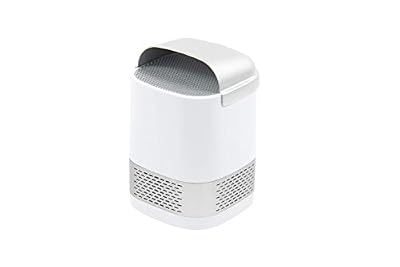
The LUFT Duo is the best cup-holder option here and the easiest to live with day to day. It uses photocatalytic nanotechnology instead of a disposable HEPA filter, so the washable filter rinses clean under a tap every few weeks and there is no regular filter purchase to remember. A vent cap and a cup holder are included in the box, and the 0.55-pound aluminum body drops into a standard cup holder.
Three fan speeds run from a USB Type-C cable, drawing 5 volts from any car USB port or power bank, and noise stays below 30 dB on the lower settings. The maker lists coverage up to 240 sq ft. It comes in four colors. It suits commuters who want steady, quiet filtration close by.
Specs
- Technology: Photocatalytic nanotechnology with washable filter, no disposable HEPA
- Power: USB Type-C, 5 volts
- Fan: Three speeds
- Noise: Listed below 30 dB
- Size and weight: 3 x 3 x 3.86 inches, 0.55 pounds
- Coverage: Up to 240 sq ft, as stated by the maker
5. Clean Air Improved Car Air Purifier Ionizer

The Clean Air ionizer is the simplest and most affordable way to tackle cabin odors. It plugs directly into the 12V car outlet and releases ions that help neutralize smoke, food smells, pet odors, and pollen, with no filter to buy and no maintenance beyond plugging it in.
Because it is an ionizer rather than a HEPA purifier, it does not trap dust and pollen the way a filter unit does, so it works best as an odor and freshness device rather than a heavy-duty particle cleaner. There is nothing to replace, clean, or configure. Choose this model when your main complaint is stale air and lingering smells on a short commute, and choose one of the HEPA models above when dust, pollen, or exhaust particles are the main concern.
Specs
- Technology: Ionizer, filter-free design with no replacement filters
- Power: 12V car outlet plug-in
- Targets: Odors, pollen, smoke, dust, and stale air
- Design: Compact portable plug-in unit
- Color: Blue
How to Choose the Best Air Purifier for Car
Start with filtration type, because it decides what the unit can actually remove. True HEPA filters trap fine particles such as dust, pollen, pet dander, and exhaust soot, and an activated carbon layer adds odor and gas control. Ionizers and photocatalytic units work differently, neutralizing odors and breaking down pollutants without a dense filter, which means lower maintenance but less particle capture.
Next, match power and placement to your car. A 12V plug-in unit with automatic on and off suits a daily commuter, while a USB model fits cars with spare ports and a rechargeable battery model suits road trips and parked use. Measure the mounting spot first: cup holders suit small units, vent clips suit slim ionizers, headrest mounts suit larger ones.
Check noise, filter costs, and sensor features before ordering. Look for a stated decibel figure and more than one fan speed. Confirm that replacements for your exact model are sold and note the recommended interval. A PM2.5 sensor with automatic mode is worth having on a commute through traffic, because it raises the fan when pollution spikes and quiets down when the air clears. Finally, check ozone: look for an ozone-free design or CARB certification.
Who Should Skip a Car Air Purifier
A car air purifier is not for everyone. If you replace your cabin air filter on schedule, drive mostly with the windows open on clean rural roads, and have no odor or allergy complaints, a separate purifier adds little. Drivers who expect a small cup-holder unit to clean a large SUV or van cabin in minutes will also be disappointed, since these devices clean a personal zone or a small cabin gradually.
Skip ionizer-only models when your main problem is dust or pollen, since they do not trap particles the way a HEPA filter does. Skip premium headrest units when your car has fixed headrests or no mounting point. A purifier also cannot fix an exhaust leak, a moldy cabin filter, or smoking inside the car, so fix the source first.
Frequently Asked Questions
Does a car air purifier replace the cabin air filter?
No. The cabin air filter sits in the ventilation system and screens the air coming into the car, while a portable purifier cleans the air already inside the cabin. Replace the cabin filter on schedule and use a portable purifier as an extra step for odors and fine particles.
Where should I place a car air purifier?
Place it as close to the breathing zone as practical without blocking your view or controls. Cup holders suit small cylindrical units, headrest mounts suit premium units aimed at one seat, and a dashboard or center console spot suits flat models with a stable base. Keep the intake clear so the fan can draw air freely.
Do car air purifiers need a power outlet while driving?
Most do. Plug-in models run from the 12V outlet or a USB port and usually switch on and off with the ignition, so they need no attention. Battery models such as the Westinghouse 1804 run cord-free for hours and recharge while you drive, which suits parked use.
How often do car purifier filters need replacing?
It depends on the model and how much you drive. HEPA filters in car units often last for several months of daily driving, and some makers state a filter life in operating hours, so check the manual for your exact model. Ionizer and photocatalytic models have no HEPA filter to replace.
Final Verdict
The LUFTRUM C401A is the strongest all-around pick, with H13 HEPA filtration, a PM2.5 sensor, and automatic operation. Drivers who want the deepest filtration should step up to the IQAir Atem Car, and frequent road trippers should pick the battery-powered Westinghouse 1804. The LUFT Duo is the quiet cup-holder choice with no disposable filters, while the Clean Air ionizer covers basic odor control. Match the filtration type to your main complaint, measure the mounting spot, and confirm filter availability before ordering.








Write Your Review
No reviews yet. Be the first to share your experience!