
- Top Pick: Etekcity Lasergrip 1080
- Runner-up: Fluke 62 MAX+
- Also consider: Etekcity Lasergrip 774
An infrared thermometer reads surface temperature without touching the surface, which makes it one of the most useful diagnostic tools in a home or HVAC kit. Point it at a supply register, a duct seam, a motor housing, or a hot water pipe, pull the trigger, and the reading appears in under a second. That speed matters when you are tracing a cold spot along a duct run or comparing registers in a room.
The catch is that a low reading on a shiny metal duct does not always mean the duct is cold. Distance-to-spot ratio, emissivity, and temperature range all change what the number on the screen means. The five models below run from a simple everyday gun to a rugged job-site instrument.
As an Amazon Associate, we earn from qualifying purchases.
Quick Answer
For most HVAC and home use, the Etekcity Lasergrip 1080 is the best infrared thermometer because it combines a wide temperature range, adjustable emissivity, and a clear backlit display in a simple trigger-style gun. Homeowners who want the simplest option should look at the Lasergrip 774, while technicians who need tougher construction and dual-laser targeting should consider the Fluke 62 MAX+.
1. Etekcity Lasergrip 1080

The Lasergrip 1080 is the most versatile gun in this roundup, covering the widest spread of household and HVAC jobs without adding complexity. Its range reaches high enough for furnace flues and heat exchangers, yet it still reads cold surfaces such as air conditioning coils. The adjustable emissivity setting separates it from cheaper fixed-emissivity guns, because it lets you correct readings on different materials instead of accepting the default setting.
Walk through a home, aim at each supply register from the same distance, and you can spot one running noticeably cooler than the rest, which often points to a damper, duct leak, or insulation gap upstream. Note that older listings for this model showed a lower top end of the range, so confirm the range on the listing and the box before relying on it for very hot surfaces.
Specs
- Temperature range: minus 58 to 1130 degrees Fahrenheit
- Distance-to-spot ratio: 12 to 1
- Emissivity: adjustable from 0.1 to 1.0
- Display: backlit LCD with maximum temperature hold
- Laser: single targeting laser
- Power: two AAA batteries, included
- Weight: about 6.4 ounces
2. Fluke 62 MAX+

The Fluke 62 MAX+ is the professional pick in this group, built for technicians who use an infrared thermometer every day and need it to survive the job site. It is drop rated to three meters, carries an IP54 rating against dust and splashing water, and clips to a tool belt. The dual rotating lasers mark the edges of the measurement area, which removes much of the guesswork about which circle of surface the sensor is averaging.
For HVAC diagnostics, the 62 MAX+ adds Min, Max, Average, and Difference readouts plus high and low alarms, which help when you are comparing supply and return temperatures. Its top end reaches 1202 degrees Fahrenheit, covering furnace and flue work that budget guns cannot reach. The trade-off is a steeper learning curve and a manual that is mostly pictograms, so allow a few minutes to learn the modes before the first job.
Specs
- Temperature range: about minus 22 to 1202 degrees Fahrenheit
- Distance-to-spot ratio: 12 to 1
- Emissivity: adjustable from 0.10 to 1.00
- Display: large backlit LCD with Min, Max, Average, and Difference readouts
- Lasers: dual rotating targeting lasers
- Protection: IP54 rated for dust and splashing water, drop rated to three meters
- Alarms: high and low temperature alarms
- Power: single AA battery
3. Etekcity Lasergrip 774
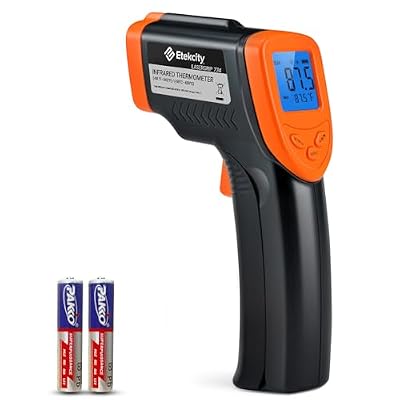
The Lasergrip 774 is the simplest gun here, and simplicity is its main selling point. It has one button to measure, a laser pointer switch, and an adjustable emissivity control, with no extra modes to learn or accidentally change. For a homeowner who wants to check a vent, find a drafty window frame, or compare radiators from room to room, that is exactly enough tool.
Its range tops out at 842 degrees Fahrenheit, which covers nearly all home heating and cooling work, including furnace cabinets, ductwork, and hot water pipes. It lacks the Min, Max, and Average calculations of the Fluke, but for routine home checks, its low weight and one-button operation make it the gun most people will actually reach for.
Specs
- Temperature range: minus 58 to 842 degrees Fahrenheit
- Distance-to-spot ratio: 12 to 1
- Emissivity: adjustable from 0.1 to 1.0
- Display: backlit LCD with maximum temperature hold
- Response time: about half a second
- Laser: single targeting laser with on and off switch
- Power: two AAA batteries, included
- Weight: about 5.6 ounces
4. ThermoPro TP30

The ThermoPro TP30, now listed under the TempPro name, is a strong middle option that pairs a wide range with adjustable emissivity in a straightforward design. Its top end of 1022 degrees Fahrenheit sits between the 774 and the Fluke, covering oven and grill surfaces as well as furnace and duct work. Emissivity adjusts from 0.1 to 1.0, the full spread you need for painted ductwork, bare metal, and plastic grilles.
What makes the TP30 appealing for HVAC use is its consistency across repeated readings. When you are sweeping a duct run for a cold section, a gun that gives the same reading on the same spot every time is more valuable than one with extra features. Note that this model has changed brand names on its listing from ThermoPro to TempPro, so the box may show either name for the same TP30 model.
Specs
- Temperature range: minus 58 to 1022 degrees Fahrenheit
- Distance-to-spot ratio: 12 to 1
- Emissivity: adjustable from 0.1 to 1.0
- Display: backlit LCD with maximum temperature hold
- Response time: about half a second
- Laser: single targeting laser
- Power: battery powered, batteries included
5. Etekcity Lasergrip 1025D
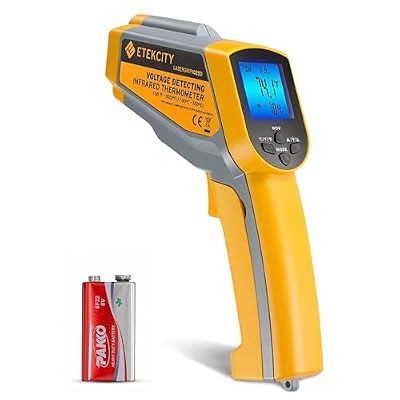
The Lasergrip 1025D stands out in this roundup for one reason: it adds a non-contact voltage tester to a dual-laser infrared thermometer. For anyone who works around electrical panels, furnace wiring, or blower motors, one tool can confirm a surface temperature and check whether a wire or terminal is live before you touch it. The dual lasers also make it easier to see the measurement area when you are aiming into a crowded air handler or across a room at a ceiling register.
Beyond that extra feature, the 1025D is a capable general-purpose gun, with the same range, adjustable emissivity, and 12 to 1 ratio as the rest of this group. The voltage tester is a convenience feature, not a replacement for a proper multimeter. Treat it as a quick screening check, and use rated electrical test equipment for anything beyond that.
Specs
- Temperature range: minus 58 to 1022 degrees Fahrenheit
- Distance-to-spot ratio: 12 to 1
- Emissivity: adjustable from 0.1 to 1.0
- Lasers: dual targeting lasers
- Extra feature: built-in non-contact voltage tester
- Display: backlit LCD
- Power: battery powered
How to Choose an Infrared Thermometer
Start with the temperature range. For home HVAC work, a gun that reads from below freezing to at least 800 degrees Fahrenheit covers registers, ducts, radiators, and furnace cabinets. If you also want to check flues or heat exchangers, look for a top end above 1000 degrees Fahrenheit, which is where the 1080, the TP30, and the Fluke 62 MAX+ sit.
Next, understand the distance-to-spot ratio, because it decides how close you need to stand. A 12 to 1 ratio means that from 12 inches away, the sensor averages a circle about one inch wide, and from 24 inches away that circle is about two inches wide. Stand too far back and the reading blends the register with the wall around it. All five guns here use a 12 to 1 ratio.
Emissivity is the setting most people ignore and the one that causes the most confusing readings. Shiny bare metal reflects infrared energy and reads colder than it really is, while painted or matte surfaces read closer to their true temperature. Every model here offers adjustable emissivity, and a small piece of matte black tape on a shiny duct gives the gun something consistent to read.
Who Should Skip an Infrared Thermometer
An infrared thermometer is the wrong tool when you need the temperature inside something rather than on its surface. It cannot read the internal temperature of food, the water temperature inside a pipe, or the air temperature in the middle of a room. For air temperature, a probe thermometer or a room thermometer is the right instrument.
You should also skip a basic infrared gun if your work involves mostly shiny, unpainted metal and you are not willing to adjust emissivity or use tape on the surface, because the readings will mislead you more than they help. People who need certified accuracy for safety or compliance work should look at calibrated instruments with documentation instead. And do not use any of the models here to measure human body temperature: they are designed for inanimate surfaces only.
Frequently Asked Questions
Can an infrared thermometer measure air temperature coming out of a vent?
Not directly. It measures the surface of whatever it is pointed at, so aiming it into a stream of air gives an unreliable reading. To check a register, point it at the grille and take readings from the same distance each time.
Why does my infrared thermometer read low on a shiny metal duct?
Shiny metal has low emissivity, so it reflects infrared energy and the gun interprets that as a lower temperature. Set the emissivity to match the surface, or stick a small piece of matte tape on the duct and aim at the tape.
What distance should I stand from the surface I am measuring?
Follow the distance-to-spot ratio. With a 12 to 1 gun, standing 12 inches away measures a circle about one inch across, and standing 24 inches away measures a circle about two inches across. For small targets, step closer so the circle stays on the target and not on the surrounding wall.
Do I need dual lasers or adjustable emissivity for home HVAC checks?
Adjustable emissivity is worth having, because home HVAC systems mix painted ductwork, bare metal, plastic grilles, and insulation, and each surface reads differently. A single-laser gun with adjustable emissivity, such as the Lasergrip 774 or 1080, handles most home checks well.
Final Verdict
The best infrared thermometer for most HVAC and home use is the Etekcity Lasergrip 1080, because it pairs a wide range with adjustable emissivity, a clear backlit display, and a simple trigger design. The Fluke 62 MAX+ is the right upgrade for technicians who need dual-laser targeting, Min, Max, and Average readouts, and a body that survives drops and dust. Homeowners who want the simplest tool should choose the Lasergrip 774, while the ThermoPro TP30 and the Lasergrip 1025D cover the middle ground. Whichever model you choose, learn the distance-to-spot ratio and the emissivity setting first, because those two habits decide whether the number on the screen means anything.








Write Your Review
No reviews yet. Be the first to share your experience!