
- Top Pick: Final Verdict
- Runner-up: Final Verdict
- Also consider: Final Verdict
A sump pump sits in a pit below the basement floor, waits for groundwater to rise, and moves that water outside before it can reach carpet, drywall, or stored belongings. When it fails during a heavy storm, the damage can spread across a whole lower level in a single night.
The best sump pump for your home depends on how much water your pit collects, how high the water must be lifted, and whether you need protection during a power outage. The five pumps below cover that range, from a budget utility pump to a cast iron workhorse and a battery backup system.
As an Amazon Associate, we earn from qualifying purchases.
Table of Contents
- Quick Answer
-
- Wayne CDU800
-
- Zoeller M53 Mighty-Mate
-
- Wayne WSS30VN Combination System
-
- Superior Pump 91250
-
- Basement Watchdog Emergency BWE
- How to Choose a Sump Pump
- Who Should Skip These Pumps
- Frequently Asked Questions
- Final Verdict
- Product and ASIN Reference
Quick Answer
For most basements, the Wayne CDU800 is the top pick, with a 1/2 HP motor, up to 5,100 gallons per hour of flow, and a vertical float switch that fits narrow pits. If your basement floods during power outages, add the Basement Watchdog Emergency BWE as a battery backup. For light, occasional water, the Superior Pump 91250 covers the basics on a budget.
1. Wayne CDU800
The Wayne CDU800 is a 1/2 HP submersible sump pump with a cast iron housing and corrosion resistant steel body. It moves up to 5,100 gallons per hour, enough for basements that flood quickly in storms. The integrated vertical float switch turns the pump on and off automatically, and because the float moves straight up and down, the pump fits pits as small as 11 inches in diameter. A top suction design draws water from above the pit floor to resist clogging, and the float switch is tested to one million cycles. It carries a 3-year warranty and is assembled in the USA.
Specs
- Motor: 1/2 HP, 115 volt
- Maximum flow: 5,100 gallons per hour
- Maximum lift: 20 feet
- Discharge: 1-1/2 inch
- Float switch: integrated vertical float, tested to one million cycles
- Power cord: 8 feet
- Construction: cast iron and corrosion resistant steel
- Warranty: 3 years
- Tier: mid-range
2. Zoeller M53 Mighty-Mate
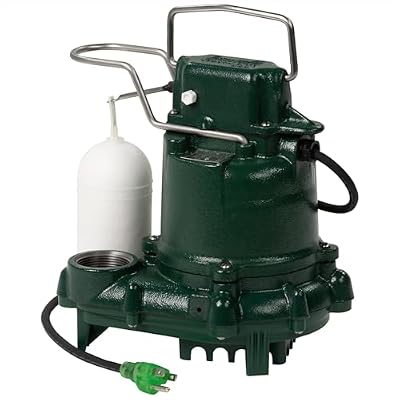
The Zoeller M53 Mighty-Mate is one of the most widely installed residential sump pumps, and its reputation rests on a simple, durable design. A 3/10 HP motor drives a non-clogging vortex impeller that passes solids up to 1/2 inch without a screen, so nothing catches debris and stalls the pump. The cast iron motor housing is oil filled for cooling, and each pump is factory tested in water before it ships. Stainless steel hardware resists corrosion, and an LED power plug shows at a glance whether the pump has power.
Specs
- Motor: 3/10 HP, sold as 1/3 HP, 115 volt
- Maximum flow: 43 gallons per minute
- Maximum lift: 19.25 feet
- Discharge: 1-1/2 inch NPT
- Float switch: snap action float with stainless steel guard
- Power cord: 9 feet
- Solids handling: up to 1/2 inch
- Construction: cast iron housing with engineered plastic base
- Warranty: 3 years
- Tier: mid-range
3. Wayne WSS30VN Combination System
The Wayne WSS30VN is a pre-assembled combination system that pairs a 1/2 HP primary sump pump with a 12 volt battery backup pump in one unit. The primary pump moves up to 5,100 gallons per hour, while the backup pump moves up to 2,700 gallons per hour when the power goes out or the main pump cannot keep up. Because the system arrives pre-assembled, installation is simpler than building a two-pump setup. The primary pump uses a top suction design that reduces clogging and removes the need for a vent or weep hole, and the backup pump runs on a deep cycle battery of 40 or 75 amp hours, sold separately. A 3-year warranty covers the system.
Specs
- Primary motor: 1/2 HP, 115 volt
- Backup motor: 12 volt DC
- Primary flow: up to 5,100 gallons per hour
- Backup flow: up to 2,700 gallons per hour
- Discharge: 1-1/2 inch
- Float switch: integrated vertical float
- Battery: deep cycle battery required, 40 or 75 amp hour, sold separately
- Construction: cast iron and steel primary pump
- Warranty: 3 years
- Tier: premium
4. Superior Pump 91250
The Superior Pump 91250 is the budget pick in this roundup, a compact and portable option for occasional water removal. Its 1/4 HP motor moves up to 1,800 gallons per hour and lifts water up to 25 feet, enough to drain a flooded window well, a shallow pit, or a pool cover. A removable suction screen filters large debris, and the pump handles solids up to 1/8 inch. It has no float switch, so it runs only while plugged in and must be watched during use. That makes it a manual helper rather than a set-and-forget basement pump, but it fits inside a 6-inch opening and connects to a garden hose through the included adapter. It is UL and CUL listed, CSA certified, and backed by a 1 year limited warranty.
Specs
- Motor: 1/4 HP, 120 volt
- Maximum flow: 1,800 gallons per hour
- Maximum lift: 25 feet
- Discharge: 1-1/4 inch NPT with 3/4 inch garden hose adapter
- Float switch: none, manual operation
- Power cord: 10 feet
- Solids handling: up to 1/8 inch
- Construction: thermoplastic
- Warranty: 1 year limited
- Tier: budget
5. Basement Watchdog Emergency BWE
The Basement Watchdog Emergency, model BWE, is a dedicated battery backup sump pump that sits beside your main pump and takes over when the power fails, the main pump fails, or inflow exceeds the main pump capacity. It moves up to 2,000 gallons per hour at ground level and 1,000 gallons per hour at a 10 foot lift, and it can pump continuously for up to 6 hours on a charged battery. A 24/7 monitoring controller watches the pump, power, and battery, sounds an alarm when something goes wrong, and lights an indicator that identifies the problem and the fix. A dual float switch uses two micro-reed floats for redundancy, and an automatic charger keeps the battery full. The battery is sold separately, and the system carries a 2 year limited warranty.
Specs
- Power source: 12 volt DC battery backup, 115 volt AC charger
- Maximum flow: 2,000 gallons per hour at 0 feet, 1,000 gallons per hour at 10 feet
- Float switch: dual micro-reed float switch
- Controller: 24/7 monitoring with alarm and indicator lights
- Charger: automatic, prevents overcharging
- Battery: sold separately, matching model BW-27AGM
- Continuous run time: up to 6 hours
- Warranty: 2 years limited
- Tier: mid-range
How to Choose a Sump Pump
Start with horsepower and flow. A 1/3 HP pump suits light to moderate inflow, while a 1/2 HP pump handles heavier inflow and higher lifts. Compare flow at the same lift height, since a pump rated at 5,100 gallons per hour at ground level moves far less water at a 10 foot lift. Measure the distance from the pit to the discharge point outside, then check the pump curve for that height.
Next, measure the pit. A vertical float switch fits pits as small as 10 to 11 inches in diameter, while a tethered float needs more room to swing. Most residential pumps use a 1-1/2 inch discharge, and the pipe, check valve, and fittings should match.
Think about power outages before you buy. A battery backup pump or a combination system protects the basement when the main pump loses power, which is exactly when storms bring the most water. Budget for the battery, since most backup pumps ship without one, and test the setup twice a year by pouring water into the pit. Cast iron housings last longer in a harsh pit than thermoplastic, and longer warranties usually signal a maker that stands behind the motor and switch. Fit a check valve to stop water flowing back into the pit, and route the outlet well away from the foundation.
Who Should Skip These Pumps
Skip a standard residential sump pump if your pit collects sewage or water with large solids, since that job calls for a sewage or effluent pump. Skip a submersible pump if your pit is too shallow or too narrow, because a float switch that cannot move freely will either run dry or never start. Skip a battery backup if you never lose power and your main pump has never been overwhelmed. Skip a manual utility pump like the Superior Pump 91250 as a primary basement pump, because it has no float switch and cannot protect the basement while you are away. Homes with very high inflow should skip 1/4 HP and 1/3 HP models and move straight to a 1/2 HP or larger pump.
Frequently Asked Questions
What size sump pump do I need for my basement?
Match the pump to inflow and lift. A 1/3 HP pump covers light to moderate inflow, while a 1/2 HP pump suits heavy inflow or a lift of 10 feet or more. Compare pumps by flow at your lift height, not maximum flow.
How long do sump pumps last?
A well made residential sump pump often lasts 7 to 10 years, though heavy use, gritty water, and frequent cycling shorten that span. Replace a pump that runs loudly, cycles rapidly, or fails to keep up with inflow.
Do I need a battery backup sump pump?
A battery backup is worth it if your area loses power during storms, since outages and heavy rain often arrive together. The backup pump takes over when the main pump has no power or fails. The battery is usually sold separately and needs periodic checks.
Can I install a sump pump myself?
Many homeowners install a submersible sump pump in an existing pit with basic tools, a check valve, and PVC pipe. The work involves setting the pump level, connecting the discharge pipe, and routing the outlet away from the foundation. If the pit needs digging or electrical work is involved, hire a licensed plumber or electrician.
Final Verdict
The Wayne CDU800 is the best sump pump for most basements, with a 1/2 HP motor, strong flow, a vertical float for narrow pits, and a 3-year warranty at a mid-range tier. The Zoeller M53 suits buyers who want a proven cast iron pump with a clog resistant vortex impeller, while the Wayne WSS30VN covers homes that need a primary pump and a battery backup in one pre-assembled unit. For light or occasional water, the Superior Pump 91250 handles the job on a budget, and the Basement Watchdog Emergency BWE is the simplest way to add outage protection beside an existing pump. Measure your pit, check your lift height, and choose the pump that matches your basement.









Write Your Review
No reviews yet. Be the first to share your experience!