
- Top Pick: Repa Market 4" Inch 90° Degree Duct Male Fit Connector – Round Metal Inlet-Outlet Elbow Bend – Galvanized Steel Dryer Vent Pipe Adapter for HVAC Home or Industrial Ventilation
- Best Value: Four Inches
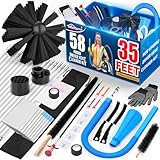
- Premium Choice: Particle Furnace Cleaning Brush, 4"/6" Brush,Chimney Brush,Dryer Vent Cleaner Kit,Flexible Rods (15PcsRods+1Pcs 4"+1Pcs 6" Brush)
Choosing between a four inch vs six inch duct brush is less about getting the biggest cleaning head and more about matching the brush to the duct opening, the debris inside it, and the amount of room available to maneuver. A brush that is too large can scrape, jam, or damage flexible ductwork. One that is too small may clean slowly and leave dust along the edges.
For most household dryer vents, bathroom exhaust runs, and narrow round ducts, a four-inch brush is the practical starting point. A six-inch brush makes more sense for larger rigid ducts, fireplace flues, furnace components, and broad openings where coverage matters more than flexibility. The right choice in 2026 depends on your duct diameter, the length of the run, and whether you are cleaning occasionally or maintaining several vents.
As an Amazon Associate we earn from qualifying purchases at no extra cost to you.


Quick Verdict
Choose a four-inch duct brush when you need precision, easier handling, and access through a standard four-inch dryer vent. It is lighter on the duct walls, more likely to pass through bends, and generally costs less when purchased as a replacement head.
Choose a six-inch duct brush when the opening is at least six inches wide, the duct is relatively straight, or you want to cover more surface with each pass. It can speed up cleaning in larger round ducts, but it needs more clearance and can be awkward in tight elbows.
If you are uncertain, measure the inside diameter of the duct rather than relying on the outside size of a connector. The brush should fit into the opening without being tightly compressed. Never force a six-inch head into a four-inch duct.
Side by Side
| Factor | Four-inch duct brush | Six-inch duct brush |
|---|---|---|
| Comfort | Usually easier to push, twist, and control; commonly weighs about 2 to 6 ounces for the head | Requires more hand pressure and may weigh about 4 to 10 ounces for the head |
| Durability | Good for routine lint and dust; narrow bristles may bend if aggressively forced | Often handles heavier debris well, but wider bristles can deform in undersized ducts |
| Price range | About $8 to $25 for a head; complete rod kits commonly run $20 to $45 | About $10 to $30 for a head; complete kits commonly run $22 to $50 |
| Maintenance | Rinses and dries quickly; easier to inspect for trapped lint | Collects more debris per pass and may take longer to rinse and dry |
| Space needed | Works in ducts around 4 inches wide and in tighter bends | Needs an opening near 6 inches or larger and more turning clearance |
| Look and feel | Compact, light-duty appearance suited to household vent cleaning | Larger, fuller head with a more substantial feel |
| Resale or reuse | Useful to more homeowners because four-inch venting is common | More specialized, but valuable if you own larger ducts or chimney tools |
| Best for | Dryer vents, bathroom exhausts, small HVAC branches, and apartments | Six-inch HVAC ducts, furnace cleaning, fireplaces, chimneys, and broad rigid runs |
| Typical reach | Often paired with flexible rods measuring 10 to 20 feet in a household kit | Often paired with rods of similar length, though straighter runs are easier |
Where Four Inch Wins
The four-inch brush has a major advantage: it matches one of the most common residential vent sizes. Standard dryer vent connections are frequently four inches in diameter, so this brush can clean from the exterior termination or from a disconnected interior section without excessive pressure.
Its smaller profile also helps when a duct contains a 90-degree turn. A brush head roughly four inches across can flex through a properly sized elbow more readily than a six-inch head. That matters in apartments, older homes, and laundry rooms where the dryer sits close to the wall and the vent path is not perfectly straight.
A four-inch head is also easier to use with a drill attachment, provided the brush system is designed for powered cleaning and the manufacturer permits it. Keep the drill at a low speed; high speed can twist flexible rods, loosen connections, or damage foil-style ducting. For manual cleaning, the smaller head creates less resistance, which is helpful for a homeowner working overhead or reaching behind an appliance.
Replacement cost is another advantage. A basic four-inch head can cost around $8 to $15. For example, the listed “Four Inches” option is priced at $7.92, while a broader particle furnace cleaning kit containing both 4-inch and 6-inch brushes and 15 flexible rods is listed at $22.99. A combination kit can be economical if you clean different vent sizes, but a single four-inch head is usually the simplest purchase for a dryer-only task.
Choose soft or medium bristles for flexible ductwork. Stiffer bristles are useful for metal ducts, but they should not be pushed aggressively against thin foil, plastic, or fabric-lined sections.
Where Six Inch Duct Brush Wins
A six-inch brush covers more wall area in a single pass. In a duct with an inside diameter close to six inches, its fuller bristle pattern can loosen settled dust, cobwebs, and light debris efficiently. It is particularly useful for accessible furnace compartments, larger HVAC branches, fireplace openings, and chimney-cleaning setups.
The wider head can also feel more stable in a straight metal duct. Instead of moving loosely through the center, the bristles make broader contact with the walls. That can reduce the number of passes needed, although actual cleaning speed depends on the rod length, debris level, and how many bends are in the system.
Six-inch brushes are not only sold for air ducts. A listed 6 Inch Dryer Vent Cleaner Brush Head costs $9.99 and includes a 3/8-inch hex shaft drill attachment. Another combination kit includes both four- and six-inch heads. These products illustrate why diameter and attachment style should be considered together: a brush may fit the opening but still be incompatible with your rods, drill adapter, or access point.
The tradeoff is maneuverability. A six-inch head can bind in a smaller elbow, especially if the bristles are stiff. It can also push loose debris forward rather than sweep it out if the duct is packed. Before buying, measure the opening, identify the duct material, and check whether the brush head’s connector matches your existing rods. For an exposed six-inch round connection, a component such as the Repa Market 4-inch 90-degree galvanized steel connector, listed at $21.45, may help with a compatible four-inch section, but it does not turn a four-inch brush into a six-inch tool. Match every connector to the actual duct dimensions.
Cost Over 5 Years
For occasional household use, the five-year cost difference is usually modest. A basic four-inch brush head may cost $8 to $15, while a better-constructed head or short rod set may cost $20 to $35. A six-inch head commonly falls between $10 and $20, with complete kits reaching $50.
Consider a homeowner who cleans one dryer vent twice a year. A $10 four-inch head, rinsed after each use and stored dry, could last the full five years. The five-year equipment cost would be about $10, or roughly $1 per year. If the head wears out after two or three years, buying two would bring the total to about $20.
A six-inch setup might cost $15 for the head plus $10 to $30 for compatible rods or an adapter. If it is used only on one larger duct, the five-year cost could be $15 to $45. A dual-size $22.99 kit may offer better value for a home with both four-inch dryer venting and six-inch furnace or chimney openings.
These estimates exclude a drill, replacement rods, shipping, and professional cleaning. The least expensive brush is not the best value if its connector does not fit your rods or if it cannot pass through your duct’s bends.
Which One for Your Home
Small apartment
Choose a four-inch brush for a standard dryer vent or bathroom exhaust. Storage is easier, and the smaller head is less likely to bind in a short, crowded vent path. A compact rod kit is preferable when you have limited closet space.
Family with kids and pets
A four-inch brush is usually best for the dryer vent because lint buildup is the primary concern and the size matches common dryer ducting. If your home has a six-inch HVAC branch or fireplace, consider a dual-size kit so you can use the correct head rather than forcing one brush everywhere.
Rental
Buy a four-inch brush if you are responsible for routine dryer maintenance and can access the vent without altering the property. Avoid rigid or overly aggressive tools in unfamiliar ductwork. Ask the landlord or property manager before cleaning shared HVAC or chimney systems.
Long-term home
A six-inch brush can be worthwhile if your home has larger rigid ducts, a furnace room, or a fireplace. For the most flexibility, a kit with both four- and six-inch heads and 15-foot or longer rods may cover several maintenance jobs. Keep each head labeled by size to prevent accidental use in the wrong duct.
FAQ
Can I use a six-inch brush in a four-inch duct?
No. An oversized brush can jam, scrape the duct, damage flexible walls, or become difficult to remove. Use a brush that is sized for the duct’s inside diameter and allow enough clearance for the bristles to flex.
Is a four-inch brush only for dryer vents?
No. It can also work for small bathroom exhaust ducts, narrow HVAC branches, and other round passages near four inches wide. Confirm the duct material and brush stiffness before cleaning.
Should I use a drill with either brush?
Only when the brush head, rods, and attachment are designed for powered use. Start at low speed, keep the rods aligned, and stop if the tool catches. Manual rotation is safer for fragile flexible ducting.
Do I need both sizes?
Not necessarily. Buy four inches for common residential dryer and exhaust work; buy six inches for larger openings and straight rigid ducts. A combination kit is sensible when your home contains both sizes and costs less than purchasing several compatible parts separately.
Ready to decide? Our #1 pick for 2026 is the Comfort.
Live price & availability on Amazon.


Write Your Review
No reviews yet. Be the first to share your experience!