
No airflow from one bedroom vent indicates a localized restriction inside your home heating and cooling distribution system. Uncovering whether a disconnected duct, closed register damper, or blocked ductwork line causes this drop restores balanced temperature. Taking prompt action keeps indoor climate uniform and efficient.
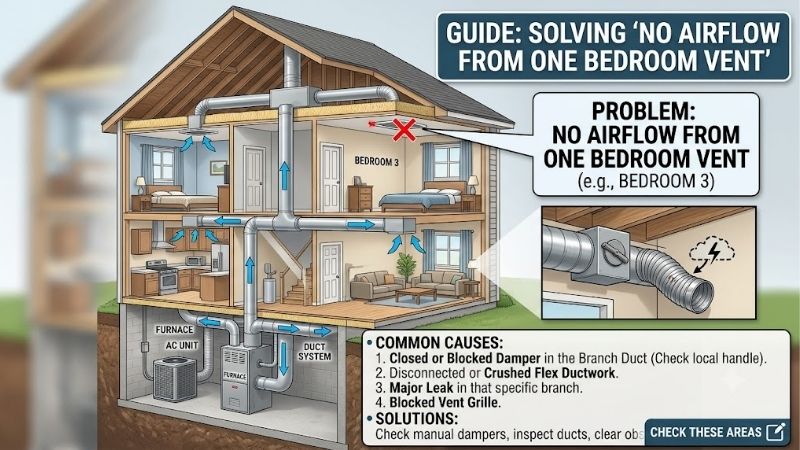
How to Choose the Right No Airflow From One Bedroom Vent Solutions
When experiencing no airflow from one bedroom vent, systematically evaluating your ductwork setup prevents buying incorrect accessories. Identifying the underlying cause allows you to choose effective register fans, sealant tapes, or smart dampers. Tailoring your strategy restores ventilation without harming central HVAC fan performance.
Inspecting Branch Duct Connections
First check if flexible duct branches disconnected completely from main supply trunks in attics or crawl spaces. Dislodged duct runs dump conditioned air into unconditioned spaces, completely cutting supply to isolated bedroom registers. Reconnecting loose collars with foil tape restores full volume rapidly across distant bedrooms.
Visual inspections uncover crushed flexible inner liners that obstruct normal air movement without obvious outer damage. Replacing collapsed flex ducting or securing hanging straps eliminates severe resistance along long runs. Addressing physical structural defects ensures newly added booster fans operate with maximum airflow capacity.
Checking Register Dampers and Louvers
Manual volume dampers hidden inside duct branches often slip shut accidentally, blocking supply pathways completely. Inspecting basement or attic ductwork for external damper handles reveals whether internal metal blades restricted delivery. Realigning damper handles parallel to duct lines instantly restores full volume to cold rooms.
Ensure floor and ceiling wall registers open fully before investing in active ventilation equipment. Seized internal register mechanisms can be freed or replaced with high-flow vent covers to eliminate localized restrictions. Verifying unrestricted register opening prevents unnecessary spending on secondary booster fan devices.
Evaluating Distance and Blower Capacity
Bedrooms located furthest from central furnace air handlers experience high friction loss along lengthy duct runs. Standard central blower fans struggle to push adequate volume through long, twisting ductwork branches without auxiliary assistance. Installing localized quiet booster fans pulls air actively through long runs to equalize temperatures.
Measure available register dimensions accurately before selecting active booster fans or register covers. Most residential floor registers use standard four-by-ten or six-by-twelve inch floor openings. Selecting correctly sized register hardware ensures a flush fit, preventing conditioned air leaks around bedroom floor edges.
Assessing Duct Leakage and Thermal Loss
Unsealed duct seams lose significant static pressure before reaching end-of-line bedroom supply registers. Escaping conditioned air starves remote bedrooms, leaving occupants uncomfortable during seasonal temperature extremes. Sealing visible joints with HVAC mastic sealant or aluminum foil tape preserves vital pressure and temperature.
Insulating metal ductwork running through unconditioned attics prevents severe thermal losses along supply lines. Warm air cools rapidly during winter journeys through uninsulated ducts, making registers feel virtually dead. Adding insulation sleeves preserves delivered air temperature and improves overall home heating efficiency.
| Solution Strategy | Primary Airflow Cause | Installation Difficulty | Ideal Bedroom Use Case |
|---|---|---|---|
| Register Booster Fan | Long Duct Runs & Friction | Very Easy (Plug & Play) | Distant Upper-Floor Bedrooms |
| Foil Tape / Mastic Seal | Unsealed Joint Leaks | Easy to Moderate | Accessible Attic & Crawlspace Ducts |
| Smart Vent System | Unbalanced Room Airflow | Moderate (Sensor Setup) | Whole-Home Automated Balancing |
| Air Deflector Shield | Obstructed Floor Register | Extremely Easy | Vents Hidden Under Bedroom Furniture |
Top Picks for Fixing No Airflow From One Bedroom Vent
Addressing no airflow from one bedroom vent requires targeted tools designed to boost air draw, seal duct leaks, or redirect output. The following real Amazon products resolve weak register supply across distant bedrooms while protecting central system stability. These tested accessories restore custom comfort efficiently.
AC Infinity AIRTAP T4 Quiet Register Booster Fan
Ideal for homeowners suffering from dead airflow in distant upstairs bedrooms. The AC Infinity AIRTAP T4 features dual quiet PWM fans and a sleek digital thermostat controller. It actively pulls conditioned air through stubborn supply ducts, transforming cold or hot bedrooms into comfortable living spaces with minimal energy draw.
Requires an adjacent wall power outlet, leaving visible wiring unless concealed. Fan noise becomes noticeable on maximum speed settings, though lower speeds remain virtually silent. Overall, it delivers an exceptional active solution for weak bedroom supply registers without requiring complex ductwork modifications or professional help.
Suncourt Equalizer EZ Smart Register Booster Fan
Designed for budget-conscious homeowners seeking automatic airflow boosting in underperforming bedrooms. The Suncourt Equalizer EZ utilizes smart sensors to detect furnace or air conditioner operation automatically. Its flush-fit grill housing fits standard floor registers seamlessly, pulling weak airflow into cold master suites.
Plastic body housing feels less substantial than heavy premium metal grilles. Manual speed adjustments require using small front buttons, which can prove tricky for floor placements. Nevertheless, it offers an economical and reliable plug-in option for restoring steady temperature control across isolated home bedrooms.
Nashua 324A Cold Weather Foil Tape
Perfect for DIYers sealing leaking sheet metal joints and flexible duct collars in attics. Nashua 324A features heavy-duty aluminum backing coated with aggressive acrylic adhesive. Sealing loose duct seams prevents conditioned air loss, ensuring maximum static pressure reaches remote bedroom supply registers during peak seasons.
Requires thorough cleaning of dusty metal surfaces prior to application for optimal adhesion. Paper backing strip can tear inconveniently during overhead crawlspace installations. Despite minor handling quirks, it provides an essential professional-grade seal that recovers lost airflow volume across distant home branches.
Deflecto Premium Heavy Duty Air Deflector
Suited for bedrooms where low floor registers sit directly beneath heavy drapes or beds. The Deflecto Premium Deflector uses strong built-in magnets to attach securely onto steel floor grilles. It redirects trapped supply air into the center of the room, preventing suffocated register output without creating duct backpressure.
Magnets only adhere to ferrous steel registers, failing to grip aluminum or plastic grilles. Clear plastic material can crack if stepped on heavily in high-traffic floor pathways. It remains the simplest low-cost fix for furniture-blocked bedroom vents, turning trapped airflow into effective room circulation.
Flair Smart Vent 4×10
Best for tech-savvy homeowners wanting automated room balancing throughout their home. The Flair Smart Vent integrates pressure and temperature sensors to adjust louver openings dynamically. It directs excess air volume from over-cooled areas straight into weak bedroom vents while guarding central HVAC fan health continuously.
Higher upfront cost compared to standard register fans, requiring a central bridge for smart features. Wireless sensors require periodic battery replacements every few years. It represents a premium long-term automated investment for solving chronic room temperature imbalances without causing dangerous duct pressure spikes.
Frequently Asked Questions
Understanding common causes behind dead room vents helps you fix airflow issues quickly without paying for expensive service calls. Below are expert answers to frequent questions regarding duct leaks, booster fans, and register balance. Learn how to diagnose supply problems and maintain healthy circulation across all bedrooms.
What causes no airflow from one bedroom vent suddenly?
Finding no airflow from one bedroom vent suddenly typically indicates a disconnected duct collar, a closed volume damper, or internal duct collapse. Flexible ductwork running through attics can slip off supply trunks due to failing tape or physical impact. Checking accessible duct runs usually reveals the dislodged connection.
External objects falling into floor registers can also block internal airflow pathways. Inspecting the boot opening with a flashlight rules out localized obstructions like fallen toys or dense dust buildup. Reconnecting dislodged flexible ducts or clearing debris quickly restores normal conditioned air output to your room.
Can a register booster fan fix a bedroom with zero airflow?
A register booster fan works effectively if low airflow stems from long duct distances or friction loss. However, if a duct line is completely disconnected or blocked by fallen insulation, a booster fan cannot pull air. Resolving physical duct disconnections first ensures booster fans receive moving air to draw into the room.
Booster fans excel at assisting weak trickle airflow into strong, steady room circulation. Installing booster devices on connected but distant duct runs equalizes room temperatures rapidly. Verifying that light airflow exists before purchasing ensures active booster fans perform at their maximum potential.
How do I know if my bedroom duct is disconnected in the attic?
A disconnected attic duct usually produces zero air movement at the bedroom register while surrounding rooms blow normally. You may also notice conditioned air escaping into your attic space when the central air handler runs. Inspecting attic supply branches reveals loose flex ducting separated from main supply trunks.
Feeling warm air around attic duct lines during cooling season strongly suggests major joint leakage. Reattaching loose flex ducts using metal worm-gear clamps and foil tape restores supply volume immediately. Repairing open attic connections stops wasting conditioned energy while restoring proper bedroom comfort.
Will closing vents in other rooms force air into my bedroom?
Closing one or two vents in over-cooled adjacent rooms can slightly redirect air toward weak bedroom registers. However, closing excessive registers increases duct static pressure, forcing air out through unsealed duct joints instead. Extreme pressure increases can also overheat central furnaces and freeze cooling coils.
Instead of shutting multiple register louvers completely, use air balance dampers to throttle excess supply gently. Adjusting duct dampers preserves safe central pressure while pushing additional volume to distant bedrooms. Maintaining balanced airflow protects your HVAC equipment while solving localized room comfort issues.
Final Thoughts
Resolving no airflow from one bedroom vent restores consistent indoor comfort and improves central HVAC system efficiency. Diagnosing disconnected attic ducts, opening hidden volume dampers, and installing targeted booster fans eliminates cold bedrooms. Taking simple corrective steps creates balanced, quiet climate control everywhere.
As an Amazon Associate we earn from qualifying purchases at no extra cost to you.












Write Your Review
No reviews yet. Be the first to share your experience!